“Rev War Revelry” Founding Martyr Dr. Joseph Warren

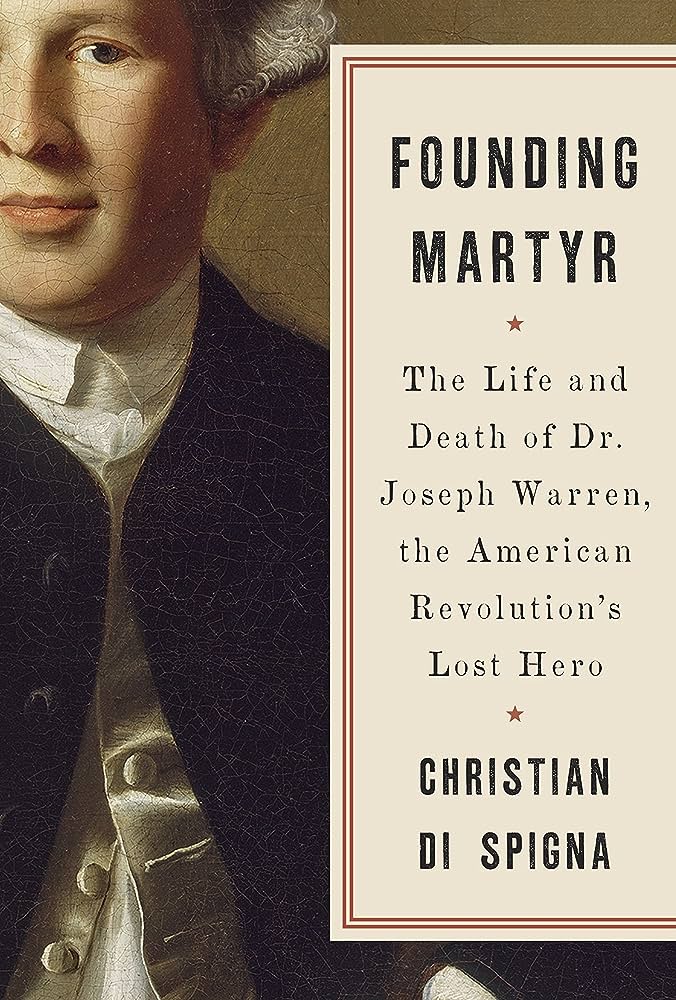
Dr. Joseph Warren is considered by many “the lost hero of the American Revolution.” Warren was the brainchild of the revolution movement in Boston. Warren was involved in almost every major insurrectionary act in the Boston area for a decade, from the Stamp Act protests to the Boston Massacre to the Boston Tea Party, and his incendiary writings included the famous Suffolk Resolves, which helped unite the colonies against Britain and inspired the Declaration of Independence.

Joining Emerging Revolutionary War will be historian and author Christian Di Spigna. He is the author of Founding Martyr: The Life and Death of Dr. Joseph Warren, the American Revolution’s lost hero. He is the Executive Director of the Dr. Joseph Warren Foundation and is the vice chairman for the Revolution 250 committee of Massachusetts Freemasons. He also serves on the board of the Bunker Hill Monument Association.

As we approach the 250th commemoration of the Boston Tea Party, we will focus on Warren’s life, his role in the Boston Tea Party and his lasting impact on the Revolution. Grab a drink and join us as we talk with author and historian Di Spigna about Warren, the patriot who once said…

“When Liberty is the prize, who would shun the warfare? Who would stoop to waste a coward thought on life?”

See you Sunday at 7 p.m. EDT on Emerging Revolutionary War’s Facebook page!

August 15, 1780 – Horatio Gates, Thomas Sumter and the road to Camden

Major General Horatio Gates, “Hero of Saratoga” was tasked with saving the American effort in the south. Credit NPS

On August 15, Maj. Gen. Horatio Gates began to finalize his plans to move against Camden, SC. Gates, appointed as the new commander of the Southern Department the previous month, believed the British garrison in Camden was weak. Gates was receiving intelligence gathered by partisan commander Thomas Sumter who was acting in and around Camden. He informed Gates that the American army outnumbered the British post and that a large portion of the men at Camden were taken ill and not fit for duty (on this account, Sumter was correct). Sumter did not provide the intelligence that Lord Cornwallis was now in Camden with reinforcements and was taking personal command of the British force in Camden.

Modern day image of the area at Rugeley’s Mills, with modern day Flat Rock Road following the historic trace of the Great Wagon Road. Credit Rob Orrison

With this information, Gates felt confident in his ability to take on the British in Camden. He developed a plan that involved a three-part movement. He would leave his force south to Saunder’s Creek (about six miles north of Camden) and establish a strong defensive position. He also ordered Francis Marion and his men to the southeast. Gates wanted Marion to take command of the Williamsburg militia, watch the British movements, and destroy boats in the Santee River that a defeated Cornwallis might need to retreat from Camden to Charleston. The third prong he ordered a few days earlier on August 13. Gates, under the encouragement of Thomas Sumter, decided to send 100 Maryland Continentals and 300 Carolina militiamen (as well as two brass three pounders) to join Sumter and move down the western side of the Wateree. From this location Sumter could attack supplies and reinforcements going into Camden from Ninety Six to the west. Gates’s confidence was evident.

South Carolina militia Brig. Gen Thomas Sumter. Credit New York Public Library

As Gates made his final disposition to move south, Sumter’s militia along with his Continental detachment met some success west of Camden. The Wateree River flowed south just one mile west of Camden. Near the important Wateree Ferry that served the major route west from Camden, Loyalist Lt. Col. James Cary built a small fort on his farm near the ferry. Sumter was aware of the fort and decided to see if he could capture it. When Col. Thomas Taylor of Sumter’s command launched the attack, most of the defenders inside were asleep, and the others were deceived by Patriot militia dressed just like those occupying the fort. The Loyalists immediately surrendered. Sumter reported that his men killed 7 and captured 30 prisoners, including Cary. Also included in the loot were 38 wagons of supplies and nearly 300 head of cattle. After capturing Cary’s Fort, Sumter was also able to attack and capture a relief column from Ninety Six to Camden. Sumter’s spoils from this attack numbered nearly 70 prisoners and numerous wagons. Sumter also reaffirmed his earlier intelligence to Gates by writing that the British in Camden “do not exceed two thousand, and not as many as one thousand of the militia, who aregenerally sickly, and much dispirited.” Sumter’s intelligence, though not accurate, gave Gates encouragement on the upcoming movement toward Camden. At 10pm on August 15, Gates had his army on the road south towards Camden.

Gates was flush with optimism, at that same time Cornwallis had his army on the road north. Though the British forces were about half the size of Gates, they were more than Gates expected and consisted of some of the best men in the British army led by one of their most accomplished generals. Soon, due to a twist of fate, these two armies collided along the Great Wagon Road in the long life pine forest of South Carolina. The result was one of the worst days in the history of the United States Army.

Authors Rob Orrison and Mark Wilcox’s new book “All That Can Be Expected: The Battle of Camden and the British High Tide in the South, August 16, 1780” is due out August, 2023 and available at: https://www.savasbeatie.com/

Rev War Revelry: New Book on the Battle of Camden “All That Can be Expected: The Battle of Camden and the British High Tide in the South”

This Sunday, August 6th at 7pm join ERW series editor Dan Welch and authors Rob Orrison and Mark Wilcox as they discuss one of the worst defeats in American history, the Battle of Camden. How did the hero of Saratoga end up the scapegoat in the south? Learn how a coincidence led to a great British victory. And how did the Patriots recover from such a large defeat and find a path to victory a year later? Orrison and Wilcox will also discuss their upcoming book “All That Can be Expected, The Battle of Camden”. Grab a drink and join us to learn more about the Battle of Camden!

All Rev War Revelries can be found LIVE on our Facebook page, or a week later on our You Tube and Spotify channels.

“Rev War Revelry” Battlefields!

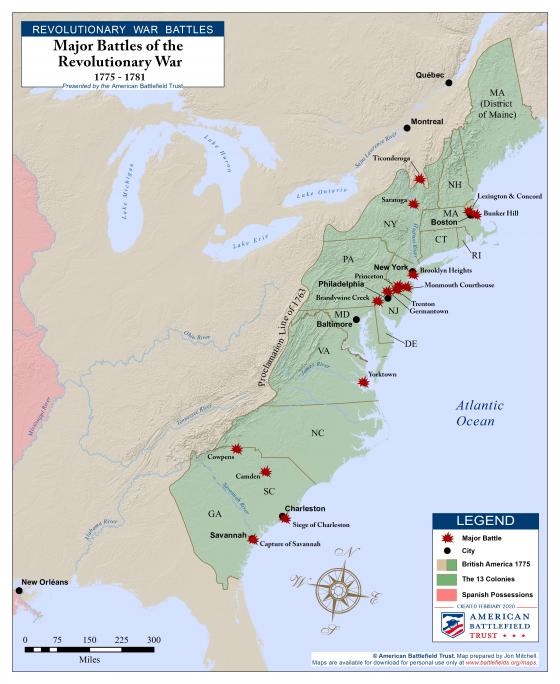
Lexington and/or Concord or both? Same question, Trenton or Princeton or both? Guilford Court House? Yorktown Battlefield? Ask any historian or history enthusiast of the American Revolutionary War period what their favorite battlefield is and you may get one of the places above. Or some other hallowed ground.

This Sunday, at 7 p.m. EDT, join Emerging Revolutionary War on our Facebook page for a panel discussion on our favorite battlefields of the American Revolution. Discussion will also include the successes, pitfalls, or failure of preservation and what one can see or not see at these sites. We look forward to a lively conversation and your comments on what is the battlefield of choice.

“The soul of General Abercromby’s army seemed to expire”: The Death of George Howe, July 6, 1758

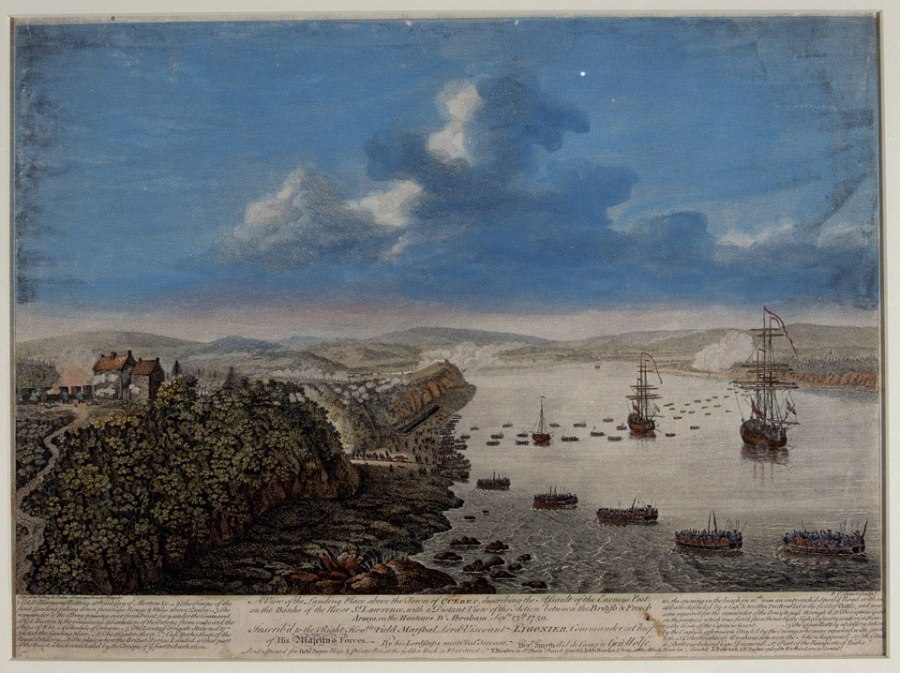
They waded ashore during the morning of July 6, 1758. Full of confidence, the vanguard of Major General James Abercromby’s massive army of over 16,000 men had completed its nearly thirty-mile trek northward across the waters of Lake George. They began pushing inland – men from Thomas Gage’s 80th Regiment of Light-Armed Foot, Phineas Lyman’s 1st Connecticut Regiment, and of Robert Rogers’ famed rangers – scattering small pockets of French resistance. By early afternoon the entire army had debarked at the designated landing site and formed into four columns to begin its advance towards the primary objective: Fort Carillon. Moving forward into the thick wilderness with the rightmost column of mixed regular and provincial units was Abercromby’s second-in-command, Brigadier General George Howe. [1]

George Howe
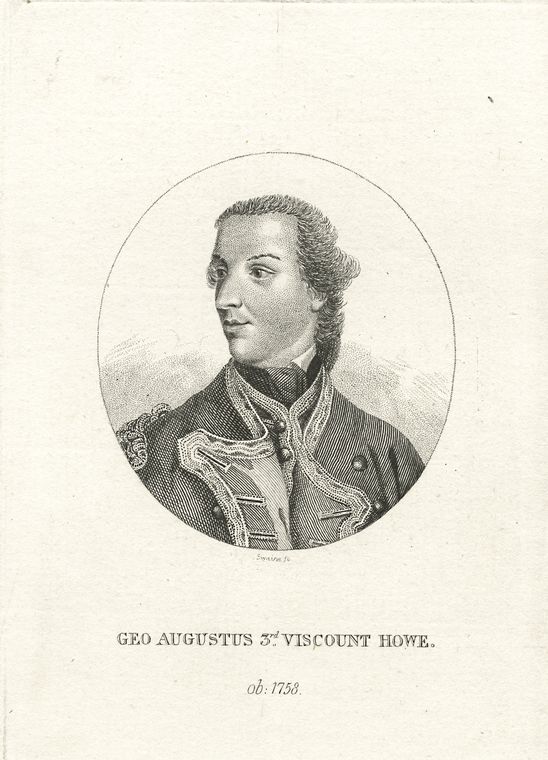
George Augustus, Third Viscount Howe. New York Public Library

George Augustus, Third Viscount Howe, was born in Ireland in 1725. Like his younger brothers, Richard and William, George was destined for a career in His Majesty’s Forces and to serve in North America. His father, Emanuel Scrope, Second Viscount Howe, was a prominent member of parliament and served several years as the Royal Governor of Barbados before dying there of disease in 1735. Upon his father’s death, George assumed the title of Third Viscount and in 1745, at age twenty, was made an ensign in the 1st Foot Guards. Subsequently serving as an aide-de-camp to William Augustus, Duke of Cumberland, Howe fervently studied the strategies and tactics employed by his own commanding officers and the enemy, and witnessed firsthand the carnage of the War of Austrian Succession. Just ten years later, when the world was set ablaze by war yet again, George was ordered to Halifax, Nova Scotia with a commission as colonel of the 60th Regiment of Foot (Royal Americans) that was set to take part in a failed operation to capture Fortress Louisbourg in 1757. He was later made colonel of the 55th Regiment of Foot, and in December, appointed Brigadier General by William Pitt. The following summer, he accompanied the largest field army ever assembled in North America up to that time as its second-in-command. Continue reading ““The soul of General Abercromby’s army seemed to expire”: The Death of George Howe, July 6, 1758”

The Road to Waxhaws: British Moves after the Capture of Charleston

Lieutenant General Henry Clinton, New York Public Library

With the Charleston in British hands, Clinton believed that all he had to do was establish outposts in South Carolina stationed with British regulars. This be believed would put down what was left of the rebellion in the state. These posts assisted the recruitment and training of the thousands of Loyalist troops he believed would now rally around the King’s Colors. To take the best advantage of his Regular troops, Clinton determined to establish three major outposts in the South Carolina backcountry. Clinton established these posts at Augusta (Georgia), Ninety-Six, and Camden. While these posts were to be centers for the British army, the local Loyalist militias were to serve as the pacification forces in South Carolina while the main British force was freed up for larger strategic goals. 

To recruit, enlist, and train the large, expected influx of Loyalist militia, Clinton named Maj. Patrick Ferguson as Inspector of Militia. Ferguson was ordered to enlist younger men, preferably unmarried, into companies that would form battalions. He was instructed to recruit from Georgia to North Carolina and offer short enlistments if necessary. Clinton believed that having the colonists maintain their own law and order (via Great Britain’s authority) would cause less apprehension with those that were mostly undecided about to whom they should throw their support, the Patriots or the British. 

By mid-May, the British army set out for their destinations in the back country. Clinton’s second in command, Lieut. Gen. Charles Lord Cornwallis, marched to Camden while Ferguson moved to Ninety-Six. Without much resistance, Clinton’s plan to conquer South Carolina was working perfectly. Patriot leaders scrambled to find ways to organize their resistance. The only organized Continental force remaining in South Carolina was a small force of Virginians under Col. Abraham Buford that was on its way to Charleston when the city surrendered. Ordered by Brig. Gen Isaac Huger to reverse course and make his way north toward Hillsborough, North Carolina. There along with the North Carolina militia, he could be the core of American defense in North Carolina.  

On May 27, Cornwallis ordered Lieut. Col. Banastre Tarleton with 300 of his dragoons and mounted infantry in pursuit of Buford. Tarleton’s British Legion was mostly composed of Loyalist recruits, so many in his force were from America. Tarleton pushed him men and horses hard, many horses falling out along the way. Buford was aware of a possible British pursuit but underestimated the speed in which Tarleton closed the gap. On May 29, Tarleton caught up with Buford in a region near the South and North Carolina border called the “Waxhaws.”  

Lieutenant Colonel Banastre Tarleton, New York Public Library

The events that took place next are still debated today. Tarleton under a flag of truce tried to get Buford to surrender. Writing to Buford, Tarleton wrote “Resistance being vain, to prevent the effusion of human blood, I make offers which can never be repeated.” Tarleton was already creating an image of himself as an aggressive and brutal fighter. Buford, however, refused, replying, “I reject your proposals, and shall defend myself to the last extremity.” With that, Buford continued his march north towards North Carolina as did Tarleton’s pursuit. Around 3:00 p.m. the lead elements of Tarleton’s force wiped out Buford’s small rearguard, forcing Buford to stop and deal with Tarleton.  

Buford decided to create a single battle line east of the Rocky River Road. Tarleton, ever the aggressive commander, ordered his horsemen to charge the Virginians. Here, Buford made what would be a devastating blunder. He ordered his men to not fire until the British cavalry was within ten yards of the American line. This would not allow the Americans a chance to fire another volley before the British charge was upon them. The Virginians fired, taking out some of the British dragoons and horses (Tarleton himself became briefly trapped under his horse), but most charged through Buford’s line, wielding their sabers and cutting down the Virginians. Total chaos ensued, and many of Buford’s men attempted to flee. Some tried to surrender by throwing their arms to the ground, but American accounts state that the British were offering “no quarter” and killing everyone that tried to surrender. Other accounts report that Buford sent a white flag to Tarleton, but probably because he was injured, it was never received, and the fighting continued. Accounts differ widely between the Americans and British on the fighting, but the fact cannot be argued that Buford’s command was destroyed. 

Waxhaws Grave and Monument, photo and flags courtesy of the author

American casualties were estimated at 350, 113 men killed, 147 wounded, 50 captured, and 2 six-pound artillery pieces and 26 wagons captured. Buford himself was able to escape the field. Tarleton only suffered 5 killed and 12 wounded, a complete victory. What has become known as “Buford’s Massacre” was not referred to as a massacre at all in many period accounts. Tarleton himself blamed the “slaughter” on the fact that his men thought he was killed in the battle and sought revenge. The disparity in numbers and the reports of indiscriminate British slaughter of Americans led to the creation of “Tarleton’s Quarter.” Patriot leaders quickly pounced on this and began to spread stories about Tarleton’s brutal tactics. This proved to be a public relations coup for the Patriot cause, as it energized their side and led to a more robust recruitment of militia and partisan forces to take on the British who now faced no organized opposition in South Carolina or Georgia.

Stay Tuned for the Emerging Revolutionary War Series newest book releases “To the Last Extremity: The Battles for Charleston, 1776-1782” by Mark Maloy and “All That Can Be Expected: The Battle of Camden and the British High Tide in the South, August 16, 1780” by Rob Orrison and Mark Wilcox to learn more abou the 1780 Southern Campaign. Both releases are published by Savas Beatie Publshing: https://www.savasbeatie.com/american-revolution/

Rev War Revelry Tackles the Myth of the Battle of Waxhaws

The Battle of Waxhaws, fought on May 29, 1780, was a lopsided British victory by Lieutenant Colonel Banastre Tarleton’s British cavalry over American Colonel Abraham Buford’s Continental forces in Waxhaws South Carolina. Buford lost 316 of 350 men with the British losing less than 20. Known popularly as “Buford’s Massacre,” Continental leaders used the battle as a propaganda tool against the Crown forces in the south. But, was it really a massacre?

Join us as we welcome historian and author Dr. Jim Piecuch as we discuss his research and theory about the Battle of Waxhaws and its aftermath. Dr. Piecuch has written several books on the Southern Campaign of the American Revolution including his book “Blood Be Upon Your Head: Tarleton and the Myth of Buford’s Massacre.” This Rev War Revelry will be pre-recorded and posted on May 28th at 7pm. Grab a drink and a good seat and enjoy this great presentation on one of the most controversial battles of the American Revolution.

Rev War Revelry Discusses NEW Emerging Rev War Book!

Charleston, South Carolina is one of the most beautiful and historic cities in the United States. Numerous sites, battlefields, and buildings from the period of the Revolution still exist.

Join us this Sunday at 7pm as we discuss ERW’s newest release “To The Last Extremity: The Battles for Charleston” by Mark Maloy. In To the Last Extremity: The Battles for Charleston, historian Mark Maloy not only recounts the Revolutionary War history of Charleston, he takes you to the places where the history actually happened. He shows you where the outnumbered patriots beat back the most powerful navy in the world, where soldiers bravely defended the city in 1779 and 1780, and where thousands suffered under occupation. Through it all, brave patriots were willing to defend the city and their liberty “to the last extremity.”

We will talk to Mark about his research, his favorite and most compelling stories and why this book is a “must have” for any history buff. Join us this Sunday, April 16 at 7pm on our Facebook page to join in on the conversation. As always, if you can not join us live you can catch the talk at any time on our You Tube or podcast channel.

This Sunday’s Rev War Revelry: Battle of the Upper Sandusky, A Chat with historian and author Eric Sterner

In May 1782, Colonel William Crawford led over 450 volunteers across Ohio to attack British-allied Native Americans who had been raiding the frontiers of Pennsylvania and Virginia for years. An experienced yet reluctant commander, Crawford and his men clashed with a similarly sized force of British Rangers and Wyandot, Delaware, and Shawnee Indians on the Sandusky River in early June. After three days, the Americans were routed in one of the worst defeats American arms suffered on the frontier during the American Revolution. During the retreat, Native American warriors captured dozens of men, including Colonel Crawford. Many were horrifically tortured to death in revenge for the Gnadenhutten massacre earlier that spring, when American volunteers bludgeoned nearly one hundred unarmed and unresisting Delaware Indians to death.

Join us on our Facebook page this Sunday at 7pm for a recorded talk with historian and author Eric Sterner as he discusses Crawford’s Campaign and his new book “The Battle of Upper Sandusky, 1782” due out this spring. The talk will be availble on our You Tube page next week.

Rev War Revelry This Sunday: William Faden’s 1778 & 1784 Maps of the Battle of Brandywine with Andrew Outten

British cartographer William Faden is well known for his maps depicting major battles of the Revolutionary War. Unusually, he produced two maps of the Battle of Brandywine, one in 1778 and the other in 1784. Each map shows troop movements and positions along with other aspects of the overall battlefield landscape, but each conveys significantly different information.

Join us this Sunday night at 7p.m. on our Facebook page as we chat with Andrew Outten, historical programs manager for the American Revolution Institute of the Society of the Cincinnati. Andrew will discuss the Battle of Brandywine, key differences between the two maps, and recent discoveries pertaining to those differences. Should be a great night sharing new research so grab a drink and join us for our January 8th Rev War Revelry!