The British Perspective….Best Book?

I recently needed to look up a quote from a British politician in the House of Commons during the American Revolutionary War. I went to my personal library (like to call it a study but since I have not found a desk to “study” on in there, I’ll continue to call it my library).

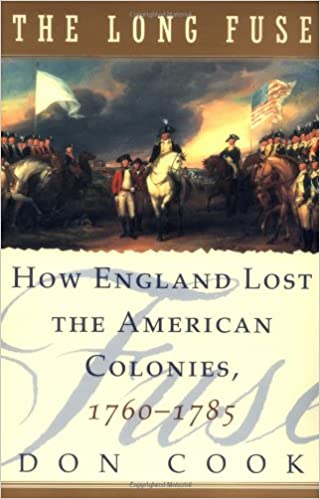
I grabbed Don Cook’s book The Long Fuse, How England Lost the American Colonies. A great read about the opposing side in the American Revolution. I found what I needed, but, as many of you probably do, that took me down a reading tangent.

Disclaimer; those of us under stay-at-home orders have some additional free time to explore more of our personal libraries. Those who can relate know what I am talking about. You pick up a book looking for something specific, which leads you to finish that book, then find one in the same genre or another micro-study of the same topic, until you have consumed multiple tomes within a matter of days, weeks.

Cook’s book led me to The Men Who Lost America: British Leadership, the American Revolution, and the Fate of the Empire. I gained a different appreciation for King George III, Lord Frederick North, and other British leaders from their perspective, filling in the gaps of historical scholarship that more America-centric volumes do not have the word count or inclination to fill.

I then went deeper down the proverbial rabbit-hole. Delving into With Zeal and With Bayonets Only: The British Army on Campaign in North America, 1775-1783, I went on a reading campaign with the British in the colonies.

Which now leads me to this blog post, what else would you recommend? What are your go-to books on the British perspective in the American Revolution?

Side note, I may delve into the loyalist viewpoint histories next, as I came across an interesting fact; the largest diaspora in the 18th century was American citizens that chose loyalty to the British crown who left or were forced to evacuate during and after the end of the American Revolution. So, as any history enthusiast will do, I will do more research….reading I mean.

“Rev War Roundtable with ERW” Heads to South Carolina (Virtually)

Join Emerging Revolutionary War this Sunday, at 7p.m. EST on our Facebook page as we head, virtually, down to South Carolina to discuss the importance of that colony/state in the American Revolution.

Most are familiar with the larger engagements, such as Cowpens and Kings Mountain or maybe the massacre at the Waxhaws. How about the Siege of Charleston, or the battles of Ninety-Six, or the countless other engagements that made the Palmetto State (which got its nickname from this era) one of the most hotly contested areas of the entire conflict.

Joining the “Rev War Revelry” will be ERW historians Vanessa Smiley, former Chief of Interpretation and Education at the Southern Campaign of the American Revolution National Park Group, which includes Cowpens, Kings Mountain, and Ninety-Six and Bert Dunkerly, former park ranger at Kings Mountain and author of a few histories on South Carolina in the Revolutionary War topics.

We look forward to seeing you for our sojourn into the Southern Theater this Sunday. Oh, and remember to grab your favorite brew for the trip!

The Southern Theater of the American Revolution | American ...
Battle of Cowpens
(courtesy of ABT)

“The Sword is Now Drawn…” The Powder Incident, Lexington and Concord moves Virginia to Revolution

download
Battle of Lexington by Amos Doolittle, December, 1775

One of the most amazing parts of the events on April 19, 1775 is just how sophisticated the colonial information network was. As soon as Lt. Col. Francis Smith’s British Regulars began to move across the Charles River, riders fanned out from Boston and to neighboring towns. Each town then had more riders that spread out and soon dozens of men were riding through the New England countryside warning of the fighting that took place. Soon information spread to the mid-Atlantic colonies and Philadelphia on April 24th. In the age of no electricity, the complexities and speed that news traveled from Boston to the other colonies was pretty amazing. Stories grew from person to person and it would take months and even years to decipher truth from exaggeration. It was imperative for both the “Patriots” and General Thomas Gage to get their version of the events of April 19th out as fast as possible. Facts or not, the importance of the public relations was of utmost importance to both sides to win the hearts and minds of the other colonies.

As the news reached Virginia, the colony was already at a crossroads with their

Sir_Joshua_Reynolds_-_John_Murray,_4th_Earl_of_Dunmore_-_Google_Art_Project_Square
Virginia Lt Governor, John Murray, 4th Earl of Dunmore

Governor. The last House of Burgesses that met in Williamsburg was dissolved in August 1774 over their vocal support of the people of Massachusetts after the Boston Port Act. The once popular Governor, John Murray, 4th Earl of Dunmore (Governor Dunmore), was angered over their overt support and ordered them dissolved and returned home. The legislature defied his orders and met soon after at the nearby Raleigh Tavern, thus constituting the “First Virginia Convention.” With questionable legal authority, the Convention called for solidarity and non-importation of British goods. They also agreed to meet again in the future. The “Second Virginia Convention” met in March of 1775 in Richmond, a safe distance from the Governor’s influence in Williamsburg. It was at this Convention that Patrick Henry made his famous “Give me Liberty or Give me Death” speech on March 23. Though considered radical at the time, the speech energized the Convention and set the tone. When the Governor learned of the Convention and especially Henry’s speech, he made a fateful decision to remove the gunpowder stored in the magazine in Williamsburg. Continue reading ““The Sword is Now Drawn…” The Powder Incident, Lexington and Concord moves Virginia to Revolution”

The Post Script

At 3:00 in the afternoon on April 21, 1781 Virginia militia Colonel James Innes sat down to write a letter near Hickory Neck Church, just shy of the halfway point between Virginia’s old colonial capitol at Williamsburg and its new capitol at Richmond. Perhaps with a heavy heart and a weary hand, Innes picked up his pen to scrawl a letter to Governor Thomas Jefferson. The situation in Virginia was bleak. It had only been a year since, in apprehension of a British attack, the Virginia Assembly voted to move the seat of government from the Peninsula west to Richmond, and along with it the public stores for outfitting, equipping, and otherwise supporting Virginia’s patriot forces in the fifth and sixth years of the war with the British. The gamble hadn’t paid off. January 1781 saw Benedict Arnold’s forces sacking Richmond. Everywhere they went, it seems, a new combined force of British, Hessian, and Loyalist forces left destruction in its wake.

he approximate landing site of the the main body of British soldiers with Col. Simcoe’s detachment landing further downstream in an effort to catch the Virginians by surprise. “…On a signal given, they all, except the gun-boat turned and rowed rapidly towards the point where the landing was to take place…” (author collection)
Continue reading “The Post Script”

Announcing “Rev War Roundtable with ERW” on Zoom!

On April 19, 1775, Massachusetts militia and minutemen responded to the call of British Regulars, “redcoats” marching from Boston to the town of Concord. What ensued was the “shot heard around the world” at the North Bridge in that town. What that shot signified was the changing course from words to war, that would define the relationship between 13 British North American colonies and Great Britain.

Now, 245 years later, Emerging Revolutionary War will turn that war back into words with its inaugural Rev War Revelry Zoom series. On Sunday, 7 p.m. EST, tune in to listen and watch historians from Emerging Revolutionary War discuss in an informal setting this momentous day in American history. Other topics are welcomed that pertain to the American Revolutionary War era as well.

As the title of the Zoom series relates, this will be similar to a tavern talk, much like the talks and information sharing rendezvous that went on in the 18th century, in places like Boston, where the road to revolution gained momentum as ales and spirits flowed. Thus, grab your favorite beverage, rest assured that ERW historians will be doing the same and join us, virtually, in our tavern Sunday evening.

62nd Foot at Freeman’s Farm

Emerging Revolutionary War welcomes guest historian Kevin Pawlak. A short bio follows the post below.

On May 25, 1775, the 62nd Regiment of Foot stood for review. The line of men, clad in their redcoats with buff facings, did not impress the reviewing officer. He called the regiment “very much drafted” and “very indifferent.” Despite the disparaging grade, in just over two years, the 62nd Foot commendably fought in one of the fiercest actions of the War for Independence.

John Anstruther
courtesy of 62ndregiment.org

Scottish military man Lt. Col. John Anstruther led the 62nd Foot in the campaign of 1777. Anstruther faced no easy task; the 62nd was the junior British regiment in John Burgoyne’s army and most of its men were inexperienced in campaigning and battle. To make the situation even worse, roughly one-quarter of the 62nd Foot’s soldiers were German. Language barriers likely prevented complete cohesion within the unit. However, with a war on, nothing could be done to rectify the regiment’s defects as it marched south into New York.

Anstruther’s regiment was present for the operations around Fort Ticonderoga in early July 1777. After American forces abandoned the fort, the conglomerate and inexperienced 62nd remained behind to man Mount Independence overlooking Lake Champlain. As the rest of Burgoyne’s army continued campaigning, the men of the 62nd Foot spent time guarding themselves against rattlesnakes rather than the enemy. Their time came to rejoin the main army before the Battle of Saratoga commenced.

Continue reading “62nd Foot at Freeman’s Farm”

“Gentlemen, what is best to be done?” Gates Moves Towards Camden and Makes a Fateful Decision

Picking up the story of Camden from Thursday morning, we continue with Col. Otho

22CITYROOM2-articleInline
Gen. Gates believed his night march on August 15th would put his army in a great defensive position above Saunder’s Creek.

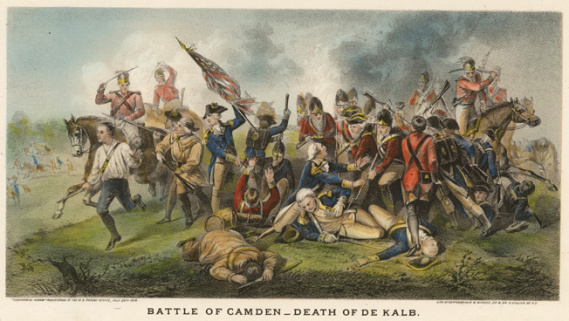
Holland Williams comments on the events on the evening of August 15th. As Gates’ army moved southward at night, a dangerous undertaking even with a professional army, notwithstanding an army mostly comprised of militia that had never fought as a cohesive unit. Williams documents the meals that the Americans ate that night before their march. When reading American accounts of Camden, most mention the impact on the evening August 15th meal had on the men and the army as a whole. Williams also mentions there is much criticisms of Gates’ plan, but no official opposition was brought to Gates. Reading Williams’ account gives us insight today into the events leading up to the disaster at Camden. When reading Williams’ narrative, it is not hard to believe that the Americans were marching to a defeat.

“Although there had been no dissenting voice in the council, the orders were no sooner promulgated than they became the subject of animadversion. Even those who had been dumb in council, said that there had been no consultation –that the orders were read to them, and all opinion seemed suppressed by the very positive and decisive terms in which they were expressed. Others could not imagine how it could be conceived, that an army, consisting of more than two -thirds militia, and which had never been once exercised in arms together, could form columns, and perform other manoeuvres in the night, and in the face of an enemy. But, of all the officers, Colonel Armand took the greatest exception. He seemed to think the positive orders respecting himself, implied a doubt of his courage –declared that cavalry had never before been put in the front of a line of battle in the dark–and that the disposition, as it respected his corps, proceeded from resentment in the general, on account of a previous altercation between them about horses, which the general had ordered to be taken from the officers of the army, to expedite the movement of the artillery though the wilderness. A great deal was said upon the occasion; but, the time was short, and the officers and soldiers, generally, not knowing, or believing any more than the general, that any considerable body of the enemy were to be met with out of Camden, acquiesced with their usual cheerfulness, and were ready to march at the hour appointed. As there were no spirits yet arrived in camp; and as, until lately, it was unusual for the troops to make a forced march, or prepare to meet an enemy without some extraordinary allowance, it was unluckily conceived that molasses, would, for once, be an acceptable substitute; accordingly the hospital stores were broached, and one gill of molasses per man, and a full ration of corn meal and meat, were issued to the army previous to their march, which commenced, according to orders, at about ten o’clock at night of the 15th. …. The troops of general Gates’ army, had frequently felt the bad consequences of eating bad provisions; but, at this time, a hasty meal of quick baked bread and fresh beef, with a desert of molasses, mixed with mush, or dumplings, operated so cathartically, as to disorder very many of the men, who were breaking the ranks all night, and were certainly much debilitated before the action commenced in the morning. …. “ Continue reading ““Gentlemen, what is best to be done?” Gates Moves Towards Camden and Makes a Fateful Decision”

Announcing the First Emerging Revolutionary War Symposium!

Mark your calendars for September 28, 2019!  Emerging Revolutionary War is excited toPrint announce that we are partnering with Gadsby’s Tavern Museum and The Lyceum of Alexandria, VA to bring to you a day long Symposium focusing on the American Revolution.

GTHomepageExterior(1).jpg
Gadsby’s Tavern Museum

Alexandria is George Washington’s hometown and we feel is a great place for us to start this new endeavor. Historic “Old Town” Alexandria is home to dozens of museums and historic sites as well as great pubs, restaurants and shops. Gadsby’s Tavern Museum is the premier 18th century tavern museum in the country and is host to the famous annual George Washington Birthnight Ball.  The Lyceum: Alexandria’s History Museum will be our host location. Today The Lyceum serves as the City’s history museum and is a center of learning through lectures, demonstrations and exhibits.

This year’s theme is “Before They Were Americans”  and will highlight several topics

Lyceum_017_720x483_72_RGB
The Lyceum

about the years leading up to the American Revolution. Our speakers include: Phillip Greenwalt, Katherine Gruber, William Griffith, Stephanie Seal Walters and Dr. Peter Henriques as the keynote. Registration will open on July 1, 2019 through AlexandriaVA.gov/Shop or by calling 703-746-4242. Stay tuned as we highlight each of our speakers and their topics.


Hamilton Recaptures Fort Sackville: Norman MacLeod’s Campaign Journal, December 17, 1778

(An occasional series highlighting British Lieutenant Governor Henry Hamilton’s march south from Detroit to recapture Vincennes (Indiana) on its 240th anniversary through the entries in Captain Norman MacLeod’s diary.)

Fort Sackville Map Inset, (Nova Scotia Archives and Record Management, Wikimedia Commons)
Fort Sackville Map Inset, Nova Scotia Archives and Records, (Wikimedia Commons)

As Lieutenant Governor Henry Hamilton’s army arrived on the lower Wabash, the river widened and deepened, enabling his much-fatigued army to spread out and make better progress to Vincennes and Fort Sackville.  All along the way, the governor’s efforts to grow his army through the addition of Indian allies had largely succeeded, not only increasing his numbers but improving his intelligence about the American forces awaiting him.  Those were paltry, indeed.

Continue reading “Hamilton Recaptures Fort Sackville: Norman MacLeod’s Campaign Journal, December 17, 1778”

Disaster on the Eastern Frontier

Part Two
For Part One, click here.

The British and loyalists would not have to wait long. Word of the landing reached the Massachusetts government within a matter of days, and preparations for a counterattack began almost immediately. There was such a hurry to respond that the General Assembly voted to carry out the operation with state forces rather than wait for Continental assistance.[1] Despite the initial rush it still took a month to assemble a force of over 1,000 militiamen, as well as the food, arms, and other supplies to sustain them. All of these troops and their supplies would be transported by a fleet of 21 transports, accompanied by nearly twenty state and Continental navy vessels and privateers. Among the warships the largest was the Frigate Warren of 32 guns which served as the flagship of Commodore Dudley Saltonstall. The Connecticut born officer was given overall command of the naval forces – no small task given the lack of experience with large scale fleet actions among his subordinates. Command of the land forces was given to Massachusetts Brigadier Solomon Lovell. Lovell has seen experience early in the war outside of Boston, but was also relatively untested in battle. The inexperience and poor communication between Saltonstall and Lovell was to have a decisive impact on the coming expedition. Notable among the other officers in the expedition was Paul Revere, who commanded the Massachusetts artillery. The expedition was also joined by a band of the local Penobscot Indians allied to the Continental Congress.

The New England fleet entered the Penobscot Bay on July 25th and immediately attempted a landing. Clearly outnumbered and with their works incomplete, General McLean and his men were determined to resist the Americans, but expected the worst. Saltonstall’s fleet sailed in close to the shore and exchanged cannon fire with both the British defences and the three remaining Royal warships, now under the command of Captain Henry Mowatt. In the confusion and smoke the Americans lowered seven launches full of marines and militiamen, but as they neared the shore they were met by a hail of musket fire[2]. At least one of the attackers – a Native American – was killed and the boats returned to the safety of the fleet. It was an inauspicious start to the battle for the New Englanders and already the relationship between the two commanding officers was becoming strained. General Lovell knew little about sailing or naval operations. He questioned the Commodore as to why he couldn’t just sail his fleet into the harbor and blast the British to pieces while his troops landed under their covering fire. The Connecticut seaman replied curtly, exclaiming “You seem to be damn knowing about the whole matter! I am not going to risk my shipping in that damned hole!”[3]

On the 26th a second militia landing on the peninsula was repulsed after the lead boat carrying militia Major Daniel Littlefield was swamped by British chain shot, drowning the Major and two privates.That same day, however, the Americans scored a small victory when a force of 200 Continental marines and artillerymen landed on Nautilus Island and captured the small British battery there[4]. More artillerymen were landed and soon the Americans had a battery from which they could harass the British shipping. With the Americans making some headway Captain Mowatt withdrew the remaining British ships deeper into the harbor, creating a defensive line across the Bagaduce River.

Castine harbor, looking out roughly where Captain Mowatt anchored the British transports and warships (Author_s photo)
Castine Harbor, looking out roughly where Captain Mowatt anchored the British transports and warships (Author’s photo)

Continue reading “Disaster on the Eastern Frontier”