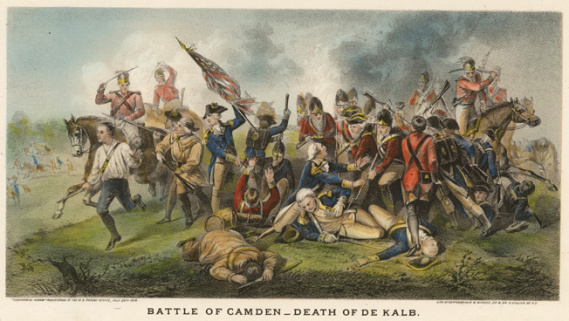
“Gentlemen, what is best to be done?” Gates Moves Towards Camden and Makes a Fateful Decision

Picking up the story of Camden from Thursday morning, we continue with Col. Otho

22CITYROOM2-articleInline
Gen. Gates believed his night march on August 15th would put his army in a great defensive position above Saunder’s Creek.

Holland Williams comments on the events on the evening of August 15th. As Gates’ army moved southward at night, a dangerous undertaking even with a professional army, notwithstanding an army mostly comprised of militia that had never fought as a cohesive unit. Williams documents the meals that the Americans ate that night before their march. When reading American accounts of Camden, most mention the impact on the evening August 15th meal had on the men and the army as a whole. Williams also mentions there is much criticisms of Gates’ plan, but no official opposition was brought to Gates. Reading Williams’ account gives us insight today into the events leading up to the disaster at Camden. When reading Williams’ narrative, it is not hard to believe that the Americans were marching to a defeat.

“Although there had been no dissenting voice in the council, the orders were no sooner promulgated than they became the subject of animadversion. Even those who had been dumb in council, said that there had been no consultation –that the orders were read to them, and all opinion seemed suppressed by the very positive and decisive terms in which they were expressed. Others could not imagine how it could be conceived, that an army, consisting of more than two -thirds militia, and which had never been once exercised in arms together, could form columns, and perform other manoeuvres in the night, and in the face of an enemy. But, of all the officers, Colonel Armand took the greatest exception. He seemed to think the positive orders respecting himself, implied a doubt of his courage –declared that cavalry had never before been put in the front of a line of battle in the dark–and that the disposition, as it respected his corps, proceeded from resentment in the general, on account of a previous altercation between them about horses, which the general had ordered to be taken from the officers of the army, to expedite the movement of the artillery though the wilderness. A great deal was said upon the occasion; but, the time was short, and the officers and soldiers, generally, not knowing, or believing any more than the general, that any considerable body of the enemy were to be met with out of Camden, acquiesced with their usual cheerfulness, and were ready to march at the hour appointed. As there were no spirits yet arrived in camp; and as, until lately, it was unusual for the troops to make a forced march, or prepare to meet an enemy without some extraordinary allowance, it was unluckily conceived that molasses, would, for once, be an acceptable substitute; accordingly the hospital stores were broached, and one gill of molasses per man, and a full ration of corn meal and meat, were issued to the army previous to their march, which commenced, according to orders, at about ten o’clock at night of the 15th. …. The troops of general Gates’ army, had frequently felt the bad consequences of eating bad provisions; but, at this time, a hasty meal of quick baked bread and fresh beef, with a desert of molasses, mixed with mush, or dumplings, operated so cathartically, as to disorder very many of the men, who were breaking the ranks all night, and were certainly much debilitated before the action commenced in the morning. …. “ Continue reading ““Gentlemen, what is best to be done?” Gates Moves Towards Camden and Makes a Fateful Decision”

Announcing the First Emerging Revolutionary War Symposium!

Mark your calendars for September 28, 2019!  Emerging Revolutionary War is excited toPrint announce that we are partnering with Gadsby’s Tavern Museum and The Lyceum of Alexandria, VA to bring to you a day long Symposium focusing on the American Revolution.

GTHomepageExterior(1).jpg
Gadsby’s Tavern Museum

Alexandria is George Washington’s hometown and we feel is a great place for us to start this new endeavor. Historic “Old Town” Alexandria is home to dozens of museums and historic sites as well as great pubs, restaurants and shops. Gadsby’s Tavern Museum is the premier 18th century tavern museum in the country and is host to the famous annual George Washington Birthnight Ball.  The Lyceum: Alexandria’s History Museum will be our host location. Today The Lyceum serves as the City’s history museum and is a center of learning through lectures, demonstrations and exhibits.

This year’s theme is “Before They Were Americans”  and will highlight several topics

Lyceum_017_720x483_72_RGB
The Lyceum

about the years leading up to the American Revolution. Our speakers include: Phillip Greenwalt, Katherine Gruber, William Griffith, Stephanie Seal Walters and Dr. Peter Henriques as the keynote. Registration will open on July 1, 2019 through AlexandriaVA.gov/Shop or by calling 703-746-4242. Stay tuned as we highlight each of our speakers and their topics.


Hamilton Recaptures Fort Sackville: Norman MacLeod’s Campaign Journal, December 17, 1778

(An occasional series highlighting British Lieutenant Governor Henry Hamilton’s march south from Detroit to recapture Vincennes (Indiana) on its 240th anniversary through the entries in Captain Norman MacLeod’s diary.)

Fort Sackville Map Inset, (Nova Scotia Archives and Record Management, Wikimedia Commons)
Fort Sackville Map Inset, Nova Scotia Archives and Records, (Wikimedia Commons)

As Lieutenant Governor Henry Hamilton’s army arrived on the lower Wabash, the river widened and deepened, enabling his much-fatigued army to spread out and make better progress to Vincennes and Fort Sackville.  All along the way, the governor’s efforts to grow his army through the addition of Indian allies had largely succeeded, not only increasing his numbers but improving his intelligence about the American forces awaiting him.  Those were paltry, indeed.

Continue reading “Hamilton Recaptures Fort Sackville: Norman MacLeod’s Campaign Journal, December 17, 1778”

Disaster on the Eastern Frontier

Part Two
For Part One, click here.

The British and loyalists would not have to wait long. Word of the landing reached the Massachusetts government within a matter of days, and preparations for a counterattack began almost immediately. There was such a hurry to respond that the General Assembly voted to carry out the operation with state forces rather than wait for Continental assistance.[1] Despite the initial rush it still took a month to assemble a force of over 1,000 militiamen, as well as the food, arms, and other supplies to sustain them. All of these troops and their supplies would be transported by a fleet of 21 transports, accompanied by nearly twenty state and Continental navy vessels and privateers. Among the warships the largest was the Frigate Warren of 32 guns which served as the flagship of Commodore Dudley Saltonstall. The Connecticut born officer was given overall command of the naval forces – no small task given the lack of experience with large scale fleet actions among his subordinates. Command of the land forces was given to Massachusetts Brigadier Solomon Lovell. Lovell has seen experience early in the war outside of Boston, but was also relatively untested in battle. The inexperience and poor communication between Saltonstall and Lovell was to have a decisive impact on the coming expedition. Notable among the other officers in the expedition was Paul Revere, who commanded the Massachusetts artillery. The expedition was also joined by a band of the local Penobscot Indians allied to the Continental Congress.

The New England fleet entered the Penobscot Bay on July 25th and immediately attempted a landing. Clearly outnumbered and with their works incomplete, General McLean and his men were determined to resist the Americans, but expected the worst. Saltonstall’s fleet sailed in close to the shore and exchanged cannon fire with both the British defences and the three remaining Royal warships, now under the command of Captain Henry Mowatt. In the confusion and smoke the Americans lowered seven launches full of marines and militiamen, but as they neared the shore they were met by a hail of musket fire[2]. At least one of the attackers – a Native American – was killed and the boats returned to the safety of the fleet. It was an inauspicious start to the battle for the New Englanders and already the relationship between the two commanding officers was becoming strained. General Lovell knew little about sailing or naval operations. He questioned the Commodore as to why he couldn’t just sail his fleet into the harbor and blast the British to pieces while his troops landed under their covering fire. The Connecticut seaman replied curtly, exclaiming “You seem to be damn knowing about the whole matter! I am not going to risk my shipping in that damned hole!”[3]

On the 26th a second militia landing on the peninsula was repulsed after the lead boat carrying militia Major Daniel Littlefield was swamped by British chain shot, drowning the Major and two privates.That same day, however, the Americans scored a small victory when a force of 200 Continental marines and artillerymen landed on Nautilus Island and captured the small British battery there[4]. More artillerymen were landed and soon the Americans had a battery from which they could harass the British shipping. With the Americans making some headway Captain Mowatt withdrew the remaining British ships deeper into the harbor, creating a defensive line across the Bagaduce River.

Castine harbor, looking out roughly where Captain Mowatt anchored the British transports and warships (Author_s photo)
Castine Harbor, looking out roughly where Captain Mowatt anchored the British transports and warships (Author’s photo)

Continue reading “Disaster on the Eastern Frontier”

Visiting the Scene of Action: Battle of Camden

A reflection on the previous month’s exploration in South Carolina.

IMG_1905 (1)August 16, 1780 would prove to be a devastating day for the American Army in the south, known as the “Grand Army” by its commander, Maj. Gen. Horatio Gates, the Hero of Saratoga. The battle between this army and that of Lt. Gen. Charles, Earl Cornwallis, in the Pine Barrens near the South Carolina town of Camden, would end in the total rout of the Americans and the destruction of the reputation of its commander. It would also temporarily leave the southern colonies without a central army to oppose the British.

On November 1, members of the Emerging Revolutionary War Era staff took a road trip to Camden, SC to research the battle, walk the battlefield and meet with local historians in preparation for an upcoming addition to our book series, on the Battle of Camden.  On the way down, we took the opportunity of visiting other sites of combat, actions that occurred prior to and after the fight at Camden. Continue reading “Visiting the Scene of Action: Battle of Camden”

Norman MacLeod’s Campaign Journal, November 27, 1778

(An occasional series highlighting British Lieutenant Governor Henry Hamilton’s march south from Detroit to recapture Vincennes (Indiana) on its 240th anniversary.)

As fall progressed, cold set in and the weather began to catch up with Hamilton’s advancing army.  By November, it regularly dealt with freezing rain, snow, mud, and ice on the river and nearby trails.  MacLeod’s November 27th entry alludes to a few of those logistical challenges and the rather low opinion that the captain had of American soldiers, which began to place higher in MacLeod’s thinking as the army neared the territory so recently conquered by George Rogers Clark.

“Embarked at eight as usual, met with Great fields of ice this day But pretty good water.  So that we made us of our Oars only in two Rapids where most of the men was obliged to drag especially those in Boats because they draw more water than the Perogues, besides this the channels in the River are as if cut Purposely for no other Craft than Perogues.  We arrived at K [one or two words illegible] at 4 oClock called [sic; camped?] 10 miles from Weatono.  Us as our tents were Pitched five Savages from that Plase Arrived in camp, who acquainted us that there was no less than 200 of their nation ready to Join us the moment we arrived at the above Place.  They further told us that the Rebels had abandoned Au Post.  How true this is alittle more time we discover.  But it agrees with my own opinion for I never once thorough they would make a Stand either there or at the Illinois with So numbers especially on hearing that the Lieut. Govr. was coming who they know had all the Indians read at [hi]s call.”

William A. Evans and Elizabeth S. Sklar, eds., Detroit to Fort Sackville, 1778-1779: The Journal of Norman MacLeod, (Detroit: Friends of the Detroit Public Library/Wayne State University Press, 1978), 87.  The spelling and grammar errors are all from the original as transcribed by Evans and Sklar.  Evans and Sklar suspect “Weatono” is MacLeod’s reference to “Ouiatenon.”

Norman MacLeod’s Campaign Journal, November 7-14, 1778

(An occasional series highlighting British Lieutenant Governor Henry Hamilton’s march south from Detroit to recapture Vincennes (Indiana) on its 240th anniversary through the entries in Captain Norman MacLeod’s diary.)

Lieutenant Governor Hamilton’s army continued its progress towards Vincennes, but it was slow and backbreaking work.  Building dams to raise river levels did not work everywhere and his army often had to resort to the simple and monotonous task of unloading its vessels, dragging them through the shallows, carrying supplies forward, and then reloading boats to continue making progress the next day.  MacLeod’s diary entries for November 7th and 14th highlight the sheer fatigue involved in moving supplies on the frontier.

Continue reading “Norman MacLeod’s Campaign Journal, November 7-14, 1778”

Norman MacLeod’s Campaign Journal, October 31, 1778

(An occasional series highlighting British Lieutenant Governor Henry Hamilton’s march south from Detroit to recapture Vincennes (Indiana) on its 240th anniversary through the entries in Captain Norman MacLeod’s diary.)

This year marked the 240th anniversary of George Rogers Clark’s “conquest of the Illinois country” in modern-day Illinois and Indiana.  During the summer, he led a small force of Virginia militia down the Ohio River and eventually captured the towns of Vincennes in modern-day Indiana as well as Cahokia and Kaskaskia in modern-day Illinois.  The British Lieutenant Governor of Quebec, Henry Hamilton, could not abide such American audacity and set out to recapture the town of Vincennes and the British fort that had ostensibly protected it, Fort Sackville.  On his march south from Detroit, he prodded, pleaded, and encouraged Native American tribes to join his force, significantly swelling his numbers for the late-fall offensive.  By October, Hamilton’s army was regularly struggling with low water and ice on the rivers it needed to move supplies while freezing rain, snow, and falling temperatures plagued men on the march.

Continue reading “Norman MacLeod’s Campaign Journal, October 31, 1778”

Press Release: Victory at Yorktown

ABT

Breaking on Friday, the 237th anniversary of the surrender of British Lord Charles Cornwallis’ surrender at Yorktown, there was another victory.

The American Battlefield Trust announced the successful acquisition of 49 acres of “hallowed ground associated with the 1781 battle.”

The full press release is at the link below!

Victory at Yorktown!

“Elbow Room” for “Uncle Johnny”

On this date in 1777, British General John Burgoyne surrendered to American General Horatio Gates around Saratoga, New York. This victory solidified French support for the fledgling American nation and became one of the turning points in the road to independence.

800px-BurgoyneByReynolds
General John Burgoyne

Out of this momentous occasion came an anecdote about the British general officer. The short story has some truth in it, yet, whether the entire tale is accurate, well, I’ll leave that for you to decide!

Two years prior to the Battles of Saratoga and upon arriving in Boston, Massachusetts, General Burgoyne remarked “Well, let us get in, and we’ll soon find elbow-room” when he was told the numbers of militia besieging British regulars around the town.

After his capitulation, Burgoyne and his forces were marched toward Albany, New York, and multitudes of people turned out to see the vanquished British and German soldiery along the route. One resident supposedly yelled from her homestead doorway;

“Make elbow room for General Burgoyne.” 

Not what he had envisioned in 1775 upon disembarking in North America. Yet, history does not relate what “Gentleman Johnny” Burgoyne thought exactly about the elbow room he received in the countryside of upstate New York!*


This slideshow requires JavaScript.


*“Gentleman Johnny” was a nickname acquired by Burgoyne was stationed in London with the Horse Guards, a fashionable cavalry regiment.” 

**Information gathered from A.J. Langguth’s “Patriots” and The Patriot Resource, which can be found here.