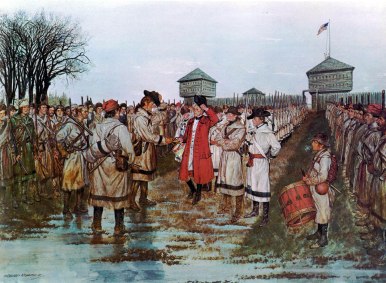
Hamilton Surrenders Fort Sackville (U.S. Army Center for Military History)
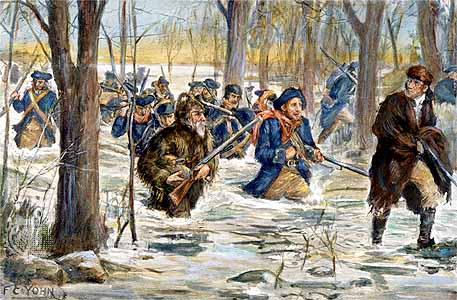
By February 23, 1779–two hundred and forty years ago—Virginia Lieutenant Colonel George Rogers Clark had marched his little army from the Mississippi across the flooded plains of what would become southern Illinois to the French town of Vincennes on the Wabash River, in modern Indiana. His men were tired, hungry, and waterlogged, but they had made it safely across the Wabash and delivered themselves to the same shore as the town and Fort Sackville, then defended by the much-hated British Lieutenant Governor Henry Hamilton. His river scouts had managed to find a small, dry hillock covered by a grove of trees and within sight of the town and Clark’s force, about 170 strong, lay in the grove drying their clothes by the sun, occasionally taking a wandering citizen from the town prisoner. Clark later reported:
March to Vincennes by Frederick Coffay Yohn, 1875-1933 (Wikimedia Commons–Most of Clark’s men would not have dressed in the blue uniforms visible here, but would have dressed in fur and buckskin like the individual in the middle of the picture.)
Last fall, I posted several pieces following British Lieutenant Governor Henry Hamilton’s campaign in the Illinois territory as seen through the eyes of Captain Norman MacLeod. MacLeod led an advance party stuck with the logistical and diplomatic mission of moving 33,000 pounds of supplies and trade goods south from Detroit in order to mobilize the local Indian tribes as British allies. Hamilton’s campaign culminated with the successful capture of Fort Sackville (Vincennes, IN) on December 17, 1778. Since it’s the 240th anniversary of the campaign, I thought I’d continue the series by shifting to the American perspective, particularly that of Virginia Lieutenant Colonel George Rogers Clark and one of his Captains, Joseph Bowman. This is not a campaign history by any stretch. It’s meant more to be considered in combination with portions of MacLeod’s diary that appeared last fall. Taken together, they might give rise to a few different ideas about the Americans and British fighting the Revolution on the frontier.
Although he planned to recapture the entire Illinois territory, Hamilton decided to winter at Fort Sackville and resume his campaign in the spring. He dismissed the bulk of his force, settling in at the fort with just under 100 men. Normally, this would have been a prudent choice. Hamilton did not expect Clark to retake the field until spring brought about the customary campaign season and dispersing his army eased the logistical burden of maintaining so many men idle in the wilderness. Hamilton had under-estimated the meddle of his adversary.
Francis Hopkinson, Signer of the Declaration and Satirical Lyricist
The Philadelphia Campaign did not end well for the Continental Army after three separate defeats at Brandywine, Paoli, and Germantown followed by the British occupation of the new nation’s capital. Among other things, however, it would produce an amusing little ditty commemorating an attack on the British on January 5, 1778 for American audiences eager to poke fun at the British.
When informed that the British had occupied his adopted hometown, Benjamin Franklin reportedly waved off his concern and replied, “No, Philadelphia has captured Howe.”[i] Franklin was more militarily astute than many politicians observing the war. When his army captured Continue reading “The Battle of the Kegs (January 5th, 1778)”→
The British and loyalists would not have to wait long. Word of the landing reached the Massachusetts government within a matter of days, and preparations for a counterattack began almost immediately. There was such a hurry to respond that the General Assembly voted to carry out the operation with state forces rather than wait for Continental assistance.[1] Despite the initial rush it still took a month to assemble a force of over 1,000 militiamen, as well as the food, arms, and other supplies to sustain them. All of these troops and their supplies would be transported by a fleet of 21 transports, accompanied by nearly twenty state and Continental navy vessels and privateers. Among the warships the largest was the Frigate Warren of 32 guns which served as the flagship of Commodore Dudley Saltonstall. The Connecticut born officer was given overall command of the naval forces – no small task given the lack of experience with large scale fleet actions among his subordinates. Command of the land forces was given to Massachusetts Brigadier Solomon Lovell. Lovell has seen experience early in the war outside of Boston, but was also relatively untested in battle. The inexperience and poor communication between Saltonstall and Lovell was to have a decisive impact on the coming expedition. Notable among the other officers in the expedition was Paul Revere, who commanded the Massachusetts artillery. The expedition was also joined by a band of the local Penobscot Indians allied to the Continental Congress.
The New England fleet entered the Penobscot Bay on July 25th and immediately attempted a landing. Clearly outnumbered and with their works incomplete, General McLean and his men were determined to resist the Americans, but expected the worst. Saltonstall’s fleet sailed in close to the shore and exchanged cannon fire with both the British defences and the three remaining Royal warships, now under the command of Captain Henry Mowatt. In the confusion and smoke the Americans lowered seven launches full of marines and militiamen, but as they neared the shore they were met by a hail of musket fire[2]. At least one of the attackers – a Native American – was killed and the boats returned to the safety of the fleet. It was an inauspicious start to the battle for the New Englanders and already the relationship between the two commanding officers was becoming strained. General Lovell knew little about sailing or naval operations. He questioned the Commodore as to why he couldn’t just sail his fleet into the harbor and blast the British to pieces while his troops landed under their covering fire. The Connecticut seaman replied curtly, exclaiming “You seem to be damn knowing about the whole matter! I am not going to risk my shipping in that damned hole!”[3]
On the 26th a second militia landing on the peninsula was repulsed after the lead boat carrying militia Major Daniel Littlefield was swamped by British chain shot, drowning the Major and two privates.That same day, however, the Americans scored a small victory when a force of 200 Continental marines and artillerymen landed on Nautilus Island and captured the small British battery there[4]. More artillerymen were landed and soon the Americans had a battery from which they could harass the British shipping. With the Americans making some headway Captain Mowatt withdrew the remaining British ships deeper into the harbor, creating a defensive line across the Bagaduce River.
Castine Harbor, looking out roughly where Captain Mowatt anchored the British transports and warships (Author’s photo)
(An occasional series highlighting British Lieutenant Governor Henry Hamilton’s march south from Detroit to recapture Vincennes (Indiana) on its 240th anniversary.)
As fall progressed, cold set in and the weather began to catch up with Hamilton’s advancing army. By November, it regularly dealt with freezing rain, snow, mud, and ice on the river and nearby trails. MacLeod’s November 27th entry alludes to a few of those logistical challenges and the rather low opinion that the captain had of American soldiers, which began to place higher in MacLeod’s thinking as the army neared the territory so recently conquered by George Rogers Clark.
“Embarked at eight as usual, met with Great fields of ice this day But pretty good water. So that we made us of our Oars only in two Rapids where most of the men was obliged to drag especially those in Boats because they draw more water than the Perogues, besides this the channels in the River are as if cut Purposely for no other Craft than Perogues. We arrived at K [one or two words illegible] at 4 oClock called [sic; camped?] 10 miles from Weatono. Us as our tents were Pitched five Savages from that Plase Arrived in camp, who acquainted us that there was no less than 200 of their nation ready to Join us the moment we arrived at the above Place. They further told us that the Rebels had abandoned Au Post. How true this is alittle more time we discover. But it agrees with my own opinion for I never once thorough they would make a Stand either there or at the Illinois with So numbers especially on hearing that the Lieut. Govr. was coming who they know had all the Indians read at [hi]s call.”
William A. Evans and Elizabeth S. Sklar, eds., Detroit to Fort Sackville, 1778-1779: The Journal of Norman MacLeod, (Detroit: Friends of the Detroit Public Library/Wayne State University Press, 1978), 87. The spelling and grammar errors are all from the original as transcribed by Evans and Sklar. Evans and Sklar suspect “Weatono” is MacLeod’s reference to “Ouiatenon.”
Emerging Revolutionary War welcomes back guest historian Travis Shaw.
Part One
I’d be willing to bet that Maine isn’t the first place to come to mind when you hear the word “frontier”. For many Americans I imagine they immediately think of the wild west. Wagon trains of pioneers crossing the prairies, and Native nations like the Sioux and Apache ranging the plains on horseback. A century before the age of Manifest Destiny, however, the region that is now the state of Maine marked the eastern frontier of the English colonies. It was a wild and sparsely settled place, caught between New England and the French colonies to the north. The few European settlers eked out a living from the thin, rocky soil or turned to lumbering and to the sea. They lived alongside and often fought against the region’s original inhabitants – the Wabanaki or “People of the Dawn.” For two centuries the Eastern Frontier was torn apart by war between various European powers and their respective Native allies. Nowhere is this more clearly evident today than in the small coastal town of Castine, Maine.
Castine is located near the mouth of the Penobscot River, more or less in the middle of the Maine coast (Google Maps)
(An occasional series highlighting British Lieutenant Governor Henry Hamilton’s march south from Detroit to recapture Vincennes (Indiana) on its 240th anniversary through the entries in Captain Norman MacLeod’s diary.)
Lieutenant Governor Hamilton’s army continued its progress towards Vincennes, but it was slow and backbreaking work. Building dams to raise river levels did not work everywhere and his army often had to resort to the simple and monotonous task of unloading its vessels, dragging them through the shallows, carrying supplies forward, and then reloading boats to continue making progress the next day. MacLeod’s diary entries for November 7th and 14th highlight the sheer fatigue involved in moving supplies on the frontier.
(An occasional series highlighting British Lieutenant Governor Henry Hamilton’s march south from Detroit to recapture Vincennes (Indiana) on its 240th anniversary through the entries in Captain Norman MacLeod’s diary.)
This year marked the 240th anniversary of George Rogers Clark’s “conquest of the Illinois country” in modern-day Illinois and Indiana. During the summer, he led a small force of Virginia militia down the Ohio River and eventually captured the towns of Vincennes in modern-day Indiana as well as Cahokia and Kaskaskia in modern-day Illinois. The British Lieutenant Governor of Quebec, Henry Hamilton, could not abide such American audacity and set out to recapture the town of Vincennes and the British fort that had ostensibly protected it, Fort Sackville. On his march south from Detroit, he prodded, pleaded, and encouraged Native American tribes to join his force, significantly swelling his numbers for the late-fall offensive. By October, Hamilton’s army was regularly struggling with low water and ice on the rivers it needed to move supplies while freezing rain, snow, and falling temperatures plagued men on the march.
Sketch of the Wabash River Made During Hamilton’s 1778 Campaign (Wikimedia Commons)
In the summer of 1778, Lieutenant Colonel George Rogers Clark of the Virginia militia launched one of the most daring American military operations of the Revolutionary War when he invaded the “Illinois country” and captured Cahokia and Kaskaskia in modern-day Illinois and Vincennes in southern Indiana, effectively neutralizing British power on the Illinois, Wabash, and Mississippi Rivers. Henry Hamilton, Lieutenant Governor of Quebec and Britain’s Superintendent for Indian Affairs in Detroit, could not allow such audacity to succeed, lest Britain’s influence with the western Indian nations wane. Learning of Fort Sackville’s fall at Vincennes on the Wabash River, he set out to recapture it.
This past spring I was able to visit a fascinating historic site, one that is largely overlooked in the larger story of the Revolution. Many of us know that in 1777 the British planned to use the Hudson River to cut off New England from the other states.
With General William Howe in New York City, and General John Burgoyne moving south from Canada, the plan seemed destined for success. Yet Howe decided to move his army by water to the Chesapeake and advance on Philadelphia.
It is commonly assumed that his lack of cooperation with Burgoyne was one major reason for the latter’s failure, and surrender, at Saratoga. In fact, a force of British troops did ascend the Hudson, hoping to cooperate with Burgoyne. I was able to follow and retrace the little known expedition.




 Emerging Revolutionary War Era