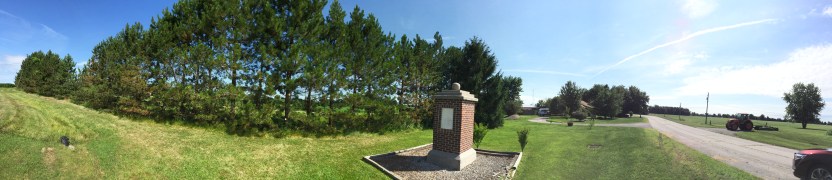
One of the few historical markers denoting the campaign. The other side of the security fence at the left is home to the county landfill. Tymochtee Creek is to the right. (Author Photo)
(part five of five)
For those men separated from the retreating main body in the pell-mell retreat, Crawford’s expedition had become a nightmare, beginning with the panic on the night of June 5. James Paul remembered being shaken awake with word that the men were leaving and attempting to retrieve his horse in the dark before finding it had already slipped its bridle and wandered away.
“I groped about in the dark and discovered two other horses tied to the same sapling and my horse standing at their tails. This revived my drooping spirits. On finding my horse standing quiet, I bridled him and mounted, and about the same time a number of other horses were mounted by their owners, and all put out from the camp ground together, amounting in all to nine in number, and we made as much haste to get away as we could, considering the darkness of the road, and no roads but open woods to ride through, and no one to guide us.” Paul and his fellows realized Colonel Williamson, now leading the main body, was retreating on a longer route home, “leaving us nine and many other stragglers behind to take care of themselves as best they could, and to steer their own course homeward, and, as it turned out afterward, but few of these stragglers ever got home.”[1]
Paul and his group eventually became mired in a swamp and had to abandon their horses, making their way on foot, pursed by Native American warriors who forced them to scatter. After sleeping in hollow logs and under rocks, going without food other than a blackbird and occasional handful of berries, Paul eventually made his way back across the Ohio alone near Wheeling, arriving at a small fort where settlers had taken refuge against renewed Indian raids.[2]
As the night of June 5 gave way to a dark retreat on June 6, the militia struggled eastward, attempting to reimpose some order on their main body. According to Rose, Crawford set out after one wayward company that had decided on a more circuitous route of retreat that separated it from the main body. While he was gone, the Indians began firing into the militia camp in the dark. At “that instant, every Body was pushing as if it had been a signal agreed for that purpose.”[i]
Rose fell in with a group of about fifty men, who pushed south back toward the abandoned Wyandot town on the Sandusky they had passed through just a few days earlier, seeking to avoid the Shawnee, and then rejoined Williamson with the main body of men as it returned the way the expedition had come.[ii] In the rush, they lost track of Colonel Crawford. They moved directly to the route east without much order, placing speed over the coherence of a fighting unit. Williamson did manage to separate his best horsemen into a smaller group to contest any light horsemen they encountered on the Sandusky plain, but expected to find relative safety when they reached more heavily timbered areas. On June 6, Rose had a close call. Riding ahead while trying to keep the group from breaking up into smaller parties, mounted Indians charged him and his companions from a wooded area on the left. Rose managed to make it back to the main body, which promptly counter-charged with the light horse Williamson had created.[iii] In the process, he lost contact with his two companions, Colonel William Harrison (Colonel Crawford’s son-in-law) and Mr. William Crawford, (Colonel Crawford’s nephew).[iv]
The monument to the “Battle of the Olentangy.” The battle was more of a skirmish, but marked the end of British pursuit of Williamson’s retreating force. Native Americans continued to chase and harass the Americans. (Author Photo)
Later that day, about 24 miles into their march, the militia paused to rest along Olentangy creek. Their mounted pursuers promptly fired into the main body from behind and the militiamen detected a light screen moving into place ahead of them, the beginning of an encirclement.[v] The militia started skirmishing while Rose rode to the rear, nearly through the Native Americans behind them, retrieved the rear body, which contained a substantial portion of the light horse, and sent them to clear the woods of enemy skirmishers in front. The maneuver succeeded and the militia were able to enter the woods, losing three dead and eight wounded in the hour-long fight. Despite anticipating a degree of relative safety there, pursuers continued to harass the flanks and the rear. Simultaneously, the poorly organized militia lost still more cohesion as a fighting unit as the woods broke up formations and isolated men in small groups. To make matters worse, the skies opened up and a heavy downpour soaked everyone to the bone.[vi]
The Battle Monument. “Battle Island” is likely on a slight rise through the pines. (Author Photo)
The expedition continued through thick forest until June 4, when it finally came upon a Wyandot town on the upper Sandusky after noon. It was abandoned to the surprise of Crawford’s guides.[i] (The Wyandot shifted from “Upper Sandusky,” which became known as “old town” and was above the modern town of Upper Sandusky to a new town of “Upper Sandusky,” which became known as Half-King’s town and was below the modern town of Upper Sandusky.) At this point, several men expressed their desire to return to the Ohio, complaining they were down to five days provisions.[ii] Crawford sent a reconnaissance party of about 40 men under Major Rose to the north, where the woods opened up into a gentle plain. Dr. Knight recalled, “there are a great many extensive plains in that country; The woods in general grow very thin, and free from brush and underwood; so that light horsemen may advance a considerable distance before an army without being much exposed to the enemy.”[iii] Indeed, northwestern Ohio was a gently rolling plain flattened by glaciers over a million years ago and covered in 1782 with knee- to waist-high grass, interrupted by an occasional grove of trees. The terrain rolls with small, gentle gulleys and hills rising in quick succession. The combination limited one’s ability to see great distances. It was perfect for the mounted force Crawford led, theoretically capable of moving quickly. But, the slow pace of the advance, the difficulty of terrain, poor availability of forage in the woods, and quality of the horses had worn the mounts out.[iv]
In April, 1782 local leaders, in particular David Williamson, petitioned Irvine to lead a punitive raid to the Sandusky River aimed at the Wyandot and Hopocan’s Delaware.[i] While he could provide no material support or leadership, Irvine approved the attack and laid down several conditions: that the expedition operate under laws governing the militia, that their purpose not extend beyond protecting the border, that the force assembled be large enough to accomplish the task, that the raiders equip and sustain themselves on horseback at their own expense, and that the expedition conduct the raid on behalf the United States with an eye toward bringing honor to the United States. Perhaps he had the brutality of the Gnadenhutten raid in mind and sought to avoid a repeat.[ii]
This Sandusky raid did not reflect Irvine’s strategy of either reducing Detroit or bringing the tribes to battle; it was simply another American raid on Indian towns, which would likely be abandoned by the time the expedition arrived. Irvine informed Washington that the expedition was going forward and did not seek permission. Indeed, he may not have had the power to stop it given the restlessness of the local population on the frontier. Rather that departing in early August, this raid would leave in late May, before the summer heat dried out the countryside. Speed and surprise would be important, perhaps explaining Irvine’s requirement that every man be mounted, that the expedition dispense with artillery, and that it limit baggage and supplies to 30 days’ worth.[iii] Irvine wrote Washington, “If their number exceeds three hundred, I am of opinion they may succeed, as their march will be so rapid they will probably in a great degree effect a surprise.”[iv] But, it would be a risky enterprise. Continue reading “The Crawford Campaign, 1782: Birth of an Expedition”→
War on the American frontier was generally brutal, but few incidents inflamed American passions in the country’s early history as much as the torture and execution of Colonel William Crawford in June 1782 in Northwestern Ohio. Crawford’s death marked the emotional climax of another patriot attempt to neutralize British power at Detroit, generally exercised through Native American proxies who had their own reasons for fighting the Americans, and halt the raids against American settlers on the frontier. The Huron and Wyandot who lived about the Sandusky River, and the Shawnee to their South on the Scioto and Miami Rivers, both occasionally aided by various clans of the Delaware and Mingo tribes, were particularly troublesome in the Ohio River valley. Colonel Crawford’s campaign, which resulted in his death, was meant to punish the tribes for past raids to forestall future raids.
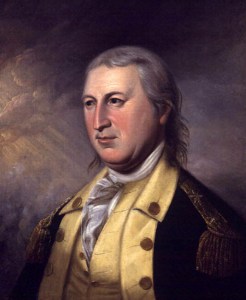
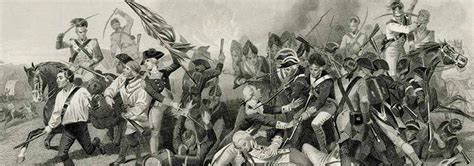
238 years ago today the United States military suffered one of its worst defeats. The Battle of Camden, fought on August 16, 1780 just a few miles north of Camden, SC was a total defeat for the American “Grand Army” under popular General Horatio Gates. The British under Lord Cornwallis inflicted nearly 1,900 casualties (out of 4,000) at a loss of only 300. One of the biggest losses was the death of General Baron Johann de Kalb, a popular foreign general in the American army. Though a strategic defeat for Gates, it was the retreat that would lead to Gates’ demise. As the militia broke and ran, Gates was caught up in the panic and fled the field as half of his army was still fighting.
Writing several days later from Hillsborough, NC Gates submitted his account of the battle to Congress. Already, reports of cowardice were starting to spread about Gates’ conduct during the battle. Gates decision to fight and his decision to leave the field during the battle have been debated ever since that August day in 1780. Below is a portion of Gates’ letter.
“In the deepest distress and anxiety of mind, I am obliged to acquaint your excellency with the defeat of the troops under my command. I arrived with the Maryland line, the artillery, and the North-Carolina militia, on the 13th instant at Rugeley’s, thirteen miles from Camden; and took post there, and was the next day joined by General Stevens, with seven hundred militia from Virginia…. Having communicated my plan to the general officers in the afternoon of the 15th, it was resolved to march at ten at night, to take post in a very advantageous situation, with a deep creek in front, seven miles from Camden; the heavy baggage, &c. being ordered to march immediately by the Waxhaw road. At ten the army began to march in the following order: Colonel Armand’s legion in front, supported on both flanks by Colonel Porterfield’s regiment, and the light infantry of the militia; the advanced guard of infantry, the Maryland line, with their artillery, in front of the brigades, the North-Carolina militia, the Virginia militia, the artillery, &c. and the rear guard. Having marched about five miles, the legion was charged by the enemy’s cavalry, and well supported on the flanks, as they were ordered, by Colonel Porterfield, who beat back the enemy’s horse, and was himself unfortunately wounded; but the enemy’s infantry advancing with a heavy fire, the troops in front gave way to the first Maryland brigade, and a confusion ensued, which took some time to regulate. At length the army was ranged in line of battle, in the following order: General Gist’s brigade upon the right, with his right close to a swamp, the North-Carolina militia in the center, and the Virginia militia, with the light infantry and Porterfield’s corps, on the left; the artillery divided to the brigades; and the first Maryland brigade as a corps de reserve, and to cover the can non in the road, at a proper distance in the rear. Colonel Armand’s corps were ordered to the left, to support the left flank, and oppose the enemy’s cavalry. At daylight the enemy attacked and drove in our light party in front, when I ordered the left to advance and attack the enemy; but to my astonishment, the left wing and North -Carolina militia gave way. General Caswall and myself, assisted by a number of officers, did all in our power to rally the broken troops, but to no purpose, for the enemy coming round the left flank of the Maryland division, completed the rout of the whole militia, who left the continentals to oppose the enemy’s whole force. I endeavoured, with General Caswall, to rally the militia at some distance, on an advantageous piece of ground, but the enemy’s cavalry continuing to harass their rear, they ran like a torrent, and bore all before them. Hoping yet, that a few miles in the rear they might recover from their panic, and again be brought into order, I continued my endeavour, but this likewise proved in vain. The militia having taken the woods in all directions, I concluded, with General Caswall [sic], to retire toward Charlotte.”
Approximately one month ago, I took a temporary detail assignment to Morristown National Historical Park. The national park preserves the winter cantonments of the Continental Army during the American Revolution; including the harshest winter, weather-wise, of the entire war, in 1779-1780.
For parts of multiple winters and even during the campaigning season, Washington’s forces would come to Morristown, situated behind the Watchung Mountains, which provided safety but also a perch to monitor the British in the New York City.
The town still bears witnesses to this rich legacy of housing soldiers, with historic buildings and signs dotted around the spiraling town. On a walk the other day, I came across the house below, with a small plaque situated on the front of the dwelling.
The home saw soldiers use it for their encampments throughout the majority of the war years. On his return to the United States the Marquis de Lafayette was welcomed with a reception in the building as well, which is in the photo below.
Morristown is filled with tidbits of history from the American Revolution and I as spend the next few months there as a park ranger, I will share what I come across. So, stay tuned as I uncover the history of the place that “Saved America” according to the park’s unofficial slogan.
Emerging Revolutionary War welcomes back guest historian Bill Backus
The American Revolution ultimately set in motion a chain of events that transformed not only society in the Americas but also back in the Old World. Six years after the United States gained independence, revolution broke out across France. While Americans focused on building a new nation, across the Atlantic the French Revolution sparked a series of wars subsequently known as the French Revolutionary Wars. Eventually after many years of combat and political chaos, a young army officer named Napoleon Bonaparte emerged as the new Emperor of France. Led by the Emperor the French army and nation embarked on a series of new wars that spread from Spain to Russia. From the beginning of the French Revolution to the defeat of Napoleon at Waterloo, Europe was at war for nearly 26 years, or nearly the entire lives of people born during the American Revolutionary period.
European Armies of the French Revolution, 1789–1802 (Campaigns and Commanders Series) by Frederick C. Schneid
While Napoleon’s French Empire is widely known on both sides of the Atlantic, the wars that allowed Napoleon’s ascent to power are less prominent. Concerned that revolution could spread to the rest of continental Europe, Revolutionary France found itself engaged fighting the European status co intent on restoring the Bourbon monarchy in France. Over the course of years war and peace ebbed and flowed in Europe, with war sometimes sparked by the French in hopes of unifying a splintered public. In “European Armies of the French Revolution, 1789-1802”, historian Frederick Schneid has organized a study exploring the role of some of the prominent European armies in this period. Collaborating with noted scholars in their respective fields, the essays explore the armies of the nation-states of France, Prussia, Austria, Russia, Great Britain, Spain, and the Ottoman Empire, along side the various German principalities and the armies of the Italian states. Continue reading “Review: European Armies of the French Revolution, 1789–1802 (Campaigns and Commanders Series) Edited by Frederick C. Schneid”→
A special announcement in the preservation world was made public today. The Civil War Trust, which the Campaign 1776 initiative spawned from, officially changed their name to the American Battlefield Trust. You can see their video announcement of the name change and what it means, here.
Emerging Revolutionary War sent an email inquiry to our friends at American Battlefield Trust to elaborate a little further on what this name change means and the impact to their current and future preservation efforts. Continue reading “A Very Special Message”→
Emerging Revolutionary War welcomes back guest historian Michael Aubrecht
John Trumbull
John Trumbull’s paintings represent some of the most familiar depictions from the time of the American Revolution. Trumbull was a graduate of Harvard University and the gifted son of the Governor of Connecticut. As a child, Trumbull showed a remarkable talent for an attention to detail. This aptitude set his drawings apart from his contemporaries. Trumbull traveled to London in 1784 to study painting under the master Benjamin West. It was then that he started painting some of his most notable pieces. There he honed his expertise for realistic painting. A year later later Trumbull traveled to the City of Paris to do commissioned artworks. He later did portraits of George Washington, John Adams, Alexander Hamilton and Thomas Jefferson. In 1816, he was selected as the president of the American Academy of the Fine Arts where he would serve for 20 years. Emphasizing classic traditions Trumbull attempted to teach the skills he had acquired while overseas. Following his death in 1843 at the age of 87, Trumbull was buried beneath the Art Gallery at Yale University which he had designed. In 1867, his collection of artworks were displayed at the Street Hall building on the same grounds. He and his wife’s remains were later re-interred and buried on the grounds of that building. Trumbull’s approach to painting has been studied by art students around the world. Today Trumbull’s paintings remain some of the most cherished ever to be painted by an American artist. Continue reading “The Brush of John Trumbull”→








 Emerging Revolutionary War sent an email inquiry to our friends at American Battlefield Trust to elaborate a little further on what this name change means and the impact to their current and future preservation efforts.
 Emerging Revolutionary War Era