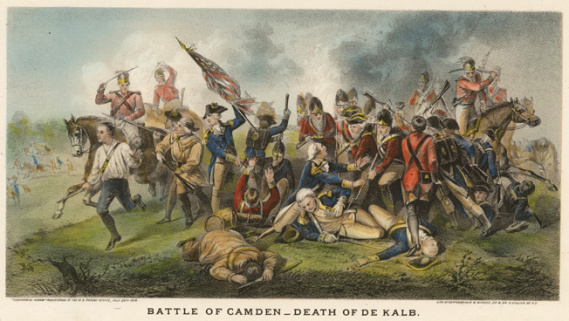
“Gentlemen, what is best to be done?” Gates Moves Towards Camden and Makes a Fateful Decision

Picking up the story of Camden from Thursday morning, we continue with Col. Otho

22CITYROOM2-articleInline
Gen. Gates believed his night march on August 15th would put his army in a great defensive position above Saunder’s Creek.

Holland Williams comments on the events on the evening of August 15th. As Gates’ army moved southward at night, a dangerous undertaking even with a professional army, notwithstanding an army mostly comprised of militia that had never fought as a cohesive unit. Williams documents the meals that the Americans ate that night before their march. When reading American accounts of Camden, most mention the impact on the evening August 15th meal had on the men and the army as a whole. Williams also mentions there is much criticisms of Gates’ plan, but no official opposition was brought to Gates. Reading Williams’ account gives us insight today into the events leading up to the disaster at Camden. When reading Williams’ narrative, it is not hard to believe that the Americans were marching to a defeat.

“Although there had been no dissenting voice in the council, the orders were no sooner promulgated than they became the subject of animadversion. Even those who had been dumb in council, said that there had been no consultation –that the orders were read to them, and all opinion seemed suppressed by the very positive and decisive terms in which they were expressed. Others could not imagine how it could be conceived, that an army, consisting of more than two -thirds militia, and which had never been once exercised in arms together, could form columns, and perform other manoeuvres in the night, and in the face of an enemy. But, of all the officers, Colonel Armand took the greatest exception. He seemed to think the positive orders respecting himself, implied a doubt of his courage –declared that cavalry had never before been put in the front of a line of battle in the dark–and that the disposition, as it respected his corps, proceeded from resentment in the general, on account of a previous altercation between them about horses, which the general had ordered to be taken from the officers of the army, to expedite the movement of the artillery though the wilderness. A great deal was said upon the occasion; but, the time was short, and the officers and soldiers, generally, not knowing, or believing any more than the general, that any considerable body of the enemy were to be met with out of Camden, acquiesced with their usual cheerfulness, and were ready to march at the hour appointed. As there were no spirits yet arrived in camp; and as, until lately, it was unusual for the troops to make a forced march, or prepare to meet an enemy without some extraordinary allowance, it was unluckily conceived that molasses, would, for once, be an acceptable substitute; accordingly the hospital stores were broached, and one gill of molasses per man, and a full ration of corn meal and meat, were issued to the army previous to their march, which commenced, according to orders, at about ten o’clock at night of the 15th. …. The troops of general Gates’ army, had frequently felt the bad consequences of eating bad provisions; but, at this time, a hasty meal of quick baked bread and fresh beef, with a desert of molasses, mixed with mush, or dumplings, operated so cathartically, as to disorder very many of the men, who were breaking the ranks all night, and were certainly much debilitated before the action commenced in the morning. …. “ Continue reading ““Gentlemen, what is best to be done?” Gates Moves Towards Camden and Makes a Fateful Decision”
“troops will observe the profoundest silence upon the march…” Gen. Gates’ Orders on August 15, 1780

22CITYROOM2-articleInline.jpg
General Horatio Gates

Two hundred and thirty nine years ago today from his camp at Rugeley’s Mill, SC, American General Horatio Gates issued the following orders to his Southern Army to move on to the British post of Camden, SC.

“The sick, the extra artillery stores, the heavy baggage, and such quartermaster’s stores, as are not immediately wanted, to march this evening, under a guard, to Waxaws. To this order the general requests the brigadier generals, to see that those under their command, pay the most exact and scrupulous obedience. Lieutenant Colonel Edmonds, with the remaining guns of the park, will take post and march with the Virginia brigade, under General Stevens; he will direct, as any deficiency happens in the artillery affixed to the other brigades, to supply it immediately; his military staff, and a proportion of his officers, with forty of his men, are to attend him and await his orders. The troops will be ready to march precisely at ten o’clock, in the following order, Continue reading ““troops will observe the profoundest silence upon the march…” Gen. Gates’ Orders on August 15, 1780″

Southside Revolutionary Virginia 1775 Tour – October 12, 2019

From our friends at the American Revolution Round Table of Richmond 

Tour Leader –  Dr. Patrick H. (Pat) Hannum, Professor, Joint Forces Staff College, National Defense University, Lt Col USMC (Ret)

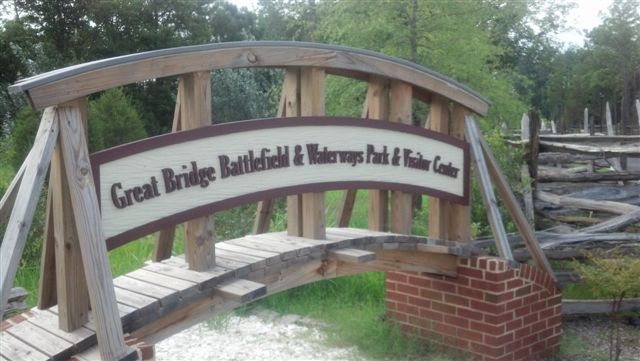
Great Bridge
Great Bridge Battlefield (courtesy of Great Bridge Battlefield & Waterways History Foundation)

This tour will visit three critically important Revolutionary War sites, in the modern Cities of Norfolk, Virginia Beach and Chesapeake, in order to help inform the important events and explain how the Whig Government ousted the Royal Governor, Lord Dunmore, and British military forces from the State of Virginia. These events largely unfolded in the fall of 1775 and culminated with the destruction of the City of Norfolk in early 1776. Strategically important, these events led to near uncontested Whig control of the State of Virginia for three and one-half years. The British defeat at Yorktown in October 1781 traces its roots to the critical decisions and decisive actions of the Whig Governments of Virginia and North Carolina in the fall of 1775.  We will visit: Continue reading “Southside Revolutionary Virginia 1775 Tour – October 12, 2019”

Rise and Fight Again for Southern Revolutionary History

From our friends at American Battlefield Trust (ABT). To learn more about the ABT, click here.

ABT

At stake are 31 acres associated with two Southern Campaign Revolutionary War battlefields, Hanging Rock in South Carolina and Guilford Courthouse in North Carolina.

At Hanging Rock, generous battlefield preservationists like you have already secured 141 acres. These 30 acres in the part of the battlefield where the initial Patriot attack began will add significantly to the land we have saved there already.

At Guilford Courthouse, the half-acre tract at stake may be small, but it’s part of a larger strategy to deal with the modern development crowding in on this battlefield from all points of the compass. Our plan is to buy up plots of battlefield land – including small ones and those with non-historic structures on them like this one – remove all non-historic structures and restore the battlefield. The Guilford Courthouse National Military Park has generously agreed to take responsibility for demolishing and removing the house on this plot, a considerable cost that we would typically need to cover. Continue reading “Rise and Fight Again for Southern Revolutionary History”

Battle of Fort San Carlos – Westernmost Battle of the American Revolution

St. Louis, Missouri is considered the gateway to the west for the United States beginning in the 19th century. In the 18th century, St. Louis was not on the radar of many in the burgeoning United States.

IMG_6914
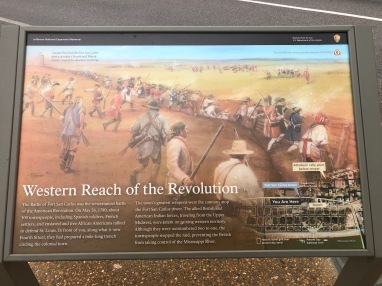
Western Reach of the Revolution, wayside informational tablet at Gateway Arch National Park (author collection)

However, the westernmost engagement of the American Revolution unfolded in the town of St. Louis, crushing British designs to conquer the territory from the Spanish, who were allied with the French and thus the United States.

On May 26, 1780, a hodgepodge force of 300 townsfolk, free and enslaved blacks, French settlers, and Spanish soldiers rallied to defend their town from the advance of a combined British and Native American force. Continue reading “Battle of Fort San Carlos – Westernmost Battle of the American Revolution”

Announcing the First Emerging Revolutionary War Symposium!

Mark your calendars for September 28, 2019!  Emerging Revolutionary War is excited toPrint announce that we are partnering with Gadsby’s Tavern Museum and The Lyceum of Alexandria, VA to bring to you a day long Symposium focusing on the American Revolution.
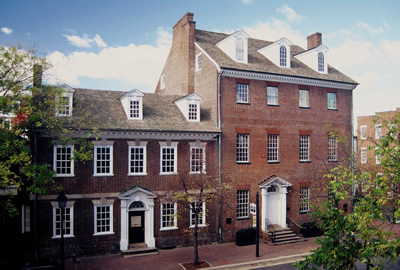
GTHomepageExterior(1).jpg
Gadsby’s Tavern Museum

Alexandria is George Washington’s hometown and we feel is a great place for us to start this new endeavor. Historic “Old Town” Alexandria is home to dozens of museums and historic sites as well as great pubs, restaurants and shops. Gadsby’s Tavern Museum is the premier 18th century tavern museum in the country and is host to the famous annual George Washington Birthnight Ball.  The Lyceum: Alexandria’s History Museum will be our host location. Today The Lyceum serves as the City’s history museum and is a center of learning through lectures, demonstrations and exhibits.

This year’s theme is “Before They Were Americans”  and will highlight several topics

Lyceum_017_720x483_72_RGB
The Lyceum

about the years leading up to the American Revolution. Our speakers include: Phillip Greenwalt, Katherine Gruber, William Griffith, Stephanie Seal Walters and Dr. Peter Henriques as the keynote. Registration will open on July 1, 2019 through AlexandriaVA.gov/Shop or by calling 703-746-4242. Stay tuned as we highlight each of our speakers and their topics.


“You are a fine fellow”: The April 24, 1777 Attack on Boonesborough

Emerging Revolutionary War welcomes historian Daniel T. Davis. 

1777.

Boone
An elder Daniel Boone (courtesy of the LoC)

The conflict ignited at Lexington and Concord finally reached beyond the Allegheny Mountains as the British stepped up their raids on American settlements in Kentucky. With so many troops dedicated to the colonies, Henry Hamilton, the Lieutenant Governor at Detroit, relied on Native tribes allied with the Crown to carry on the war effort. In March, Shawnees began to harass Harrodsburg, Logan’s Station and Boonesborough. Founded as part of the Col. Richard Henderson’s proprietary colony of Transylvania along the banks of the Kentucky River, Boonesborough derived its name from one of the most famous long hunters of the day and resident, Daniel Boone. Continue reading ““You are a fine fellow”: The April 24, 1777 Attack on Boonesborough”

Book Review: Peckuwe 1780, by John F. Winkler

erw-book-reviews-11


9781472828859_6

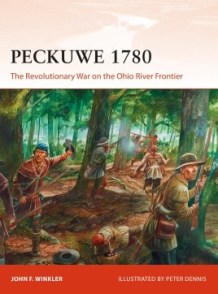
John F. Winkler, Peckuwe 1780: The Revolutionary War on the Ohio River Frontier, (Oxford: Osprey Publishing, 2018).   $24.00

I once read a review comparing Osprey Publishing’s monographs on particular battles, weapons, uniforms, or campaigns to “flash cards,” which made me smile.  As a kid, I somehow acquired stacks of flashcards laying out the technical specs of various military aircraft or ships and thought they were the greatest things since sliced bread.  Those were the days before Amazon or Barnes & Noble, when a kid had to depend on the local library and Waldenbooks for books about history, which they didn’t have in large numbers.  The Osprey monographs were a windfall of sorts when the local library started carrying them.  They’re not intended for an academic audience by any stretch, but can play a useful role in interesting popular audiences in places, people, and events that might otherwise prove too obscure or too intimidating for a young or casual reader.  So, when I came across John F. Winkler’s new monograph for Osprey, Peckuwe 1780, I snapped it up as much for sentimental reasons as for my interest in the American Revolution on the western frontier.

Continue reading “Book Review: Peckuwe 1780, by John F. Winkler”

From the Preservation Front: “Liberty Trailblazers – American Battlefield Trust”

ABTFrom our friends at American Battlefield Trust (ABT) comes the following announcement and call for assistance. 

The first line of the announcement sums up the importance of this new initiative of the American Battlefield Trust:

“They secured our liberty. It’s time for us to honor their legacy.” 

In a collaboration between the ABT, the National Park Service, and the South Carolina Battleground Trust, the joint initiative is to highlight the “tremendous significance of these places to American independence.” Their combined goal is to preserve 2,500 acres of American Revolutionary War battle lands in the Palmetto State.

As of the middle of this month, 308 acres of hallowed ground has been saved. The land protected are part of the battlefields of Camden and Eutaw Springs, which “bookend a period of incredible consequence to the American Revolution.”

This is a great start, but as that means, it is a beginning and the ABT will need all our help to make it happen. This new direction will bring preservation, education, and technology together into one investment and keep the effort going, until this land is saved for the present and future generations.

For those readers of ours that are already members, thank you. For those that are interested in learning  more, click here.

To check out the various sites and history associated with the Liberty Trail, click here.

First Shots

IMG_6846-min
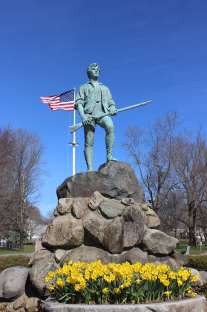
Lexington Minuteman Statue , facing the route of the British advance (author collection)

We all have bucket list items that we want to check off in our lifetime. Some revolve around traveling, some may revolve around learning a new hobby or skill. We may have different categories of items. The last is true for me.

One of those categories was to see the first shots of the wars of the United States (okay and the French and Indian War, since that started the march toward independence, when looked at through the lens of history and distance). Continue reading “First Shots”