Mention the following words to any casual student or enthusiast of the American Revolutionary War and we can almost guarantee what the first word(s) or topic out of their mouths will be.
Virginia.
1781.
American Revolution.
If you are thinking, Yorktown, or Siege of Yorktown or Surrender of Yorktown, then our rhetorical question above is correct.
Most people know about the Siege and Surrender at Yorktown, but Virginia was a hot spot of activity the summer leading up to Yorktown. With British troops, led by the likes of Benedict Arnold, William Phillips, Alexander Leslie, and lastly by Lord Charles Cornwallis in the Old Dominion throughout the year and American leaders like the Marquis de Lafayette and Baron von Steuben, Virginia saw very active campaigning ranging through most of the central and eastern parts of the colony.
That is why you need to tune in and Join Emerging Revolutionary War this Sunday, on our Facebook page, at 7p.m EST for the next “Rev War Revelry” as we discuss the events leading up to Yorktown in October 1781.
We will cover actions such as Spencer’s Ordinary, Green Spring, Gloucester Point and of course Yorktown.
ERW will be joined by historians J. Michael Moore, Kirby Smith and Drew Gruber. All three live and work in the “Historic Triangle” of Virginia. The three gentlemen all have researched, led tours and have written published works about this important period of the American Revolution.
Map by Michel du Chesnoy (1746-1804)
This will be a precursor to ERW’s annual fall trip, when we will visit Gloucester Point, Spencer’s Ordinary, Green Sping and Yorktown (which we invite you to follow along with on our Facebook page).
Every year the historians of Emerging Revolutionary War take a fall trip to research, visit Revolutionary War sites/battlefields and to promote our museum partners and preservation. The trip usually is a follow up to our Annual Symposium, but with the COVID-19 pandemic, that has been moved to May 22nd (you can get more information on speakers, topics and registration on our Symposium link from our main page).
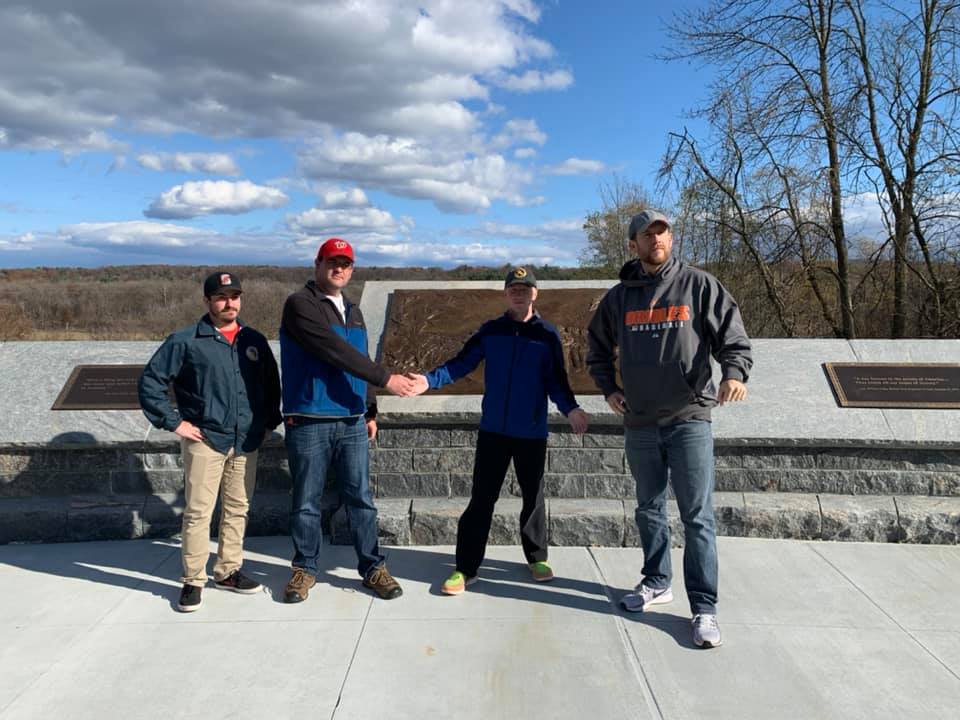
The ERW Crew recreates the surrender scene at Saratoga last fall.
After much discussion, we have decided to keep our annual fall trip tradition, but a more scaled back version. Don’t worry there will still be revelry and Facebook lives! Our original plan was to head to North and South Carolina, as a follow up to our visit there in 2018. In lieu of COVID-19, we have decided to keep it more “local” by focusing on sites in and around Yorktown, VA (many of our contributors are based in Virginia and Maryland). We will visit sites such as Gloucester, Yorktown, Spencer’s Ordinary, Green Spring, Great Bridge and Williamsburg.
Memorial at Green Spring Battlefield
We will be posting FB Live videos the entire trip, bringing you some behind the scenes opportunities with our museum partners, some exclusive talks with historians and we will wrap up the trip with a special Sunday Night Rev War Revelry. Stay tuned to our blog and social media pages starting on November 6th and continuing on to our Sunday Night Rev War Revelry on November 8th.
Our goal is not just to share with you great information and encourage support for historic sites/museums but also to share with you the fun and passion we have for interpreting the events around the American Revolution. As a public history focused effort, we feel making history fun and accessible leads to a great appreciation for our shared history. We hope you join us virtually on our trip this November.
On October 4, 1777, General George Washington’s Continental Army struck the British outpost at Germantown, Pennsylvania. Less than a month after the Battle of Brandywine and approximately a week after the loss of their capital, Philadelphia.
Initially successful, Washington’s forces got bogged down by fog and British holdouts in a stone structure called Cliveden. What started so promising did end in a tactical defeat for the Americans. Yet, coming days before the climatic battle in New York, dubbed Saratoga collectively, the cause of American independence was buoyed.
Although outshone in the annals of history by Saratoga, the setback at Germantown proved decisive in the French court, especially with the French foreign minister, who saw that the simple fact that Washington could regroup following Brandywine and come within some bad luck and fog of defeating the British was testament to resolve of the American effort for independence.
To cut through the fog and discuss the campaign, engagement, and repercussions of the Battle of Germantown, Emerging Revolutionary War invites back historian and author Michael C. Harris this Sunday for the next installment of “Rev War Revelry” at 7pm EST on our Facebook page.
He will join a duo of ERW historians. In addition, his publication, Germantown: A Military History of the Battle of Philadelphia, October 4, 1777, is now available through the publisher, Savas Beatie, LLC. Click here to order.
We look forward to hearing your comments, questions, and/or opinions this Sunday. So, set a side an hour-ish–as you know historians can get to talking and lose track of time easily, especially when books are also involved–for this historian happy hour.
Junction of Saint Mary’s, Saint Joseph’s, and Maumee Rivers/Kekionga (Indiana Historical Society)
The Revolutionary War has more than its share of adventurers, rogues, soldiers-of-fortune, and risk-takers. Augustin Mottin De La Balme combined all these characteristics in his person. In November 1780, they brought the Frenchman and his soldiers to a horrible end outside the Miami Village of Kekionga, near the confluence of the Saint Joseph, Saint Mary’s, and Maumee Rivers in modern Fort Wayne, Indiana.
La Balme was born in France in 1736, entered the Gendarmerie in 1757, served in the seven Years War, gained experience in the cavalry, received an army appointment in 1763, and retired with a pension in 1773. He wrote several books on cavalry training and tactics, but finding his fortunes stalled, left for America in 1777 with a letter of introduction from Benjamin Franklin, just one more French officer seeking rank, advancement, and his fortune in the war against Great Britain.[i] Major General William Heath, who met him in Boston, wrote Washington, “We swarm with French Officers at this Place, Two arrived in the Ship on Sunday at this Place They are much Superior to any that I have as yet Seen, One is an Engineer The other a Captain of Cavalry, They are Gentlemen of Education, Sense and Genius, The Captain has with him Two Treatises on the Discipline and management of the Horse, written by himself, and much Approved by all the Generals in the French Service.”[ii] Despite a glut of would-be foreign officers, La Balme received a commission as a Lieutenant Colonel and then Colonel and Inspector General of Cavalry. Dissatisfied with the appointment, he resigned, focused his attention on mobilizing Frenchmen still living in North America, and kept petitioning Congress to find useful work for him. Eventually, Congress tried to pay him off and send him home, but the French officer stayed, trying his hand at various schemes to contribute, including mobilizing Indians in Maine to attack the British. That short-lived campaign accomplished nothing, but resulted in La Balme’s capture and eventual escape.[iii]
Today 240 years ago in the back country of South Carolina, General Horatio Gates and his “Grand Army” were encamped around Rugeleys Mills South Carolina. He had come a long way in a short amount of time with his army from Deep Creek, NC. The men were ill fed, mostly poorly trained militia but he needed to strike a win for the American cause in the South. What he planned that evening is still debated today.
Gates had only been in command of the re comprised Southern Continental Army for a few weeks. He was tasked with turning around a disastrous year for the Americans in South Carolina. Most of the Southern army was captured at Charleston in May 1780 and then a bloody defeat of Virginia forces on May 29th at Waxhaws. American partisans such as Moultrie and Sumter had found some success, but the Continental Congress worried that they were about to lose the southern colonies. Something had to be done and many believed (though Washington and his supporters wanted Nathaniel Greene) the hero of Saratoga was the man for the job.
Now that Gates had brought his army so close to the British post at Camden, SC he needed intelligence on his next move. There could be no misstep, he was only 12 miles from the British at Camden. At that time, Gates believed he outnumbered the British under Lord Rawdon, but what he was soon to find out is he over inflated his own numbers and now Lord Cornwallis was in command. Gates’ force was still slightly larger, but it was mostly made up for militia. The British army comprised of some of the best units in North American. A very different situation indeed.
Gates ordered his engineer Lt. Col. Johann Christian Senf and Virginian Lt. Col. Charles Porterfield southward towards Camden. Senf was to find a suitable location for the American army to march and set up a defensive position. Gates had no illusions to attacking the British at Camden, and most likely he hoped they would abandon Camden all together. Senf wrote “reconnoitering a deep creek 7 miles in front was found impassable 7 miles to the right and about the same distance to the left, only at the place of the Ford interjects the great road”. (1) This creek was Saunder’s Creek and it is where Gates decided to move his “Grand Army” and await developments from Thomas Sumter who he had sent on a mission along the Wateree River in the flank and rear of Camden.
Bernardo De Galvez, Governor of Louisiana (Wikimedia Commons)
Willing’s next target was the town of Manchack upon which he descended “so rapidly that they reached the Settlements without being discovered.”[1] On the 23rd, Willing’s advance parties captured the 250-ton British sloop Rebecca, with sixteen 4-pounders and six swivels.[2] It was a coup worthy of Navy SEALS. Rebecca was normally a merchant vessel, but had been armed and sent upriver to contest the Rattletrap’s advance by protecting Manchack. Instead, her presence had strengthened Willing’s force. Captured while lying against the levy opposite the town, she only had fifteen men aboard when an equal or superior force of Americans struck about 7 am.[3] With Manchack captured and the Rebecca renamed the Morris, Willing turned his attention to the end game at New Orleans, where he hoped to dispose of his booty and obtain supplies useful for the American war effort.
At New Orleans, the Congressional Agent, Oliver Pollock, was aware of Rattletrap’s advance and began making preparations to dispose of the property Willing and his raiders had taken, a growing portion of which constituted slaves. He organized a small force under his nephew, Thomas Pollock, to go up river and help Willing bring his vessels and cargo into port. Instead, Pollock and his men proceeded down the river, where they captured an English brig, the Neptune, eventually bringing her into New Orleans as a prize.[4] (The British would argue strenuously that Neptune and a private boat were not in fact legal prizes.)
Willing’s Marine Expedition, The Marines in the Revolution: A Pictorial History, (Washington, DC: United States Marine Corps/Government Printing Office, 1975)
In 1778, Captain James Willing and his crew sailed and rowed the bateaux Rattletrap down the Ohio River to the Mississippi. A “left” turn of sorts then took them down the Mississippi all the way to the Gulf of Mexico. Willing’s purpose was straightforward: secure the neutrality of residents along the Mississippi, obtain supplies from New Orleans, and return them to the new United States. It was as tall an order as the Ohio and Mississippi were dangerous. British rangers and their Native American allies closely watched both shores and would readily attack vulnerable river traffic. Willing’s only refuge lay in a string of forts the Americans had established on the Ohio, but they did not extend very far. He would have to make due with his crew and the two swivel guns that armed Rattletrap. Continue reading “Captain James Willing’s Mississippi Raid, Part 1”→
Marquis de Lafayette was a French aristocrat serving in the French army, and recently married, when the Revolution broke out in America. He followed events with interst, and was motivated to come and fight with the Americans.
He arrived in March, 1777, nineteen years old and eager. He immediately formed a friendship with Washington, and was an aide on his staff. In the meantime British forces had invaded Pennsylvania, intent on capturing Philadelphia. Washington’s army took a position behind Brandywine Creek, and the British attacked on September 11, 1777. British troops had flanked the Americans, and reinforcements were rushed to the threatened sector, making a stand on Birmingham Hill.
Eager to get to the fighting, Lafayette and a group of French officers rode to the unfolding battle at Birmingham Hill, arriving as the action was at its hottest. Approaching from the south, they rode up the Birmingham Road, and turned to the left, coming in behind the brown-coated troops of General Thomas Conway’s Pennsylvania brigade.
Billy Griffith, Kevin Pawlak, Rob Orrison and Mark Maloy at George Washington’s HQ in Newburgh, NY
Just over two weeks ago, ERW historians Billy Griffith, Phillip Greenwalt, Mark Maloy, Rob Orrison and Kevin Pawlak took a long weekend trip up to upstate New York. This was the fourth year that ERW authors have gotten together to take a “field trip” to see sites related to the French and Indian War and the American Revolution.
The trips not only serve as chances for research, but also to make new connections with public historians working in the American Revolution era. Along the way, we posted several videos from locations to give our followers an idea of some of the great places to visit out there. Again, our goal is to not just share this history, but to get people to visit these great sites.
Sites visited on the first day included the Stony Point Battlefield, where Americans under Gen. Anthony Wayne over ran a surprised British outpost. Reading about this action almost rings empty until you stand on the ground. Looking at the steep terrain that Wayne’s men climbed after traversing through a wetland, it is hard to imagine how the Continentals were able to take the British fort with so few casualties. Later that day we made a quick stop at George Washington’s headquarters in Newburgh. Here Washington lived from April 1782 to August 1783 and where he learned of the cease fire with the British, wrote his now famous circular letter to the colonial governors on his vision for the new government. Most importantly, here Washington responded to the Newburgh Conspiracy of his officers looking to possibly over throw the civil government. This site is also important in the history of the museum field as it is the first publicly owned historic site in the United States, opened in 1850 as a museum. A worthwhile nearby site, the New Windsor Cantonment site, preserves the camp site of the Continental Army during the 1782-1783 time period. Several of the buildings are rebuilt, including the Temple of Virtue, where Washington made his impassioned speech to his officers (with the assistance of his glasses) to diffuse their discontent with Congress.
The morning of the second day of the trip was spent visiting sites around Lake George, NY, including some much over looked French and Indian War sites. That afternoon sites along the upper Hudson including the site of the murder of Jane McCrea, Fort Edward and sites in Albany.
Park Interpreter Bob Hoar explains the terrain of the battlefield
Early Sunday morning, a quick trip to the Bennington Battlefield State Park was highlighted with a great personal tour by Bob Hoar. The battlefield is well preserved and interpreted. Bob also shared some of his research into reinterpreting the battlefield using first person accounts and the landscape. Again, understanding the landscape of these places creates such a better understanding.
The majority of the day on Sunday was spent at Saratoga National Historical Park, posting several Facebook Live videos from various points across the battlefield. Also a special visit to the surrender site in Schuylerville which was recently preserved and opened as a memorial by the Friends of Saratoga Battlefield. A great preservation victory that adds to the overall story of Saratoga.
One of the highlights of the trip took place on Monday, where we received a behind the
Curator Matthew Keagle gave a behind the scenes tour of Fort Ticonderoga’s amazing collection storage.
scenes tour by Fort Ticonderoga staff. We started by learning about the military interpretive program by Ron Vido, Military Programs Supervisor. Anyone who has visited Fort Ticonderoga knows about their quality interpretive staff and programs. Ron also shared with us their plans to slowly restore the Carillon Battlefield (1758), which will be a great addition to the understanding of North America’s bloodiest battle before the Civil War. That afternoon we were treated to a behind the scenes tour of Fort Ticonderoga’s collections storage by Curator Matthew Keagle. The Fort has been collecting 18th century items for nearly 100 years. Their collection is one of the largest collection of 18th century military artifacts in the United States. From a Continental knapsack to an original copy of Baron von Steuben’s drill manual, the collection on display is only a small portion of what the museum owns. Matt also shared the museum’s ongoing work to digitize their collection for the purpose of research. The day was capped off by a visit to one of the best preserved battlefields in the United States, Hubbardton. Fought as part of the Saratoga Campaign, this is Vermont’s only battlefield. The landscape at the foot of the Green Mountains is amazing and the viewsheds are near pristine. A nice state park and visitor center are there to help explain the events of July 7, 1777.
Thank you to all the people that assisted us in this trip and all the sites that were nice enough to host us. We will be posting more on the blog in the future focusing on some of the stories around these amazing sites. Again, we encourage you to take the time to visit all these places. History books are great, but there is no substitute for being in the footsteps of history
Emerging Revolutionary War welcomes back guest historian Daniel T. Davis.
Last month, I heard Emerging Revolutionary War co-founder Phill Greenwalt remark “when you think about retreats, victory is a word that doesn’t come to mind.” The period of January 18 to February 14, 1781 is the exception to the rule. During this time frame, the American army under Maj. Gen. Nathanael Greene and the British under Charles, Lord Cornwallis, marched across the backcountry of the Carolinas. Known as the “Race to the Dan”, this episode between the engagements at Cowpens and Guilford Courthouse, is a largely forgotten but consequential even in the Southern Campaign of 1781.





 Emerging Revolutionary War Era