Doctor. Major General. President of the Provincial Congress. Author of political tracts. A true patriot. Forgotten.
All these words, plus many more, are titles that depict the life of Dr. Joseph Warren. However, the last term is most synonymous with the Massachusetts doctor who fell in the Battle of Bunker Hill on June 17, 1775 in the early stages of the American Revolutionary War. That last word, forgotten, is exactly what author and historian Christian Di Spigna is hoping to expunge with his new biography, Founding Martyr.
Di Spigna, an early American history expert and Colonial Williamsburg volunteer, focuses his account of Dr. Warren on not the events immediately surrounding his death at Bunker Hill and subsequent martyrdom but “to fill in the more obscure parts of Warren’s life” which will lead to understanding more of the “key period in the formation of his character, his special networks, and ultimately his medical and political careers” (pg. 7). Continue reading “Review: Founding Martyr, The Life and Death of Dr. Joseph Warren, the American Revolution’s Lost Hero by Christian Di Spigna”→
A few random musings on the importance of this date in American Revolutionary history…
President’s chair, Independence Hall, Independence National Historical Park (author collection)
This day was the date that the assembled Second Continental Congress voted on the draft of a document that was Richard Henry Lee, a delegate from Virginia had put forth in a measure, in June, to be voted on declaring;
“That these United Colonies are, and of right out to be, free and independent States, that they are absolved from all allegiance to the British Crown, and that all political connection between them and the State of Great Britain is, and ought to be, totally dissolved.”
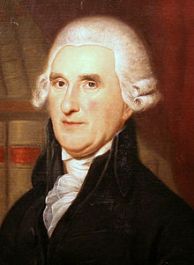
Thomas McKean by Charles Wilson Peale
On July 4, two days after this resolution passed, the final and formal version was approved by Congress. John Hancock, president of the Continental Congress affixed his signature boldly and largely at the bottom of the document. Eventually 55 other men would place their signature on the Declaration of Independence, with Thomas McKean, generally accepted, as the last to sign the document, possibly as late as January 1777.
Copies were made and four days later, on July 8, the first public reading occurred in Philadelphia. George Washington had the document read to the Continental Army in New York on the following day, July 9.
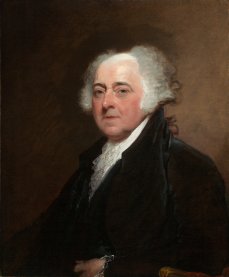
John Adams by Gilbert Stuart
For John Adams, future second president of the United States, the second day of July would and should be the day to remember American Independence, as he wrote;
“The most memorable Epocha, in the History of America. I am apt to believe that it will be celebrated, by succeeding Generations, as the great anniversary Festival…It ought to be solemnized with Pomp and Parade with shews, Games, Sports, Guns, Bells, Bonfires, and Illuminations from one End of this continent to the other from this Time forward forever more.”
And that is how many Americans choose to celebrate the anniversary of the Declaration of Independence, however, usually two days later on July 4th. Yet, it took another war; World War II, for July 4th to become a national paid holiday for workers of the Federal government when Congress approved it in 1941.
So, happy Independence Day!
*Feel free to add any interesting historical tidbits about the Second Continental Congress, the signers, or 1776 below!*
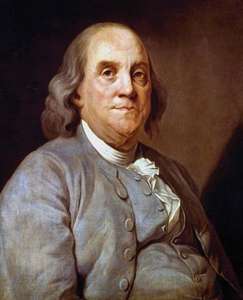
Benjamin Franklin, one of the Founding Fathers of the United States, could have contributed to a forgotten shipwreck narrative, according to new research.
Benjamin Franklin
Based on studies of Franklin’s early life as a printer, Dr Hazel Wilkinson claims there are clues which provide information about Benjamin Franklin’s activities during his first visit to London as an 18-year-old printer.
While prepping for a few summer programs I was re-reading The Road to Guilford Courthouse, The American Revolution in the Carolinas by John Buchanan.
The Road to Guilford Courthouse by John Buchanan
In his prologue, Buchanan states the following premise:
“But that tragedy [the American Civil War] is of far less interest than the American Revolution. The Revolution was the most important event in American history. The Civil War was unfinished business. The armies of the Revolutionary War were small but the stage global, the characters larger than life. The American Revolution was the first of the great modern revolutions, arguably the most important, and certainly the only one that did not end in tyranny or one-party rule.”
The Civil War is the most written about subject in American history, but is it the most important? Is it just the book-end of the American Revolution and was just wrapping up “unfinished business” as Buchanan writes.
Do you agree with the author? Disagree? Conversations and perspectives help shape our recollections and allows for fresh outlooks and critical observations into our shared past. So, feel free to comment below with your thoughts, opinions, and/or insights!
From our friends at American Battlefield Trust (ABT). To learn more about the ABT, click here.
At stake are 31 acres associated with two Southern Campaign Revolutionary War battlefields, Hanging Rock in South Carolina and Guilford Courthouse in North Carolina.
At Hanging Rock, generous battlefield preservationists like you have already secured 141 acres. These 30 acres in the part of the battlefield where the initial Patriot attack began will add significantly to the land we have saved there already.
At Guilford Courthouse, the half-acre tract at stake may be small, but it’s part of a larger strategy to deal with the modern development crowding in on this battlefield from all points of the compass. Our plan is to buy up plots of battlefield land – including small ones and those with non-historic structures on them like this one – remove all non-historic structures and restore the battlefield. The Guilford Courthouse National Military Park has generously agreed to take responsibility for demolishing and removing the house on this plot, a considerable cost that we would typically need to cover. Continue reading “Rise and Fight Again for Southern Revolutionary History”→
From our friends at the Southern Campaigns of the American Revolution comes this announcement of a Corps of Discovery tour that will cover the battles mentioned above. Led by historians David P. Reuwer and Charles B. Baxley, this comprehensive tour will be held on May 4, 2019.
Joining Reuwer and Baxley will be Dr. Tray Dunaway who will talk about the restoration forestry that has taken place at Camden Battlefield that has returned the field to the approximate look it did during the battle in August 1780. Also part of the day will be the historians guiding the tour of Hobkirk’s Hill, which includes Bill Denton, Rick Wise, Tom Oblak, and Guy Wallace.
Updates on the Historic Camden Foundation and the Liberty Trail will be part of the day as well which will start at 10:00 a.m. at the Historic Camden Revolutionary War Site and conclude at around 4:00 p.m. after the touring of Hobkirk’s Hill.
The tours are free and more information about the day can be found here.
Hope you can join our friends and fellow historians in South Carolina on May 4th!
Emerging Revolutionary War welcomes guest historian Kate Bitely
In the Foot Steps of James Madison.
A view from the front yard of Montpelier (author collection)
Spring is finally here in Virginia and if you are looking for a place to explore that offers a great outdoor experience, get in the car and head to Montpelier, in Orange Virginia. James Madison’s plantation home offers visitors a glimpse of what life was like in colonial America. Be sure to start your trip with the feature film in the welcome center that provides highlights of Montpelier’s lengthy history dating back to the mid 1700’s. The preserved property has something to offer everyone including hikes, gardens, and a breath-taking view of the blue ridge mountains. The grounds are filled with opportunities to learn about our nation’s early history and the impact it still has on our country today. Continue reading “ERW Weekender: In the Footsteps of James Madison”→
Emerging Revolutionary War welcomes historian Daniel T. Davis.
1777.
An elder Daniel Boone (courtesy of the LoC)
The conflict ignited at Lexington and Concord finally reached beyond the Allegheny Mountains as the British stepped up their raids on American settlements in Kentucky. With so many troops dedicated to the colonies, Henry Hamilton, the Lieutenant Governor at Detroit, relied on Native tribes allied with the Crown to carry on the war effort. In March, Shawnees began to harass Harrodsburg, Logan’s Station and Boonesborough. Founded as part of the Col. Richard Henderson’s proprietary colony of Transylvania along the banks of the Kentucky River, Boonesborough derived its name from one of the most famous long hunters of the day and resident, Daniel Boone. Continue reading ““You are a fine fellow”: The April 24, 1777 Attack on Boonesborough”→
Emerging Revolutionary War welcomes historian Dan Welch
As we commemorate the 244th anniversary of the engagements at Lexington and Concord, it is an opportunity to reflect upon this moment’s importance in American history. The results of what happened in April 1775 were truly “heard around the world.” The importance of those events are commemorated and remembered in various forms across the fabric our country. This holds true, even in Youngstown, Ohio.
The Road to Remembrance Memorial on the southside of Youngstown, Ohio. (Image courtesy of the author)
As the country grappled with the effects of the Great Depression, numerous civic organizations in the state of Ohio sought to construct a “Road of Remembrance” in honor of the servicemen from the country’s previous conflict. On June 17, 1930, the state legislature designated a portion of Route 193 from Lake Erie to 422 in Youngstown as a memorial roadway in honor of those soldiers who gave their last full measure of devotion during the Great War. Many towns planted memorial trees along the route, some erected monuments, while other organizations held ceremonies marking the occasion. This special route was to be just a small portion of remembrance that was to span from Montreal, Canada to the Gulf of Mexico. Continue reading “The Shot Heard in Youngstown?”→
As the blog continues to grow and the accompanying book series enters its second year with volumes three and four being released in fall 2019, Emerging Revolutionary War thought it was time for our own logo.
As part of the “Emerging” family, we wanted a logo that tied us into that brand. So, this is the product of that aspect meeting artistry.



 All these words, plus many more, are titles that depict the life of Dr. Joseph Warren. However, the last term is most synonymous with the Massachusetts doctor who fell in the Battle of Bunker Hill on June 17, 1775 in the early stages of the American Revolutionary War. That last word, forgotten, is exactly what author and historian Christian Di Spigna is hoping to expunge with his new biography, Founding Martyr.






 Emerging Revolutionary War Era