Often the study of history can ground us and make us feel less “unique.” This allows us to hopefully put our own experiences into perspective and be able to hopefully learn from lessons of the past. Many today complain about how print and social media can distort facts to support a particular agenda. This is not a modern phenomenon. Many in the Sons of Liberty (such as Paul Revere) used print media to their advantage to promote resistance to and then independence from Great Britain.
Many pro-Patriot newspapers printed nothing less than propaganda pieces after the battles of April 19, 1775. Here is part of what was printed by the Massachusetts Spy on May 3, 1775.
“Americans! forever bear in mind the BATTLE of LEXINGTON! where British Troops, unmolested and unprovoked wantonly, and in a most inhuman manner fired upon and killed a number of our countrymen, then robbed them of their provisions, ransacked, plundered and burnt their houses! nor could the tears of defenseless women, some of whom were in the pains of childbirth, the cries of helpless, babes, nor the prayers of old age, confined to beds of sickness, appease their thirst for blood! – or divert them from the DESIGN of MURDER and ROBBERY!”
Obviously a historic study of the events on April 19, 1775 disputes much of what is claimed by the Massachusetts Spy. But when you have a point to make, an agenda to promote and a local population to rally to a cause…why should truth get in the way?! We have come a long way since 1775, but in many ways not much has changed.
The prints by Amos Doolittle of the events on April 19, 1775 did a lot to promote the Patriots cause in their “media war” war against the British.
Debuting yesterday, the Campaign 1776, an initiative by the Civil War Trust, released an animated map that covers the “entirety of the American Revolution,” according to Civil War Trust Communications Manager Meg Martin.
At eighteen minutes in length, the video is a “succinct and engaging” access to gaining an overview of the entirety of the American Revolution, from the first shots in Massachusetts at Lexington and Concord to the culmination of the Siege of Yorktown in 1781. The video even includes a segment entitled “The Twilight Years” which explains the two years the war continued on after the victory at Yorktown; from 1781 to 1783. One can also jump to different parts, as the video has subheadings at the bottom to break the eighteen minute video into segments.
The video combines modern photography,with “live-action footage, 3-D animation, and in-depth battle maps” to give the viewer a sense of what the American Revolution, the pivotal event that “shaped America” was like.
Furthermore, “The Revolutionary War” animated map is part of a larger series of animated battle maps of battles on Civil War battles, which can be found here.
This animated map may be the first in the series of American Revolution and War of 1812 battles that the Campaign 1776 and Civil War Trust team is contemplating doing. We will all have to stay tuned and find out.
Yet, this animated map, of the entire American Revolution, is a great beginning introduction, so sit back, dedicate eighteen minutes, and learn about this defining moment in American history.
*Emerging Revolutionary War would like to thank Meg Martin of the Civil War Trust for the information about this release.*
Emerging Revolutionary War is dedicated to promoting the continued learning and interest in the American Revolutionary War era. Starting this month, the blog will highlight one American Revolutionary War Round Table. So, continue to check back for a round table, historical society, and/or history study group near your neck of the woods.
Founded in 2004 with a “magnificent seven” men that were interested in visiting the hallowed fields of the American Revolution and having a forum to discuss the events that unfolded on those grounds.
However, unlike the majority, if not all, of military round tables around the country, the Southern Campaigns American Revolutionary War Roundtable (SCARWRT) does not have the traditional “dinner-speaker” setup for their meetings. Their meeting happens semi-annually at historic sites in Georgia and the Carolinas and constitutes an all-day Saturday gathering with numerous speakers and a field trip to sites to conclude.
There are no member dues, by-laws, or even a round table constitution and one can be a novice student in the era of American history or a life-long enthusiast. More information can be found on the Southern Campaigns of the American Revolution website; http://www.southerncampaigns.org.
One caveat, the website mentioned above does not belong to the SCARWWT but there has been a strong connection over the years between the two.
Check the website above or the “American Revolutionary War Round Table” link at the top of this page to get in contact with the SCARWRT.
For the last nineteen years, the Civil War Trust has done their own sort of “spring cleaning.” On the first weekend of April, the Trust has promoted clean-up at various battlefields and historic sites across the nation. Officially called “Park Day” this year’s date is April 2nd.
This year, the Civil War Trust is expanding their park clean up day to include American Revolution and War of 1812 battlefields, as part of their “Campaign 1776” initiative. Hallowed ground such as Guilford Court House and River Raisin Battlefield are just two of the battlefields on the list.
Volunteer activities include everything from picking up trash to building trails to painting. All ages are welcome and even groups, such as Boys Scout packs, Lions Club members, and like-minded groups are encouraged to seek out the opportunities close to their home.
In return for volunteering, a free t-shirt commemorating your work in Park Day along with the chance to hear local historians describe the history that unfolded on that sacred ground.
For more information on participating in this “annual hands-on preservation event” and to find a historic site and/or battlefield near you, click the link below.
The night was chilly, snow laid on the streets and walks of Boston, and the cold air kept people bundled up around the port town of Massachusetts colony.
Yet, the cold air could not dampen was the seething resentment a growing number of Bostonians were feeling toward the occupying British military. Minor brawls and exchanges had taken place in the various taverns and around the bustling harbor; common places where alcohol and/or hard work created short tempers.
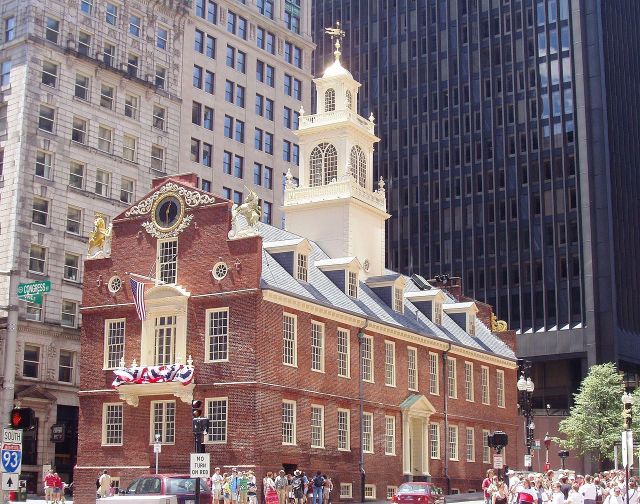
However, on this night, March 5, 1770, outside the Custom House on King Street a British redcoat infantrymen, the sentry, kept his post. Private Hugh White, whose shift it was to stand guard, would have noticed the approach of Edward Garrick, who had come calling for a British officer who owed Garrick’s boss money for his wig services. Unbeknownst to Garrick, the apprentice, the debt had been paid, so no response from the field officer was forthcoming.
Old State House (Custom House) scene of the Boston Massacre on March 5, 1770
A response from White was forthcoming, who admonished the young man to have a more respectful tone when speaking to an officer in His Majesty, the King’s service. Garrick did not take too kindly to this tone and responded with an insult of his own toward White.
This prompted White to leave his post and literally knock some sense into Garrick by way of a musket strike to the side of the head. Garrick yelped in agony and a companion took up the verbal barrage toward the British soldier.
The cacophony created by the yelling of insults and as the colonial version of a game of telephone spread the message about what was transpiring at the Customs House. Church bells were rung, a telltale sign that something was afoot, led to the crowd surging past 50 in number by the evening.
White, prudently, had left his post and retreated up onto the steps of the Customs House summoned a runner (messenger) to race to the local barracks for extra manpower.As was custom, there was an officer of the watch, in this case, Captain Thomas Preston and seven soldiers responded.
En route, Henry Know, destined to become chief of artillery for the Continental Army in the American Revolution urged Preston, “For God’s sake, take care of your men, if they fire, you must die.”
Against this sage advice, shouts of “Fire” were emanating from the crowd, which had also resorted to throwing snowballs and spitting in the direction of the red-coated soldiers. Other derogatory names for British soldiers, like “lobsterbacks” which took into account the red uniforms adorned by the British infantry were also heard being shouted.
The British soldiers, with loaded muskets, and Captain Preston reached White’s station, the British officer ordered the large crowd to disperse. Preston had taken a position in front of his soldiers and had told a member of the crowd that his soldiers would not fire unless ordered.
No order was ever given.
Shortly after Preston spoke those words to a Bostonian, a foreign object hurtled toward Private Hugh Montgomery and knocked the infantryman off his feet. His musket clattered onto the steps. Standing up, Montgomery reportedly yelled “Damn you, fire!” and pulled the trigger of his musket. The accompanying “bang” reverberated in the square.
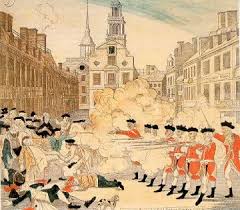
Copy of the lithograph by Paul Revere on the Boston Massacre
And then there was a pause of an uncertain length.
This silence was broken by the staccato of other muskets being fired. A few rounds belched forth from the British soldiers. Screams and shouts along with deafening echo of the discharge of black-powder muskets in an enclosed city square mixed with the sickening thud of lead impacting bone and body.
All told, eleven colonists were hit from the volley fire. Three were killed outright; Samuel Gray, James Caldwell, and Crispus Attucks. One more, Samuel Maverick, who was struck by a ricocheting round would die later that same evening. One more, a recent immigrant from Ireland, Patrick Carr, would succumb to his wounds a fortnight later.
In the immediate aftermath, Preston would call the majority of his unit, the 29th Regiment of Foot to the scene. With the mob spilling out of the Customs House Square, Governor Thomas Hutchinson, the acting governor, was able to temporarily restore a semblance of tranquility with the promise that a fair trial of what transpired that March 5th evening would happen.
The trial would be a major event for the city of Boston, but, that was in the near future. With the shots fired and the citizens struck, the burgeoning independence movement had a rallying point. Lives were lost that night, but, the events that followed would, to the proponents of American independence, make them martyrs for the cause.
Numerous biographies grace the shelves of book stores, museum shops, and the personal libraries of American Revolutionary Era history enthusiasts. Yet, until 2015, not a single dedicated biography was written about an extraordinary American general that rose from the ranks during the war to assume such a lofty position by the successful conclusion of the conflict.
That unintentional omission has now been filled with the excellently detailed oriented and primary source driven biography entitled Otho Holland Williams in the American Revolution by John Beakes. The author is a graduate of the United States Naval Academy in Annapolis, Maryland and a resident of Ellicott City, Maryland.
I had a chance to interview the author via email and one of the questions I asked him was if there was one takeaway you wanted your readers or those interested in the book to know, what would it be? His answer is below and sums up the importance of Williams and soldiers like him:
“Otho Holland Williams was a vibrant, healthy young man with distinctive intellectual gifts and leadership capabilities when he joined the army at age 26 in 1775. Had there been no War of Independence, he might well have lived a long life enjoying the family relationships that he cherished so deeply, and have risen to a position of prominence and wealth.
Instead, Williams died at age 45, spitting up blood and much weakened in body and spirit from the tuberculosis that he had contacted while a prisoner-of-war in New York after the Battle of Fort Washington.
We owe much to the young men like Williams who gave so much in the fight for our nation’s independence, and yet he is largely forgotten.
Here, truly, was a life laid in sacrifice on the altar of our freedom.”
This biography is part of an ongoing effort by The Nautical and Aviation Publishing Company of America to publish a biography on the chief lieutenants that served under and with George Washington and were instrumental in winning American Independence. Previous volumes in the series include titles on John Eager Howard and Henry “Light-Horse” Lee. The series is entitled, “George Washington’s Best Officers Book Series” and definitely worth the read for the enthusiastic and/or serious student of the American Revolution.
So, why was Otho Holland Williams chosen as the third installment? I asked the author and his response is below;
“Otho Holland Williams kept appearing in all of the key moments of the story of the war in the South, but always tantalizingly just beneath the surface, hidden in the shadow of larger figures like Nathanael Greene and Daniel Morgan. Williams was a compelling writer, and his descriptions of battles like Camden and Eutaw Springs are superbly written and deeply insightful observations of a first-hand participant. His leadership of the Screening Force during the Race to the Dan displayed combat leadership skills of the first order, but his life story was largely untold.”
Furthermore, the reader will glean that Williams is the quintessential depiction of the American soldier, rising from the ranks to one of the top positions in the Southern theater by war’s end. The process, superbly told by Beakes, winds the reader from the early days of the revolutionary movement in western Maryland to the Siege of Boston, to the defeats of the New York Campaign. Those achievements and setbacks combined to give Williams the invaluable training as a military officer. For Williams, like a majority of the men who would hold rank in the American forces;
“Military knowledge and experience were scant commodities in the colonies at the start of the Revolutionary War, and young men like Howard, Lee and Williams joined the army in their twenties with virtually no prior military experience. There were no institutions such as military academies, officer candidate schools, or ROTC to help them learn. They read all the available military literature. They observed leaders like Washington, and took in the written guidance that he provided, often in General Orders, for how to develop into effective officers. And most importantly, they learned by experience in the daily rigor of military discipline and in their various combat engagements.
Starting with such “bare bones” learning opportunities, in the short years between 1775 and 1780, when the Southern Campaigns began, these young officers had become exceptional military leaders, and the army that they led was as fine a combat organization as any on earth. It is a story of grit and determination and persistence that brought these young civilians to such a high state of military capability.”
During this early part of the war, Williams also became a prisoner-of-war after the fall of Fort Washington during the New York Campaign of 1776. After being exchanged, Williams would feel the affects of his imprisonment which would eventually cause his death in 1794 from tuberculosis.
Yet Williams, like many other junior officers, are still worth studying in history, as Beakes claims, because,
“With the resources available today, we have a powerful opportunity to take a fresh look at these stories. Unfortunately, our fresh look at original sources sometimes reveals that writers along the way have perpetuated false information, sometimes from honest mistakes, but also sometimes from blatant political motives.
We have an important opportunity to correct the record. Stories like those of Otho Holland Williams give readers a look at the War of Independence from the front-lines and from ground level, a perspective that fills out and enriches the more strategic insights of the well-known works on the Founders.”
This book, like two previous volumes in the series, is definitely a worthy addition to any avid reader of the American Revolutionary Era. If these great in-depth biographies already grace your private library, don’t worry there is more biographies in the works. Beakes is currently working on research for a volume on Baron de Kalb.
Stay tuned and enjoy the read!
*Book Information*
Publisher: The Nautical and Aviation Publishing Company of America
Published Date: November 5, 2015
346 pages, including appendices, bibliography, notes, and index
Click here to view the website where further information, including how to purchase the book, is available.
Emerging Revolutionary War welcomes guest historian Robert “Bert” Dunkerly to the blog as the author of this post.
It is well known that German troops (commonly called Hessians) fought alongside the British during the war. One of the more intriguing questions of the Revolution remains; how did they communicate? At any given time, German units could comprise from one third to one half of the larger British armies. They were also present in equal numbers in smaller detachments.
French was a common language that many European officers would have known, and there is evidence that German and English officers communicated in French during campaigns. The language barrier also impacted daily army operations. For example, Georg Pausch of the Hesse-Hanau Artillery requested an English officer who spoke German for a court martial. Yet most of that procedure was conducted in French.
Written orders from General Phillips in Montreal in 1777 to Hessian Artillery units were given in French, suggesting that this was commonly done in these calm, routine situations.
It wasn’t a perfect system but it worked well enough. Adjutant General Major Bauermister of Hesse-Cassel, for example, notes that the English spoke poor French, when communicating with them. Yet what about among small units like companies or battalions?
Re-enactors portraying the Hesse Kassel Jaeger KorpsWould mediocre command of a language suffice for communication in combat situations? Often small groups of British and German troops operated together on patrols or raids. Marching to Freeman’s Farm (Saratoga) in 1777 was a column that included Germans on the left, English on the right, and English troops as flankers. Such situations required close coordination.
Other times they were side by side on battlefields, such as at the Battle of Guilford Courthouse in 1781, where the German Von Bose Regiment was aligned next to the British 71st Highland Regiment. Close coordination in these cases was essential.
Still another example is from Brandywine, where Captain Johann Ewald wrote that in the army’s advance, were 60 jaegers on foot, fifteen mounted jaegers, a company of Highlanders, and a company of British light infantry. All these troops worked in tandem to protect the army from ambush and clear the way for the advance. Yet Ewald was silent on how they did so.
Captain Ewald, also wrote of his experiences in Virginia, where, in the advance on Richmond, small numbers of troops were interspersed. They marched into the town in this order: Jaegers, British dragoons, more jaegers, and British Light Infantry. There are dozens of other examples.
Despite the many instances of German and British units mingling, there is precious little documentary evidence of how officers, or the common soldiers, communicated. Perhaps they used a combination of French, translators who spoke either English or German, and hand signals or other agreed- upon methods.
Timing and clarity are key in close quarters combat, there is no chance to second guess in an ambush or a raid. There were likely instances of misunderstanding that may have led to mistakes and even led to friendly fire incidents.
Of the many accounts this author has researched, only a few mention how they communicated. Perhaps it was something so mundane, or so well understood, that they saw no need to comment on it in their writings. It is hoped that further research will shed light on this question.
A fisherman by trade before the war, the savior of the American Continental Army during the war on two occasions, and returned to civilian life with personal, physical, and economic hardships because of the war.
John Glover
That one line could simply sum up John Glover of Marblehead, Massachusetts. Unfortunately, Glover has received scant attention; a few lines here, a page in this publication, or a reference in passing when talking about the engagements around New York or the Crossing of the Delaware.
Daniel Glover is more than well deserving of the epithet, “one of the greatest leaders of the American Revolution you have never heard of.”
Born on November 5, 1732 in what is now Danvers, Massachusetts, where he lived until the death of his father when he was just four years old. His mother Tabitha Bacon Glover moved young Daniel to Marblehead, on the coast of Massachusetts where he would apprentice, when he came of age, as a shoemaker. He eventually looked toward the sea and made a living as a merchant.
Daniel became well-entrenched in Marblehead society, he joined the local militia in 1759 and entered politics, aligning himself with the Whig party in 1760. By the time of the first shots on the Green of Lexington and the North Bridge at Concord, Glover was a colonel of militia in the Marblehead Regiment.
Although his regiment made the march to Boston and took part in the siege, Glover was away on detached duty when the Battle of Bunker (Breed’s Hill) was fought. When George Washington rode into Cambridge, Massachusetts and assumed command of the American forces, Glover lost his headquarters. A product of Glover’s fine taste, the Marblehead sailor had picked the home of a loyalist as his own command post. Washington chose the mansion, which now is a national historic site, as his own. Yet, a company of Glover’s Marblehead soldiers was also chosen to be the guard of Washington’s new headquarters.
Showing his importance and marshaling his background in shipping, Glover donated one of his own ships, the Hannah, named after his spouse, to build a hodgepodge navy for use by the Americans. One of the ships that made this volunteer navy actually captured a British ship, the brig HMS Nancy in which held as its cargo, 2,000 muskets, 30,000 rounds of artillery ammunition, and one brass mortar amongst other crucial military supplies much in need by Washington’s army.
After the siege of Boston was lifted with the evacuation of the British, Glover, with the rest of the Continental Army, headed south to New York City where another campaign and another chance to show his worth to the cause awaited.
On the night of August 29 and into the early morning hours of August 30, Colonel Glover and his able Marblehead regiment sailed the majority of Washington’s forces from Brooklyn across the East River to safety. Altogether, approximately 9,000 soldiers, plus artillery and supplies escaped from under British General Sir William Howe’s command. With Marylanders under Lord William Stirling launching ferocious rear-guard suicidal charges, Glover’s men saved Washington’s army that late August night.
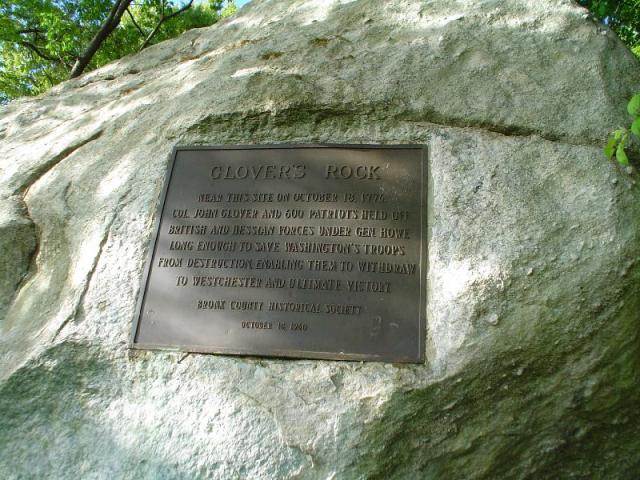
A month and a half later, on October 18th, Glover’s Brigade of Massachusetts soldiers held off a large contingent of British and Hessian mercenaries as Washington’s army retreated to safety. With approximately 750 men at his disposal, Glover’s rearguard action held over 4,000 enemy soldiers from threatening the retreat of the American forces.
Glover’s Rock, commemorating the action at Pell’s Point
Showing his humility, Glover would write about seeing the enemy come ashore before the engagement at Pell’s Point, that his first inkling was to give “a thousand worlds to have General [Charles] Lee or some other experienced officer present.” Luckily for the Americans, Glover did not get his wish and led admirably.
Glover’s command stuck with Washington’s forces during their retreat across New Jersey and into Pennsylvania and eventually to the banks of the Delaware River. In the prelude to the pivotal “Crossing of the Delaware” the former Marblehead sailors and their 43-year old commander would prove crucial.
To complete the surprise, Washington had to get his men across the ice-clogged Delaware River and to Trenton, New Jersey. Washington laid his eyes on Glover and outlined his thoughts and the big issue at hand; how to ferry his men across?
The response to his commander in chief was simple; to “not be troubled about that, as his boys could manage it.” Another primary account said that Glover and his command showed “perseverance…accomplished what at first seemed impossible.”
With Washington’s daring plan and Glover’s practicality, the “impossible” happened and the Americans scored a cause rallying victory at Trenton on December 26, 1776 and another equally important victory at Princeton, New Jersey on January 3, 1777.
After these winter battles, Glover went home to care for his gravely ill wife, Hannah, but there was nothing he could do. After a year long struggle, Hannah died on November 13, 1778 leaving John with eight children, including the oldest John who was a captain in his father’s Marblehead regiment.
While at home, George Washington petitioned the Continental Congress to promote Glover to brigadier general. Congress agreed and on February 21, 1777 the former Marblehead merchant became a general in the Continental Army.
When Glover returned to active duty, he was given the task of escorting the British and Hessian prisoners captured at the Battle of Saratoga and also took part in the unsuccessful attempt to expel the British from Newport, Rhode Island in 1778.
The end of the war saw him still in service in the Hudson Highlands where most notably he was on the board of officers that sentenced British spy Major John Andre to death. At the very end of the war, on September 30, 1783, Glover received a brevet to major general.
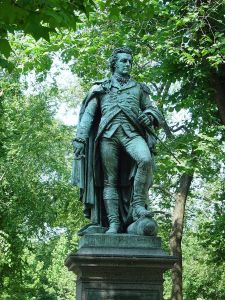
John Glover Statue Commonwealth Avenue, Boston
With the war over, Glover and his second wife, Francis Fosdick resided in Marblehead. However, Glover’s health and family were devastated by the war. Glover’s health was impaired by years of hard campaigning, including struggling with malaria in 1777. He lost his first wife Hannah during the war and his oldest son, John, disappeared as a prisoner-of-war while being transported over the Atlantic Ocean. Even his pre-war career, as a merchant, was greatly impacted by the seven-year conflict.
Glover rebounded as best he could and did serve in a few political positions, including in the Massachusetts State Legislature and as a Selectman for Marblehead. One highlight of the post-war years was when President George Washington stopped over in Marblehead and was entertained by his former subordinate.
On January 30, 1797, Glover passed away from hepatitis at the age of 64 and became one of the greatest leaders of the American Revolution you have never heard of.
Full disclosure: Mr. Brown is a fan of the reviewer’s blog and I received a copy of the DVD for review purposes.
Kent Masterson Brown is likely known to many readers as an author and historian of the War Between the States. But Mr. Brown’s knowledge, interest and expertise in the field of American history is much broader than just his study of the Civil War. This is evident in his recent film project, Daniel Boone and the Opening of the American West. I recently viewed the film for the purpose of this review.
The docudrama is an in-depth look at Boone’s life and his impact on the American frontier and the settlement of Kentucky. There is also detailed information regarding the geography and natural history of Kentucky which I found quite fascinating. The DVD comes packaged as a 2 disc, 112 minute DVD and was produced by Witnessing History, LLC – a company led by Brown. This is the first full-length film on the life of Daniel Boone ever produced for television broadcast. The film includes an original score by composer Clark D. Cranfill which provides a perfect backdrop for the narrative. Numerous Boone scholars consulted on the film. Included in the film are original Boone documents and works of art.
Let me begin by stating that I thought I knew a little bit about one of the American frontier’s best known icons until I viewed this documentary. Born in 1958, I had the privilege of being introduced to Daniel Boone by the popular 1960’s TV series, “Daniel Boone.” I watched the show so many times growing up (and still on occasion) that I can still sing the show’s theme song! Though the 1964-1970 television production took quite a bit of literary license the series was, nonetheless, responsible for instilling an interest in, and love of, American history in many a young boy during that time period. I rarely missed an episode growing up and have purchased the series for my own grandsons.
While watching this latest production, I couldn’t help but chuckle about some of the misconceptions many Americans have about Boone due, perhaps, to that old TV series. Brown explodes some of those misconceptions in this project: Boone was not the first white man to explore or settle Kentucky (then part of Virginia). He did not care for coonskin caps and never wore one. He was court-martialed, refused an attorney, defended himself, was acquitted and then promoted. He never used tobacco and though he did not totally abstain from alcohol, he was never known to abuse its use. He was red-headed and fair-skinned. He had a deep and abiding faith in God. His reading and writing skills were largely self-taught. And he was, as Brown notes, “one of America’s most authentic and remarkable men.”
This effort by Witnessing History is the first documentary film of its kind about the life of one of America’s best known historical figures. Brown describes some aspects of this project:
The filming of action scenes of Boone’s early explorations of Kentucky, his first attempt at settlement, the Treaty of Sycamore Shoals, the opening of the Wilderness Road, the Revolutionary War in Kentucky and the Ohio Valley (including the sieges of Boonesborough, Ruddle’s Station and Bryan’s Station and the disastrous Battle of BlueLicks), and Boone’s later life as a surveyor, tavern keeper and even a legislator in Virginia were planned.
More than 100 actors and actresses were specially contacted to appear. The production was designed to be studded with magnificent scenes filmed in Pennsylvania, Virginia, Tennessee, North Carolina, Kentucky and Missouri, as Boone would have seen them, the traces, caves, springs, rivers, creeks, hills, and even dwellings and cemeteries.
Born in Reading, Pennsylvania in 1734 and (like so many of America’s early pioneers), of Scots-Irish stock, the film traces Boone’s life through America’s founding era, with the American Revolution as the backdrop, to his death in 1820 in Missouri. The film reveals that Boone was an intensely religious man and grew up in a Quaker family.
In addition to being instrumental in the settlement of Kentucky, Boone also helped establish Kentucky as the dominant horse-breeding state by presenting a bill in May of 1775 to “encourage the breeding of fine horse flesh.” To this day, horse-breeding and Kentucky are synonymous.
The film reminded me of the many hardships endured by the men, women and families that settled the American frontier—something so easy for modern Americans to forget. Particularly heart-wrenching is the film’s recounting of the death of Boone’s oldest son, James. Just 16, James and some companions were ambushed by a party of Shawnee Indians. Most of the party was killed, but James and one other member of the group were both paralyzed by the attack. They were then tortured for hours by the Shawnee. Their screams and cries could be heard for miles. Daniel Boone soon discovered the sad carnage and buried his son where he had been killed. Boone’s efforts to settle Kentucky had cost him his first-born son. It would not be his last sorrow as his brother would suffer a similar fate.
Daniel Boone Escorting Settlers through the Cumberland Gap (1851–52) by George Caleb Bingham.
I found much of the scenery in the film breathtakingly beautiful, particularly the landscape of “the inner bluegrass” with its “sinks, sinkhole topography, sinking springs, sinking creeks and subterranean streams.” Much of that particular scenery, with its limestone formations, reminded me of my native Shenandoah Valley to which, interestingly enough, Boone also has a connection.
Brown’s knowledge of and love for his native Kentucky comes through in his narration of the film. This, in my mind, only makes the film more compelling and I found myself feeling as though I was actually standing in the landscape Brown so expertly and passionately describes.
Explorer, pioneer, folk hero, woodsman, frontiersman, militia officer during the Revolutionary War and surveyor; Daniel Boone was most assuredly, as Brown describes him, “one of America’s most authentic and remarkable men.”
The documentary was written, narrated and directed by Kent Masterson Brown. Full of historical nuggets and surprises, the film is as entertaining as it is educational. And though the documentary is 112 minutes, it moves along at a quick pace and it kept me interested the whole time I was watching. The closing few minutes of the film are quite poignant as Brown summarizes Boone’s life in few, but profound words. This is the way that history films should be done. In June of 2015, Daniel Boone and the Opening of the American West, won the coveted Telly Award.
If you are, as I am, a fan of Brown’s work or if you’re interested in learning something about Daniel Boone you didn’t know, I highly recommend this film and give it 5 out of 5 stars. It really is that good.
Note: If you are an Amazon Prime member, you can watch several of Witnessing History’s other projects for free, as part of your membership. Unfortunately, the Boone project is not one of them.
Richard G. Williams Jr., is a writer and the author of four books and numerous articles and essays related to the Civil War. His latest, The Battle of Waynesboro, (The History Press, 2014), was part of The History Press’s Sesquicentennial Series. He’s also written three essays for The Essential Civil War Curriculum which is an online Sesquicentennial project at the Virginia Center for Civil War Studies at Virginia Tech. Williams serves on the Board of Trustees for the National Civil War Chaplains Museum in Lynchburg, VA and blogs at oldvirginiablog.blogspot.com. He writes from the Shenandoah Valley.
The name Robert Middlekauf is very familiar to enthusiasts of the American Revolutionary War era. Twenty-three years ago, Middlekauf, Preston Hotchkiss Professor of American History, Emertius, at California-Berkeley, published A Glorious Cause. The book was a finalist for the Pulitizer Prize and was a thorough introduction to the build-up to and through the American Revolution.
Washington’s Revolution, the Making of America’s First Leader by Robert Middlekauff
For fans of Middlekauf, his most recent publication, Washington’s Revolution, the Making of America’s First Leader, will not disappoint.
Washington was the American Revolution according to Middlekauf, whom in the second sentence of the prologue writes that his title “emphasizes his [Washington’s] enormous importance for its course and outcome” (xv). Middlekauf then takes the reader on a very concise, quick-paced, blend of biography and history, journey through Washington’s early years to the culmination of the American Revolution.
“All the time that he served as commander of the Continental Army, he was in fact also the leader of the Revolution” (304). A tall order for a tall man–both literally and figuratively–but Washington was able to succeed because “he understood that the Revolution represented a rare opportunity”
To evaluate, examine, and explain Washington, one has to do a series of reading between the lines and looking at other primary sources of the compatriots. Washington was meticulous in reviewing what he left for posterity about his life achievements.
Middlekauf’s skill blends the reasons Washington embodied the American Revolution–from his daring in the winter of 1776 that culminated in the twin victories of Trenton and Princeton to literally holding the Continental Army together every winter–the Virginian insisted, cajoled, pressured, and through his own strong determination saw the war through.
That success, was due “in large part because he understood the Revolution represented a rare opportunity–something quite new, in fact–to lead a people in defense of principle long honored in conceptions of liberty” (304).
Not only was Washington a military leader, he also understood the political ramifications of his actions and the need to keep the army subjected to the rules of Congress. Even if that body was the cause of his soldiers going hungry and bereft of other necessities.
His “grand imagination, a vision of his new country….set him apart and made him a great leader” (306). Not too bad for just “a general” (306).
This book is a welcome addition to any military historian’s library. The blending of biography and historical monograph allows one to learn about the entire American Revolution and then from the Notes on the Sources have a road-map to delve into longer narratives on specific subjects.
Book Information
Publisher: Alfred Knopf, 2015.
358 pages, including maps, acknowledgments, notes, and sources


 Often the study of history can ground us and make us feel less “unique.” This allows us to hopefully put our own experiences into perspective and be able to hopefully learn from lessons of the past. Many today complain about how print and social media can distort facts to support a particular agenda. This is not a modern phenomenon. Many in the Sons of Liberty (such as Paul Revere) used print media to their advantage to promote resistance to and then independence from Great Britain.
 Debuting yesterday, the Campaign 1776, an initiative by the Civil War Trust, released an animated map that covers the “entirety of the American Revolution,” according to Civil War Trust Communications Manager Meg Martin.


![030_30[1]](https://emergingrevolutionarywar.org/wp-content/uploads/2016/02/030_301.jpg?w=640)





 Emerging Revolutionary War Era