Yes, this may be the first college student protest recorded in what became the United States of America.
No, this was not just about butter or butter substitutes.
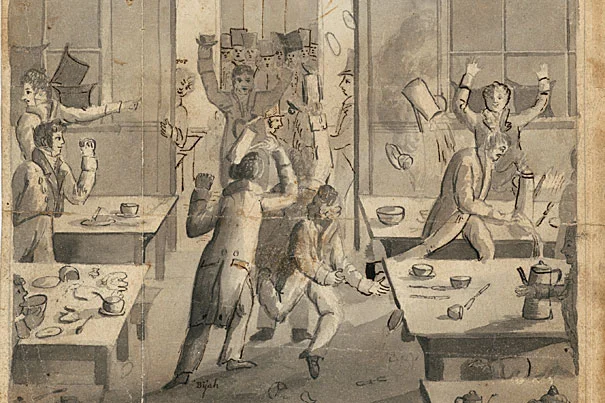
At Harvard College, in 1766, three students, all seniors at the institution, Asa Dunbar, Daniel Johnson, and Thomas Hodgson had had enough of the lack of fresh food being served to the student body. Dunbar, who may be best known as the grandfather of Henry David Thoreau, led the protest, stating that the butter served by the college was “stinketh” and he incited the student body to reject this rancid fare by jumping onto his chair and yelling
“Behold our butter stinketh! Give us therefore butter that stinketh not!”
Dunbar faced disciplinary action, being punished for insubordination and instigating a potential riot. After he received his punishment, the student body enacted another protest, by walking out of the hall, cheering loudly in Harvard Yard, and continuing into Cambridge to dine instead. To give some credit to the college, the adminstration acknowledged the butter ws rancid. With restrictions due to economic difficulties the availability of fresh food was limited however.
As Massachusetts moved closer to open rebellion in their remonstrances against British Parliament and the British crown their example was mirrored by the student body of Harvard. After a month of impassed including “insulting proceedings” the royal governor of Massachusetts, Sir Francis Bernard personally addressed the student body in the chapel on campus and the protests and insubordination of the student body concluded.
A depiction of a student protest courtesy of The Harvard Gazette
Concluding, with a Butter Rebellion, a Tea Party, what food or drink would the colonists focus on next? For me, I think I will sip my Samuel Adams brew. Leave the butter and tea to the Massachusettans.
(Yes, I know that Samuel Adams beer was not around at the time of the American Revolution but I thought it was fitting. And beer and history go together anyways right?)
Join us this Sunday at 7 pm as we welcome Saratoga historian Lauren Roberts. Lauren will discuss with us the upcoming as we discuss their upcoming Women in War Symposium and Bus Tour hosted by the Saratoga County 250th Commission. The third Annual Women in War Symposium will be held on May 4, from 8:15 a.m. to 3:30 p.m. at the Old Saratoga American Legion Post, located at 6 Clancy St. As an enhancement to the Symposium, a bus tour of historic sites will be offered on May 5.
Lauren will also discuss some of the topics being covered at the Symposium and some of the diverse history in Saratoga that relates to the American Revolution. We all know about the Battle of Freeman’s Farm and Bemis Heights, but how many know about the “witch of Saratoga”? Grab a drink and join us this Sunday night at 7pm on our Facebook page for a fun and insightful discussion into the great work that Saratoga County is doing to commemorate “America’s Turning Point.”
The following is from David Reuwer, who was a good friend of Charles Baxley and worked with Charles to help preserve and interpret the story of Camden, Hobkirk’s Hill and South Carolina in the American Revolution. Both men shared an unmatched level of passion and enthusiasm for history.
“I never heard that,” was a common cadence with which this practical lawyer and self-taught historian responded to new information about the American Revolution in South Carolina. He both challenged the statement maker to support it and welcomed the newbie into the fellowship of the Southern Campaigns. This is how Charles B. Baxley operated with both hands – one gladly shaking an entry to join our exploits and the other cautioning you to rise to ever higher and increasing standards. He would push, exacerbate, pull, and uplift you. The Southern Campaigns of the American Revolution was created in 2004 by Charles Baxley and David Reuwer when they delineated the tripod elements of scholarship, fellowship and fun. Charles defined scholarship as building blocks of historic research, inquisition and field evidence; fellowship as to include anyone who would cite source material gone before us while presently lifting others up around us; and fun as joyfully sharing one another’s knowledgeable victories as we pursued historic adventures.
The substantive virtue Charles practiced daily was broad inclusion – come and join us! There was always another chair at the table and more room for additional players according to him. However, you had to participate somehow, to care about the commonweal, and to help others with their project needs and requests. You had to give as well as take.
Charles suffered from PAD – project aggrandizement disorder – in that he cajoled and made each of us go deeper when all the rest of us thought it had been done. He could come up with endless lists of questions when everyone else considered the subject utterly exhausted. History was neither boring, stale nor irrelevant the way Charles viewed and worked it. History is an experience, as much about the present as it was about the past. We must place our “boots on the ground” – the actual locatable sites – in order to fulfill our duties of scholarship and fellowship. Only when a little more (or a lot) is known and understood, that we can pass on, have we accomplished the tasks before us responsibly to the future generations. Charles achieved much of this by writing, sending and responding to multiplicative emails and countless phone calls while sitting in his “war room” den at home late into the night and wee morning hours.
Charles was inherently an encourager of others making us to think hard about their historic project, to question everything, to counsel with others, to be in mentorship, and to ./explore new thinking about what one is doing. His queries to you could sometimes be unnerving but if you really worked for the answers, the growth toward historic truth was rewarding. No wonder he was awarded the Order of the Palmetto by Governor Mark Sanford in 2006; no surprise in 2022 that Governor Henry McMaster appointed him the Chairman of the South Carolina American Revolution Sestercentennial Commission (SC250). He was one of the key people who took on the gigantuan task of restoring South Carolina’s Revolutionary battlefield stories into their proper place in American history since 1856 when Senator Andrew Butler vociferously debated Charles Sumner of Massachusetts on the floor of the U.S. Senate.
It is true that he liked chairing the Round Tables with intervening commentary and being the centrifugal point-man in most other Revolutionary War conversations. His verbal editorials were always engaging and usually enlightening.
He liked playing “director” and was sincerely effectual at connecting people with other people and endeavors with other projects. His brain was way ahead of most other thinking minds, historically, and he courteously provoked when he did. Perhaps no other single person currently had as much comprehensive breadth-and-depth knowledge about the Revolution in SC as Charles. “Learning is not virtue but the means to bring us an acquaintance with it. Integrity without knowledge is weak and useless, and knowledge without integrity is dangerous and dreadful. Let these be your motives to action through life, the relief of the distressed, the detection of frauds, the defeat of oppression, and diffusion of happiness,” professed 38-year-old General Nathanael Greene, final military commander of the Southern Department during the Revolution. Charles embodied this learning for 70 plus years and shared this way to live with all the rest of us. If you were not about doing a task, he would assign you one. Charles often related that we were only as good as our current task, project or mission and persuasively demanded that we focus on it for the purpose of sharing it with others.
Our State has lost one most caring advocate of the Revolutionary founding 1770-1783 era – a hero of history. For him, it was about accurately working the historic puzzle and conclusively moving the story forward in truth. Most substantively, many of us State residents, numerous thousands of 250th out-of-state tourists, and untold future generations of all Americans will HEAR and HAVE HEARD of South Carolina’s significant persons, places, battles, and events of the Southern Campaigns because of Charles B. Baxley. Mirroring Christopher Gadsden, he lived for “What I can do for my country, I will do.”
Approximately 5,000 African-American or Black soldiers fought for the patriot cause in the American Revolution. Some joined state militias, some joined the Continental Army, and some sailed the seas with the fledgling navies of the United Colonies. William and Benjamin Frank were two of those 5,000. Both were free Blacks from Rhode Island who enlisted in the 2nd Rhode Island Regiment in 1777. Their father was a veteran of the French and Indian War, so the family was well-established in military tradition.
The 2nd Rhode Island fought and defended Fort Mercer during the campaigns of 1777 and survived harsh winters at Valley Forge and Morristown before returning to Rhode Island to literally defend the hearth and home from the British. Author and historian Dr. Shirley L. Green, adjunct professor at the University of Toledo, a 26-year veteran of the law enforcement community, and current Director of the Toledo Police Museum in Ohio, “takes the reader on a journey based on her family’s history, rooted in its oral tradition.”
Her book Revolutionary Blacks, Discovering the Frank Brothers, Freeborn Men of Color, Soldiers of Independence was published by Westholme Publishing in November 2023.
Furthermore, Dr. Green puts “together the pieces of the puzzle through archival research, interviews, and DNA evidence” to authenticate and expand the family history. The end result is a very readable and needed addition to the historiography of the American Revolution. Her ability to tell “a complex account of Black life during the Revolutionary Era demonstrates that free men of color…demonstrates that free men of color shared with white soldiers the desire to improve their condition in life and to maintain their families safely in postcolonial North America.”
Emerging Revolutionary War looks forward to an engaging and informative discussion with Dr. Green, this Sunday, at 7 p.m. EDT on our Facebook page. We hope you can tune in for this next episode of Emerging Revolutionary War’s “Rev War Revelry.”
For more information about the book and to order a copy, click here.
Emerging Revolutionary War welcomes guest historian Eric Wiser to the blog.
This is a brief story of my first and memorable visit to the Camden Battlefield in South Carolina this September past. I am a husband and father living in the suburbs of Chicago. I make my living as an accountant. As rewarding as my career has been, it’s my strong interest in early American history that stirs my imagination. My pilgrimage to Camden was part of a visit to my friend Phil Kondos who moved to eastern Georgia with his family over a decade ago. Phil is a gifted musician and wonderful father and happens to share a mutual love of history. This narrative of our visit will hopefully inspire others to place Camden Battlefield on their bucket list.
My interest in the Battle of Camden mostly derives from having a Patriot ancestor who fought there. Pvt. Michael Wiser, a 23-year-old grist miller from Frederick County, Maryland, was with the First Maryland Brigade and captured by the British at Camden.[i]
“Given the order to defend the American withdrawal from Long Island, the Maryland Line saved the Continental Army from annihilation in the first major battle of the war.” wrote historian Ryan Polk.
Tench Tilghman, staff officer to George Washington and a native Marylander wrote about his fellow soldiers, “bore the palm…by behaving with as much Regularity as possible.”
Furthermore, if you Google “Battle of Guilford Court House” the image used by Wikipedia depicts an artist’s rendition of the 1st Maryland defending Nathanael Greene’s last line during the March 1781 engagement. The particular image is below.
The Continental Maryland Line was one of the preeminent stalwarts of the American army, both in the northern and southern theaters of the war. Join Emerging Revolutionary War historians in a discussion about the men from the Old Line State and their military acumen during the American Revolutionary War. The discussion will also highlight their memory and memorialization. We hope you can join us Sunday at 7 p.m. EST on the Facebook page of Emerging Revolutionary War.
The Battle of Bunker Hill is routinely mentioned in the pantheon of memorable American military victories. Although myths of the engagement have obscured some of the history, much like the smoke of battle, the patriot victory on June 17, 1775, was another pivotal moment in the early stages of what became the American Revolutionary War.
To discuss the engagement, ramifications, and interpretation of the battle, Emerging Revolutionary War welcomes historian Dr. Paul Douglas Lockhart, Professor of History at Wright State and author of “The Whites of Their Eyes, Bunker Hill, the First American Army, and the Emergence of George Washington.” A full biography of Dr. Lockhart, including his other works, is at the bottom of this post.
As a teaser, this may be the first time in “Rev War Revelry” history that we mention Artemas Ward, who according to Dr. Lockhart is the “unsung hero of the battle (and indeed of 1775).” Come hear why! And full disclosure, I agree.
We hope you can join us on Sunday, January 21 at 7 p.m. EDT on Emerging Revolutionary War’s Facebook page for the next installment of the popular “Rev War Revelry.” Be ready to ask questions as you sip your favorite beverage during this historian happy hour.
Biography of Dr. Lockhart
“Paul Douglas Lockhart is Professor of History at Wright State University in Dayton, Ohio, where he has taught since earning his PhD in 1989. A native of Poughkeepsie, New York, Lockhart completed the PhD at Purdue University, where he studied military history with the late Gunther Rothenberg, the renowned Napoleonic scholar, and early modern European history with Charles Ingrao. He has seven single-author books to his credit. Four of them deal with the history of Scandinavia during the “Age of Greatness,” including Denmark, 1513-1660: The Rise and Decline of a Renaissance Monarchy, published by Oxford University Press in 2007. He is probably better known for his books on military history: The Drillmaster of Valley Forge: The Baron de Steuben and the Making of the American Army (2008), The Whites of Their Eyes: Bunker Hill, The First American Army, and the Emergence of George Washington (2011), and most recently his study of the parallel evolution of warfare and firearms: Firepower: How Weapons Shaped Warfare (2021). Wright State has awarded him the Brage Golding Distinguished Professorship and the Trustees’ Award for Faculty Excellence, the University’s highest academic honor. The Ohio Academy of History named him Distinguished Historian for 2020-21, and in 2021 he was elected to membership in The Royal Society for Danish History for his contributions to the history of Denmark, an honor rarely accorded to foreigners. He lives in Centerville, Ohio, with his family.”
In an age where the names of Franklin, Jefferson, and Washington are household, the names of Wilkinson, Kemper, and Bowles seem to be consigned to the fringes of histories of the early American republic. With the formation of the fledgling United States of America, both the honorable and not-so-honorable helped shape the direction of expansion, and diplomacy, and reinforce societal values of the 18th and early 19th centuries. This collection of essays is akin to watching a true crime television documentary.
With a collection of essays, editors David Head and Timothy C. Hemmis, historians, and biographers provide snippets into the lives of these scoundrels of the early Republic. A few of the names are well known, including Benedict Arnold and Aaron Burr, a few will conjure up memories from the fringes of other histories, such as James Wilkinson, whereas others have escaped the main avenues of historical exploration. Throughout the various essays, “this collection seeks to reexamine the Founding generation” to “replace the hagiography of the Founding Fathers with something more realistic” (pg. xx).
First, an examination of the word “scoundrel” is needed. According to usage at the time and the 1755 dictionary of Samuel Johnson’s authoring, that word meant “a mean rascal; a low petty villain” (pg. xiii). Through 12 individuals, the various authors explain how each earned the moniker “scoundrel” and how that affected the development of the United States. Especially interesting was the role of various individuals in Western expansion and the domino effect on international diplomacy. Individuals such as Aaron Burr and James Wilkinson are better known but Philip Nolan and Thomas Green are not so much.
Others, such as Benedict Arnold and Charles Lee get a fresh look from two great Revolutionary-era historians, James Kirby Martin and Mark Edward Lender. Included in those discussed, William Augustus Bowles and Diego de Gardeoqui show how international actors played prominent roles in providing heartburn to the national government. One theme, the west and south of the original thirteen states provided the arena for scheming, opportunity, and risk.
In conclusion, the editors examine three main reasons a study like this is important, that the “unintended result of the American Revolution” was “many men decided they had their own ideas about what was important” (pg. 266). Secondly, the “vital importance of the American West as a zone of territorial expansion, economic opportunity, and foreign intrigue” and lastly simply “early America was…a time and place for scoundrels…” (pgs. 267-268).
Overall this essay-comprised book is a fun, fresh read that looks at those scoundrels that sought an opportunity to change the landscape of the early American republic and potentially change the course of United States history. Who does not like to read about plots, scheming, and resultant escapades?
Welcome to the first “Rev War Revelry” of 2024! To kick off the new year, Emerging Revolutionary War is joined by Tom Hand, author, historian, and founder of Americana Corner. However, in the later stages of 20234, Tom added published book author to his lengthy list of accomplishments. His book, American Triumph is now available via his website.
The book, “masterly blends the personal experiences and historic milestones” of three luminaries of the early Republic, Benjamin Franklin, George Washington, and John Adams. The book, with a plethora of graphics, sidebars, and informational tidbits aims to provide a “captivating collection of stories” for the “everyday American.”
We look forward to a lively and friendly discussion with Tom. Hope you can tune in, to Emerging Revolutionary War’s Facebook page at 7 p.m. EDT this Sunday, January 7th.
As we move towards to the 250th anniversary of the Boston Tea Party, we at ERW have gotten a lot of questions with a central theme…” why was it tea that led to revolution?” Was tea so central to colonial life that it was worth risking war or was it something else? The answer is somewhere in the middle and as with most history, there is nuance to the story (and yes, tea WAS a big part of everyday live in British America).
On May 10, 1773, Parliament passed the Tea Act, this act was a way for the British government to help bail out a major corporation, the British East India Company. The British East India Company was one of the largest global companies and faced immense debt and financial trouble. Furthering their troubles, they held a large amount of tea stored in warehouses in London. The British East India Company sought a way to offload this tea, which was considered some of the best tea in the world. The company’s success was directly tied to Great Britain’s international strategy, as the company spread British influence across the globe especially in India where they basically managed the British colony. The Tea Act reduced the cost on the tea (cutting out the “middleman” in Great Britain), and now the colonists could buy the tea directly from the British East India Company.
The British colonies in North America consumed on average of 1.2 million pounds of black tea annually. In 1773, about 1/3 of the population drank tea at least twice a day. It was a common luxury among most middle- and upper-class colonists. They preferred black tea but also drank green tea. Black tea varieties included Bohea, Congou and Souchong and common green tea varieties included Singlo and Hyson. All the tea that the British East India Company sold was grown and imported from China. Tea from China was preferred by most for better flavor, but it tended to be more expensive. The North American colonies consumed a lot of smuggled tea from the Dutch, the quality of the tea was not the same but much cheaper. A large market grew for smuggled tea with most British port officials looking the other way. All of this changed when the Tea Act was passed.
Nineteenthcentury lithograph depicting a tea plantation in Qing China
Many in Parliament believed the colonists would have little opposition to this new act. They could now purchase their preferred tea for a cheaper price than the smuggled tea from the Netherlands. Unfortunately for Royal leaders, this was not the case. As word reached the colonies Whig leaders such as Samuel Adams called it nothing more than a British authorized monopoly of the tea market, cutting into the pockets of colonial merchants (though their tea smuggling business was illegal to begin with). The Tea Act also highlighted a British policy that the colonists opposed for many years, the Townshend Acts. The Townshend Acts imposed duties on imported lead, glass, paper, paint, and tea. This “tax” was payable at ports and funded the salaries of colonial judges, governors, and other government officials. This angered many colonial leaders for two reasons. First, it levied another tax on the colonists without having their own representation in Parliament. Secondly, it made the government officials more beholden to the British government (and the tax) than the colonial governments.
Whig groups like the Sons of Liberty used local taverns as places for their meetings. The most famous being the Green Dragon Tavern in Boston. It no longer stands today.
As the news of the Tea Act reached the colonies, the reaction was mixed. Whig leaders in major cities such as Charleston, New York, Philadelphia and Boston saw it as a way to reinvigorate their cause of opposing British rule. Recently things were mostly quiet with little interest by the public for protest. But now the Whig spin machine went into full affect. The Tea Act was a direct affront to colonial self-rule and economic interest. The taxes paid for the tea went to British officials in the colonies and the cheaper priced (and better quality) tea would put many American merchants out of business. Whigs were able to control the message that the Tea Act was just another way for Parliament to make money off the colonists, who did not have representation in Parliament.
As part of the Tea Act, consignees were appointed to oversee the sale of tea and the collection of the taxes on behalf of the British East India Company. As the tea began to arrive in colonial ports, public pressure was put on consignees to resign. This pressure was successful in New York, Philadelphia and in Charleston. Each of these cities were able to either stop the tea from being offloaded or, as in the case of Charleston, they confiscated the tea and didn’t allow any duties to be paid on it. All of these were direct affronts to the law but the events in Boston proved to be the most dramatic.
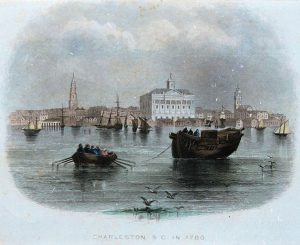
Ca, 1780 view of Charleston Harbor, and the Exchange Building where the confiscated tea was locked away by Whig leaders.
Unlike in other port cities, the consignees in Boston refused to resign. Richard Clarke, leading merchant in Boston and one of consignees faced a mob at his warehouse trying to pressure him and the other consignees to resign. Encouraged by the Massachusetts Governor Thomas Hutchinson (who had two sons serving as tea consignees) to stand their ground, the consignees refused to resign. Soon news arrived that the first ship carrying the tea, the Dartmouth, was arriving in Boston soon.
Hosting several town meetings, some hosting thousands of people, Whig leaders such as Samuel Adams, Dr. Joseph Warren and John Hancock were able to organize a strong opposition to the tea. Of course, Boston was already a tinderbox due to the “Boston Massacre” in 1770 and the large contingent of British regular troops stationed in Boston. Bostonians were reminded daily of Royal influence. The Whigs protested to the Governor to order the ships to return to England, but Hutchinson refused to do so and claimed he didn’t have that authority. Many historians believed Hutchinson, who recently had resigned as Governor and was awaiting his replacement, had grown tired and frustrated with the likes of the Whigs and Sons of Liberty in Boston and was trying to press the issue.
On November 28, the Dartmouth arrived in Boston Harbor. Captain James Hall was turned away at the first wharf he sailed too and was redirected to Griffins Wharf. Everyone knew that once a ship entered the harbor, the captain had twenty days to unload the cargo and pay the custom duties. Soon two more ships arrived at Griffins Wharf with more tea. With the Governor refusing to allow the ships to leave the harbor and local patrols watching the ships to make sure the tea was not offloaded, the stage was set for December 16th, the last day the ship’s captains had to unload their cargo.









 Emerging Revolutionary War Era