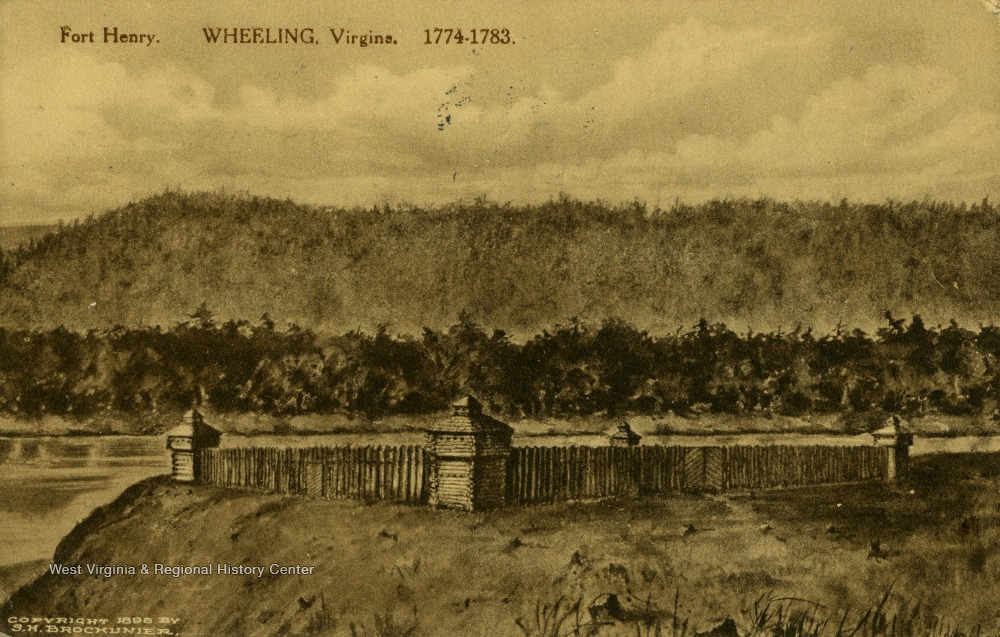
“By no means comparable with the feats of a similar character” and “performed an act of daring” and “nay, desperate horsemanship” and “seldom been equaled by man or beast.” All these describe the amazing escape of Major Samuel McColloch in September 1777 during the attack on Fort Henry around where present-day Wheeling, West Virginia.
I first encountered this amazing, daring, and crazy eluding of capture when I took my own, well not as risky, but still a leap, moving to Wheeling to attend university there. Parents were 3,000 miles away in England and I was attempting to juggle basketball, studies, getting re-acclimated to life in the United States, and unknowingly, a left knee that was about to explode. Being a history major, this was one of the first accounts learned in a freshman year seminar class about local history to inspire the incoming students to explore the area outside of campus.
Fort Henry, built in 1774, was originally named Fort Fincastle, one of the titles of Lord Dunmore, the royal governor of Virginia. When the colonies revolted, the fortification was renamed in honor of Patrick Henry.
The Southwestern corner of Pennsylvania was perhaps the most isolated in the state. It was also a region claimed by both Virginia and Pennsylvania. Far removed from assistance from the eastern centers of population, they had to rely on their own resolve for defense.
Along the wooded ridges of central Pennsylvania, a brutal war raged that was far removed from the orderly movements of large armies in the east. The attack on Phillip’s Rangers is a good example of this warfare.
Native Americans, supplied and encouraged by the British, raided far and wide on the frontier. These included Seneca, Shawnee, Delaware, and Mingo peoples. By the 1780s, many of these groups had been pushed out of their traditional homes to the east, and many viewed war with the Americans as the only way to protect what land they had left.
While the Second Continental Congress met
in the early summer of 1776, colonists in the far away backcountry of South
Carolina faced a threat from a perennial foe, the Cherokees. While delegates
debated a declaration of independence, war parties struck settlements between
the Broad and Saluda Rivers in the Ninety Six District. In response to these
raids, militia Major Andrew Williamson mustered his Ninety Six regiment.
Augmented by militia from the Carolinas and Virginia, he commenced a campaign
against the Cherokee villages along the eastern face of the Blue Ridge.
General Andrew Pickens of South Carolina
Williamson struck at Esseneca on August 1.
The colonials sustained twenty casualties but forced the warriors to abandon
the village. Over the course of the next week, Williamson moved further into
enemy territory. Rather than engage his force, the Cherokees retreated before
the advance. Williamson burned a number of towns including Oconee, Estatoe and
Toxaway.
The regiment reached Tamassee on August 12.
Once again, Williamson found the village abandoned. He decided to send out
scouting parties to examine the nearby hills. One of the patrols was led by a
company commander from the Long Canes region of South Carolina, Captain Andrew
Pickens. He took with him about sixty men. To cover more ground, Pickens
divided his group and continued on with thirty five militiamen.
Emerging Revolutionary War welcomes guest historian Kieran O’Keefe.
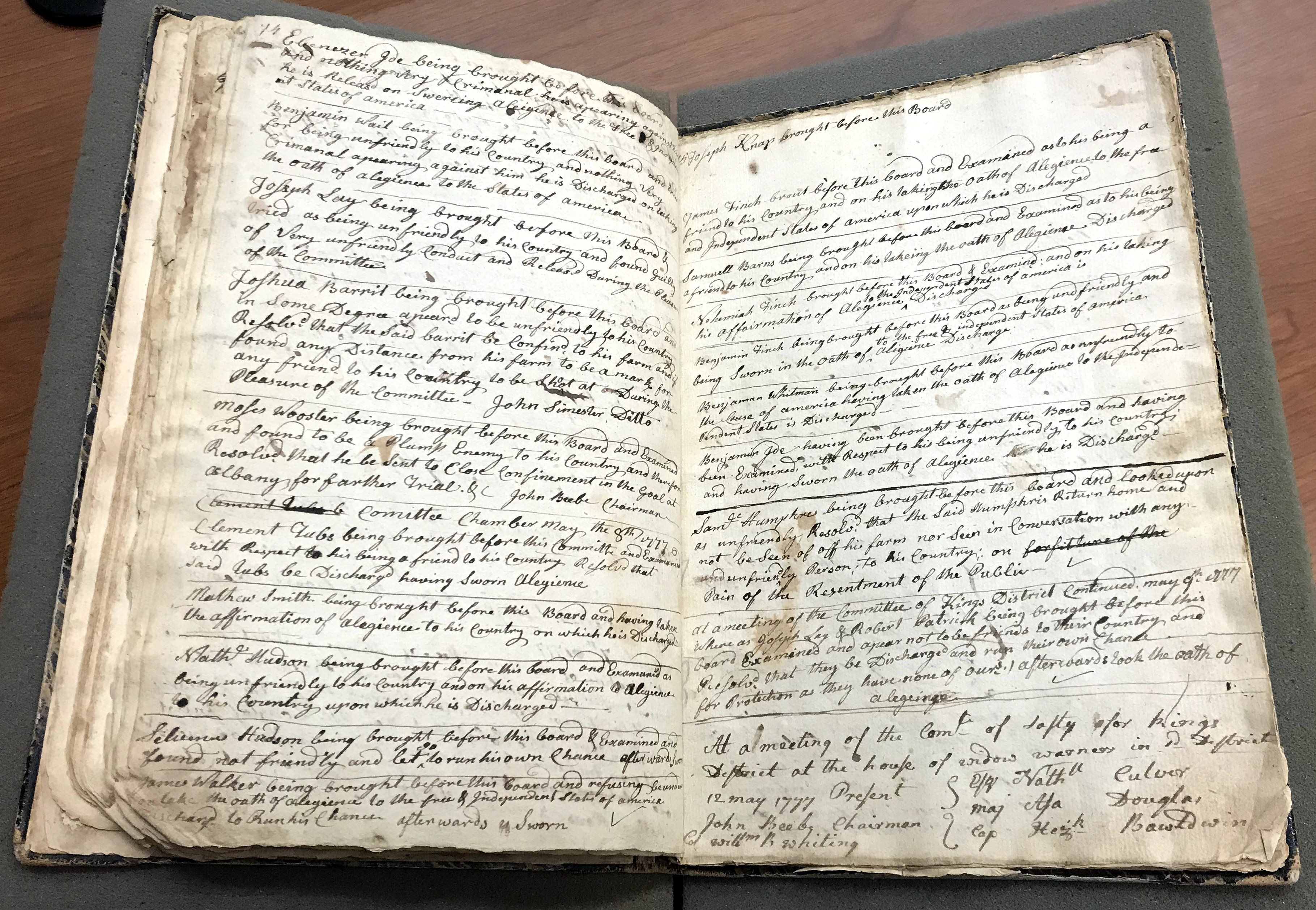
While the most famous scenes of the American Revolutionary War involve major battles or deliberations in Congress, the driving force behind the Revolution within small towns were committees of safety. As the war progressed and British authority dissipated, these committees became the effective government in most localities until the formal establishment of state governments. They had responsibilities such as regulating the economy, suppressing loyalists, procuring military supplies, raising revolutionary forces, and overseeing civil and criminal justice. Despite their ubiquity, it is rare to find the records of a committee completely intact. One such exception is the King’s District Committee of Albany County, New York, whose minutes survive in the Library of Congress.
The First Continental Congress created the committee system when it adopted the Continental Association in 1774. The Association called for the non-importation, non-consumption, and non-exportation of goods between the colonies and Great Britain, Ireland, and the British West Indies. This boycott was to put economic pressure on Britain to repeal the punitive Coercive Acts, which punished Massachusetts for the Boston Tea Party by closing the port of Boston and bringing the colony under tighter royal control with the aid of British redcoats. The Continental Association also stated that “a committee be chosen in every county, city, and town, by those who are qualified to vote for representatives in the legislature, whose business it shall be attentively to observe the conduct of all persons touching this association.” These committees were to ensure that all Americans adhered to the boycott stipulated in the Association. Committees began forming throughout the colonies in late 1774 and soon took on a greater role than originally designed, frequently seizing the reins of local government. The committees were unusually democratic. They generally consisted of about five men who were popularly elected, and many members were from the middling ranks of society with no prior political experience.
The King’s District Committee record book (author collection)
Mark your calendars for September 28, 2019! Emerging Revolutionary War is excited to announce that we are partnering with Gadsby’s Tavern Museum and The Lyceum of Alexandria, VA to bring to you a day long Symposium focusing on the American Revolution.
Gadsby’s Tavern Museum
Alexandria is George Washington’s hometown and we feel is a great place for us to start this new endeavor. Historic “Old Town” Alexandria is home to dozens of museums and historic sites as well as great pubs, restaurants and shops. Gadsby’s Tavern Museum is the premier 18th century tavern museum in the country and is host to the famous annual George Washington Birthnight Ball. The Lyceum: Alexandria’s History Museum will be our host location. Today The Lyceum serves as the City’s history museum and is a center of learning through lectures, demonstrations and exhibits.
This year’s theme is “Before They Were Americans” and will highlight several topics
The Lyceum
about the years leading up to the American Revolution. Our speakers include: Phillip Greenwalt, Katherine Gruber, William Griffith, Stephanie Seal Walters and Dr. Peter Henriques as the keynote. Registration will open on July 1, 2019 through AlexandriaVA.gov/Shop or by calling 703-746-4242. Stay tuned as we highlight each of our speakers and their topics.
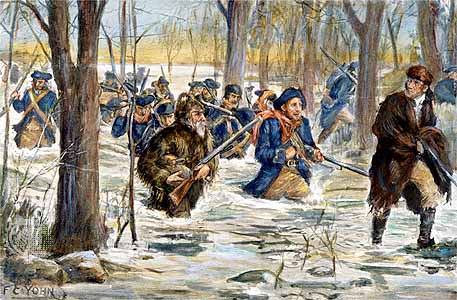
March to Vincennes by Frederick Coffay Yohn, 1875-1933 (Wikimedia Commons–Most of Clark’s men would not have dressed in the blue uniforms visible here, but would have dressed in fur and buckskin like the individual in the middle of the picture.)
Last fall, I posted several pieces following British Lieutenant Governor Henry Hamilton’s campaign in the Illinois territory as seen through the eyes of Captain Norman MacLeod. MacLeod led an advance party stuck with the logistical and diplomatic mission of moving 33,000 pounds of supplies and trade goods south from Detroit in order to mobilize the local Indian tribes as British allies. Hamilton’s campaign culminated with the successful capture of Fort Sackville (Vincennes, IN) on December 17, 1778. Since it’s the 240th anniversary of the campaign, I thought I’d continue the series by shifting to the American perspective, particularly that of Virginia Lieutenant Colonel George Rogers Clark and one of his Captains, Joseph Bowman. This is not a campaign history by any stretch. It’s meant more to be considered in combination with portions of MacLeod’s diary that appeared last fall. Taken together, they might give rise to a few different ideas about the Americans and British fighting the Revolution on the frontier.
Although he planned to recapture the entire Illinois territory, Hamilton decided to winter at Fort Sackville and resume his campaign in the spring. He dismissed the bulk of his force, settling in at the fort with just under 100 men. Normally, this would have been a prudent choice. Hamilton did not expect Clark to retake the field until spring brought about the customary campaign season and dispersing his army eased the logistical burden of maintaining so many men idle in the wilderness. Hamilton had under-estimated the meddle of his adversary.
(An occasional series highlighting British Lieutenant Governor Henry Hamilton’s march south from Detroit to recapture Vincennes (Indiana) on its 240th anniversary through the entries in Captain Norman MacLeod’s diary.)
Fort Sackville Map Inset, Nova Scotia Archives and Records, (Wikimedia Commons)
As Lieutenant Governor Henry Hamilton’s army arrived on the lower Wabash, the river widened and deepened, enabling his much-fatigued army to spread out and make better progress to Vincennes and Fort Sackville. All along the way, the governor’s efforts to grow his army through the addition of Indian allies had largely succeeded, not only increasing his numbers but improving his intelligence about the American forces awaiting him. Those were paltry, indeed.
The British and loyalists would not have to wait long. Word of the landing reached the Massachusetts government within a matter of days, and preparations for a counterattack began almost immediately. There was such a hurry to respond that the General Assembly voted to carry out the operation with state forces rather than wait for Continental assistance.[1] Despite the initial rush it still took a month to assemble a force of over 1,000 militiamen, as well as the food, arms, and other supplies to sustain them. All of these troops and their supplies would be transported by a fleet of 21 transports, accompanied by nearly twenty state and Continental navy vessels and privateers. Among the warships the largest was the Frigate Warren of 32 guns which served as the flagship of Commodore Dudley Saltonstall. The Connecticut born officer was given overall command of the naval forces – no small task given the lack of experience with large scale fleet actions among his subordinates. Command of the land forces was given to Massachusetts Brigadier Solomon Lovell. Lovell has seen experience early in the war outside of Boston, but was also relatively untested in battle. The inexperience and poor communication between Saltonstall and Lovell was to have a decisive impact on the coming expedition. Notable among the other officers in the expedition was Paul Revere, who commanded the Massachusetts artillery. The expedition was also joined by a band of the local Penobscot Indians allied to the Continental Congress.
The New England fleet entered the Penobscot Bay on July 25th and immediately attempted a landing. Clearly outnumbered and with their works incomplete, General McLean and his men were determined to resist the Americans, but expected the worst. Saltonstall’s fleet sailed in close to the shore and exchanged cannon fire with both the British defences and the three remaining Royal warships, now under the command of Captain Henry Mowatt. In the confusion and smoke the Americans lowered seven launches full of marines and militiamen, but as they neared the shore they were met by a hail of musket fire[2]. At least one of the attackers – a Native American – was killed and the boats returned to the safety of the fleet. It was an inauspicious start to the battle for the New Englanders and already the relationship between the two commanding officers was becoming strained. General Lovell knew little about sailing or naval operations. He questioned the Commodore as to why he couldn’t just sail his fleet into the harbor and blast the British to pieces while his troops landed under their covering fire. The Connecticut seaman replied curtly, exclaiming “You seem to be damn knowing about the whole matter! I am not going to risk my shipping in that damned hole!”[3]
On the 26th a second militia landing on the peninsula was repulsed after the lead boat carrying militia Major Daniel Littlefield was swamped by British chain shot, drowning the Major and two privates.That same day, however, the Americans scored a small victory when a force of 200 Continental marines and artillerymen landed on Nautilus Island and captured the small British battery there[4]. More artillerymen were landed and soon the Americans had a battery from which they could harass the British shipping. With the Americans making some headway Captain Mowatt withdrew the remaining British ships deeper into the harbor, creating a defensive line across the Bagaduce River.
Castine Harbor, looking out roughly where Captain Mowatt anchored the British transports and warships (Author’s photo)
Emerging Revolutionary War welcomes back guest historian Travis Shaw.
Part One
I’d be willing to bet that Maine isn’t the first place to come to mind when you hear the word “frontier”. For many Americans I imagine they immediately think of the wild west. Wagon trains of pioneers crossing the prairies, and Native nations like the Sioux and Apache ranging the plains on horseback. A century before the age of Manifest Destiny, however, the region that is now the state of Maine marked the eastern frontier of the English colonies. It was a wild and sparsely settled place, caught between New England and the French colonies to the north. The few European settlers eked out a living from the thin, rocky soil or turned to lumbering and to the sea. They lived alongside and often fought against the region’s original inhabitants – the Wabanaki or “People of the Dawn.” For two centuries the Eastern Frontier was torn apart by war between various European powers and their respective Native allies. Nowhere is this more clearly evident today than in the small coastal town of Castine, Maine.
Castine is located near the mouth of the Penobscot River, more or less in the middle of the Maine coast (Google Maps)



 announce that we are partnering with Gadsby’s Tavern Museum and The Lyceum of Alexandria, VA to bring to you a day long Symposium focusing on the American Revolution.



 Emerging Revolutionary War Era