Emerging Revolutionary War welcomes back guest historian Travis Shaw.
Part One
I’d be willing to bet that Maine isn’t the first place to come to mind when you hear the word “frontier”. For many Americans I imagine they immediately think of the wild west. Wagon trains of pioneers crossing the prairies, and Native nations like the Sioux and Apache ranging the plains on horseback. A century before the age of Manifest Destiny, however, the region that is now the state of Maine marked the eastern frontier of the English colonies. It was a wild and sparsely settled place, caught between New England and the French colonies to the north. The few European settlers eked out a living from the thin, rocky soil or turned to lumbering and to the sea. They lived alongside and often fought against the region’s original inhabitants – the Wabanaki or “People of the Dawn.” For two centuries the Eastern Frontier was torn apart by war between various European powers and their respective Native allies. Nowhere is this more clearly evident today than in the small coastal town of Castine, Maine.
Castine is located near the mouth of the Penobscot River, more or less in the middle of the Maine coast (Google Maps)
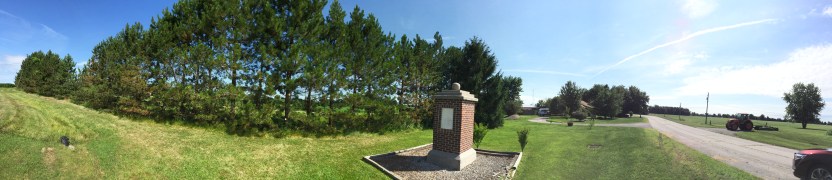
The Battle Monument. “Battle Island” is likely on a slight rise through the pines. (Author Photo)
The expedition continued through thick forest until June 4, when it finally came upon a Wyandot town on the upper Sandusky after noon. It was abandoned to the surprise of Crawford’s guides.[i] (The Wyandot shifted from “Upper Sandusky,” which became known as “old town” and was above the modern town of Upper Sandusky to a new town of “Upper Sandusky,” which became known as Half-King’s town and was below the modern town of Upper Sandusky.) At this point, several men expressed their desire to return to the Ohio, complaining they were down to five days provisions.[ii] Crawford sent a reconnaissance party of about 40 men under Major Rose to the north, where the woods opened up into a gentle plain. Dr. Knight recalled, “there are a great many extensive plains in that country; The woods in general grow very thin, and free from brush and underwood; so that light horsemen may advance a considerable distance before an army without being much exposed to the enemy.”[iii] Indeed, northwestern Ohio was a gently rolling plain flattened by glaciers over a million years ago and covered in 1782 with knee- to waist-high grass, interrupted by an occasional grove of trees. The terrain rolls with small, gentle gulleys and hills rising in quick succession. The combination limited one’s ability to see great distances. It was perfect for the mounted force Crawford led, theoretically capable of moving quickly. But, the slow pace of the advance, the difficulty of terrain, poor availability of forage in the woods, and quality of the horses had worn the mounts out.[iv]
In April, 1782 local leaders, in particular David Williamson, petitioned Irvine to lead a punitive raid to the Sandusky River aimed at the Wyandot and Hopocan’s Delaware.[i] While he could provide no material support or leadership, Irvine approved the attack and laid down several conditions: that the expedition operate under laws governing the militia, that their purpose not extend beyond protecting the border, that the force assembled be large enough to accomplish the task, that the raiders equip and sustain themselves on horseback at their own expense, and that the expedition conduct the raid on behalf the United States with an eye toward bringing honor to the United States. Perhaps he had the brutality of the Gnadenhutten raid in mind and sought to avoid a repeat.[ii]
This Sandusky raid did not reflect Irvine’s strategy of either reducing Detroit or bringing the tribes to battle; it was simply another American raid on Indian towns, which would likely be abandoned by the time the expedition arrived. Irvine informed Washington that the expedition was going forward and did not seek permission. Indeed, he may not have had the power to stop it given the restlessness of the local population on the frontier. Rather that departing in early August, this raid would leave in late May, before the summer heat dried out the countryside. Speed and surprise would be important, perhaps explaining Irvine’s requirement that every man be mounted, that the expedition dispense with artillery, and that it limit baggage and supplies to 30 days’ worth.[iii] Irvine wrote Washington, “If their number exceeds three hundred, I am of opinion they may succeed, as their march will be so rapid they will probably in a great degree effect a surprise.”[iv] But, it would be a risky enterprise. Continue reading “The Crawford Campaign, 1782: Birth of an Expedition”→
War on the American frontier was generally brutal, but few incidents inflamed American passions in the country’s early history as much as the torture and execution of Colonel William Crawford in June 1782 in Northwestern Ohio. Crawford’s death marked the emotional climax of another patriot attempt to neutralize British power at Detroit, generally exercised through Native American proxies who had their own reasons for fighting the Americans, and halt the raids against American settlers on the frontier. The Huron and Wyandot who lived about the Sandusky River, and the Shawnee to their South on the Scioto and Miami Rivers, both occasionally aided by various clans of the Delaware and Mingo tribes, were particularly troublesome in the Ohio River valley. Colonel Crawford’s campaign, which resulted in his death, was meant to punish the tribes for past raids to forestall future raids.
238 years ago today the United States military suffered one of its worst defeats. The Battle of Camden, fought on August 16, 1780 just a few miles north of Camden, SC was a total defeat for the American “Grand Army” under popular General Horatio Gates. The British under Lord Cornwallis inflicted nearly 1,900 casualties (out of 4,000) at a loss of only 300. One of the biggest losses was the death of General Baron Johann de Kalb, a popular foreign general in the American army. Though a strategic defeat for Gates, it was the retreat that would lead to Gates’ demise. As the militia broke and ran, Gates was caught up in the panic and fled the field as half of his army was still fighting.
Writing several days later from Hillsborough, NC Gates submitted his account of the battle to Congress. Already, reports of cowardice were starting to spread about Gates’ conduct during the battle. Gates decision to fight and his decision to leave the field during the battle have been debated ever since that August day in 1780. Below is a portion of Gates’ letter.
“In the deepest distress and anxiety of mind, I am obliged to acquaint your excellency with the defeat of the troops under my command. I arrived with the Maryland line, the artillery, and the North-Carolina militia, on the 13th instant at Rugeley’s, thirteen miles from Camden; and took post there, and was the next day joined by General Stevens, with seven hundred militia from Virginia…. Having communicated my plan to the general officers in the afternoon of the 15th, it was resolved to march at ten at night, to take post in a very advantageous situation, with a deep creek in front, seven miles from Camden; the heavy baggage, &c. being ordered to march immediately by the Waxhaw road. At ten the army began to march in the following order: Colonel Armand’s legion in front, supported on both flanks by Colonel Porterfield’s regiment, and the light infantry of the militia; the advanced guard of infantry, the Maryland line, with their artillery, in front of the brigades, the North-Carolina militia, the Virginia militia, the artillery, &c. and the rear guard. Having marched about five miles, the legion was charged by the enemy’s cavalry, and well supported on the flanks, as they were ordered, by Colonel Porterfield, who beat back the enemy’s horse, and was himself unfortunately wounded; but the enemy’s infantry advancing with a heavy fire, the troops in front gave way to the first Maryland brigade, and a confusion ensued, which took some time to regulate. At length the army was ranged in line of battle, in the following order: General Gist’s brigade upon the right, with his right close to a swamp, the North-Carolina militia in the center, and the Virginia militia, with the light infantry and Porterfield’s corps, on the left; the artillery divided to the brigades; and the first Maryland brigade as a corps de reserve, and to cover the can non in the road, at a proper distance in the rear. Colonel Armand’s corps were ordered to the left, to support the left flank, and oppose the enemy’s cavalry. At daylight the enemy attacked and drove in our light party in front, when I ordered the left to advance and attack the enemy; but to my astonishment, the left wing and North -Carolina militia gave way. General Caswall and myself, assisted by a number of officers, did all in our power to rally the broken troops, but to no purpose, for the enemy coming round the left flank of the Maryland division, completed the rout of the whole militia, who left the continentals to oppose the enemy’s whole force. I endeavoured, with General Caswall, to rally the militia at some distance, on an advantageous piece of ground, but the enemy’s cavalry continuing to harass their rear, they ran like a torrent, and bore all before them. Hoping yet, that a few miles in the rear they might recover from their panic, and again be brought into order, I continued my endeavour, but this likewise proved in vain. The militia having taken the woods in all directions, I concluded, with General Caswall [sic], to retire toward Charlotte.”
Last year I came across Dr. John Knight’s account of the torture and execution of Colonel William Crawford by members of the Delaware Indian tribe in 1782. It was a vicious execution, but not unheard of in the wars on the American frontier, where violence and brutality from both sides were common.
Crawford at about 40, twenty years before his execution (Wikimedia Commons)
Born in 1722, Crawford was a long-time business partner of George Washington, particularly in the acquisition of land in the Ohio River valley. A veteran of frontier conflicts, during the Revolution he had served as the Lieutenant Colonel of the 5th Virginia Regiment, commanded the 7th Virginia in the east, and then returned to the Pittsburgh area to raise the 13th Virginia. Sidelined during the war’s last years, he commanded local Pennsylvania militia and was largely retired by 1782. For years, settlers in the Ohio Valley had agitated for punitive raid against the Ohio Tribes along the Sandusky River in today’s northwestern Ohio. Their goal was to retaliate for Indian raids across the Ohio and spoil future raids. By the spring of 1782, they could not be restrained. After the militia massacred defenseless Christian Indians at Gnadenhutten in March, Brigadier General William Irvine, the Continental Commander at Pittsburgh, arranged for Colonel Crawford to lead the inevitable militia expedition, likely in hopes that Crawford could prevent a repeat. (Crawford had taken no part in the Gnadenhutten Massacre).
Love brought Dr. Samuel Prescott, a practicing physician, to the town of Lexington on the night of April 18, 1775. The young doctor was courting Ms. Lydia Mulliken, when the alarm of the British soldiers marching from Boston went out to the local militia. Lydia’s brother was one of those called to gather.
Love. That emotion also drew Dr. Prescott back toward his hometown of Concord—this time to alert friends, neighbors, and family members of the urgent news of the evening. En route, Dr. Prescott along with Paul Revere and William Dawes, alerted the countryside of the moving British troops. After being vetted and vouchsafed as a true friend of liberty, Dr. Prescott rode posthaste to his hometown, where his word carried greater weight.
A artist’s interpretation of Paul Revere’s (or maybe William Dawes or Dr. Samuel Prescott)’s ride to warn the Massachusetts countryside. (courtesy of VFW)
As British General Thomas Gage and his American Whig (or Patriot) antagonists squared off in Boston and the surrounding towns, information gathering became the key to success. Both sides had created networks of spies, but the advantage was clearly in favor of the Whigs. During the winter 1774-1775, groups such as the Sons of Liberty had established a complex spy network within Boston comprised of a system of riders that spread information and “alarms’ quickly. The Committee of Safety and the Massachusetts Provincial Congress relied on this network to stay informed of what was going on in Boston and the British intentions. Continue reading “Two Riders….Gage Gathers Information”→
“the Country was an amazing strong one; full of Hills, Woods, stone Walls, & c., which the Rebels did not fail to take advantage of, for they were all lined with People who kept an incessant fire upon us…”
From the diary of Lieutenant Frederick Mackenzie who was part of the 23rd Regiment–the Royal Welch Fusiliers that survived the ordeal of April 19, 1775. He would keep a diary until the early 1790’s and chronicled his experiences in the American Revolutionary War. His account on April 19, of the retreat from Concord is most descriptive. The British did not just take the brunt of the firing as the marched hurriedly back toward Boston and safety, but;
“as we did too upon them, but not with the same advantage, as they were so concealed there was hardly any seeing them: in this way we marched between 9 and 10 miles, their numbers increasing from all parts…”
The column was led by Lieutenant Colonel Francis Smith and had been tasked by General Thomas Gage, British military leader in North America, to root out the military supplies being stored in Concord by the colonials. The mission, albeit supposedly secretive, did not remain so for long, and the colonials got word out to the countryside. After initial firing at Lexington Green and then at the North Bridge in Concord, the British had to march back through the countryside, facing arriving militia and minute men.
“while ours was reducing by deaths, wounds, and fatigue; and we were totally surrounded with such an incessant fire as it is impossible to conceive; our ammunition was likewise near expended.”
Modern-day view along Battle Road, the route the British column retreated back toward Boston on (author collection)
Luckily, for Mackenzie and the other struggling British officers and rank-and-file, on a rise in the ground, outside the town of Menotomy, was a relief column, ready to provide a few moments’ respite.
With British soldiers pouring into the fort, Colonel Ledyard ordered a ceasefire, and prepared to surrender Fort Griswold to the victorious British. However, the British disregarded the ceasefire and continuing pouring fire into the American garrison, killing or wounding nearly all of the fort’s defenders. “I believe there was not less than five or six hundred men of the enemy on the parade in the fort,” claimed American soldier Rufus Avery. “They killed and wounded nearly every man in the fort as quick as they could.”
Maj. Stephen Bromfield, the ranking British officer after Montgomery fell, called out, “Who commands this fort?” Ledyard stepped forward and responded, “I did, sir, but you do now.” Another American, Jonathan Rathbun, watched Bromfield run Ledyard through the heart and lungs with Ledyard’s own sword:
“…the wretch who murdered him [Ledyard], exclaimed, as he came near, “Who commands this fort?” Ledyard handsomely replied, “I did, but you do now,” at the same
moment handing him his sword, which the unfeeling villain buried in his breast! Oh, the
hellish spite and madness of a man that will murder a reasonable and noble-hearted officer, in the act of submitting and surrendering!”







 Emerging Revolutionary War Era