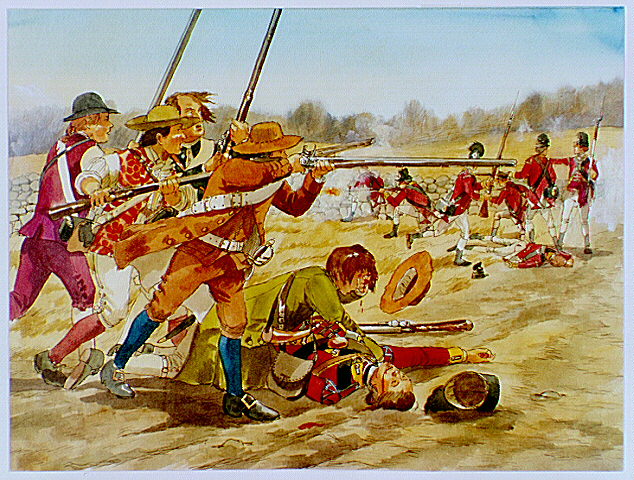
Lieutenant CFighting between soldiers from Tarleton's Legion (British) and Morgan's Army (American Continental).

Life Lessons from the Battle of Cowpens

Two hundred and forty years ago, January 17, 1781, Brigadier General Daniel Morgan strategically manuevered his Colonial forces to defeat the British, led by Lieutenant Colonel Banastre Tarleton, at the Battle of Cowpens.

What can we learn from the Battle of Cowpens? Military strategy, yes. Historical knowledge, absolutely. But as we near the 250th commemoration of the American Revolutionary War, how do we turn the battle into relevancy for today’s modern society?

As historians, we can find meaning and connection to places and events at their face value. It’s a natural ability we have ingrained in our knowledge-seeking souls. What about those that can’t and don’t? How do we make them relevant to them so that our history is not forgotten?

The answers lie in the stories we tell and how we tell them. Instead of rehashing the specific details of the Battle of Cowpens, I’m going to try something a little different: think of a time when you were able to not only prove that someone’s opinion of you was wrong, you used it to your advantage to achieve a goal. Go ahead, I’ll wait.

Now recall that a key element of Morgan’s strategy was his use of the British underestimation of the Colonial militia forces. Before the Battle of Cowpens, Tarleton, like many British commanders, believed that the militia were mostly untrained or inexperienced civilians that would flee in face of a real battlefield. To be fair, this was witnessed at several battles (Battle of Camden on August 16, 1780 immediately comes to mind) so it’s a fair assessment.

Using this knowledge to his advantage, Morgan set a trap. Putting his militia front and center of his second battle line, he ordered them to fire off two volleys at the oncoming British before falling back. The perspective fueled the British assumption that the militia were fleeing the battlefield, and Tarleton drove his men forward… and right into Morgan’s trap.

Fighting between soldiers from Tarleton’s Legion (British) and Morgan’s Army (American Continental)
by Don Troiani. NPS Commissed Artwork.

Perhaps if Tarleton had not underestimated the militia, he would not have found himself in the only successful double envelopment in the American Revolution. But more to the point, Morgan took strategic advantage of the British perception of the militia’s capabilities.

While this battle’s lessons learned are easily applied to modern military education, how can we apply them to our everyday civilian life, particularly the lesson that comes from Tarlton’s mistake and Morgan’s strategy relating to the militia? The motto “never assume” comes to mind first. At the very least, it compels the message “Don’t let what other people may or may not think of you prevent you from achieving what matters most to you.” I personally like the potential of “If someone doesn’t see value in your abilities, prove them wrong.”

What life lesson do you pull from the battle’s story?

ERW Annual Fall Trip Takes on Yorktown, Great Bridge and Williamsburg

Every year the historians of Emerging Revolutionary War take a fall trip to research, visit Revolutionary War sites/battlefields and to promote our museum partners and preservation. The trip usually is a follow up to our Annual Symposium, but with the COVID-19 pandemic, that has been moved to May 22nd (you can get more information on speakers, topics and registration on our Symposium link from our main page).

The ERW Crew recreates the surrender scene at Saratoga last fall.

After much discussion, we have decided to keep our annual fall trip tradition, but a more scaled back version. Don’t worry there will still be revelry and Facebook lives! Our original plan was to head to North and South Carolina, as a follow up to our visit there in 2018. In lieu of COVID-19, we have decided to keep it more “local” by focusing on sites in and around Yorktown, VA (many of our contributors are based in Virginia and Maryland). We will visit sites such as Gloucester, Yorktown, Spencer’s Ordinary, Green Spring, Great Bridge and Williamsburg.

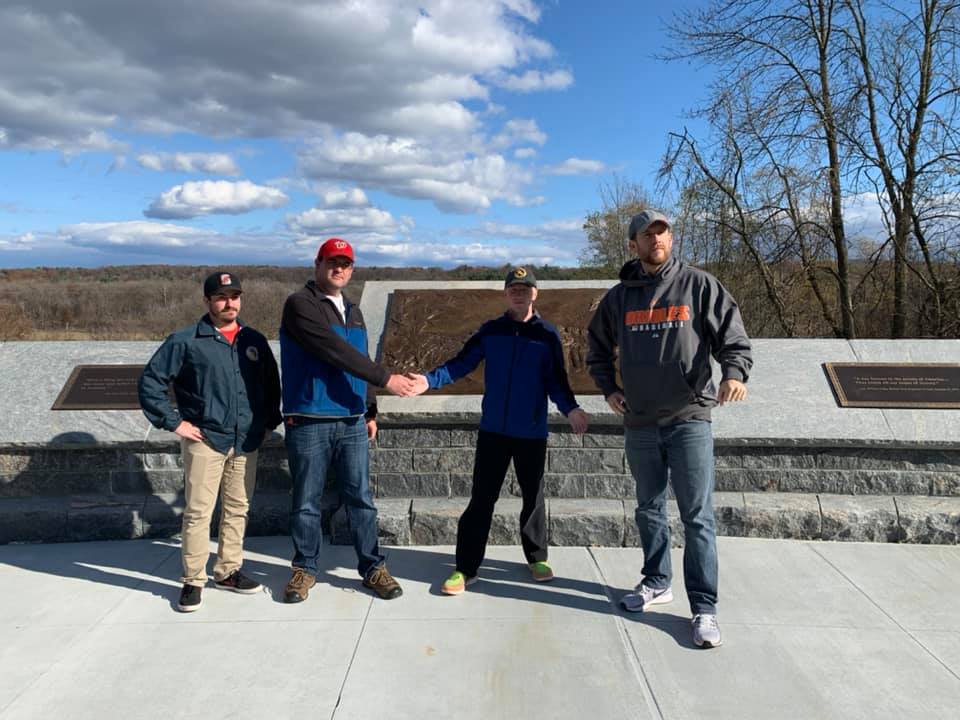
Memorial at Green Spring Battlefield

We will be posting FB Live videos the entire trip, bringing you some behind the scenes opportunities with our museum partners, some exclusive talks with historians and we will wrap up the trip with a special Sunday Night Rev War Revelry. Stay tuned to our blog and social media pages starting on November 6th and continuing on to our Sunday Night Rev War Revelry on November 8th.

Our goal is not just to share with you great information and encourage support for historic sites/museums but also to share with you the fun and passion we have for interpreting the events around the American Revolution. As a public history focused effort, we feel making history fun and accessible leads to a great appreciation for our shared history. We hope you join us virtually on our trip this November.

African American Experiences in the Siege of Ninety-Six

There are important stories often hidden in the threads of our American history. It won’t be a surprise to many that these stories desperately need to come to light. But sometimes research is scarce, with limited or hard-to-find resources to fully tell these stories to their fullest. One such example are the stories of the enslaved and free African-American people who helped build the nation, starting back even before the colonies fought for independence. America’s fight for freedom from Britain is oxymoronic considering an entire population of blacks were still kept in chains after the war. But their contributions to that fight should not go unnoticed.

The history of the construction of the British defense fortifications, including the Star Fort, at Ninety Six, South Carolina, has many layers of these diverse stories that make up the fabric of the site’s history. Lt. Colonel Nisbet Balfour set up an outpost at Ninety Six after the fall of Charleston in early 1780. In terms of fortifications – specifically the stockades and protections around the town and the jail – during this initial occupation, Balfour wrote to Cornwallis on June 24, 1780, “As to this post, it is so situated, that three small redoubts, well Abbattis [sic], I think, can easily defend it…”

Balfour also encouraged using slave labor, stating that “we have carpenters enough, and ammunition.” Balfour’s plan to construct fortifications was similar to a more extensive defense system suggested by Patrick Ferguson in his “Plan for Securing the Province of So. Carolina, &c.” dated May 16, 1780. Ferguson also recommended using slaves to construct the fortifications.

In fact, in that same June 24 letter to Cornwallis, Balfour writes that most of the labor that was used to construct the Ninety Six fortifications was from roughly 200 enslaved blacks that the British took from area plantations. Who were these 200 men? Were they promised freedom in exchange for their labor? We may never know. While research is underway to uncover the stories of these 200 individuals, very little primary resources remain. But we can still acknowledge that the British defense of Ninety Six relied heavily on the forced labor of these black men.

Work continued into the fall and winter of 1780 on the defense structures at Ninety Six, this time under Lt. Colonel John Harris Curger, including several field fortifications called abatis: defensive obstacles formed by felled trees with sharpened branches facing the enemy. The trunks are put deep into the ground, usually 4-5 feet, and is typically hard manual labor in the hard red clay of South Carolina. In a letter on December 29, 1780, Lt. Colonel Isaac Allen wrote to Cornwallis’s aide, Lt. Henry Haldane, of the hard work of the men constructing the abatis. And yes, those men were enslaved men. “I… have orderd [sic] the Abattiss [sic] cut, but Kings work like Church work goes on slow. The Poor naked Blacks can do but little this cold weather.”

The Star Fort at Ninety Six, South Carolina. Photo: NPS/Ninety Six NHS

Next up in the defense plan was the Star Fort itself, a large earthen redoubt whose remains are still the best-preserved earthen fort from the American Revolution. Once again, those approximately 200 enslaved men were used in its construction. Upon the completion of the fort, additional work included a network of ditches and trenches both for communication and transport of supplies.

By spring of 1781, the defenses were ready. Lt Colonel Cruger’s military force was nearly 600 but this was supplemented by a large number of Loyalist civilians in the town as well as several hundred enslaved African Americans from the surrounding country. Most likely, though it’s not known for sure, these were the roughly 200 men who helped build those very physical defenses.

But the hidden story of the enslaved at Ninety Six does not stop there, nor is their story solely on the shoulders of the British. During the Siege of Ninety Six in May and June of 1781, there are several instances that beg for more research. The first is from the morning of May 23, when Patriot forces had been digging trenches towards the Star Fort throughout the night. An attack by Loyalist militia from the fort pushed the Patriots back and they managed to capture not only the tools the Patriots were using, but “several Negro laborers abandoned by the Americans.” (Greene, 128)

It should come as no surprise that the Patriots were also using slave labor. James Mayson, a wealthy Patriot supporter living just a few miles from Ninety Six, described later how foraging parties were dispatched to the countryside to get food and supplies for Greene’s army, which included slaves “not earlier recruited by the British.”

As the Siege dragged on into June, there is one more hidden story that deserves additional research to discover the identities of the enslaved men who risked their lives for the British military garrisoned at the Star Fort. As the heat of the early Carolina summer sapped water supplies, Lt Colonel Cruger needed to get water from a nearby stream, Spring Branch, to keep their supply up. But Patriot marksmen were at the ready to prevent this from happening. Turning to the enslaved in their midst, a handful of them were ordered to strip out of their clothing and go at night to the stream to file buckets. They apparently succeeded. A British lieutenant by the name of Hatton would later recall that their naked bodies were indistinguishable “in the night from the fallen trees, with which the place abounded.”

These are just snippets of hidden stories at just one site of the American Revolution. And that’s only during one specific time in Ninety Six’s history; additional stories exist for both before and after the war, during the French and Indian War, and during the Regulator movement, as well as stories of enslaved Natives from the time of early settlement in the region.

How many stories are yet untold? Who were these men and women who currently remain nameless? For these stories aren’t just tidbits of historical facts – they represent real people who experienced real emotions and a real existence at the time when our nation was first figuring out what it wanted to be. The stories of black Loyalists and Patriots deserve to be told and in doing so, will add a new layer of complexity and understanding to the story of America during the Revolutionary War and beyond.

Bibliography

Government Documents
Greene, Jerome A. Historic Resource Study and Historic Structure Report, Ninety Six: A Historical Narrative. National Park Service: Denver Service Branch of Historic Preservation, 1978.

Manuscripts & Papers
Ann Arbor. University of Michigan. William L. Clements Library. Patrick Ferguson, “Plan for Securing the Province of So, Carolina, &c,” May 16, 1780.

Ann Arbor. University of Michigan. William L. Clements Library. Nathanael Greene Papers. James Mayson to Greene, May 29, 1781.

Washington. Manuscript Division of the Library of Congress. British Public Record Office. Cornwallis Papers. Balfour to Comwallis, June 24, 1780. BPRO 30/11/2 (1)

Washington. Manuscript Division of the Library of Congress. British Public Record Office. Amherst Papers. Thomas Anderson. “Journal of Thomas Anderson’s” 1st Delaware regiment [May 6, 1780-April 7, 1782].”

Books and Pamphlets
Haiman, Miecislaus. Kosciuszko in the American Revolution. New York: Polish Institute of Arts and Sciences in America, 1943. Reprint; Boston: Gregg Press, 1972.

Mackenzie, Roderick. Strictures on Lt. Col. Tarleton’s “History of the Campaigns of 1780 and 1781, in the Southern Provinces of North America.” London: Printed for the Author, 1787.

Stedman, Charles. The History of the Origin, Progress, and Termination of the American War, Volume 2. London: Printed for the Author, 1794.

Ward, Christopher. The War of the Revolution, Volume 2. New York: The Macmillan Company, 1952.

Weigley, Russell F. The Partisan War: The South Carolina Campaign of 1780-1782. Columbia: University of South Carolina Press, 1970.

“Rev War Roundtable with ERW” War of 1812

The War of 1812 is considered by some historians as the end of the American Revolutionary Era. From the conflict, the United States will find a war hero and future president, Andrew Jackson and a poem by lawyer Francis Scott Key that turns into our national anthem.

But, the origins of the war, the military actions that spread around the United States, from Louisiana to the nation’s capital, to the invasion of Canada, and on the high seas are largely overlooked. There are numerous reasons for this.

That, in part, is why, this Sunday, at 7pm EST, on ERW’s Facebook page, the next historian happy hour “Rev War Revelry” will be focused on this important conflict. Join ERW historian Phillip S. Greenwalt along with the following guest historians for an hour-ish discussion of the three-year war.

Joining Phill will be;

Dan Davis, of the American Battlefield Trust, who has lectured on Andrew Jackson and the Battle of New Orleans. He is also a full-time historian with Emerging Civil War.

Also, formerly of Fort McHenry National Monument and Historic Shrine, and now working for the National Park Service in the Washington D.C. area, guest historian Jim Bailey will be the second of three guest historians.

Leaving the best for last, okay pun intended, as all three guest historians are great. But in all seriousness, the third guest historian joining for this revelry will be George Best. He is a park ranger for the National Park Service at Harper’s Ferry National Historical Park and volunteers as the Communications Coordinator for the Friends of Maryland’s War of 1812.

We look forward to you joining with your thoughts, comments, and questions this Sunday on our Facebook page (there will be an event post for you to use as a reminder) as we discuss this three-year conflict that had reverberations for many years afterwards.

A Tree as Old as the Country

Muir Woods Bicentennial Tree

The coastal redwoods of Muir Woods form as close to a natural cathedral as I’ve ever visited. Tucked in a hidden valley in the Golden Gate Recreation Area, just north of San Francisco, the national park allows visitors to escape from the metropolitan hustle and bustle and step into a primordial landscape.

Some of the trees in the forest are estimated to be more than a thousand years old. One, not near so old, still lays claim to special historical significance: the Bicentennial Tree.

Continue reading “A Tree as Old as the Country”

ERW Weekender: Ninety Six, The Site That Has It All

Emerging Revolutionary War welcomes historian Vanessa Smiley to the blog.

The thing about Ninety Six National Historic Site is that it’s unassuming exterior hides a wealth of history. It’s also nowhere near a major highway, meaning you have to want to get there if you’re thinking of visiting. And when you do get there, you will realize that there’s more history per acre than its demur entrance lets on. Located in the back country of South Carolina, Ninety Six has a history that speaks to the stories of Native Americans, the American frontier of the 18th century, and the American Revolution.

Entrance to the park
(courtesy of Ninety Six NHS, NPS)

The site at Ninety Six holds a treasure trove of study on these subjects. Native American, mostly Cherokee, activity was heavy in the area long before European settlers arrived. One of the earliest backcountry trading posts, established by Robert Gouedy in 1759, made Ninety Six a hotbed of trading activity thanks to its location at the crossroads of twelve different roads and paths, linking the area to nearly all parts of the colonies.

Continue reading “ERW Weekender: Ninety Six, The Site That Has It All”

ERW Weekender: Boston Massacre: 250 Years and 1-Day Later

Crispus Attucks. Every American school child learned that name in a social studies or history class in grade school. On the night of March 5, 1770, Attucks, an African-American was one of the six Bostonians that was killed by British soldiers.

Known in American history as the “Boston Massacre” the tragic event was used as fodder by the Sons of Liberty and pro-revolutionary minded individuals to propel the colonies toward rupture with Great Britain.

Continue reading “ERW Weekender: Boston Massacre: 250 Years and 1-Day Later”

ERW in the Hudson Valley: 4th Annual ERW Trip

73515593_10157426708611343_3821591423862439936_n
Billy Griffith, Kevin Pawlak, Rob Orrison and Mark Maloy at George Washington’s HQ in Newburgh, NY

Just over two weeks ago, ERW historians Billy Griffith, Phillip Greenwalt, Mark Maloy, Rob Orrison and Kevin Pawlak took a long weekend trip up to upstate New York. This was the fourth year that ERW authors have gotten together to take a “field trip” to see sites related to the French and Indian War and the American Revolution.

The trips not only serve as chances for research, but also to make new connections with public historians working in the American Revolution era. Along the way, we posted several videos from locations to give our followers an idea of some of the great places to visit out there. Again, our goal is to not just share this history, but to get people to visit these great sites.

Sites visited on the first day included the Stony Point Battlefield, where Americans under Gen. Anthony Wayne over ran a surprised British outpost. Reading about this action almost rings empty until you stand on the ground. Looking at the steep terrain that Wayne’s men climbed after traversing through a wetland, it is hard to imagine how the Continentals were able to take the British fort with so few casualties. Later that day we made a quick stop at George Washington’s headquarters in Newburgh. Here Washington lived from April 1782 to August 1783 and where he learned of the cease fire with the British, wrote his now famous circular letter to the colonial governors on his vision for the new government. Most importantly, here Washington responded to the Newburgh Conspiracy of his officers looking to possibly over throw the civil government. This site is also important in the history of the museum field as it is the first publicly owned historic site in the United States, opened in 1850 as a museum. A worthwhile nearby site, the New Windsor Cantonment site, preserves the camp site of the Continental Army during the 1782-1783 time period. Several of the buildings are rebuilt, including the Temple of Virtue, where Washington made his impassioned speech to his officers (with the assistance of his glasses) to diffuse their discontent with Congress.

The morning of the second day of the trip was spent visiting sites around Lake George, NY, including some much over looked French and Indian War sites. That afternoon sites along the upper Hudson including the site of the murder of Jane McCrea, Fort Edward and sites in Albany.

73515782_10157426695236343_5408864994043363328_n
Park Interpreter Bob Hoar explains the terrain of the battlefield

Early Sunday morning, a quick trip to the Bennington Battlefield State Park was highlighted with a great personal tour by Bob Hoar. The battlefield is well preserved and interpreted. Bob also shared some of his research into reinterpreting the battlefield using first person accounts and the landscape. Again, understanding the landscape of these places creates such a better understanding.

The majority of the day on Sunday was spent at Saratoga National Historical Park, posting several Facebook Live videos from various points across the battlefield. Also a special visit to the surrender site in Schuylerville which was recently preserved and opened as a memorial by the Friends of Saratoga Battlefield. A great preservation victory that adds to the overall story of Saratoga.

One of the highlights of the trip took place on Monday, where we received a behind the

77017756_10157426686486343_6006429566371889152_n
Curator Matthew Keagle gave a behind the scenes tour of Fort Ticonderoga’s amazing collection storage.

scenes tour by Fort Ticonderoga staff. We started by learning about the military interpretive program by Ron Vido, Military Programs Supervisor. Anyone who has visited Fort Ticonderoga knows about their quality interpretive staff and programs. Ron also shared with us their plans to slowly restore the Carillon Battlefield (1758), which will be a great addition to the understanding of North America’s bloodiest battle before the Civil War. That afternoon we were treated to a behind the scenes tour of Fort Ticonderoga’s collections storage by Curator Matthew Keagle. The Fort has been collecting 18th century items for nearly 100 years. Their collection is one of the largest collection of 18th century military artifacts in the United States. From a Continental knapsack to an original copy of Baron von Steuben’s drill manual, the collection on display is only a small portion of what the museum owns. Matt also shared the museum’s ongoing work to digitize their collection for the purpose of research. The day was capped off by a visit to one of the best preserved battlefields in the United States, Hubbardton. Fought as part of the Saratoga Campaign, this is Vermont’s only battlefield. The landscape at the foot of the Green Mountains is amazing and the viewsheds are near pristine. A nice state park and visitor center are there to help explain the events of July 7, 1777.

Thank you to all the people that assisted us in this trip and all the sites that were nice enough to host us. We will be posting more on the blog in the future focusing on some of the stories around these amazing sites. Again, we encourage you to take the time to visit all these places. History books are great, but there is no substitute for being in the footsteps of history

To check out the Facebook Live videos and photos from the trip, please visit our Facebook page at https://www.facebook.com/emergingrevwar/ .

74670649_10101885389915367_7190293784905646080_n.jpg
Bill Griffith, Kevin Pawlak, Phill Greenwalt, Mark Maloy and Rob Orrison at Saratoga, over looking the Hudson River.


August in Lexington, Massachusetts

From our friends at the Lexington Historical Society, a few events to mark on your calendar if going to be in that area of the country. Click here for more information about the events below.

On Thursday, August 8th at 7:00 p.m. at the Lexington Depot
I Am An Honest Woman: Female Revolutionary Resistance 

Most women had limited opportunities for political action during the American Revolution. While some of the lower classes could take to the streets, “genteel” women had to find more subtle ways to support the Patriot cause, while maintaining the illusion of domestic contentment. Dr. Emily Murphy, National Park Service curator and living historian, will discuss the “Daughters of Liberty” and their political accomplishments. These women were able to take an active role in the Revolution by politicizing traditional female activities, like spinning flax into linen to create homespun fabric in protest of British imports. A group of 50 protesting Bostonian men would incite a riot, but who would cross a crowd of dutiful housewives showing off their domestic skills?

Saturday, August 31, 12:00 – 4:00 p.m., across from Battle Green on Harrington Road
Lexington’s Spinning Protest

On the exact 250th anniversary of the 1769 spinning protest in Lexington, come to a reenactment of that important event! There will be spinners in period dress, interpreters sharing information about the craft of spinning, the political climate of the time and the British goods boycott that sparked the 1769 spinning bee. Plus, a preview of our 2020 Buckman Tavern exhibit on women and political protest. Free and open to the public.

ERW Weekender: A Visit to Fort Stanwix

Fort Stanwix in Rome, New York, has plenty of history to offer, but it’s equally a success story of urban renewal. The fort’s original location was long swallowed up by the city’s expansion in the twentieth century, but it was then reclaimed in advance of the American Bicentennial. City blocks were razed, the fort reconstructed, and American history became a central tourist attraction in the heart of downtown Rome. It’s a “faithful reproduction,” the Park Service says, constructed using “many original plans and documents.”

The site of Fort Stanwix in 1969 and after its reclamation in 1976. (courtesy NPS)

Continue reading “ERW Weekender: A Visit to Fort Stanwix”