Emerging Revolutionary War welcomes guest historian Kevin Pawlak. A short bio follows the post below.
On May 25, 1775, the 62nd Regiment of Foot stood for review. The line of men, clad in their redcoats with buff facings, did not impress the reviewing officer. He called the regiment “very much drafted” and “very indifferent.” Despite the disparaging grade, in just over two years, the 62nd Foot commendably fought in one of the fiercest actions of the War for Independence.
John Anstruther courtesy of 62ndregiment.org
Scottish military man Lt. Col. John Anstruther led the 62nd Foot in the campaign of 1777. Anstruther faced no easy task; the 62nd was the junior British regiment in John Burgoyne’s army and most of its men were inexperienced in campaigning and battle. To make the situation even worse, roughly one-quarter of the 62nd Foot’s soldiers were German. Language barriers likely prevented complete cohesion within the unit. However, with a war on, nothing could be done to rectify the regiment’s defects as it marched south into New York.
Anstruther’s regiment was present for the operations around Fort Ticonderoga in early July 1777. After American forces abandoned the fort, the conglomerate and inexperienced 62nd remained behind to man Mount Independence overlooking Lake Champlain. As the rest of Burgoyne’s army continued campaigning, the men of the 62nd Foot spent time guarding themselves against rattlesnakes rather than the enemy. Their time came to rejoin the main army before the Battle of Saratoga commenced.
On the night of September 20, 1777, while encamped in Chester County, PA just outside Philadelphia, a division of American soldiers was defeated in a swift surprise attack by a slightly smaller British force. American propagandists, in an effort to galvanize Patriot support, would make the most of this encounter to show the British Army as overly brutal and bloodthirsty. On the foggy morning of December 9, 2019, members of the ERW paid a call on this battle site; Paoli Battlefield Historical Park.
Billy Griffith, Kevin Pawlak, Rob Orrison and Mark Maloy at George Washington’s HQ in Newburgh, NY
Just over two weeks ago, ERW historians Billy Griffith, Phillip Greenwalt, Mark Maloy, Rob Orrison and Kevin Pawlak took a long weekend trip up to upstate New York. This was the fourth year that ERW authors have gotten together to take a “field trip” to see sites related to the French and Indian War and the American Revolution.
The trips not only serve as chances for research, but also to make new connections with public historians working in the American Revolution era. Along the way, we posted several videos from locations to give our followers an idea of some of the great places to visit out there. Again, our goal is to not just share this history, but to get people to visit these great sites.
Sites visited on the first day included the Stony Point Battlefield, where Americans under Gen. Anthony Wayne over ran a surprised British outpost. Reading about this action almost rings empty until you stand on the ground. Looking at the steep terrain that Wayne’s men climbed after traversing through a wetland, it is hard to imagine how the Continentals were able to take the British fort with so few casualties. Later that day we made a quick stop at George Washington’s headquarters in Newburgh. Here Washington lived from April 1782 to August 1783 and where he learned of the cease fire with the British, wrote his now famous circular letter to the colonial governors on his vision for the new government. Most importantly, here Washington responded to the Newburgh Conspiracy of his officers looking to possibly over throw the civil government. This site is also important in the history of the museum field as it is the first publicly owned historic site in the United States, opened in 1850 as a museum. A worthwhile nearby site, the New Windsor Cantonment site, preserves the camp site of the Continental Army during the 1782-1783 time period. Several of the buildings are rebuilt, including the Temple of Virtue, where Washington made his impassioned speech to his officers (with the assistance of his glasses) to diffuse their discontent with Congress.
The morning of the second day of the trip was spent visiting sites around Lake George, NY, including some much over looked French and Indian War sites. That afternoon sites along the upper Hudson including the site of the murder of Jane McCrea, Fort Edward and sites in Albany.
Park Interpreter Bob Hoar explains the terrain of the battlefield
Early Sunday morning, a quick trip to the Bennington Battlefield State Park was highlighted with a great personal tour by Bob Hoar. The battlefield is well preserved and interpreted. Bob also shared some of his research into reinterpreting the battlefield using first person accounts and the landscape. Again, understanding the landscape of these places creates such a better understanding.
The majority of the day on Sunday was spent at Saratoga National Historical Park, posting several Facebook Live videos from various points across the battlefield. Also a special visit to the surrender site in Schuylerville which was recently preserved and opened as a memorial by the Friends of Saratoga Battlefield. A great preservation victory that adds to the overall story of Saratoga.
One of the highlights of the trip took place on Monday, where we received a behind the
Curator Matthew Keagle gave a behind the scenes tour of Fort Ticonderoga’s amazing collection storage.
scenes tour by Fort Ticonderoga staff. We started by learning about the military interpretive program by Ron Vido, Military Programs Supervisor. Anyone who has visited Fort Ticonderoga knows about their quality interpretive staff and programs. Ron also shared with us their plans to slowly restore the Carillon Battlefield (1758), which will be a great addition to the understanding of North America’s bloodiest battle before the Civil War. That afternoon we were treated to a behind the scenes tour of Fort Ticonderoga’s collections storage by Curator Matthew Keagle. The Fort has been collecting 18th century items for nearly 100 years. Their collection is one of the largest collection of 18th century military artifacts in the United States. From a Continental knapsack to an original copy of Baron von Steuben’s drill manual, the collection on display is only a small portion of what the museum owns. Matt also shared the museum’s ongoing work to digitize their collection for the purpose of research. The day was capped off by a visit to one of the best preserved battlefields in the United States, Hubbardton. Fought as part of the Saratoga Campaign, this is Vermont’s only battlefield. The landscape at the foot of the Green Mountains is amazing and the viewsheds are near pristine. A nice state park and visitor center are there to help explain the events of July 7, 1777.
Thank you to all the people that assisted us in this trip and all the sites that were nice enough to host us. We will be posting more on the blog in the future focusing on some of the stories around these amazing sites. Again, we encourage you to take the time to visit all these places. History books are great, but there is no substitute for being in the footsteps of history
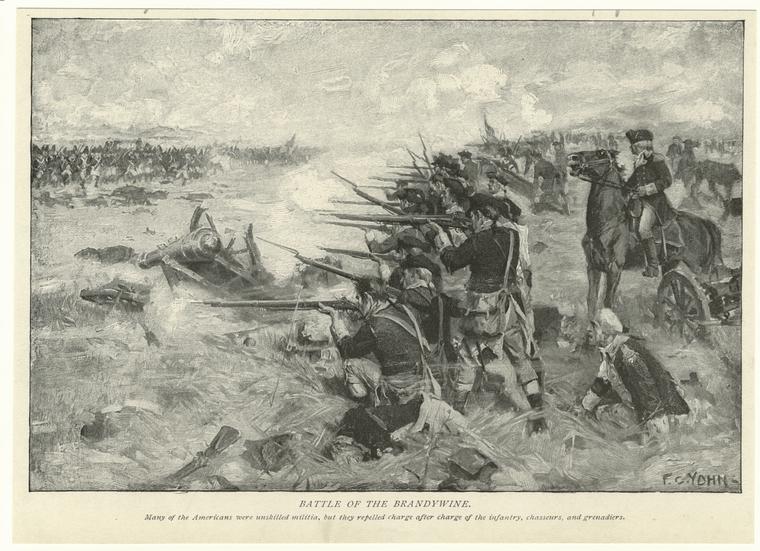
Before the horrific terrorist attacks that struck the United States on September 11, 2001, this date in American history saw the longest single day engagement with the highest number of combatants during the entire American Revolution fought in southeastern Pennsylvania.
Known to history as the Battle of Brandywine, approximately 30,000 soldiers were involved and 1,887 became casualties, the majority, 1,300 being Americans. One of those 1,300 individuals was Reverend or Chaplain Joab Trout, from New Hampshire.
Battle of Brandywine (courtesy of NYPL)
The night before the engagement, he gave the following sermon beat the evening call on the eve of battle. And 242 years later the words still echo with a sense of patriotism and stoicism for a cause that was worth fighting and dying for. Below is the full sermon:
Emerging Revolutionary War welcomes guest historian Kieran O’Keefe.
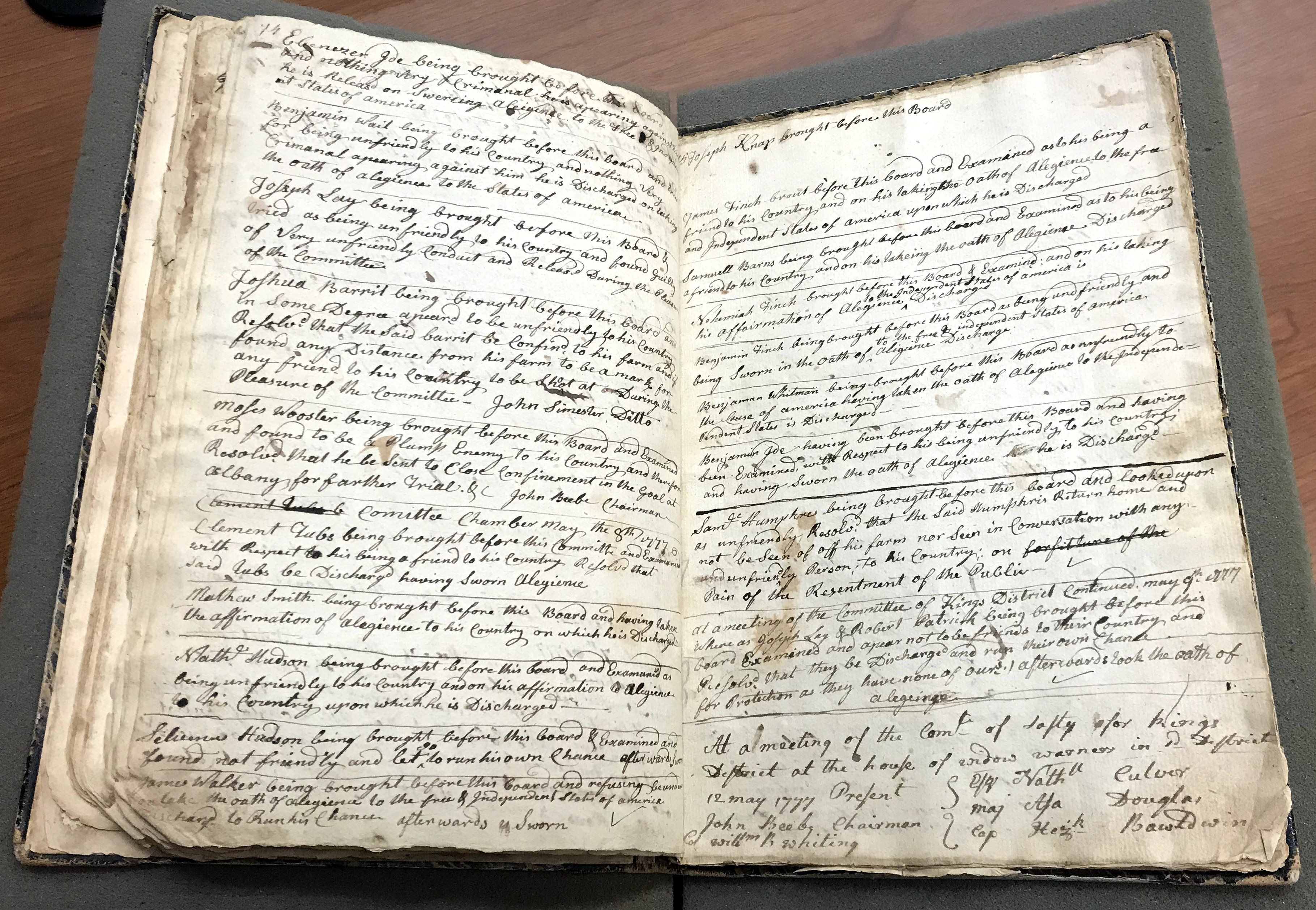
While the most famous scenes of the American Revolutionary War involve major battles or deliberations in Congress, the driving force behind the Revolution within small towns were committees of safety. As the war progressed and British authority dissipated, these committees became the effective government in most localities until the formal establishment of state governments. They had responsibilities such as regulating the economy, suppressing loyalists, procuring military supplies, raising revolutionary forces, and overseeing civil and criminal justice. Despite their ubiquity, it is rare to find the records of a committee completely intact. One such exception is the King’s District Committee of Albany County, New York, whose minutes survive in the Library of Congress.
The First Continental Congress created the committee system when it adopted the Continental Association in 1774. The Association called for the non-importation, non-consumption, and non-exportation of goods between the colonies and Great Britain, Ireland, and the British West Indies. This boycott was to put economic pressure on Britain to repeal the punitive Coercive Acts, which punished Massachusetts for the Boston Tea Party by closing the port of Boston and bringing the colony under tighter royal control with the aid of British redcoats. The Continental Association also stated that “a committee be chosen in every county, city, and town, by those who are qualified to vote for representatives in the legislature, whose business it shall be attentively to observe the conduct of all persons touching this association.” These committees were to ensure that all Americans adhered to the boycott stipulated in the Association. Committees began forming throughout the colonies in late 1774 and soon took on a greater role than originally designed, frequently seizing the reins of local government. The committees were unusually democratic. They generally consisted of about five men who were popularly elected, and many members were from the middling ranks of society with no prior political experience.
The King’s District Committee record book (author collection)
Mark your calendars for September 28, 2019! Emerging Revolutionary War is excited to announce that we are partnering with Gadsby’s Tavern Museum and The Lyceum of Alexandria, VA to bring to you a day long Symposium focusing on the American Revolution.
Gadsby’s Tavern Museum
Alexandria is George Washington’s hometown and we feel is a great place for us to start this new endeavor. Historic “Old Town” Alexandria is home to dozens of museums and historic sites as well as great pubs, restaurants and shops. Gadsby’s Tavern Museum is the premier 18th century tavern museum in the country and is host to the famous annual George Washington Birthnight Ball. The Lyceum: Alexandria’s History Museum will be our host location. Today The Lyceum serves as the City’s history museum and is a center of learning through lectures, demonstrations and exhibits.
This year’s theme is “Before They Were Americans” and will highlight several topics
The Lyceum
about the years leading up to the American Revolution. Our speakers include: Phillip Greenwalt, Katherine Gruber, William Griffith, Stephanie Seal Walters and Dr. Peter Henriques as the keynote. Registration will open on July 1, 2019 through AlexandriaVA.gov/Shop or by calling 703-746-4242. Stay tuned as we highlight each of our speakers and their topics.
Emerging Revolutionary War welcomes historian Dan Welch
As we commemorate the 244th anniversary of the engagements at Lexington and Concord, it is an opportunity to reflect upon this moment’s importance in American history. The results of what happened in April 1775 were truly “heard around the world.” The importance of those events are commemorated and remembered in various forms across the fabric our country. This holds true, even in Youngstown, Ohio.
The Road to Remembrance Memorial on the southside of Youngstown, Ohio. (Image courtesy of the author)
As the country grappled with the effects of the Great Depression, numerous civic organizations in the state of Ohio sought to construct a “Road of Remembrance” in honor of the servicemen from the country’s previous conflict. On June 17, 1930, the state legislature designated a portion of Route 193 from Lake Erie to 422 in Youngstown as a memorial roadway in honor of those soldiers who gave their last full measure of devotion during the Great War. Many towns planted memorial trees along the route, some erected monuments, while other organizations held ceremonies marking the occasion. This special route was to be just a small portion of remembrance that was to span from Montreal, Canada to the Gulf of Mexico. Continue reading “The Shot Heard in Youngstown?”→
The British and loyalists would not have to wait long. Word of the landing reached the Massachusetts government within a matter of days, and preparations for a counterattack began almost immediately. There was such a hurry to respond that the General Assembly voted to carry out the operation with state forces rather than wait for Continental assistance.[1] Despite the initial rush it still took a month to assemble a force of over 1,000 militiamen, as well as the food, arms, and other supplies to sustain them. All of these troops and their supplies would be transported by a fleet of 21 transports, accompanied by nearly twenty state and Continental navy vessels and privateers. Among the warships the largest was the Frigate Warren of 32 guns which served as the flagship of Commodore Dudley Saltonstall. The Connecticut born officer was given overall command of the naval forces – no small task given the lack of experience with large scale fleet actions among his subordinates. Command of the land forces was given to Massachusetts Brigadier Solomon Lovell. Lovell has seen experience early in the war outside of Boston, but was also relatively untested in battle. The inexperience and poor communication between Saltonstall and Lovell was to have a decisive impact on the coming expedition. Notable among the other officers in the expedition was Paul Revere, who commanded the Massachusetts artillery. The expedition was also joined by a band of the local Penobscot Indians allied to the Continental Congress.
The New England fleet entered the Penobscot Bay on July 25th and immediately attempted a landing. Clearly outnumbered and with their works incomplete, General McLean and his men were determined to resist the Americans, but expected the worst. Saltonstall’s fleet sailed in close to the shore and exchanged cannon fire with both the British defences and the three remaining Royal warships, now under the command of Captain Henry Mowatt. In the confusion and smoke the Americans lowered seven launches full of marines and militiamen, but as they neared the shore they were met by a hail of musket fire[2]. At least one of the attackers – a Native American – was killed and the boats returned to the safety of the fleet. It was an inauspicious start to the battle for the New Englanders and already the relationship between the two commanding officers was becoming strained. General Lovell knew little about sailing or naval operations. He questioned the Commodore as to why he couldn’t just sail his fleet into the harbor and blast the British to pieces while his troops landed under their covering fire. The Connecticut seaman replied curtly, exclaiming “You seem to be damn knowing about the whole matter! I am not going to risk my shipping in that damned hole!”[3]
On the 26th a second militia landing on the peninsula was repulsed after the lead boat carrying militia Major Daniel Littlefield was swamped by British chain shot, drowning the Major and two privates.That same day, however, the Americans scored a small victory when a force of 200 Continental marines and artillerymen landed on Nautilus Island and captured the small British battery there[4]. More artillerymen were landed and soon the Americans had a battery from which they could harass the British shipping. With the Americans making some headway Captain Mowatt withdrew the remaining British ships deeper into the harbor, creating a defensive line across the Bagaduce River.
Castine Harbor, looking out roughly where Captain Mowatt anchored the British transports and warships (Author’s photo)
Emerging Revolutionary War welcomes back guest historian Travis Shaw.
Part One
I’d be willing to bet that Maine isn’t the first place to come to mind when you hear the word “frontier”. For many Americans I imagine they immediately think of the wild west. Wagon trains of pioneers crossing the prairies, and Native nations like the Sioux and Apache ranging the plains on horseback. A century before the age of Manifest Destiny, however, the region that is now the state of Maine marked the eastern frontier of the English colonies. It was a wild and sparsely settled place, caught between New England and the French colonies to the north. The few European settlers eked out a living from the thin, rocky soil or turned to lumbering and to the sea. They lived alongside and often fought against the region’s original inhabitants – the Wabanaki or “People of the Dawn.” For two centuries the Eastern Frontier was torn apart by war between various European powers and their respective Native allies. Nowhere is this more clearly evident today than in the small coastal town of Castine, Maine.
Castine is located near the mouth of the Penobscot River, more or less in the middle of the Maine coast (Google Maps)
On this date in 1777, British General John Burgoyne surrendered to American General Horatio Gates around Saratoga, New York. This victory solidified French support for the fledgling American nation and became one of the turning points in the road to independence.
General John Burgoyne
Out of this momentous occasion came an anecdote about the British general officer. The short story has some truth in it, yet, whether the entire tale is accurate, well, I’ll leave that for you to decide!
Two years prior to the Battles of Saratoga and upon arriving in Boston, Massachusetts, General Burgoyne remarked “Well, let us get in, and we’ll soon find elbow-room” when he was told the numbers of militia besieging British regulars around the town.
After his capitulation, Burgoyne and his forces were marched toward Albany, New York, and multitudes of people turned out to see the vanquished British and German soldiery along the route. One resident supposedly yelled from her homestead doorway;
“Make elbow room for General Burgoyne.”
Not what he had envisioned in 1775 upon disembarking in North America. Yet, history does not relate what “Gentleman Johnny” Burgoyne thought exactly about the elbow room he received in the countryside of upstate New York!*
This slideshow requires JavaScript.
*“Gentleman Johnny” was a nickname acquired by Burgoyne was stationed in London with the Horse Guards, a fashionable cavalry regiment.”
**Information gathered from A.J. Langguth’s “Patriots” and The Patriot Resource, which can be found here.