The Shot Heard in Youngstown?

Emerging Revolutionary War welcomes historian Dan Welch

As we commemorate the 244th anniversary of the engagements at Lexington and Concord, it is an opportunity to reflect upon this moment’s importance in American history. The results of what happened in April 1775 were truly “heard around the world.” The importance of those events are commemorated and remembered in various forms across the fabric our country. This holds true, even in Youngstown, Ohio.
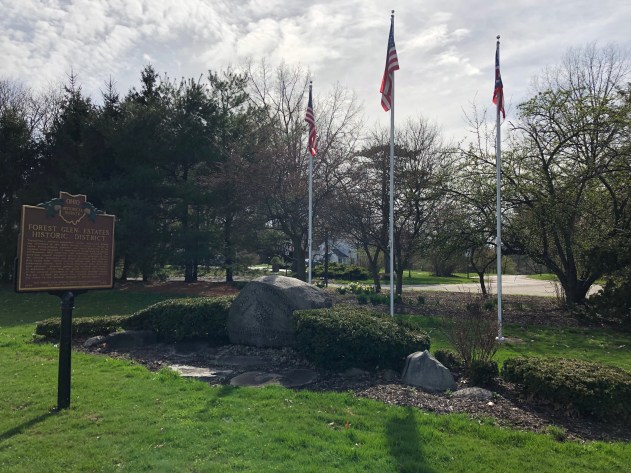
ERW 1
The Road to Remembrance Memorial on the southside of Youngstown, Ohio. (Image courtesy of the author)

As the country grappled with the effects of the Great Depression, numerous civic organizations in the state of Ohio sought to construct a “Road of Remembrance” in honor of the servicemen from the country’s previous conflict. On June 17, 1930, the state legislature designated a portion of Route 193 from Lake Erie to 422 in Youngstown as a memorial roadway in honor of those soldiers who gave their last full measure of devotion during the Great War. Many towns planted memorial trees along the route, some erected monuments, while other organizations held ceremonies marking the occasion. This special route was to be just a small portion of remembrance that was to span from Montreal, Canada to the Gulf of Mexico. Continue reading “The Shot Heard in Youngstown?”

Disaster on the Eastern Frontier

Part Two
For Part One, click here.

The British and loyalists would not have to wait long. Word of the landing reached the Massachusetts government within a matter of days, and preparations for a counterattack began almost immediately. There was such a hurry to respond that the General Assembly voted to carry out the operation with state forces rather than wait for Continental assistance.[1] Despite the initial rush it still took a month to assemble a force of over 1,000 militiamen, as well as the food, arms, and other supplies to sustain them. All of these troops and their supplies would be transported by a fleet of 21 transports, accompanied by nearly twenty state and Continental navy vessels and privateers. Among the warships the largest was the Frigate Warren of 32 guns which served as the flagship of Commodore Dudley Saltonstall. The Connecticut born officer was given overall command of the naval forces – no small task given the lack of experience with large scale fleet actions among his subordinates. Command of the land forces was given to Massachusetts Brigadier Solomon Lovell. Lovell has seen experience early in the war outside of Boston, but was also relatively untested in battle. The inexperience and poor communication between Saltonstall and Lovell was to have a decisive impact on the coming expedition. Notable among the other officers in the expedition was Paul Revere, who commanded the Massachusetts artillery. The expedition was also joined by a band of the local Penobscot Indians allied to the Continental Congress.

The New England fleet entered the Penobscot Bay on July 25th and immediately attempted a landing. Clearly outnumbered and with their works incomplete, General McLean and his men were determined to resist the Americans, but expected the worst. Saltonstall’s fleet sailed in close to the shore and exchanged cannon fire with both the British defences and the three remaining Royal warships, now under the command of Captain Henry Mowatt. In the confusion and smoke the Americans lowered seven launches full of marines and militiamen, but as they neared the shore they were met by a hail of musket fire[2]. At least one of the attackers – a Native American – was killed and the boats returned to the safety of the fleet. It was an inauspicious start to the battle for the New Englanders and already the relationship between the two commanding officers was becoming strained. General Lovell knew little about sailing or naval operations. He questioned the Commodore as to why he couldn’t just sail his fleet into the harbor and blast the British to pieces while his troops landed under their covering fire. The Connecticut seaman replied curtly, exclaiming “You seem to be damn knowing about the whole matter! I am not going to risk my shipping in that damned hole!”[3]

On the 26th a second militia landing on the peninsula was repulsed after the lead boat carrying militia Major Daniel Littlefield was swamped by British chain shot, drowning the Major and two privates.That same day, however, the Americans scored a small victory when a force of 200 Continental marines and artillerymen landed on Nautilus Island and captured the small British battery there[4]. More artillerymen were landed and soon the Americans had a battery from which they could harass the British shipping. With the Americans making some headway Captain Mowatt withdrew the remaining British ships deeper into the harbor, creating a defensive line across the Bagaduce River.

Castine harbor, looking out roughly where Captain Mowatt anchored the British transports and warships (Author_s photo)
Castine Harbor, looking out roughly where Captain Mowatt anchored the British transports and warships (Author’s photo)

Continue reading “Disaster on the Eastern Frontier”

Disaster on the Eastern Frontier

Emerging Revolutionary War welcomes back guest historian Travis Shaw.

Part One

I’d be willing to bet that Maine isn’t the first place to come to mind when you hear the word “frontier”. For many Americans I imagine they immediately think of the wild west. Wagon trains of pioneers crossing the prairies, and Native nations like the Sioux and Apache ranging the plains on horseback. A century before the age of Manifest Destiny, however, the region that is now the state of Maine marked the eastern frontier of the English colonies. It was a wild and sparsely settled place, caught between New England and the French colonies to the north. The few European settlers eked out a living from the thin, rocky soil or turned to lumbering and to the sea. They lived alongside and often fought against the region’s original inhabitants – the Wabanaki or “People of the Dawn.” For two centuries the Eastern Frontier was torn apart by war between various European powers and their respective Native allies. Nowhere is this more clearly evident today than in the small coastal town of Castine, Maine.

Castine is located near the mouth of the Penobscot River, more or less in the middle of the Maine coast (Google Maps)

Continue reading “Disaster on the Eastern Frontier”

“Elbow Room” for “Uncle Johnny”

On this date in 1777, British General John Burgoyne surrendered to American General Horatio Gates around Saratoga, New York. This victory solidified French support for the fledgling American nation and became one of the turning points in the road to independence.

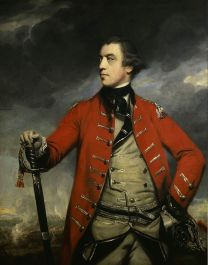
800px-BurgoyneByReynolds
General John Burgoyne

Out of this momentous occasion came an anecdote about the British general officer. The short story has some truth in it, yet, whether the entire tale is accurate, well, I’ll leave that for you to decide!

Two years prior to the Battles of Saratoga and upon arriving in Boston, Massachusetts, General Burgoyne remarked “Well, let us get in, and we’ll soon find elbow-room” when he was told the numbers of militia besieging British regulars around the town.

After his capitulation, Burgoyne and his forces were marched toward Albany, New York, and multitudes of people turned out to see the vanquished British and German soldiery along the route. One resident supposedly yelled from her homestead doorway;

“Make elbow room for General Burgoyne.” 

Not what he had envisioned in 1775 upon disembarking in North America. Yet, history does not relate what “Gentleman Johnny” Burgoyne thought exactly about the elbow room he received in the countryside of upstate New York!*


This slideshow requires JavaScript.


*“Gentleman Johnny” was a nickname acquired by Burgoyne was stationed in London with the Horse Guards, a fashionable cavalry regiment.” 

**Information gathered from A.J. Langguth’s “Patriots” and The Patriot Resource, which can be found here.

Captain John Asbhy

Part Two

Captain John Ashby and his fellow Virginians would face their greatest test of the war on the afternoon of September 11th, 1777 at the Battle of Brandywine. Following a wide flank march the bulk of the Crown forces emerged on Washington’s right flank, ready to trap and smash the Continental Army. Washington reorganized his line, drawing men north in a desperate attempt to meet the new threat. The Third Virginia was ordered into position far in advance of the American lines – their objective was to hold a wooded hill near the Birmingham Friends Meeting House in order to buy time for the rest of the American troops to take up position. Ashby and his fellow officers arranged their men among the buildings and woodlot of the Samuel Jones farm and awaited the attack that was certain to come.

The Battle of Brandywine, September 11, 1777 (American Battlefield Trust)

Continue reading “Captain John Asbhy”

Captain John Ashby

Emerging Revolutionary War welcomes guest historian Travis Shaw. 

Part One

As he looked northward across the open ground in front of his position, Captain John Ashby could see the advance guard of the British army moving steadily closer. They came on in a loose, open line, taking time to return the fire of Ashby’s men. Made up of red-coated light infantry and their German counterparts, the rifle-armed Jaegers, the advance guard were the cream of the Crown forces – men chosen for their fitness, marksmanship, and ability to endure hardship. Ashby and his men were veterans, so they must have known they’d be in for a fight. As the battle intensified around him, one wonders if Captain Ashby’s thoughts turned to home. The Brandywine Valley of Pennsylvania was a long way from his native Virginia Piedmont.

The Crooked Run Valley in northern Fauquier County looks much as it did when John Ashby lived there two centuries ago (Author_s photo)
The Crooked Run Valley in northern Fauquier County looks much as it did when John Ashby lived there two centuries ago (Author’s photo)

John Ashby was born in 1740 in northwestern Fauquier County, among the foothills of the Blue Ridge Mountains. The son of Robert Ashby and Rosanna Berry, he grew up at Yew Hill, the family estate that lay just a few miles from the Gap that bears the family’s name to this day[1]. John’s uncle and namesake, Captain “Jack” Ashby commanded a company of Virginia rangers during the French and Indian War, where he made the acquaintance (and drew the ire) of a young George Washington[2]. Continue reading “Captain John Ashby”

Uncovering the Continental Army in Morristown

Part of an ongoing series about the Continental Army in Morristown, New Jersey. To read previous posts, click here.

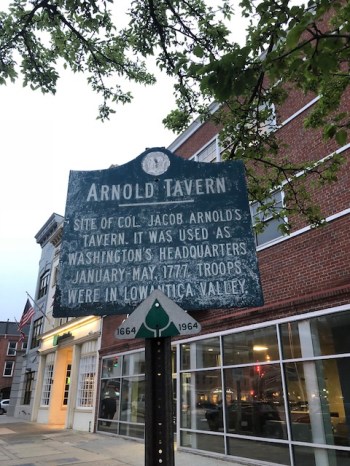
All that remains is a historical marker, on the side of North Park Place across the street from Morristown Green. For a few months, between January 1777 and May 1777, in this location, the headquarters of the Continental Army was located. Within that headquarters, obviously, was George Washington.

IMG_3024
Arnold’s Tavern historic sign (author’s collection)

Although no specific date of construction exists, it is believed that Arnold’s Tavern was built by Samuel Arnold between 1735 and 1750. By the time of the American Revolution owned by the son, Colonel Jacob Arnold. The structure was three stories high, with a wide hallway that bisected the building, a front and back parlor, barroom, dining room, and kitchen. Continue reading “Uncovering the Continental Army in Morristown”

Uncovering the Continental Army in Morristown

Approximately one month ago, I took a temporary detail assignment to Morristown National Historical Park. The national park preserves the winter cantonments of the Continental Army during the American Revolution; including the harshest winter, weather-wise, of the entire war, in 1779-1780.

For parts of multiple winters and even during the campaigning season, Washington’s forces would come to Morristown, situated behind the Watchung Mountains, which provided safety but also a perch to monitor the British in the New York City.

The town still bears witnesses to this rich legacy of housing soldiers, with historic buildings and signs dotted around the spiraling town. On a walk the other day, I came across the house below, with a small plaque situated on the front of the dwelling.

IMG_2771

The home saw soldiers use it for their encampments throughout the majority of the war years. On his return to the United States the Marquis de Lafayette was welcomed with a reception in the building as well, which is in the photo below.

IMG_2772

Morristown is filled with tidbits of history from the American Revolution and I as spend the next few months there as a park ranger, I will share what I come across. So, stay tuned as I uncover the history of the place that “Saved America” according to the park’s unofficial slogan.


The Brush of John Trumbull

Emerging Revolutionary War welcomes back guest historian Michael Aubrecht

Trumbull
John Trumbull

John Trumbull’s paintings represent some of the most familiar depictions from the time of the American Revolution. Trumbull was a graduate of Harvard University and the gifted son of the Governor of Connecticut. As a child, Trumbull showed a remarkable talent for an attention to detail. This aptitude set his drawings apart from his contemporaries. Trumbull traveled to London in 1784 to study painting under the master Benjamin West. It was then that he started painting some of his most notable pieces. There he honed his expertise for realistic painting. A year later later Trumbull traveled to the City of Paris to do commissioned artworks. He later did portraits of George Washington, John Adams, Alexander Hamilton and Thomas Jefferson. In 1816, he was selected as the president of the American Academy of the Fine Arts where he would serve for 20 years. Emphasizing classic traditions Trumbull attempted to teach the skills he had acquired while overseas. Following his death in 1843 at the age of 87, Trumbull was buried beneath the Art Gallery at Yale University which he had designed. In 1867, his collection of artworks were displayed at the Street Hall building on the same grounds. He and his wife’s remains were later re-interred and buried on the grounds of that building. Trumbull’s approach to painting has been studied by art students around the world. Today Trumbull’s paintings remain some of the most cherished ever to be painted by an American artist.  Continue reading “The Brush of John Trumbull”

Fight for Osborne Hill

From a Pennsylvania State Historical Commission marker, one quickly can find out the importance of Osborne Hill to the Battle of Brandywine, fought on September 11, 1777.

Photo184914
Osborne Hill Marker (courtesy of Keith Smith, hmdb.org)

The hillside was the site of British General William Howe’s post in which he coordinated and commanded the different components of the British and Hessian forces that day. The battle opened the way for the British conquest of Philadelphia and was the largest, in terms of manpower fighting, of any American Revolutionary War battle.

Now, this important tract of land needs a few more people to fight for its control and preservation. Continue reading “Fight for Osborne Hill”