

With autumn just around the corner, cooler weather on the horizon, and the holidays quickly approaching. Some stores in the local area have Halloween, Thanksgiving, and Christmas decorations all for sale currently, Emerging Revolutionary War wanted to bring your attention to a few different Revolutionary War Era happenings to mark on your calendars. Continue reading “Upcoming Lectures, Talks, and/or Events”
Category: Revolutionary War
The Battle of Groton Heights, September 6, 1781: The Fort Griswold Massacre
Part Three
Click here for parts one and two.
With British soldiers pouring into the fort, Colonel Ledyard ordered a ceasefire, and prepared to surrender Fort Griswold to the victorious British. However, the British disregarded the ceasefire and continuing pouring fire into the American garrison, killing or wounding nearly all of the fort’s defenders. “I believe there was not less than five or six hundred men of the enemy on the parade in the fort,” claimed American soldier Rufus Avery. “They killed and wounded nearly every man in the fort as quick as they could.”

Maj. Stephen Bromfield, the ranking British officer after Montgomery fell, called out, “Who commands this fort?” Ledyard stepped forward and responded, “I did, sir, but you do now.” Another American, Jonathan Rathbun, watched Bromfield run Ledyard through the heart and lungs with Ledyard’s own sword:
“…the wretch who murdered him [Ledyard], exclaimed, as he came near, “Who
commands this fort?” Ledyard handsomely replied, “I did, but you do now,” at the same
moment handing him his sword, which the unfeeling villain buried in his breast! Oh, the
hellish spite and madness of a man that will murder a reasonable and noble-hearted
officer, in the act of submitting and surrendering!”
Continue reading “The Battle of Groton Heights, September 6, 1781: The Fort Griswold Massacre”
Preserve Washington’s Legacy
If you follow Campaign 1776, the initiative by our friends at Civil War Trust, you are familiar with the saga over the Princeton Battlefield. Now you have a chance to help as well.

Reporting Success on a Monday!
With the start of the work week, some folks loath logging onto the computer to check work email, news, and updates. If you are one of those folks, keep reading, as the news we are about to share is positive and exciting.
 This past Thursday, July 27, 2017, Campaign 1776, the initiative of the Civil War Trust, announced the preservation of 184 acres at two sites in New York state. One tract of land was pivotal to the United States success in the Saratoga Campaign in 1777 and where a U.S. fleet was saved during the War of 1812.
The Battle of Fort Ann, fought on July 8, 1777 was a four-hour affair and was influential in the course of the larger Saratoga Campaign as it affected the British’s attempt to secure the strategically important Hudson River Valley. The delay around Fort Ann and every delay on the route of General John Burgoyne’s push south aided the Patriot cause tremendously.
Fast-forward to the War of 1812 and Sackets Harbor, New York provided as safe-haven for the United States fleet operating on the Great Lakes. Horse Island and the harbor that gained prominence during the May 29, 1813 offensive by the British, is where 24 acres were saved by Campaign 1776. The battlefield, which was one of 19 sites that benefited from $7.2 million in grants announced earlier in July and the first War of 1812 site anywhere in the country to be awarded money since the National Park Service expanded the grant opportunities in 2014.
Not just one success, but two for this Monday morning! For the full report, courtesy of our friends at Civil War Trust, click here.
Part Two: The Battle of Groton Heights, September 6, 1781: The Fort Griswold Massacre
For Part One, click here.
Lt. Col. Edmund Eyre’s battalion of 800 Regulars and Loyalists landed on the east bank of the Thames River, facing tangled woodlands and swamps. The New Jersey Loyalists, in fact, had so much difficulty moving the artillery that they did not participate in the assault on Fort Griswold.
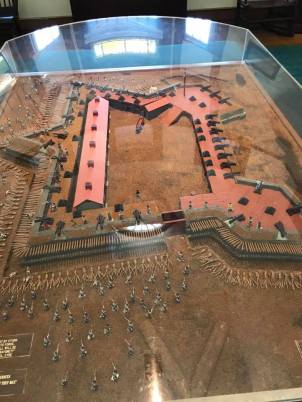
Eyre sent a Captain Beckwith to the fort under a flag of truce to demand its surrender. Ledyard called a council of war and consulted with his officers. The Americans believed that a large force of militiamen would answer the call, and that this augmented force could defend the fort. Ledyard responded by sending an American flag to meet the British flag bearer. The American told Beckwith, “Colonel Ledyard will maintain the fort to its last extremity.” Displeased by the response, Eyre sent a second flag, threatening no quarter if the militia did not surrender. Ledyard gave the same response even though some of the Americans suggested that they should leave the fort and fight outside instead. Continue reading “Part Two: The Battle of Groton Heights, September 6, 1781: The Fort Griswold Massacre”
“Old Ironsides” To Set Sail Again!
Happen to be around Boston this weekend? Or live within traveling distance? Check out the special event happening this weekend from Sunday, July 23rd through Monday, July 24th at the U.S.S. Constitution Museum and Charlestown Navy Yard.
The U.S.S. Constitution, the oldest commissioned naval vessel still afloat will set sail again. Launched in 1797 and named by President George Washington, the vessel is a wooden-hulled, three-masted heavy frigate. She has been dry-docked since May 18, 2015 but will return to the water on July 23rd.
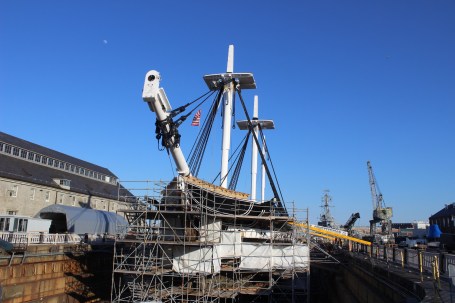
The event, co-sponsored with the National Parks of Boston will have a full-plate of free, family-fun events starting at 4:00 p.m. on Sunday and continuing into the morning hours of Monday.
For a full-listing of these events, including information about the museum, and answers to a few frequently answered questions, click here.
For those that cannot make it live to the re-launch, the event will be live on Facebook video streams at 4:00 p.m. and 6:00 p.m. along with live video streams throughout the night of the major events. Check out the Facebook site for the museum by clicking here.
The Battle of Groton Heights, September 6, 1781: The Fort Griswold Massacre
Part One
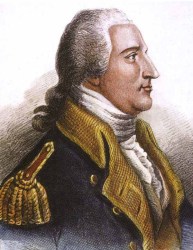
After turning coat, Benedict Arnold received a commission as a brigadier general in the British army as part of the deal that he made in order to betray his country.
In August 1781, George Washington decided to shift forces in order to attack the army of Lt. Gen. Lord Charles Cornwallis in Virginia. Washington began pulling troops from the New York area. Lt. Gen. Sir Henry Clinton, the British commander-in-chief in America, realized on September 2 that Washington’s tactics had deceived him, leaving him unable to mobilize quickly enough to help Cornwallis. Further, there was still a significant force of Continentals facing him in front of New York, and Clinton did not feel that he could detach troops to reinforce Cornwallis as a result.
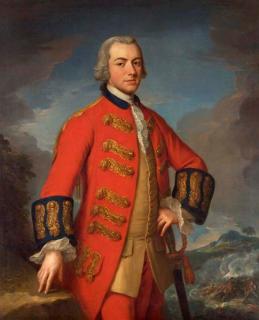 Instead, Clinton decided to launch a raid into Connecticut in the hope of forcing Washington to respond. Clinton intended that this be a raid, but he also recognized that New London could be used as a permanent base of operations into the interior of New England. Clinton appointed Arnold to command the raid because he was from Connecticut and knew the terrain.
Arnold commanded about 1,700 British solders, divided into two battalions. Lt. Col. Edmund Eyre commanded a battalion consisting of the 40th and 54th Regiments of Foot and Cortland Skinner’s New Jersey Volunteers, a Loyalist unit. Arnold himself commanded the other battalion, made up of the 38th Regiment of Foot and various Loyalist units, including the Loyal American Regiment and Arnold’s American Legion. Arnold also had about 100 Hessian Jägers, and three six-pound guns. This was a formidable force anchored by the three Regular regiments. Continue reading “The Battle of Groton Heights, September 6, 1781: The Fort Griswold Massacre”
American Revolutionary Era Reading Lists
Recently, a few emails have appeared in the Emerging Revolutionary War (ERW) email detailing lists of books to read on the American Revolutionary Era. During the summer months, when large segments of the population hit the road for vacations, ERW thought a post about what books to nab for that trip would be a helpful tidbit of information.
 One of the emails was from our friends at The Museum of the American Revolution and was geared toward younger audiences. The books were geared toward different age groups, bracketed for 12 years and up, ages 7 to 12 years, and then ages 2 to 7. A final category was for graphic novels.
Reaching younger enthusiasts is the goal of many preservation and/or historic sites and this list is a great way to get them involved during the summer months. Check out the entire list here.
Lastly, if so inclined, the Museum sends out a “Read the Revolution” email list via their website to read reviews of applicable books.
The other email was our friends at the Journal of the American Revolution and was geared toward adults as it tabulated “The 100 Best American Revolution Books of All Time.” The list is broken down into different categories, including but limited to, “all-in-one” histories, people, politics, and conflict and war.

For the complete listing, click here. How many have you read? What has been your favorite?
Happy Reading!
ERW Weekender: Cornwallis House
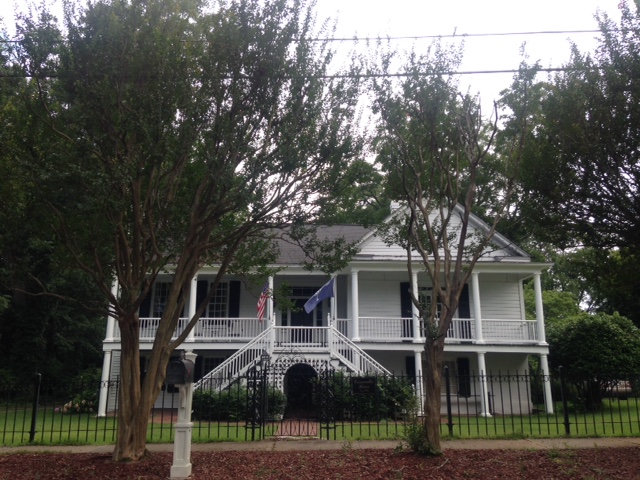
In the quaint South Carolina town of Winnsboro, a few miles off of current Interstate-77 sites a two-story stands one of the oldest dwellings in a town founded by Richard Winn of Virginia a few years before the start of the American Revolution.
Yet, it was during those hostilities that one of the more famous military leaders came to “Winnsborough” as it was sometimes listed on maps of the time. His name, Lord Charles Cornwallis, the overall commander of British forces in the Southern Colonies. He would use the house during the winter of 1780-1781.
The house itself is an enigma. The structure dates to pre-1776 obviously, but the builder and owner of the house is still not known. Yet, it is well document that the house did serve during the labeled “winter of discontent” for the British and Cornwallis.
Across the street resides the Mount Zion Institute which became quarters for British soldiers during that winter of 1780-1781.
After the conflict the property and house was deeded to Captain John Buchanan, a veteran of the American Revolution. Buchanan was part of the welcoming party for the Marquis de Lafayette when the Frenchman landed at Georgetown, South Carolina.
Although not open to the public, special requests will be entertained. Click here for the link below for more information on the house and also who to contact for those special arrangements.
ERW Weekender: Bunker Hill Monument & Museum
Emerging Revolutionary War welcomes back guest historian Katie Turner Getty.
Towering over Charlestown, Massachusetts, its foundation set in sacred battleground soil, the Bunker Hill Monument is a 221 foot obelisk commemorating the Battle of Bunker Hill. The cornerstone of the monument was laid by the Marquis De Lafayette in 1825, fifty years after the battle was fought on June 17, 1775.
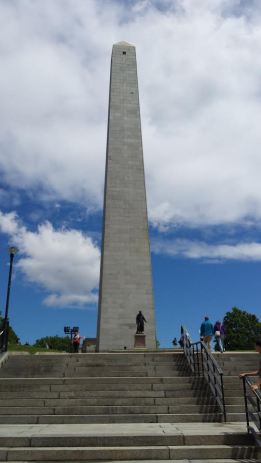
Although the land surrounding the monument has been greatly developed since the battle, visitors today can get still get a sense of the 18th-century landscape just by walking through Charlestown and climbing the hill to reach Monument Square. Approaching visitors are greeted by the statue of Colonel William Prescott, the gray granite of the monument serving as an impressive backdrop behind him. Continue reading “ERW Weekender: Bunker Hill Monument & Museum”
 Emerging Revolutionary War Era