Part 2: The Defense in Depth as a Revolutionary War Battlefield Tactic

For part one, click here

Brig. Gen. Daniel Morgan, the “Old Wagoner,” as he was known, commanded a light infantry corps assigned to Maj. Gen. Nathanael Greene’s southern army. Morgan met with Greene in Charlotte, North Carolina on December 3, 1780.  Implementing a Fabian strategy, Greene split his army to harass the British while buying time to recruit additional soldiers. Greene ordered Morgan to use his 600-man command to forage and harass the enemy in the back country of South Carolina while avoiding battle with Lt. Gen. Charles Lord Cornwallis’ British army.

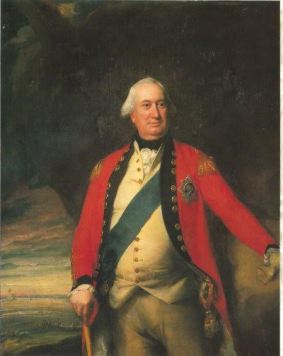
Once Cornwallis realized what was going on he dispatched Lt. Col. Banastre Tarleton’s British Legion to track down Morgan’s command and bring it to battle. Tarleton commanded a combined force of Loyalist American troops. The Legion consisted of fast-marching light infantry and dragoon units. At its peak strength, the Legion numbered approximately 200 infantry and 250 dragoons. It was known for its rapid movements and for its ruthless policy of giving the enemy no quarter. Patriot forces feared Tarleton and his Legion, and for good reason.

By January 12, Tarleton’s scouts had located Morgan’s army in the South Carolina back country, and Tarleton began an aggressive pursuit. Morgan hastily retreated to a position at the Cowpens, a prominent crossroads and pasturing grounds for cattle. The field was about 500 yards long and about as wide, dotted with trees, but devoid of undergrowth, which served as a food source for grazing battle.

Once Morgan learned that Tarleton was pursuing him, he spread the word for local militia units to rendezvous with him at the Cowpens. Through the night, South Carolina militiamen drifted into camp. Morgan visited their camps, encouraging them to stand and fight. Morgan’s words were particularly effective; the grizzled veteran knew how to motivate these men. They would need to be prepared, because they faced a stern task the next day.

January 17, 1781 dawned clear and very cold. After his scouts reported Tarleton’s approach, Morgan rode among his men, crying out, “Boys, get up! Benny’s coming!” Morgan designed a defense in depth that was intended to draw the British Legion in and then defeat them by pouncing on their exposed flanks. He knew that his militia had a reputation of being unreliable, and his ability to maneuver was limited, so he elected to design and implement a defense in depth that took advantage of the terrain features of the Cowpens.

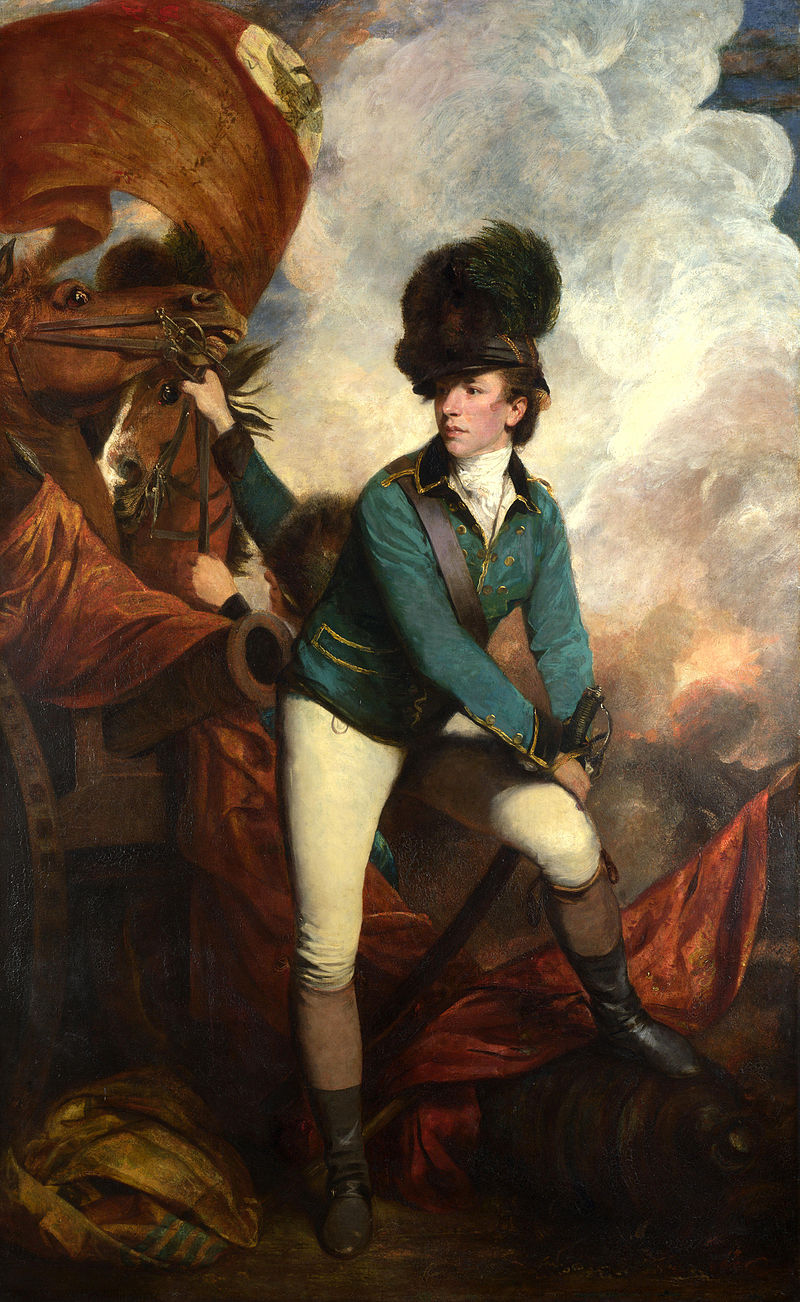
Banastre Tartleton, British commander at Cowpens

Tarleton was overconfident. He believed that Morgan’s command was hemmed in by the nearby Broad River and also believed that the cleared fields of the Cowpens were ideal ground for his dragoons, and concluded that Morgan must be desperate to fight in such a place.

Morgan had prepared three defensive positions. Selected sharpshooters out front and hiding behind trees manned the first line. They picked off a number of Tarleton’s dragoons as they advance, specifically targeting officers. Traditional accounts indicate that they downed 15 of Tarleton’s dragoons this way. Confused, the dragoons retreated.

Having accomplished their initial goal, the sharpshooters then fell back about 150 yards or so to join the second line, which consisted of Brig. Gen. Andrew Pickens’ militiamen. Morgan asked these men to stand long enough to fire two volleys, after which they were to fall back to the third—and main line—manned by Col. John Eager Howard’s Continentals, another 150 yards or so in the rear of the second line. Thus, Morgan had designed a textbook example of a defense in depth.

Andrew Pickens, commanded some of the South Carolina militia at Cowpens

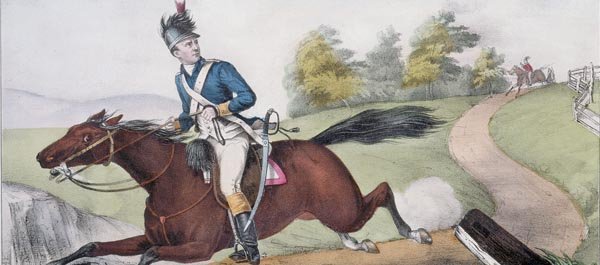
Some of the militia got off two volleys and then most of the militia fell back to a spot behind the third line. Tarleton orders his dragoons to pursue the retreating militiamen, and as the dragoons bore down on them with their sabres drawn, Col. William Washington’s Continental cavalry suddenly thundered onto the field, seemingly from nowhere. They routed the surprised Loyalist dragoons, who fled the field with heavy losses.

The infantry then engaged. With their drums beating and their fifes shrilling, the British infantry advanced at a trot. Recognizing that the moment of crisis had arrived, Morgan cheered his men on, rode to the front and rallied the militia, crying out, “form, form, my brave fellows! Old Morgan was never beaten!”

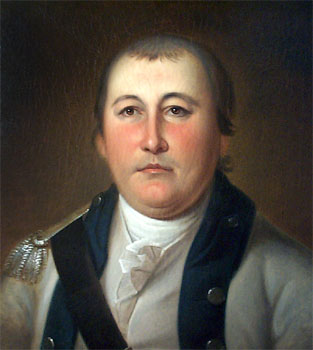
William Washington, commander of American cavalry at Cowpens and a distant relation to George Washington

Tarleton’s 71st Highlanders, a veteran unit made of Scotsmen, which had been held in reserved, now charged the Continental line, their skirling bagpipes adding to the cacophony of battle. Howard ordered his right flank to face slight right to counter a charge from that direction, but in the noise and chaos, was misunderstood as a call to retreat. As other companies along the line began to pull out, Morgan rode up to ask Howard if he had been beaten. Howard pointed at the orderly ranks of his retreat and assured Morgan that they had not been beaten. Morgan then put spurs to his horse and ordered the retreating units to face about and, on his order, to fire in unison. Their deadly volley dropped numerous British soldiers, who, sensing victory, had broken ranks in a determined charge. The combination of this volley and a determined bayonet charge by the Continentals turned the tide of battle in favor of the Americans.

At the moment, the rallied and re-formed militia and Washington’s cavalry attacked, leading to a double envelopment of the British, who began surrendering in masses. Tarleton and some his men fought on, but others refused to obey orders and fled the field in a panic. Finally, Tarleton realized that he had been badly beaten and fled down the Green River Toad with a handful of his men. Racing ahead of his cavalry, William Washington dashed forward and engaged Tarleton and two of his officers in hand-to-hand combat. Only a well-timed pistol shot by his young bugler saved Washington from the upraised saber of one of the British officers. Tarleton and his remaining forces escaped and galloped off to Cornwallis’ camp to report the bad news.

And bad news it was: Tarleton’s Legion lost 110 dead, over 200 wounded and 500 captured. By contrast, Morgan lost only 12 killed and 60 wounded. His perfectly designed and perfectly implemented defense had worked even beyond the Old Wagoner’s wildest dreams and highest hopes.

Knowing that Cornwallis would pursue him, Morgan buried the dead and then withdrew to the north to live and fight another day. Morgan reunited with Greene’s army and the combined force headed for North Carolina. Morgan, whose health was fragile, soon retired from further duty in the field, but he had left his mark. Cowpens was his finest moment, and set a precedent for Greene to follow two months later at Guilford Courthouse.

Battle of Cowpens (Courtesy of Campaign 1776/CWT)
Battle of Cowpens
(Courtesy of Campaign 1776/CWT)

*Suggestions for additional reading: for a superb book-length microtactical treatment of the Battle of Cowpens, see Lawrence E. Babits, A Devil of a Whipping: The Battle of Cowpens (Chapel Hill: University of North Carolina Press, 1998). This book is the primary resource consulted in drafting this article.

The Defense in Depth as a Revolutionary Battlefield Tactic

Part One of Four 

As a general statement, most people don’t think of the Revolutionary War as a testing ground for battlefield tactics. That assumption would not be correct. In fact, the Revolutionary War proved beyond doubt that traditional European set-piece battlefield tactics were largely ineffective against a determined enemy that was not bound by the traditional rules of war.  As just one example, the extremely effective hit and run tactics used by the Minutemen to harass and deplete the British forces that marched to Lexington and Concord that were based on the tactics used by Native American fighters prove this beyond doubt. The British Regulars had no experience or training in dealing with these tactics, and they suffered as a result.

Also, in the European model, wherein gentlemen fought wars and assiduously avoided civilian casualties, it was considered impolite and improper to target the other side’s officers during the course of battle. American forces refused to comply with these rules, causing serious losses among the ranks of British officers, and the British had to adapt to these tactics also.

Another tactic adopted by American officers proved to be incredibly effective during the campaigns in the South in 1781. Brig. Gen. Daniel Morgan and Maj. Gen. Nathanael Greene, in particular, made extremely effective use of the defense in depth in carrying out their Fabian strategy during the Southern Campaigns of the Revolutionary War.

A Fabian strategy—named for its most famous practitioner, the Roman dictator, Quintus Fabius Maximus Verruscosus—avoids pitched battles and frontal assaults in favor of wearing down an opponent through a war of attrition and indirection. While avoided decisive battles, the side employing a Fabian strategy harassed the enemy through skirmishes to inflict losses, disrupt supply, and affect enemy morale. Typically, the employment of this strategy suggests that the side adopting it believes that time is on its side. George Washington was absolutely convinced that a Fabian strategy would ultimately wear down the British, and he was right.

unnamed (1)
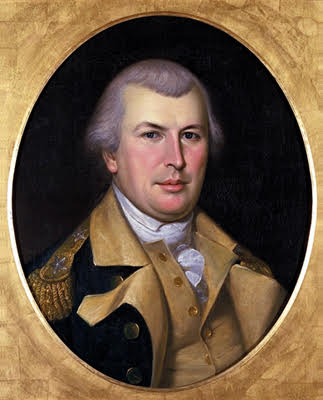
General Nathanael Greene, who mastered the Fabian strategy in the Southern Campaign of 1781

His protégé, Greene, also believed that a Fabian strategy was the way to defeat the British. Faced with the task of defending a large swath of the South with a small army, he had little choice. His subordinate, Brig. Gen. Daniel Morgan, a rough but extremely effective amateur soldier, pioneered the use of a defense in depth at the Battle of Cowpens in January 1781, and Greene then used it on a larger scale at the Battle of Guilford Courthouse about sixty days later. That two untrained amateur soldiers could develop and use such a tactic so effective demonstrates their genius.

A defense in depth, also known as a deep or elastic defense, seeks to delay, rather than prevent, the advance of an attacker, buying time and inflicting additional casualties by trading time for space. Instead of facing an attacker with a single, strong defensive position, a defense in depth relies upon the tendency of an attack to lose momentum and cohesion over time as it covers a larger area. Thus, a defender can yield lightly defended territory in an effort to outstrip an attacker’s logistics or spread out a numerically superior attacking force. Once that attacker has lost momentum, or has become spread out to hold territory, well-planned and well-placed counterattacks can be directed at the attacker’s weak points, with the objective of causing attrition warfare or driving the attacker back to its original starting position.

A conventional defensive strategy concentrates all of a defender’s military resources in a well-defended front line, which, if breached by an attacker, would expose the remaining troops in danger of being flanked, cut off, and surrounded, and leaving lines of supply, communications, and command vulnerable to being cut.

By contrast, a defense in depth requires that defenders deploy their resources, such as prepared fortifications, earthworks, and additional forces at and well behind the front line. Once an attacker breaches the weaker initial position, it continues to meet resistance as it presses on. As the attacker penetrates further, its flanks become vulnerable, and if the advance stalls, the attacking force can find itself completely surrounded and subject to being destroyed or forced to surrender. Thus, a defense in depth is particularly effective against an attacker that can concentrate its force to attack a small number of places along an extended defensive position.

In a well-designed and properly implemented defense in depth, the defending forces fall back to a succession of prepared positions designed to inflict a heavy price on the advancing enemy while minimizing the risk of being overrun or outflanked. By delaying the enemy’s advance, a defense in depth neutralizes manpower advantages and the element of surprise, and buys time for additional forces to be readied for well-timed counterattacks. A well-designed defense in depth will use its forces in mutually supporting positions and in appropriate roles. In this scenario, poorly trained soldiers—such as militiamen—can be used in static positions at the front line, while more experienced and better-trained soldiers can form a mobile reserve, or man the ultimate defensive position to be defended.  Further, a well-designed defense in depth will make good use of the natural advantages offered by terrain features and other natural obstacles such as streams, ponds, etc.

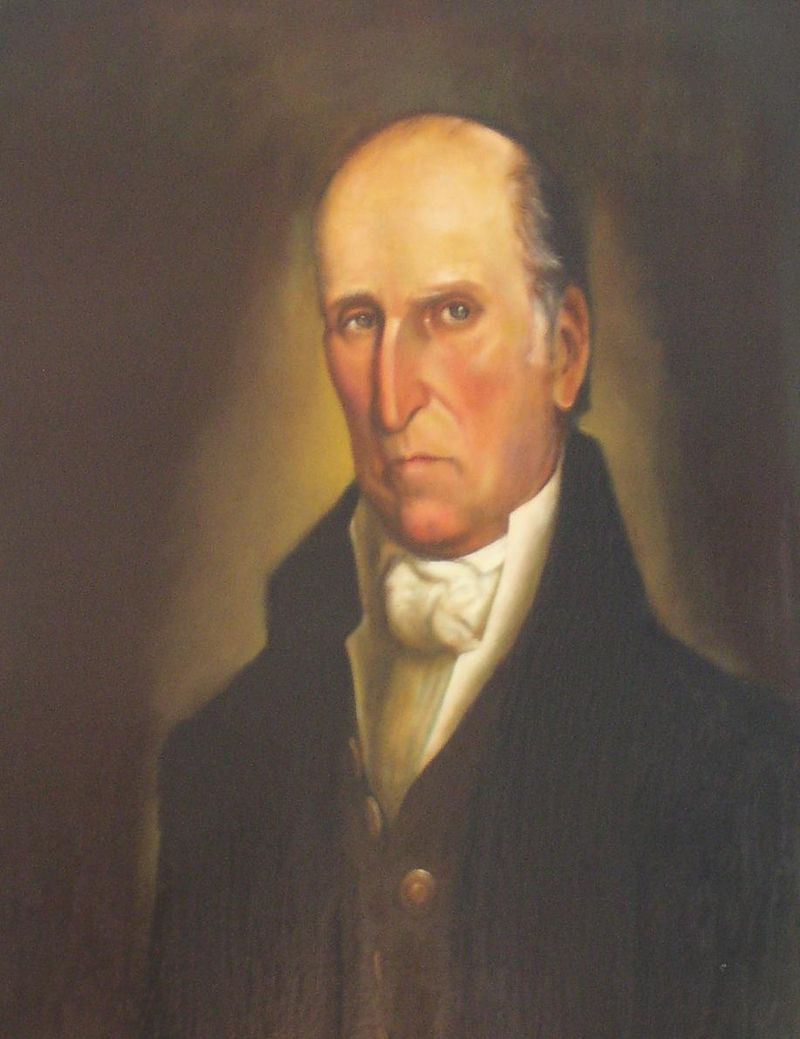
DanielMorgan
General Nathanael Greene, who mastered the Fabian strategy in the Southern Campaign of 1781

There are disadvantages associated with the defense in depth. For one thing, constantly retreating can take a toll on the morale of defending forces. Further, these forces also require a high degree of mobility to accommodate those retreats, and also the space to do so.

Morgan designed and implemented a very effective defense in depth at Cowpens that proved so effective that Greene adopted that tactic and, while he lost the Battle of Guilford Courthouse, the heavy losses his army imposed on Lord Cornwallis’ army prompted Greene to note that the British, “have met with a defeat in a victory.”

The Revolution’s Southwest Front

Emerging Revolutionary War is honored to welcome back historian Robert “Bert” Dunkerly. 

During a trip to Mobile, Alabama for some Civil War research, I came across a fascinating and lesser-known aspect of the American Revolution.  When I travel, I always keep my eye out for unusual finds and hidden history.  I was rewarded on my trip to Mobile with a great discovery.

Ft C
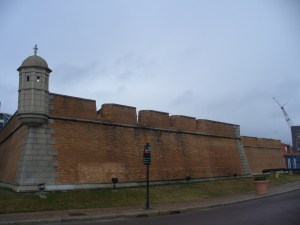
Fort Conde (author collection)

One of the main historic sites in downtown Mobile is the reconstructed Fort Conde.  This brick fort interprets the early history of Mobile and the region under the flags of France, Spain, and the United States.  Just outside the fort is a marker discussing the battle of Fort Charlotte.

Mobile was originally the capital of the French Louisiana Territory until the close of the French and Indian War.  As part of the settlement of that conflict in 1763, this French territory passed to the British.  Fort Conde, built in 1723, was renamed Fort Charlotte by its new owners.

Map
Map of Ft. Conde superimposed over modern Mobile streets, (photo by author)

Most of us know that the French were anxiously watching the American Revolution when the conflict broke out, hoping to score revenge against their English adversaries. Also watching with interest were the Spanish.

The British garrisons along the Gulf of Mexico coast (Pensacola, Mobile, Baton Rouge) were quite small and vulnerable.  The Spanish had been providing material aid and funds to the Americans, but finally declared war on Britain in 1779.  The Spanish were ambivalent about American independence, and unlike the French, did not recognize the United States, but did agree to help militarily.

Even before Spain’s entry into the war, New Orleans was a source of aid smuggled in for the American effort.  The Crescent City, and all the land west of the Mississippi, had been awarded to Spain at the close of the French and Indian War.  From here, supplies moved up the Mississippi to Fort Pitt at Pittsburgh, PA.  And from New Orleans, Governor Bernardo de Galvez attacked British posts up the Mississippi and along the Gulf Coast.

bernardo
General Bernardo de Galvez, (artist unknown)

A statue of the Spanish general who did much to wrest the Mississippi and Gulf coast areas away from the British stands near the World Trade Center in New Orleans.  A gift from Spain to the city of New Orleans, the statue is a reminder of this important but neglected aspect of the war.  A group known as Granaderos y Damas de Galvez are dedicated to preserving his memory and that of the Spanish role in the Revolution.

Oliver Pollock was a Philadelphia merchant with close ties in Cuba and New Orleans.  When the war broke out, he used his connections to aid the Revolutionary cause from the Crescent City.  In 1777 he was appointed “commercial agent of the United States at New Orleans” and used his fortune to finance American operations in the west, such as General George Rogers Clark.  When Spain entered the war he served as an aide to General Bernardo de Galvez.

Moving up from New Orleans, a force under General de Galvez, that included Spanish troops, American volunteers, Acadian settles, and free blacks, attacked and captured the British outpost of Fort Richmond at Baton Rouge on September 21, 1779.  Today a memorial with plaques and a cannon marks the site.

In February, 1780, Spanish troops and American volunteers under Governor Bernardo de  Galvez laid siege to the 300 British in Fort Charlotte at Mobile.  The siege lasted a month.  The garrison’s surrender gave the Spanish control of this important site, and removed all English military forces from the Gulf region.

This was one of the few actions of the war in which Spanish and American troops fought side by side.  Spain declared war on Britain but did not recognized the United States, their primary interest being to settle scores with the British.


For more information on these fascinating events, check the following websites: 

http://www.museumofmobile.com/ft_conde.php

http://granaderos.org/


Campaign 1776 Presents….The Revolutionary War Animated Map

campaign-1776-logo-220Debuting yesterday, the Campaign 1776, an initiative by the Civil War Trust, released an animated map that covers the “entirety of the American Revolution,” according to Civil War Trust Communications Manager Meg Martin.

At eighteen minutes in length, the video is a “succinct and engaging” access to gaining an overview of the entirety of the American Revolution, from the first shots in Massachusetts at Lexington and Concord to the culmination of the Siege of Yorktown in 1781. The video even includes a segment entitled “The Twilight Years” which explains the two years the war continued on after the victory at Yorktown; from 1781 to 1783. One can also jump to different parts, as the video has subheadings at the bottom to break the eighteen minute video into segments.

The video combines modern photography,with “live-action footage, 3-D animation, and in-depth battle maps” to give the viewer a sense of what the American Revolution, the pivotal event that “shaped America” was like.

To check out the video, click here.

Furthermore, “The Revolutionary War” animated map is part of a larger series of animated battle maps of battles on Civil War battles, which can be found here.

This animated map may be the first in the series of American Revolution and War of 1812 battles that the Campaign 1776 and Civil War Trust team is contemplating doing. We will all have to stay tuned and find out.

Yet, this animated map, of the entire American Revolution, is a great beginning introduction, so sit back, dedicate eighteen minutes, and learn about this defining moment in American history.


*Emerging Revolutionary War would like to thank Meg Martin of the Civil War Trust for the information about this release.*

Southern Campaigns American Revolutionary War RoundTable

Emerging Revolutionary War is dedicated to promoting the continued learning and interest in the American Revolutionary War era. Starting this month, the blog will highlight one American Revolutionary War Round Table. So, continue to check back for a round table, historical society, and/or history study group near your neck of the woods.

scarban

Founded in 2004 with a “magnificent seven” men that were interested in visiting the hallowed fields of the American Revolution and having a forum to discuss the events that unfolded on those grounds.

However, unlike the majority, if not all, of military round tables around the country, the Southern Campaigns American Revolutionary War Roundtable (SCARWRT) does not have the traditional “dinner-speaker” setup for their meetings. Their meeting happens semi-annually at historic sites in Georgia and the Carolinas and constitutes an all-day Saturday gathering with numerous speakers and a field trip to sites to conclude.

There are no member dues, by-laws, or even a round table constitution and one can be a novice student in the era of American history or a life-long enthusiast. More information can be found on the Southern Campaigns of the American Revolution website; http://www.southerncampaigns.org.

One caveat, the website mentioned above does not belong to the SCARWWT but there has been a strong connection over the years between the two.

Check the website above or the “American Revolutionary War Round Table” link at the top of this page to get in contact with the SCARWRT.

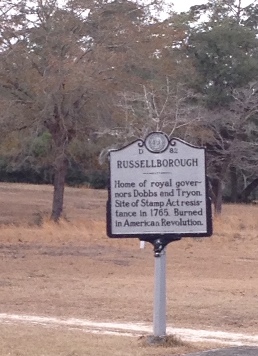
The Ruins of Russellborough

Russellborough SignRussellborough doesn’t look like much now, but once upon a time, these ruins were one of the nicest homes along the North Carolina coast. Now, its spaciousness comes from the cavernous pavilion that protects the houses’ remains.

By the outline of stone and brick on the excavated ground, though, the house must have once been quite impressive. The stump of a stone fireplaces rise from the edge of the far foundation. A round brick cylinder marks the location of an indoor well. The house apparently had a secret passage that allowed residents to escape trouble, too. Continue reading “The Ruins of Russellborough”

Author Interview & Review: Otho Holland Williams in the American Revolution by John Beakes

ERW Book Reviews (1)

Numerous biographies grace the shelves of book stores, museum shops, and the personal libraries of American Revolutionary Era history enthusiasts. Yet, until 2015, not a single dedicated biography was written about an extraordinary American general that rose from the ranks during the war to assume such a lofty position by the successful conclusion of the conflict.

That unintentional omission has now been filled with the excellently detailed oriented and primary source driven biography entitled Otho Holland Williams in the American Revolution by John Beakes. The author is a graduate of the United States Naval Academy in Annapolis, Maryland and a resident of Ellicott City, Maryland.

I had a chance to interview the author via email and one of the questions I asked him was if there was one takeaway you wanted your readers or those interested in the book to know, what would it be? His answer is below and sums up the importance of Williams and soldiers like him:

“Otho Holland Williams was a vibrant, healthy young man with distinctive intellectual gifts and leadership capabilities when he joined the army at age 26 in 1775.  Had there been no War of Independence, he might well have lived a long life enjoying the family relationships that he cherished so deeply, and have risen to a position of prominence and wealth.

Instead, Williams died at age 45, spitting up blood and much weakened in body and spirit from the tuberculosis that he had contacted while a prisoner-of-war in New York after the Battle of Fort Washington.

We owe much to the young men like Williams who gave so much in the fight for our nation’s independence, and yet he is largely forgotten.

Here, truly, was a life laid in sacrifice on the altar of our freedom.”

This biography is part of an ongoing effort by The Nautical and Aviation Publishing Company of America to publish a biography on the chief lieutenants that served under and with George Washington and were instrumental in winning American Independence. Previous volumes in the series include titles on John Eager Howard and Henry “Light-Horse” Lee. The series is entitled, “George Washington’s Best Officers Book Series” and definitely worth the read for the enthusiastic and/or serious student of the American Revolution.

otho-holland-williams-american-revolution

So, why was Otho Holland Williams chosen as the third installment? I asked the author and his response is below;

“Otho Holland Williams kept appearing in all of the key moments of the story of the war in the South, but always tantalizingly just beneath the surface, hidden in the shadow of larger figures like Nathanael Greene and Daniel Morgan.  Williams was a compelling writer, and his descriptions of battles like Camden and Eutaw Springs are superbly written and deeply insightful observations of a first-hand participant.  His leadership of the Screening Force during the Race to the Dan displayed combat leadership skills of the first order, but his life story was largely untold.”

Furthermore, the reader will glean that Williams is the quintessential depiction of the American soldier, rising from the ranks to one of the top positions in the Southern theater by war’s end. The process, superbly told by Beakes, winds the reader from the early days of the revolutionary movement in western Maryland to the Siege of Boston, to the defeats of the New York Campaign. Those achievements and setbacks combined to give Williams the invaluable training as a military officer. For Williams, like a majority of the men who would hold rank in the American forces;

“Military knowledge and experience were scant commodities in the colonies at the start of the Revolutionary War, and young men like Howard, Lee and Williams joined the army in their twenties with virtually no prior military experience.  There were no institutions such as military academies, officer candidate schools, or ROTC to help them learn.  They read all the available military literature.  They observed leaders like Washington, and took in the written guidance that he provided, often in General Orders, for how to develop into effective officers. And most importantly, they learned by experience in the daily rigor of military discipline and in their various combat engagements.  

Starting with such “bare bones” learning opportunities, in the short years between 1775 and 1780, when the Southern Campaigns began, these young officers had become exceptional military leaders, and the army that they led was as fine a combat organization as any on earth.  It is a story of grit and determination and persistence that brought these young civilians to such a high state of military capability.”

During this early part of the war, Williams also became a prisoner-of-war after the fall of Fort Washington during the New York Campaign of 1776. After being exchanged, Williams would feel the affects of his imprisonment which would eventually cause his death in 1794 from tuberculosis.

Yet Williams, like many other junior officers, are still worth studying in history, as Beakes claims, because,

“With the resources available today, we have a powerful opportunity to take a fresh look at these stories. Unfortunately, our fresh look at original sources sometimes reveals that writers along the way have perpetuated false information, sometimes from honest mistakes, but also sometimes from blatant political motives. 

We have an important opportunity to correct the record. Stories like those of Otho Holland Williams give readers a look at the War of Independence from the front-lines and from ground level, a perspective that fills out and enriches the more strategic insights of the well-known works on the Founders.”

This book, like two previous volumes in the series, is definitely a worthy addition to any avid reader of the American Revolutionary Era. If these great in-depth biographies already grace your private library, don’t worry there is more biographies in the works. Beakes is currently working on research for a volume on Baron de Kalb.

Stay tuned and enjoy the read!


*Book Information*

Publisher: The Nautical and Aviation Publishing Company of America
Published Date: November 5, 2015
346 pages, including appendices, bibliography, notes, and index

Click here to view the website where further information, including how to purchase the book, is available.


How Did They Communicate?

Emerging Revolutionary War welcomes guest historian Robert “Bert” Dunkerly to the blog as the author of this post. 

It is well known that German troops (commonly called Hessians) fought alongside the British during the war.  One of the more intriguing questions of the Revolution remains; how did they communicate?  At any given time, German units could comprise from one third to one half of the larger British armies. They were also present in equal numbers in smaller detachments.

French was a common language that many European officers would have known, and there is evidence that German and English officers communicated in French during campaigns.  The language barrier also impacted daily army operations.  For example, Georg Pausch of the Hesse-Hanau Artillery requested an English officer who spoke German for a court martial.   Yet most of that procedure was conducted in French.

Written orders from General Phillips in Montreal in 1777 to Hessian Artillery units were given in French, suggesting that this was commonly done in these calm, routine situations.

It wasn’t a perfect system but it worked well enough. Adjutant General Major Bauermister of Hesse-Cassel, for example, notes that the English spoke poor French, when communicating with them. Yet what about among small units like companies or battalions?

030_30[1]
Re-enactors portraying the Hesse Kassel Jaeger Korps
Would mediocre command of a language suffice for communication in combat situations?  Often small groups of British and German troops operated together on patrols or raids.  Marching to Freeman’s Farm (Saratoga) in 1777 was a column that included Germans on the left, English on the right, and English troops as flankers. Such situations required close coordination.

Other times they were side by side on battlefields, such as at the Battle of Guilford Courthouse in 1781, where the German Von Bose Regiment was aligned next to the British 71st Highland Regiment. Close coordination in these cases was essential.

Still another example is from Brandywine, where Captain Johann Ewald wrote that in the army’s advance, were 60 jaegers on foot, fifteen mounted jaegers, a company of Highlanders, and a company of British light infantry.  All these troops worked in tandem to protect the army from ambush and clear the way for the advance. Yet Ewald was silent on how they did so.

Captain Ewald, also wrote of his experiences in Virginia, where, in the advance on Richmond, small numbers of troops were interspersed.   They marched into the town in this order: Jaegers, British dragoons, more jaegers, and British Light Infantry.  There are dozens of other examples.

Despite the many instances of German and British units mingling, there is precious little documentary evidence of how officers, or the common soldiers, communicated.  Perhaps they used a combination of French, translators who spoke either English or German, and hand signals or other agreed- upon methods.

Timing and clarity are key in close quarters combat, there is no chance to second guess in an ambush or a raid. There were likely instances of misunderstanding that may have led to mistakes and even led to friendly fire incidents.

Of the many accounts this author has researched, only a few mention how they communicated. Perhaps it was something so mundane, or so well understood, that they saw no need to comment on it in their writings. It is hoped that further research will shed light on this question.

Last Home of Jefferson Davis, Last Resting Place of Samuel Emory Davis

Over the Thanksgiving holiday my wife and I visited friends along the Mississippi Gulf Coast. The mutual friends knew about my keen interest in American history and had planned an excursion accordingly.

Within a fifteen-minute drive of where we were staying, sits Beauvoir, the last home of Confederate President Jefferson Davis. In 1877, the ex-Confederate president, looking for a quiet place to write his memoirs  of the Confederate cause in the  American Civil War, paid $50 a month to rent what is known as the “Library Pavilion” on the property. Davis became enamored with the property and purchased the house and grounds from the owner, a Mrs. Dorsey for the price of $5,500 in 1879.

The restored "Library Pavilion" The original was damaged by Hurricane Katrina.
The restored “Library Pavilion”
The original was damaged by Hurricane Katrina.


In the “Library Pavilion” Davis would write the majority of, The Rise and Fall of the Confederate Government. Ten years after purchasing Beauvoir, Davis was dead.

Although not buried on the property, hundreds of former Confederate soldiers are. Yet, there is one Davis is interred on the property now.

The Davis that is buried there is what struck my interest. With no surprise, according to my wife, I had researched what history sites were in that area of Mississippi and had circled Beauvoir as a place of interest. I did not realize that the friends we were visiting had also planned to take me there because they also knew I am a history nerd, err, enthusiast.

What had caught my attention and serves as the basis of this post is the other Davis.

Samuel Emory Davis's Toombstone
Samuel Emory Davis’s Toombstone

Samuel Emory Davis.

Samuel, the father of Jefferson Davis, lies buried in the cemetery. Originally buried below Vicksburg, Mississippi, the elder Davis’s remains were brought to the Gulf Coast to lie at rest at Beauvoir after the course of the Mississippi River was slightly altered.

The Sons of the American Revolution were responsible for saving the remains and having them re-interred.

Samuel Emory Davis, born sometime around 1756, served, like his half-brothers in the militia of Georgia. However, the records available lead to the fact that he served most of the war in South Carolina militia forces.

Furthermore, accounts, gathered by Rice University in conjunction with the Jefferson Davis Papers, have him serving in some of the major engagements of the American Revolution in Georgia, including the Battle of Kettle Creek on February 14, 1779 and the Siege of Savannah from September to October 1779, and lastly the Siege of Augusta between April and June 1781.

A little more research led to the fact that Samuel Davis might have even raised his own mounted force which may have led to the rank listed on his tombstone; major.

After independence, Davis moved his family to Kentucky, where Jefferson Davis was born, then to Mississippi, and finally to Louisiana. While visiting his oldest son, the old patriot died on July 4, 1824.

Marker beside Samuel Davis's grave stone.
Marker beside Samuel Davis’s grave stone.

And from 1943 to this present day the former militia officer and father of the only Confederate president, lies in the Beauvoir Confederate Cemetery.

Thus, the visit, which I am thankful for friends who coordinated it on a holiday weekend that Americans celebrate what we are thankful for, now leads to another thankful opportunity.

More reading and research into the American Revolution.

As I came to Beauvoir for the Civil War history connection. I left wanting to know more about the Davis that fought in the American Revolution.

IMG_6437