In one of the songs of the Broadway hit Hamilton, the character of Aaron Burr says: “Did ya hear the news about good old General Mercer? You know Clermont Street? They renamed it after him. The Mercer legacy is secure.”
The line is referring to Mercer Street in lower Manhattan. Ironically, while they mention in the musical that the renaming of this street secures Mercer’s legacy, many Americans probably have never heard of General Mercer, nor do they know what his true legacy was.
A drawing study John Trumbull did of Hugh Mercer for his painting of the Battle of Princeton. He likely used Mercer’s son as a stand in. (Wikimedia Commons)
Hugh Mercer was regarded as one of the greatest American heroes of the Revolutionary War, at least by his contemporaries. Interestingly, though, Mercer was born in Great Britain, (Scotland to be exact) and studied at the University of Aberdeen to be a medical doctor. After graduating, he joined the Bonnie Prince Charlie’s army as an assistant surgeon and witnessed the bloody destruction of that army on the fields of Culloden in 1746. The young 20 year old became a fugitive in his own land.
The Battle of Culloden decimated the Jacobite forces in April of 1746. The suicidal battle followed an aborted night attack that could have possibly resulted in a Jacobite victory. (Wikimedia Commons)
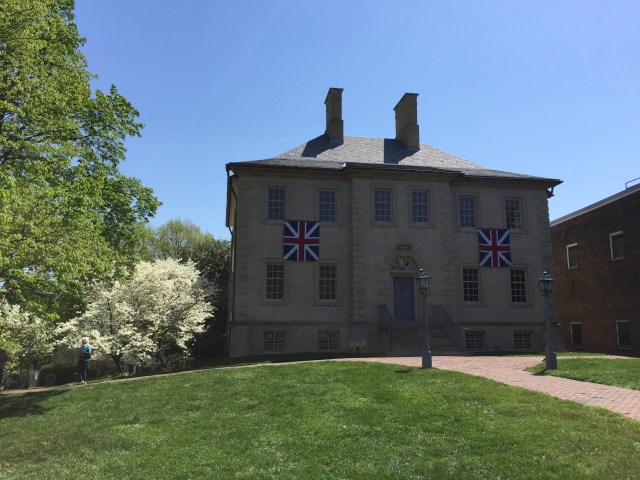
William Griffith’s examination of the Carlyle House Congress last month (The Carlyle House Congress and Britain’s Military Objectives for 1755) reminded me that I had been remiss in not visiting the site. So, the family and I set off for Alexandria, VA and a visit to John Carlyle’s home.
Emerging Revolutionary War welcomes back guest historian Bill Backus
The American Revolution ultimately set in motion a chain of events that transformed not only society in the Americas but also back in the Old World. Six years after the United States gained independence, revolution broke out across France. While Americans focused on building a new nation, across the Atlantic the French Revolution sparked a series of wars subsequently known as the French Revolutionary Wars. Eventually after many years of combat and political chaos, a young army officer named Napoleon Bonaparte emerged as the new Emperor of France. Led by the Emperor the French army and nation embarked on a series of new wars that spread from Spain to Russia. From the beginning of the French Revolution to the defeat of Napoleon at Waterloo, Europe was at war for nearly 26 years, or nearly the entire lives of people born during the American Revolutionary period.
European Armies of the French Revolution, 1789–1802 (Campaigns and Commanders Series) by Frederick C. Schneid
While Napoleon’s French Empire is widely known on both sides of the Atlantic, the wars that allowed Napoleon’s ascent to power are less prominent. Concerned that revolution could spread to the rest of continental Europe, Revolutionary France found itself engaged fighting the European status co intent on restoring the Bourbon monarchy in France. Over the course of years war and peace ebbed and flowed in Europe, with war sometimes sparked by the French in hopes of unifying a splintered public. In “European Armies of the French Revolution, 1789-1802”, historian Frederick Schneid has organized a study exploring the role of some of the prominent European armies in this period. Collaborating with noted scholars in their respective fields, the essays explore the armies of the nation-states of France, Prussia, Austria, Russia, Great Britain, Spain, and the Ottoman Empire, along side the various German principalities and the armies of the Italian states. Continue reading “Review: European Armies of the French Revolution, 1789–1802 (Campaigns and Commanders Series) Edited by Frederick C. Schneid”→
George Washington’s estate on the Potomac River is one of the most-visited places in the greater Washington, DC area, as befits the home of the Father of his Country. Just twelve miles south (by road), however, sits an equally impressive 18th century plantation home. Gunston Hall was the estate of George Mason IV (1725-1792). Best known as one of the delegates to the Constitutional Convention who in the end opposed the Constitution’s ratification, Mason doesn’t always get his due in the stories of America’s founding fathers. But, he was a critical and thoughtful voice in forming the early United States government and enshrining its first ten amendments, the Bill of Rights. Fortunately, his home is open to the public and easily accessible from the metropolitan Washington area.
In honor of April being National Poetry Month, we share the connection of the literary icons of Concord (MA) and its American Revolution heritage. Concord historian Jayne Gordon wrote about these connections in an appendix in our recent release “A Single Blow.” Below is part of that text.
None of the eighteenth-century Concord authors lived through the American Revolution, yet reminders of that eighteenth-century war abounded in Concord in their lifetimes. Their neighbors were the grandchildren of the minutemen; veterans of the war were still among the townsfolk. Buildings, gravestones, old roads, and other landmarks evoked that part of the past, and they were surrounded by the stories of the fateful day of April 19, 1775. They each drew on their interpretations of the Revolution’s symbolic meaning, and incorporated those ideas into both their private and public writings.
The “Old Manse” next to the North Bridge in Concord
In the case of RALPH WALDO EMERSON (1803-1882), there was a direct historical link to a grandfather who had played a significant role in the beginnings of the Revolution. Sixty years after colonial militiamen confronted the British troops at the North Bridge within sight of the Old Manse, the grandson of patriot minister Reverend William Emerson would come to his ancestral home to stay, writing in his journal, “Hail to the quiet fields of my fathers! . . . Henceforth I design not to utter any speech, poem, or book that is not entirely & peculiarly my work.”Continue reading “THE AUTHORS AND THE AMERICAN REVOLUTION IN CONCORD”→
Modern Replica of Fort Randolph in Point Pleasant, WV (Wikimedia Commons)
At Fort Randolph, erected on the old Point Pleasant battlefield, Captain Matthew Arbuckle decided to take matters with the Shawnee into his own hands. He was already suspicious of the Shawnee in general, and Cornstalk in particular. In 1776, he reported that Cornstalk had traveled to Detroit and was “Treating with the English.”[i] Of course, this was William Wilson’s attempt to preserve the neutrality of tribes nearer Detroit by inviting them to a pace conference. Cornstalk had gone on the mission to lend weight to Wilson’s voice with those tribes. Arbuckle did not know that. Continue reading “Chief Cornstalk’s American Revolution (part two)”→
Chief Cornstalk after an 1870 rendering (Wikimedia Commons)
The American Revolution on the frontier was brutal. Neutrality was difficult position to maintain, but some Native American tribes attempted it. In the Ohio River Valley, it was particularly challenging. But, for a time the Shawnee and Delaware tribes in modern-day Ohio sought to navigate their way between British power in Detroit and the Americans in Pittsburgh. Chief Hokoleskwa, known as Cornstalk among the whites, was a leader of the pro-peace factions of the Shawnee. Unfortunately, it got him killed. Continue reading “Chief Cornstalk’s American Revolution (part one)”→
David Smith, Whispers Across the Atlantick: General William Howe and the American Revolution, (NY: Osprey Publishing, 2017).
If it’s true that George Washington lost all his battles, but won the war, then it’s equally true that Sir William Howe won all his battles and lost the war. Of course, neither premise is accurate, but they pithily sum up the conventional interpretation of each commander’s accomplishments on the battlefield, wrong as they may be. Washington’s role as Commander-in-Chief has come under increased scrutiny as Americans revisit their history. His chief adversary, however, Sir William Howe, has largely escaped focused study. David Smith set out to rectify that shortfall in his doctoral dissertation, which became the basis of Whispers Across the Atlantick. Historians should thank him for it. Continue reading “Winning the Battles and Losing the War: A Review of Whispers Across the Atlantick: General William Howe and the American Revolution, by David Smith”→
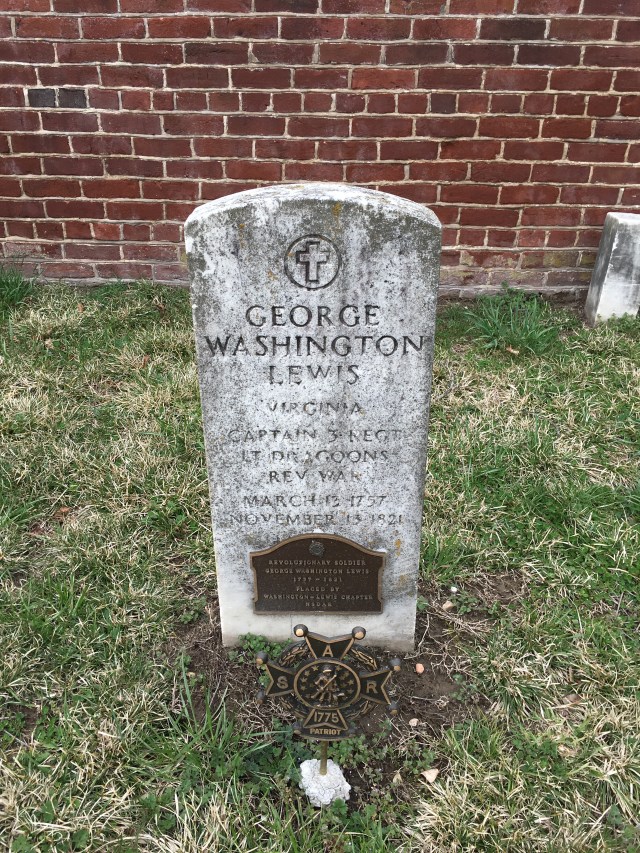
While walking through the Willis cemetery, located at the top of Marye’s Heights in Fredericksburg, Virginia, I encountered the grave of an American patriot from the Revolutionary War, George Washington Lewis. Lewis, as it turns out was George Washington’s nephew and played a role in the Trenton-Princeton campaign in 1776 and 1777.
A relatively modern stone marks the location of George Lewis’ grave in the Willis cemetery on Marye’s Heights. (Author photo)
When one studies British General Thomas Gage and his performance leading up to Lexington and Concord you must step back and put yourself in Gage’s position. A man that believed not only in Royal authority over the American colonies, but also in the basic rules of law. Gage was not anti-American by any means.
In November 1763, Gage was placed in overall command of British forces in the American colonies and settles in New York. At this time Gage was well respected by most American colonists. Of course, this all changed in 1774 when Gage was sent north to Boston to become the Royal-appointed Governor of Massachusetts and enforce the highly unpopular Port Bill that closed the port of Boston among other harsh actions. He was walking into a situation that most historians today argue was a no-win situation. Continue reading ““Acts of a Rude Rabble…” General Gage, Lord Dartmouth and Ignorant Orders”→








 Emerging Revolutionary War Era