(An occasional series highlighting British Lieutenant Governor Henry Hamilton’s march south from Detroit to recapture Vincennes (Indiana) on its 240th anniversary through the entries in Captain Norman MacLeod’s diary.)
This year marked the 240th anniversary of George Rogers Clark’s “conquest of the Illinois country” in modern-day Illinois and Indiana. During the summer, he led a small force of Virginia militia down the Ohio River and eventually captured the towns of Vincennes in modern-day Indiana as well as Cahokia and Kaskaskia in modern-day Illinois. The British Lieutenant Governor of Quebec, Henry Hamilton, could not abide such American audacity and set out to recapture the town of Vincennes and the British fort that had ostensibly protected it, Fort Sackville. On his march south from Detroit, he prodded, pleaded, and encouraged Native American tribes to join his force, significantly swelling his numbers for the late-fall offensive. By October, Hamilton’s army was regularly struggling with low water and ice on the rivers it needed to move supplies while freezing rain, snow, and falling temperatures plagued men on the march.
Sketch of the Wabash River Made During Hamilton’s 1778 Campaign (Wikimedia Commons)
In the summer of 1778, Lieutenant Colonel George Rogers Clark of the Virginia militia launched one of the most daring American military operations of the Revolutionary War when he invaded the “Illinois country” and captured Cahokia and Kaskaskia in modern-day Illinois and Vincennes in southern Indiana, effectively neutralizing British power on the Illinois, Wabash, and Mississippi Rivers. Henry Hamilton, Lieutenant Governor of Quebec and Britain’s Superintendent for Indian Affairs in Detroit, could not allow such audacity to succeed, lest Britain’s influence with the western Indian nations wane. Learning of Fort Sackville’s fall at Vincennes on the Wabash River, he set out to recapture it.
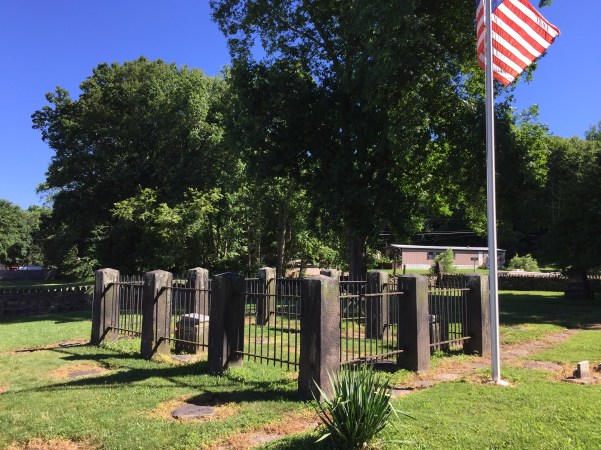
Over the summer, I took a family excursion to several Revolutionary War sites in Ohio, some of which I recently wrote about. In particular, I wanted to trace the experience of several Moravian missionaries and their congregations in the no-man’s land of the frontier. Traveling a back road along the Tuscarawas River between the villages of Gnadenhutten and New Schoenbrunn, we stumbled across the graves of David Zeisberger (1721-1808) and several notable missionaries at the crossroads of Goshen.
Previously I wrote about the fighting in the Mississippi Valley and Gulf coast during the Revolution. Below is a brief overview of the modern states in the Mississippi Valley and a summary of their colonial origins and events there during the Revolution:
Alabama
The French colonized the area that is now Alabama in the early 1700s. They constructed a fort at what is now Mobile, and this was the capital of La Louisiane- not New Orleans. The French presence was never very strong or deep, and they had few settlements in the region.
The French established trade network with Native Americans in the interior. The English were also interested in the region, and trades and explorers penetrated the northern area of modern-day Alabama.
The 1763 Treaty of Paris, which ended the Seven Years’ War after France’s defeat by Britain, resulted in France ceding its territories east of the Mississippi to Britain. Great Britain came into undisputed control of the region between the Chattahoochee and the Mississippi rivers. The portion of Alabama below the 31st parallel became a part of British West Florida. Today this is the long section of the Alabama-Florida state line.
The portion north of this line became a part of the “Illinois Country,” established by the British Crown for use by Indians. At the conclusion of the Revolution, The British ceded West Florida to Spain, and the land to the north to the United States. Yet there was disagreement about where the division between Spanish and American territory was, laying the foundation for a long boundary dispute between the two nations.
While the majority of Revolutionary War action occurred on the Atlantic coast, important events occurred farther west as well. This article takes a look at this lesser known part of the conflict.
It is well known that France was an eager ally of the fledgling United States, secretly making loans and selling supplies to the Revolutionaries. When the French felt the Americans had proved themselves at Saratoga, France officially entered the war, and became the first foreign nation to recognize the United States. On February 6, 1778 both nations signed the Treaty of Alliance, in which France declared war on Great Britain and recognized American Independence.
Spain was also on the sidelines, watching events closely. Unlike France, when Spain declared war on Great Britain, they did not recognize American independence. By the Treaty of Aranjuez on April 12, 1779, Spain entered the war as an ally of France, and agreed to attack British forts in the Mississippi Valley and Gulf Coast. Spain’s King Charles III would assist his first cousin, Louis XV of France in the conflict with the British. The Spanish hoped to recover territory lost from the British, and take advantage of Britain’s preoccupation with the rebellious colonies.
The British were already realigning their military for a worldwide conflict: facing France, Spain, and the Netherlands in India, Gibraltar, Europe, and the high seas. The Gulf of Mexico and Mississippi Valley was yet another front, one that was poorly defended by the British.
In the first action of this vast theater, American marines raided Fort Bute, a British fort located at Bayou Manchac, about 115 miles from New Orleans. The attack on the far western border of British West Florida took place in February, 1778. Continue reading “War in the Mississippi Valley: Part I”→
One of the few historical markers denoting the campaign. The other side of the security fence at the left is home to the county landfill. Tymochtee Creek is to the right. (Author Photo)
(part five of five)
For those men separated from the retreating main body in the pell-mell retreat, Crawford’s expedition had become a nightmare, beginning with the panic on the night of June 5. James Paul remembered being shaken awake with word that the men were leaving and attempting to retrieve his horse in the dark before finding it had already slipped its bridle and wandered away.
“I groped about in the dark and discovered two other horses tied to the same sapling and my horse standing at their tails. This revived my drooping spirits. On finding my horse standing quiet, I bridled him and mounted, and about the same time a number of other horses were mounted by their owners, and all put out from the camp ground together, amounting in all to nine in number, and we made as much haste to get away as we could, considering the darkness of the road, and no roads but open woods to ride through, and no one to guide us.” Paul and his fellows realized Colonel Williamson, now leading the main body, was retreating on a longer route home, “leaving us nine and many other stragglers behind to take care of themselves as best they could, and to steer their own course homeward, and, as it turned out afterward, but few of these stragglers ever got home.”[1]
Paul and his group eventually became mired in a swamp and had to abandon their horses, making their way on foot, pursed by Native American warriors who forced them to scatter. After sleeping in hollow logs and under rocks, going without food other than a blackbird and occasional handful of berries, Paul eventually made his way back across the Ohio alone near Wheeling, arriving at a small fort where settlers had taken refuge against renewed Indian raids.[2]
September 8th will mark the 237th anniversary of this battle in South Carolina’s low country. Hard fought and bloody (General Nathanael Greene used the word obstinate to describe it), the battle has not been well remembered or commemorated.
As the night of June 5 gave way to a dark retreat on June 6, the militia struggled eastward, attempting to reimpose some order on their main body. According to Rose, Crawford set out after one wayward company that had decided on a more circuitous route of retreat that separated it from the main body. While he was gone, the Indians began firing into the militia camp in the dark. At “that instant, every Body was pushing as if it had been a signal agreed for that purpose.”[i]
Rose fell in with a group of about fifty men, who pushed south back toward the abandoned Wyandot town on the Sandusky they had passed through just a few days earlier, seeking to avoid the Shawnee, and then rejoined Williamson with the main body of men as it returned the way the expedition had come.[ii] In the rush, they lost track of Colonel Crawford. They moved directly to the route east without much order, placing speed over the coherence of a fighting unit. Williamson did manage to separate his best horsemen into a smaller group to contest any light horsemen they encountered on the Sandusky plain, but expected to find relative safety when they reached more heavily timbered areas. On June 6, Rose had a close call. Riding ahead while trying to keep the group from breaking up into smaller parties, mounted Indians charged him and his companions from a wooded area on the left. Rose managed to make it back to the main body, which promptly counter-charged with the light horse Williamson had created.[iii] In the process, he lost contact with his two companions, Colonel William Harrison (Colonel Crawford’s son-in-law) and Mr. William Crawford, (Colonel Crawford’s nephew).[iv]
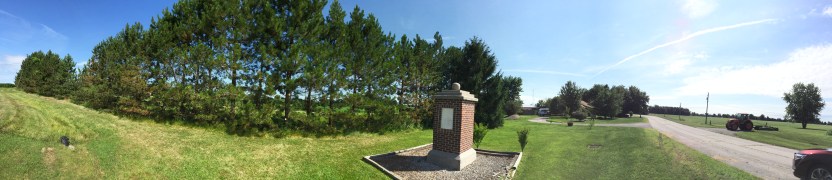
The monument to the “Battle of the Olentangy.” The battle was more of a skirmish, but marked the end of British pursuit of Williamson’s retreating force. Native Americans continued to chase and harass the Americans. (Author Photo)
Later that day, about 24 miles into their march, the militia paused to rest along Olentangy creek. Their mounted pursuers promptly fired into the main body from behind and the militiamen detected a light screen moving into place ahead of them, the beginning of an encirclement.[v] The militia started skirmishing while Rose rode to the rear, nearly through the Native Americans behind them, retrieved the rear body, which contained a substantial portion of the light horse, and sent them to clear the woods of enemy skirmishers in front. The maneuver succeeded and the militia were able to enter the woods, losing three dead and eight wounded in the hour-long fight. Despite anticipating a degree of relative safety there, pursuers continued to harass the flanks and the rear. Simultaneously, the poorly organized militia lost still more cohesion as a fighting unit as the woods broke up formations and isolated men in small groups. To make matters worse, the skies opened up and a heavy downpour soaked everyone to the bone.[vi]
The Battle Monument. “Battle Island” is likely on a slight rise through the pines. (Author Photo)
The expedition continued through thick forest until June 4, when it finally came upon a Wyandot town on the upper Sandusky after noon. It was abandoned to the surprise of Crawford’s guides.[i] (The Wyandot shifted from “Upper Sandusky,” which became known as “old town” and was above the modern town of Upper Sandusky to a new town of “Upper Sandusky,” which became known as Half-King’s town and was below the modern town of Upper Sandusky.) At this point, several men expressed their desire to return to the Ohio, complaining they were down to five days provisions.[ii] Crawford sent a reconnaissance party of about 40 men under Major Rose to the north, where the woods opened up into a gentle plain. Dr. Knight recalled, “there are a great many extensive plains in that country; The woods in general grow very thin, and free from brush and underwood; so that light horsemen may advance a considerable distance before an army without being much exposed to the enemy.”[iii] Indeed, northwestern Ohio was a gently rolling plain flattened by glaciers over a million years ago and covered in 1782 with knee- to waist-high grass, interrupted by an occasional grove of trees. The terrain rolls with small, gentle gulleys and hills rising in quick succession. The combination limited one’s ability to see great distances. It was perfect for the mounted force Crawford led, theoretically capable of moving quickly. But, the slow pace of the advance, the difficulty of terrain, poor availability of forage in the woods, and quality of the horses had worn the mounts out.[iv]
In April, 1782 local leaders, in particular David Williamson, petitioned Irvine to lead a punitive raid to the Sandusky River aimed at the Wyandot and Hopocan’s Delaware.[i] While he could provide no material support or leadership, Irvine approved the attack and laid down several conditions: that the expedition operate under laws governing the militia, that their purpose not extend beyond protecting the border, that the force assembled be large enough to accomplish the task, that the raiders equip and sustain themselves on horseback at their own expense, and that the expedition conduct the raid on behalf the United States with an eye toward bringing honor to the United States. Perhaps he had the brutality of the Gnadenhutten raid in mind and sought to avoid a repeat.[ii]
This Sandusky raid did not reflect Irvine’s strategy of either reducing Detroit or bringing the tribes to battle; it was simply another American raid on Indian towns, which would likely be abandoned by the time the expedition arrived. Irvine informed Washington that the expedition was going forward and did not seek permission. Indeed, he may not have had the power to stop it given the restlessness of the local population on the frontier. Rather that departing in early August, this raid would leave in late May, before the summer heat dried out the countryside. Speed and surprise would be important, perhaps explaining Irvine’s requirement that every man be mounted, that the expedition dispense with artillery, and that it limit baggage and supplies to 30 days’ worth.[iii] Irvine wrote Washington, “If their number exceeds three hundred, I am of opinion they may succeed, as their march will be so rapid they will probably in a great degree effect a surprise.”[iv] But, it would be a risky enterprise. Continue reading “The Crawford Campaign, 1782: Birth of an Expedition”→





 This small roadside park preserves a portion of the battlefield.

 Emerging Revolutionary War Era