Emerging Revolutionary War welcomes guest historian Paige Gibbons Backus to the blog. This Weekend marks the 244th anniversary of the Boston Tea Party.
We all know the holidays are some of the heaviest travelled times of the year and over my Thanksgiving holiday, I had the opportunity visit Boston for a day. When in the city for only one day, what do we go and see? Do you go to the U.S.S. Constitution, Bunker Hill, Faneuil Hall, or the Paul Revere House? Do you go to the colonial meetinghouses, the historic cemeteries, or just walk around the historic sections of the city? One of the sites that I decided to visit was the Boston Tea Party Ships & Museum. I heard many good things about it from online reviews and professional colleagues about the interactive exhibits and experiences available there. Working at an immersive historic site myself, I was definitely curious to see what they had done to make their history exciting to audiences, and despite the museum’s shortcomings, make it interesting they did.
One of the highlights of the Boston Tea Party Ships is that they did a decent job creating an interactive experience for visitors. After purchasing tickets outside, visitors receive an identity card and a feather, and are then invited into a room meant to replicate the South Meetinghouse. From there, first-person actors serving as tour guides take visitors through the planning, implementation, and effects of the Boston Tea Party. For example, Sam Adams rallied the crowd weaving in the events leading to the Boston Tea Party, even teaching visitors how to show approval or displeasure in a public setting, (to which I was hissing before it was cool). He even called on visitors with various identity cards to voice their opinion, bringing in interesting, albeit reluctant, audience participation. After the visitors were riled up, we donned our feathers in our hair and were lead onto the ships to commence tossing the tea. Continue reading “Emerging Revolutionary War Weekender: The Boston Tea Party Ships & Museum”→
I think it would be fair to say that John Adams spent the last 25 years of his life feeling sorry for himself. He was a grumpy and vain old man searching for the respect he thought he deserved.
If Adams were to read the highly anticipated new book by Pulitzer Prize-winning author Gordon Wood, the old curmudgeon would be no happier. In fact, the final lines of the book, handed down like a final judgement, would only confirm what Adams believed would be the view of historians forever. “To be an American,” Wood wrote, “is not to be someone, but to believe in something. And that something is what Jefferson declared. That’s why we honor Jefferson and not Adams.”[i]
The stacks of books reflect Knox’s role as a bookseller before the war.
If you have not made a trip to the new American Revolution Museum at Yorktown (the former Yorktown Victory Center) then you are missing out. Not only does the museum great exhibits on the causes of the war and the events leading up to Yorktown (with great technology), there is a changing exhibit gallery that allows for short term exhibits. The first exhibit opened in June and features the lives of four prominent Revolutionaries after the American Revolution. Continue reading “AfterWARd, the new exhibit at the American Revolution Museum at Yorktown. A visit with Curator Kate Gruber”→
The sign at the first pull-off left me underwhelmed. Fortunately, my impression of the battlefield got better and better.
I know we’re getting close to the Cowpens battlefield when we pass Redcoat Drive and then Tory Trail. Unfortunately, my GPS takes us to the maintenance shed rather than the visitor center, but the park’s signage finally manages to get us where we need to go.
I know nothing about the battle of Cowpens, but my colleague Rob Orrison has strongly recommended I visit the battlefield. It involves some of the most colorful characters of the war, he tells me: Daniel Morgan and Banastre Tarleton. “The battle changed the course of the war in the Carolinas, in my humble opinion,” Rob adds.
That seems like a pretty ringing endorsement to me. My son and I, on our way back from Atlanta, decide to make the hop off I-85 for a visit. Continue reading “A Detour to Cowpens”→
On August 27, 1776, in Brooklyn, New York, a small contingent of Maryland soldiers showed the world what valor and patriotism looked like. During one of the largest and bloodiest battles of the Revolutionary War, the actions of these brave soldiers would earn them the venerated name of the Maryland 400.
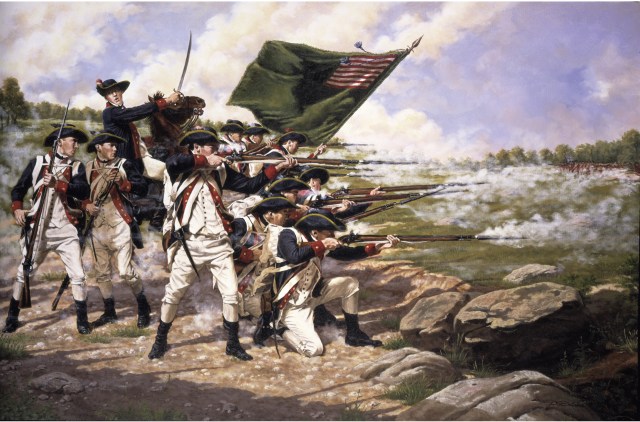
At Long Island, the 1st Delaware Regiment (pictured here) fought alongside the Marylanders on the American right flank. (Wikimedia)
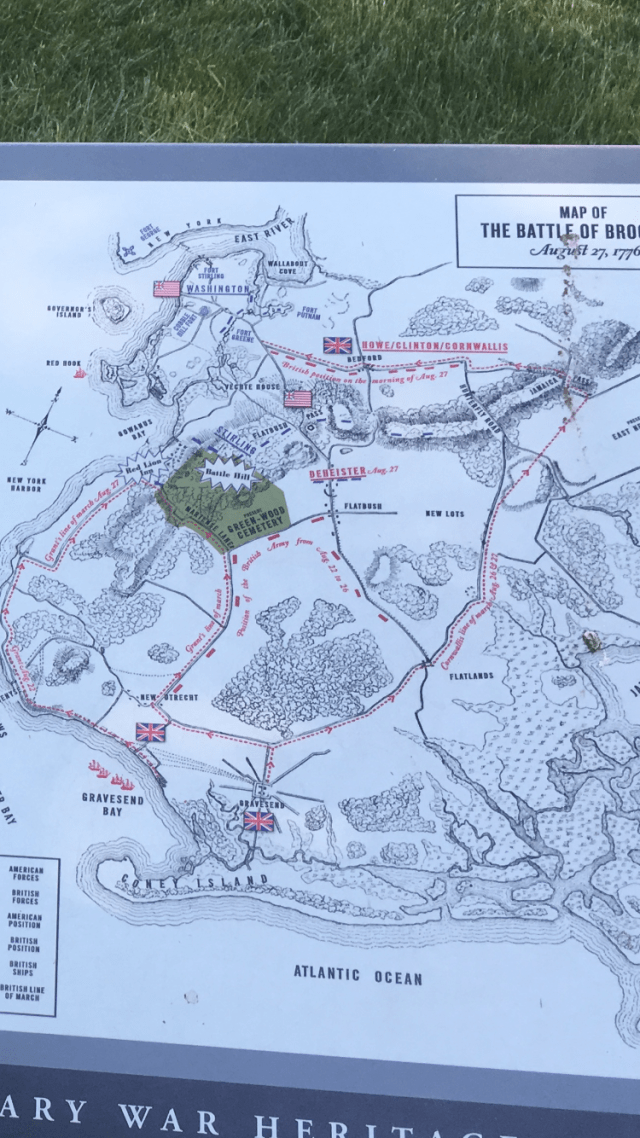
At the Battle of Long Island, the American Army was strung out in a long line across modern day Brooklyn facing south, with Washington and his headquarters located at Brooklyn Heights. However, Washington and the Americans had failed to guard the extreme left flank of the American line. As a result, British General William Howe divided his army in two, attacked the American main line head on to hold them in position, while British Generals Charles Cornwallis and Henry Clinton marched around the American flank and attacked from the east.
Map of the Battle of Long Island. (Author’s photo)
A version of this post appeared in the Emerging Civil War blog on August 17, 2018.
John S. Mosby, photographed here as a Federal civil servant
Those who know me know of my “interest” in famous Confederate partisan, John S. Mosby. Ok, some would say “love affair,” but either way, I grew up reading about Mosby and his exploits during the Civil War. It was not until later in my life that I started to read about the most interesting part of Mosby’s life—not his time in the war, but his time AFTER the war.
Mosby had a deep interest and passion in American history and you can see that on a trip that Mosby took north in April 1906 to one of the sacred sites of America’s founding: Boston, Massachusetts. In a 1906 letter to his friend Sam Chapman (a former member of Mosby’s Rangers), Mosby describes his visit and the many ironies (as a southerner) he experienced. Continue reading ““I hope my visit to Boston will do good…” Confederate Colonel John S. Mosby and American Revolution”→
In 1940, during World War II, the British and French armies were completely surrounded by the Nazis at Dunkirk. The Allies made a successful evacuation, lived on to fight another day, and gained a newfound resolve to resist the Nazi war machine. The uncertainty and suspense of the evacuation at Dunkirk has recently been brought to life on the big screen with Christopher Nolan’s movie, “Dunkirk.” As people pack the theaters this summer to see the film, it’s good to remember that America had its own desperate, nation-saving evacuation during the Revolutionary War.
In one of the most daring maneuvers of the Revolutionary War, Washington led his men on a daring night time retreat across the East River. (Library of Congress)
In the summer of 1776, Great Britain dispatched the largest expeditionary force it had had ever sent anywhere in the world up to that point in history. The British soldiers and sailors made their way into New York harbor to subdue the American rebels. Continue reading “America’s Dunkirk”→
Several weeks ago I was fortunate enough to take part in Fort Ticonderoga’s twenty-second annual War College of the Seven Years’ War as a guest author. This was my first experience attending the War College, and I can confidently say that I plan on going again. The three day symposium took place from Friday, May 19, to Sunday, May 21, and consisted of lectures, book signings, and even a tour of some of the fort’s awe-inspiring artillery collection on display throughout the complex by curator Matthew Keagle. If you have not visited Fort Ticonderoga before, their massive inventory of 17th and 18th century cannon is well worth the visit alone. In fact, this August the staff and outside historians and interpreters will be conducting a symposium entitled, “New Perspectives on the ‘Last Argument of Kings’: A Ticonderoga Seminar on 18th-Century Artillery.” You can access the schedule and more information here. I am saving up my pennies right now to go!
The War College’s Saturday and Sunday lecture lineups were superb. They included several lectures that focused on the colony of New France and France’s regular soldiers deployed in North America. I consider myself a French and Indian War historian, but I have never paid much attention to what transpired along the Mississippi River during the conflict. It is easy to forget sometimes that France’s claims on the continent included not just Canada, but south down the Mississippi River all the way to Louisiana. This region seems too far away from everything else to have served an important role during the war, but that simply was not the case. Thanks to Joseph Gagne (Laval University) and David MacDonald (Illinois State University, retired), I was introduced to events transpiring in the Illinois Country and Louisiana.
Other lectures were also given focusing on The Cherokee War (Jessica Wallace, Georgia College and State University) and even smallpox. David Kelton, University of Kansas, shared with us his work entitled, “Disease Diplomacy: How Rumors of Smallpox, Outbreaks, and Diabolical Schemes Shaped the Course of Empire in North America, 1755-1764.” His arguments targeted the myths of biological warfare conducted by the English against Native Americans. Another talk that I was excited for (it had a whole lot to do with my first book I authored) was a look at Ephraim Williams and the Bloody Morning Scout during the Battle of Lake George, presented by Gary Shattuck. Gary’s conclusions and judgements were in line with my own. He did not believe that Colonel Williams blundered his way into an ambush that left him and scores of men under him dead. It is always nice to see when historians reassess the decisions made and roles played by those who have been judged poorly by history. The photographs used in the presentation of the battlefield today were also very useful. Shattuck had a good eye for the terrain and gave me the best look at where the positions held by Baron de Dieskau’s French Regulars, Canadian militia, and Native Allies, in his opinion, most likely were (of course this is still up for debate).
Unfortunately, I needed to leave early and missed Sunday’s talks, which included Brady Crytzer discussing his new book on the Kittanning Raid of 1756, as well as a look at Cadwallader Colden, a colonial statesman from New York, and his experiences during the French and Indian War by John Dixon (College of Staten Island). Matthew Keagle also conducted a talk on the dress and traditions of light infantrymen. I missed a good day.
On my way out of Fort Ticonderoga I stopped off at one of my favorite battlefields. Just outside the fort complex down the exit road is the Carillon battlefield, where on July 8, 1758, a massive British and provincial force under the command of James Abercromby continuously assaulted a fortified line of earthworks and abatis held by a much smaller French army under the leadership of the Marquis de Montcalm. By day’s end the French had emerged victorious, inflicting over 2,000 casualties within Abercromby’s force. The 42nd Regiment of Foot (The Black Watch), alone, lost well over 600 men. It was the bloodiest military engagement fought in North America prior to the Civil War, yet it is widely forgotten.
Carillon Battlefield, Fort Ticonderoga, NY. Remnants of the French earthworks are visible in front of the treeline.
Today, the Carillon Battlefield is small, or at least the area that is easily accessible to the public is. Despite this, portions of Montcalm’s earthworks still remain (rebuilt by future armies making their way to the Heights of Carillon) and the spot is dotted with several monuments, including one for the Black Watch, as well as a reconstructed cross to mimic the one placed along the French lines by Montcalm to memorialize his victory and honor his men’s courage against such great odds. Other than this tiny open area, the rest of the battlefield is covered with a dense thicket making it difficult to explore. However, it is extremely peaceful and serene. If you look to the woods with your mind’s eye, you can almost see the waves of scarlet red moving relentlessly towards your position, and hear the shriek of the bagpipes, the crack of the drummer’s cadence, the rattling of musket fire, and the yells of men charging towards a probable death.
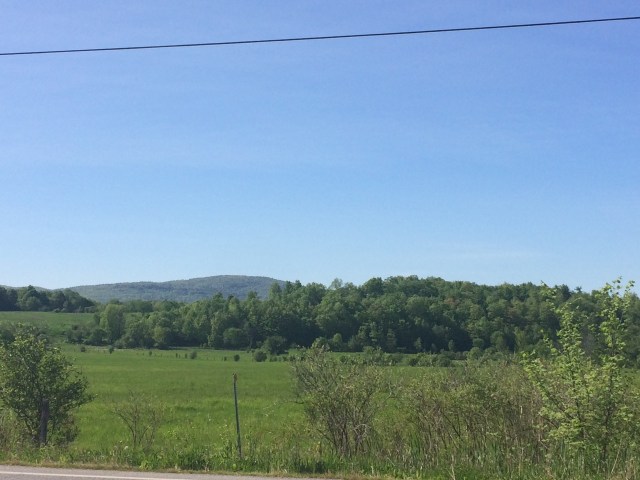
Monument to the 42nd Regiment of Foot, “The Black Watch,” dedicated in 1997.Fields just outside the exit of Carillon Battlefield and Fort Ticonderoga, where Abercromby’s men formed their ranks and repeatedly advanced against Montcalm’s fortified line.
Fort Ticonderoga and the Carillon Battlefield are a must-see for any history buff.
The Moores Creek battlefield manages to look simultaneously well manicured and primordial. Encompassing only 87 acres, it’s a landscape from before the dinosaurs that happens to have a rubberized pathway winding through its tall, thin pines.
Tucked away in a forest some 22 miles northwest of Wilmington, North Carolina, the battlefield sits along a darkwater creek that spills its banks into even darker patches of swamp. This is Moores Creek itself, where, in February 1776, Patriots and Loyalists squared off with muskets, broadswords, and a pair of cannons. (And, yes, I did say “broadswords.”) Continue reading “A Visit to Moores Creek”→




 Poor John Adams.




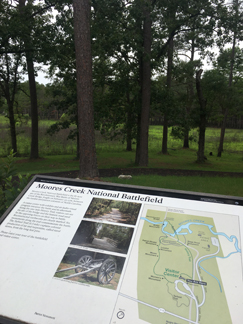 The Moores Creek battlefield manages to look simultaneously well manicured and primordial. Encompassing only 87 acres, it’s a landscape from before the dinosaurs that happens to have a rubberized pathway winding through its tall, thin pines.
 Emerging Revolutionary War Era