

This is a post from September 2016. It focuses on a critical military action that occurred during the Battle of Lake George, 264 years ago, today:
When analyzing the key actions of a military engagement in order to pinpoint a decisive moment or turning point, one does not usually come across a retreat and/or rout that actually attributed to the success of an army. However, during the late morning of September 8, 1755, roughly three miles south of Lake George in New York’s Adirondack Mountains, a contingent of men from Connecticut and Massachusetts, and their Mohawk allies conducted quite possibly the first ever organized fighting retreat in American military history – one that would turn the tide of battle and save their army from potential destruction. It is easy for a maneuver like this to be overlooked, but without the crucial time bought for William Johnson’s provincial army at its encampment along the southern shore of the lake by Lt. Colonel Nathan Whiting’s courageous New Englanders, Baron de Dieskau’s French army may well have emerged victorious during the Battle of Lake George and subsequently pushed their way to Albany’s doorstep.
Around eight o’clock in the morning, September 8, 1755, a column of men 1,200 strong was marched out of William Johnson’s camp at the southern end of Lake George. The column’s destination was Fort Lyman, roughly fourteen miles to the south located beside the Hudson River (present-day Fort Edward, NY). There, intelligence gathered by Johnson’s army had placed the 1,500 strong French force led by Jean-Armand, Baron de Dieskau, which was believed to be preparing an assault against the 500 man garrison of New Hampshire and New York provincials.
The contingent of reinforcements dispatched from the English camp was under the overall command of Colonel Ephraim Williams, 3rd Massachusetts Provincial Regiment, and was comprised of his own regiment, 200 Mohawk Indians, and another 500 men of the 2nd Connecticut Provincial Regiment led by Lt. Colonel Nathan Whiting. The column marched south down the military road with the Mohawk at its head, followed by the Massachusetts men, and Whiting’s regiment taking up the rear.
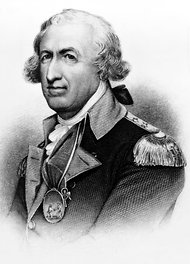
Nathan Whiting, born in 1724 and a resident of Windham, was 31-years-old in 1755 and one of William Johnson’s youngest field officers. He was a graduate of Yale and a veteran of the Louisbourg expedition during King George’s War – service which earned him a lieutenant’s commission in His Majesty’s Forces. When hostilities between England and France erupted in 1754 he was commissioned as the 2nd Connecticut Provincial Regiment’s lieutenant colonel and was sent to Albany to serve as part of the Crown Point Expedition, an offensive designed to oust the French from the Lake Champlain-Lake George-Hudson River corridor. The regiment’s colonel, Elizur Goodrich, was ill and bedridden during the Battle of Lake George, so Whiting served as the unit’s field commander during his absence. Whiting was a loyal officer and earnestly dedicated to the cause in which he was fighting for. Before reaching the southern shore of the lake on August 28, he penned a heartfelt letter to his wife that epitomized his character: “… [P]ray make your Self as easy as possible[.] I know your D[aily] prayers are for my preservation[.] Let it be an article of them that it not be obtained by any unworthy means, but in the prosecution of the Duty I owe at this time to my Self, my Country & my God.”[1]
About two hours or so and three miles into the march to Fort Lyman, the forward ranks of Ephraim Williams’s column of reinforcements were ambushed by Dieskau’s native allies, Canadian militia, and regular grenadiers of the Regiments of Languedoc and La Reine. The French outside of Fort Lyman had earlier uncovered dispatches from a dead courier that was sent to inform the English outpost that reinforcements were going to be sent from the lake encampment to assist it in case of an attack. Using this intelligence, Dieskau marched his army up the military road towards Lake George and prepared an ambush to surprise the oncoming party of reinforcements. Although the ambuscade was initiated prematurely before the entire column could march into Dieskau’s hook-like formation, it still succeeded in throwing the English force into confusion and sent it scurrying back up the road to Lake George. Both Ephraim Williams and Chief Hendrick (commanding the Mohawk contingent) were killed during the confrontation and all order was lost, leaving Whiting, who was now the highest ranking officer on the field, to try to prevent a disaster.






 Emerging Revolutionary War Era