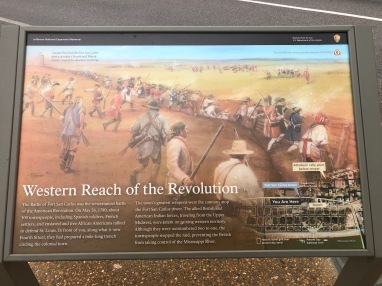
From a Pennsylvania State Historical Commission marker, one quickly can find out the importance of Osborne Hill to the Battle of Brandywine, fought on September 11, 1777.
Osborne Hill Marker (courtesy of Keith Smith, hmdb.org)
The hillside was the site of British General William Howe’s post in which he coordinated and commanded the different components of the British and Hessian forces that day. The battle opened the way for the British conquest of Philadelphia and was the largest, in terms of manpower fighting, of any American Revolutionary War battle.
19th century print of the Battle of Harlem Heights. The image shows the Americans attacking the British right flank.
After the Battle of Long Island, American forces evacuated to Manhattan Island. But with the British in command of the waters around New York, they easily could land their forces anywhere along Manhattan Island. On September 15th, the British crossed the East River north of New York City and landed at Kip’s Bay, easily pushing aside the American forces there. American forces in New York City were nearly cut off, but quickly retreated up Manhattan Island to Harlem Heights and began to dig in. On the morning of the next day, British troops arrived in front of the American lines at Harlem Heights. Washington expected an attack and decided to take the initiative.
Washington ordered a small party of 150 men called “The Knowlton Rangers” under the command of Lt. Col. Thomas Knowlton to move out and reconnoiter the British position. Knowlton quickly recognized the British were not planning a major assault but his force had brought about the attention of the British light infantry, soon the Knowlton Rangers were outnumbered and quickly retreated back to the American lines. When Knowlton reached safety, the British light infantry paused, placing them out in front of their main lines. Washington seized the opportunity and ordered an assault on their rear by Knowlton’s men and a reinforcement of 200 Virginia riflemen from the Third Virginia under Major Leitch.
Though the American attack was supposed to be in the rear of the British light infantry, but because of confusing terrain and attacking too soon, the flanking column instead hit the British in their flank. The effect still had an adverse effect on the British light infantry as they began to fall back. The Americans fought with determination and bravery. Knowlton went down mortally wounded. Colonel Griffith wrote of Leitch “He conducted himself on this occasion in a manner that does him the greatest honor, and so did all of his party.” Washington wrote the next day that “The General most heartily thanks the troop commanded yesterday by Major Leitch, who first advanced upon the enemy, and the officer who so resolutely supported them.”
At the head of the attacking column both Knowlton and Leitch led their men forward to attach the British flank. Early in the attack both men went down wounded. Knowlton died on the battlefield, Leitch took three musket balls to the abdomen and was carried off the field. At first most reported his condition as improving and he was thought to survive his ordeal. Washington wrote “Majr Leitch of Weedons Regiment (Third Virginia) had three balls through his side, and behaved exceedingly well – he is in fair way of recovery.”
Soon the British began to retreat back to their main line. Washington then ordered an attack along his line and the British light infantry fell back to the main line in confusion. Soon the entire British line began to give way. After about a 90 minute fight, Washington learned that more British forces were arriving on the field and ordered his men back to the main line. Though not a major victory, the American army had finally stood up to the British and even for a moment, pushed them off the field in combat. The British suffered 14 killed and an estimated 154 wounded, with the Americans suffering 30 killed and 100 wounded.
Though most believed that Leitch was recovering from his wounds, by September 20th Gen. Horatio Gates wrote “Major Leitch of Maryland was wounded and despaired of.” As his condition worsened, there was little for regimental surgeon David Griffith could do but to try to ease Leitch’s pain. Griffith wrote to Leitch family friend Richard Henderson on October 3rd that “[I] disagreeable duty of informing Mrs. Leitch through you, of the death of her husband is imposed upon me. He expired yesterday morning at Hackinsack Bridge where he had been removed for his better accommodation…But on the 28th Sept he was seized by lock’d jaw – with spasms about his neck and throat so violent as to baffle every effort to minister to him by medicine.” It seems the death of Leitch was a tough and unexpected blow to his fellow officers in the Third Virginia Regiment.
Where Major Leitch’s remains are today is a mystery. Captain John Chilton wrote on
Commemorative Plaque showing the wounding of Knowlton and Leitch
October 4, 1776 that “the brave Major Leitch who died of his wounds received the 16th was interred yesterday by the side of Major Henly.” We know the general area of the American camps in the fall of 1776, but this burial location is long lost to history. In 1897, historian Henry Johnston wrote in his account of the Battle of Harlem Heights that Knowlton and Leitch are probably buried somewhere “on St. Nicholas Avenue, between 135th St and 145th St.” in New York City. Of course the land has changed a lot since then and whatever remains were left were destroyed by modern development.
Today the area of the Harlem Heights battlefield is now under the campus of Columbia University in New York City. Today there is a simple plaque on the wall on the eastside of Broadway north of 117th Street. This plaque commemorates the Battle of Harlem Heights and depicts Major Andrew Leitch as well as Lt. Col. Thomas Knowlton (who was mortally wounded in the same attack as Leitch). Near here is where Leitch was mortally wounded turning the flank of the British line.
The search for Andrew Leitch continues. His contribution to the American Revolution is well documented through the letters of George Washington and others. When he moved to Dumfries, VA and where he lived is still unknown. We do know that he was influential enough to be elected to Prince William County’s Committee of Correspondence in 1774 and involved in the efforts to raise men and funds for local companies of troops. Continued research in his widow’s pension cases as well as researching contemporary archives may turn up new information. For now, he is honored with a plaque in New York City and a small park here in Virginia. My hope is that this story will end with an appropriate understanding and remembrance of a man who gave his life for our nation’s independence.
Entry in George Washington’s Papers for March 16, 1775: “Went to Dumfries to review the Independent Company there, Dined and Lodged with Mr. Leitch…”
For Further Reading:
Johnson, Henry. The Battle of Harlem Heights. New York: Macmillan Company, 1897.
Peters, Joan. The Third Virginia Regiment of Foot, 1776-1778, Volumes 1-2. Westminster (MD): Heritage Books, 2008.
After his first battlefield victory at the Battle of Harlem Heights on September 16, 1776, General George Washington wrote “The General most heartily thanks the troop commanded yesterday by Major Andrew Leitch, who first advanced upon the enemy, and the others who resolutely supported them.” The battle was a small victory for the American army, but instilled some confidence in the men who had suffered many defeats since August on Long Island and lost New York City to the British. One of the main players in this action was Major Andrew Leitch. A little known Continental officer who at the time was considered a rising star, but today is mostly forgotten.
But my connection with Andrew Leitch goes beyond my love and interest of the American Revolution, it is more personal than that. In 2008 I met the woman that became my wife. At the time, she ran a park locally named Andrew Leitch Park. Having worked here locally for a few years, I was not aware of who the park was named after. I did a quick search of the name Andrew Leitch and realized we had a Revolutionary War hero. In my ignorance thinking everyone was as interested in history as I was, I assumed my future wife knew this fact. Of course…she didn’t. But now I had an “in” to keep talking to this young lady. And of course…she saw through it and had little interest in Andrew Leitch but it worked out and now we are married and have two great young kids. So, I partly owe all of this to Mr. Andrew Leitch.
Who was this little known hero and why did have a park named after him in Prince William County, VA? In 1774 Andrew Leitch moved to Virginia from Maryland and began a new life in Northumberland County. He and his wife Margaret had three children and Leitch must have had influence because he was able to secure a commission as Captain in the 3rd Virginia Regiment on February 6, 1776. In this capacity he recruited men from Prince William County and led the Prince William Battalion (which also included men from Loudoun County). The Prince William Battalion joined the rest of the 3rd Virginia in Williamsburg in late February. Soon though Leitch received a promotion on June of the same year to Major in the 1st Virginia Regiment (though there is one source that places his promotion to Major on March 18th). As Washington moved his Continental Army from Boston to New York City in March 1776, he called for reinforcements. Men of the 1st Virginia and 3rd Virginia were called to join Washington in New York. For reasons unknown, the 1st Virginia was slow to get to New York. Leitch seemed to be a man of action as he joined his former men in the 3rd Virginia on their march to New York as they were a few weeks ahead of the 1st Virginia.
The 3rd Virginia did not arrive in New York in time for the disastrous Battle of Long
The Third Virginia flag captured at the Battle of Waxhaws on May 29, 1780. The flag is in a private collection.
Island, arriving in early September to join the American army on Harlem Heights. Washington was happy to see his fellow Virginians and he needed the reinforcements. The Americans had lost New York City and were pushed off of Long Island, all the way up to the northern tip of Manhattan Island. The Americans needed something to encourage them, a battlefield victory. Major Andrew Leitch played a crucial role in delivering that victory, though at a horrible cost.
Part 2 will cover Andrew Leitch’s role in the Battle of Harlem Heights and his once forgotten legacy.
A precedent was set in early July for the young and aspiring American republic. A date other than July 4th and in fact, nine days and eleven years later.
July 13, 1787.
Northwest Ordinance (courtesy of OurDocuments.gov)
On that date, the United States Congress enacted the Northwest Ordinance which set in motion the precedent for how new states would enter the burgeoning United States of America. In 1784 the groundwork for the Northwest Ordinance was laid, rejecting a proposal that new territories, carved from ceded land of current states, would enter as colonies. Congress set up the following parameters. Continue reading “Northwest Territory: Setting a Precedent”→
Now I know what you are thinking…the famous song by The Eagles. But, no.
Corner where Fort Gatlin once stood, Gatlin Avenue is running left to right, South Summerlin is off the right of the photo. Historical marker sign on left side of photo, D.A.R stone marker across street (to the right of the Jeep in the driveway)
Continuing a theme from the last post, military history in Orlando, I did find myself standing on a street corner, South Summerlin Avenue and Gaitlin Avenue. That is when I noticed the small stone marker, placed by the Daughters of the American Revolution. Placed next to a hedge, on the corner of a driveway, sits until recently, the only reminder of this former military installation. Around this fort sprung a small county that became the county seat of Orange County, Florida by 1856. Which grew into Orlando.
An 1844 survey of Orange County, depicting Fort Gatlin (courtesy of the Bureau of Land Management, General Land Office Records and The Florida Historical Society
Constructed on November 9, 1838, by Lieutenant Alexander Fanning and four companies of the 4th U.S. Artillery, the post was one of several built across the breadth of central Florida during the Second Seminole War. Named in honor of Dr. John S. Gatlin, who had been killed in Major Dade’s Massacre on December 28, 1835. After completing the post, which was situated on a rise that commanded three lakes, Lt. Fanning and three companies departed, leaving 1st Lieutenant F.E. Hunt.
After June 1839, the United States Army had abandoned the post, yet state militia continue to garrison the wooden ramparts. A brief return in October 1849 by the army led to it becoming an active post, briefly, until the soldiers left shortly thereafter.
One side of informational panel of the Eagle Scout project for Fort Gatlin
Abandoned, besides the stone marker, until recently. A great Eagle Scout project produced a wooden two-panel history of Fort Gatlin, Native American history, early settlers, and the 2nd Seminole War. This stands on the same corner as the Florida historical marker and across the intersection from the Daughters of the American Revolution stone marker.
Florida Historical Marker for the Site of Fort Gatlin
D.A.R. stone marker (FYI ADT sign is for the residence next door)
And standing for one day, a man on astreet corner, looking for history, a fine sight to see.
When one mentions the word “Orlando” what is the first thought to pop into your head?
Universal?
Or maybe two words; “Disney World or Walt Disney?”
In all likelihood, the name Francis Wayles Eppes, is not one of the people you would associate central Florida with. You may even be asking, who is Francis Wayles Eppes.
Francis Wayles Eppes
Born on September 20, 1801, Francis was the only surviving child of Thomas Jefferson’s daughter Maria and her husband, John Wayles Eppes. When his mother died in 1804, his grandfather, the third president of the United States at the time, took young Francis under his care and the child resided at Monticello, Jefferson’s Virginia estate.
As young Francis grew, he spent time at Poplar Forest, Jefferson’s estate near Lynchburg, Virginia, which was bequeathed to him by his grandfather after the grandson married Mary Elizabeth Randolph in 1822. Francis, prior to marriage, studied law at both Georgetown College and South Carolina College.
With the death of his father and grandfather within three years of each other; 1823 and 1826 respectively, Francis and his wife joined the movement south, leaving Virginia for sunny Florida.
Initially settling outside Tallahassee and was instrumental in the formation of one of the first Episcopalian churches in the Florida territory, when he donated $500 to a construction of St. John’s Episcopal Church. He was a vestrymen, delegate to the Episcopalian convention in Florida, and also secretary of the local diocese for many years.
After a long public service record in Tallahassee, including serving as intendant or mayor of the capital for a few terms and being an early proponent of a school of higher learning–Jefferson-esque–which became the precursor to Florida State University, Eppes relocated to central Florida in 1869.
Even in his 60’s, Eppes stayed active, becoming a citrus farmer and was part of the group that founded the Cathedral Church of St. Luke in Orlando, the first Episcopal church in the growing town.
Eppes’s home in Orlando. Plaque on front porch reads; “Site and home of Francis Eppes Grandson of President Thomas Jefferson Original House Built in 1868 Marker Placed by Orlando Chapter NSDAR December 3, 1998”
A historian, writing about Eppes’s contributions of that era summarized the Virginian in the following words; “Through the 40’s, 50’s, and 60’s [1800s] there were few civic, religious, or educational affairs in which he did not have a prominent part.”
On May 30, 1881, Francis Wayles Eppes passed away at his home and would be buried in Greenwood Cemetery. He was 79 years old.
On New Year’s Day 1777, Robert Morris wrote to George Washington and said: “The year 1776 is over, I am heartily glad of it and hope you nor America will ever be plagued with such another.” While many of us have similar thoughts every New Year’s about the previous year, the year 1776 was exceptionally bad for the patriot cause, despite the Declaration of Independence being signed that summer. After losing New York and a string of battles, Washington had shocked the world at Trenton on the day after Christmas. This glimmer of hope was almost crushed by the fact that most of his army’s enlistments expired on January 1st.
“Washington’s men had sacrificed much in the past few weeks and suffered greatly. Many believed they had done their duty, and rightly so. But at this moment, they were needed more than ever before. All day on December 31, 1776, Washington’s generals appealed to the soldiers to reenlist. Washington authorized an exorbitant $10 bounty
to those men who agreed to remain, this being funded by financier Robert Morris in Philadelphia. Some of his generals, such as Gen. Thomas Mifflin, a politician and public speaker from Philadelphia, were successful in retaining some of the men, others were not as successful. However, the most affecting scene was when Washington himself personally appealed to the patriotism of the men who had campaigned by his side. Washington paraded Gen. John Sullivan’s and Gen. Nathanael Greene’s divisions just outside Trenton. He entreated the men to stay on just a few weeks more. He asked those who wished to reenlist to move forward, but at that point no one moved. Sergeant Nathaniel Root of the 20th Continental Regiment (Connecticut) remembered that the men were “worn down with fatigue and privation” and had their “hearts fixed on home.” Washington, pleading with his brave soldiers wheeled his horse in front of the men and declared to them, “My brave fellows, you have done all I asked you to do, and more than could be reasonably expected; but your country is at stake, your wives, your houses and all that you hold dear. You have worn yourselves out with fatigues and hardships, but we know not how to spare you. If you will consent to stay only one month longer, you will render that service to the cause of liberty and to your country which you probably never can do under any other circumstances. The present is emphatically the crisis which is to decide our destiny.” After considering their commander’s words, more than two hundred of these men stepped forward to stay on and fight, and some of these men would be killed in the coming battles. The combination of patriotic pleas and hard currency helped persuade many more to
stay. Washington retained a force of about 3,000 men from his army. These veterans would prove invaluable in the coming days.”
In preparation for an upcoming publication by Emerging Revolutionary War’s historian Mark Maloy, I was doing some light reading about the Battles of Trenton and Princeton. That is when I came across the following quote by the late Albert Chestone;
“The great Christmas raid in 1776 would forever serve as a model of how a special
operation–or a conventional mission, for that matter–might be successfully
conducted. There are never any guarantees for success on the battlefield; but with a
little initiative and a handful of good Americans, the dynamics of war can be altered
in a single night.”
There is no doubt that the actions that followed the daring enterprise of crossing the Delaware was a turning point in the long road to independence of the American colonies. Yet, sometimes we overlook the entire operation as a fait accompli. Continue reading “Christmas 1776”→