

Read Part 1 here
During the spring and summer of 1754, conflict over colonial possessions in North America erupted in western Pennsylvania. England’s military influence was ousted from the Ohio River Valley, and before the year was over the Captain-General of His Majesty’s Forces, the Duke of Cumberland, planned to dispatch regular troops to the colonies. Major General Edward Braddock, along with a thousand men of the 44th and 48th Regiments of Foot, was ordered to Virginia to organize a four-pronged summer offensive against the French at the Forks of the Ohio River, in Nova Scotia, the Great Lakes region, and along Lake Champlain. The two British regiments with Braddock had served primarily in Ireland, and possessed minimal experience in combat (Colonel Sir Peter Halkett’s 44th Regiment was lightly engaged at Culloden in 1746). Historian David Preston described the experience carried to North America by the senior and junior officers of Braddock’s expeditionary force:
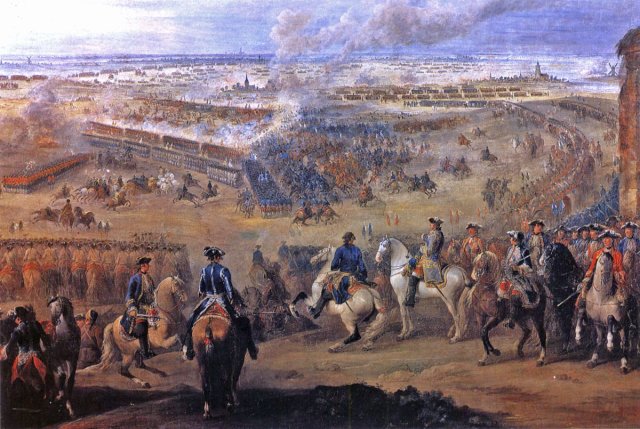
While there was a growing sense of professionalism in the mid-eighteenth-century British Army, most younger officers had formed whatever expertise they possessed through studying manuals, guidebooks, and historical works by ancient and modern authors such as Thucydides, Caesar, Vegetius, and Humphrey Bland, whose Treatise of Military Discipline, first published in 1727, was the unofficial guide to basic drill and maneuver for young officers. The officers’ own lack of formal training, along with their mechanistic daily regimens, prevented them from achieving competency much beyond the level of basic training that they were expected to perfect in their soldiers. While some senior officers had tasted battle, the first test of combat leadership for many of the junior officers or subalterns came on the banks of the Monongahela.[1]
Despite the lack of battlefield experience, King George II, the Duke of Cumberland, and Braddock were confident that the “professionalism” of the regular troops would be enough to oust French forces (Troupes de la Marine, Canadian militia, and Native American auxiliaries from the Ohio River Valley and Great Lakes) from Fort Duquesne.
The first break from Vegetius’s influence and British army doctrine in the Age of Enlightenment occurred before the campaigns of 1755 even commenced. The 44th and 48th Regiments of Foot were understrength and carried with them to North America roughly 500 men each. To raise their numbers to full battalion strength – 700 men – the units were augmented with colonial levies from Maryland, Pennsylvania, and Virginia. Already lacking in experience, the addition of colonial militiamen (militias were the largest recruiting pools in the colonies) did nothing but delegitimize the “professionalism” of the two regiments. The levies, who previously only drilled once every few months or so with their respective militias, were expected to conduct themselves like British regular soldiers.
Along with the colonists augmented into the regiments of foot, the task of capturing the various French strongholds in Nova Scotia and along Lakes Champlain and Ontario that summer was given to non-regular troops. To subdue the French garrisons, small armies of colonial provincial soldiers were recruited in New England, New Jersey, and New York. Braddock’s army, too, was supplemented with provincials from Maryland, Pennsylvania, Virginia, and the Carolinas. The expeditionary force ordered to bag Fort Saint-Frédéric (Crown Point) along Lake Champlain was composed of 3,000 provincial troops with only one British regular, Captain William Eyre of the 44th Regiment of Foot, serving among them.[2] Again, these provincial regiments were entirely green (other than some veterans of various frontier services and the Louisbourg Expedition of 1745) and made up of levies and volunteers drawn predominantly from local militias. Also, attached to these armies were Native American auxiliaries, whose style of warfare was completely foreign to regular troops and far from professional. Service against and alongside these “savages” was the first exposure to irregular warfare in North America that His Majesty’s soldiers would receive. Vegetius believed that heavy reliance on auxiliaries, in this case Native Americans, colonial provincials, and colonial troops on the British military establishment, was detrimental to the performance and survival of professional units and overall cohesion.[3]
For the most part, the colonial provincials held their own on the battlefield against French forces, more so than the British regulars did early in the French and Indian War. They obtained victories in Nova Scotia, along the southern shore of Lake George in New York, and diligently defended the frontier against French and Indian raids. However, the colonists could never truly mesh with the regulars from Great Britain. British officers held them in contempt. “The Americans,” Brigadier General James Wolfe declared, “are in general the dirtiest most contemptible cowardly dogs that you can conceive. There is no depending on them in action. They fall down dead in their own dirt and desert by battalions, officers and all. Such rascals as those are rather an encumbrance than any real strength to an army.”[4]
Officers serving in North America and British authorities in London, like William Pitt, began to recognize the importance in 1758 of separating from the seemingly arrogant professionalism that the British Army had so dearly held on to. The conflict being fought in the colonies was not a conventional European war. Even as a world war was being waged elsewhere around the globe, it became evident that something needed to change if His Majesty King George II was to claim North America as his own. William Pitt, Leader of the House of Commons and Secretary of State for the Southern Department, put forth and instituted an agenda that shifted the sole focus on winning with professional soldiers in North America to building a substantial military force consisting of a majority of colonists. He ordered 20,000 colonists to be levied or recruited into provincial units. The crown would supply them the required arms, ammunition, tents, and provisions, and would reimburse the colonial assemblies for the costs of raising, clothing and paying the men. In response to this proposal, the colonies mustered over 23,000 troops for the upcoming 1758 campaigns.[5] These men complimented the 20,000 British regulars dispatched to the colonies that year. At close glance, the measure instituted by Pitt’s administration resembled France’s levée en masse in 1793 on a smaller scale.[6] This was an early example of the departure from Vegetius’s classical reliance on professional soldiers in favor of larger armies consisting of men serving shorter terms of enlistment. Discipline for these men was mild and their training was limited. “Men,” one of Vegetius’s general maxims read, “must be sufficiently tried before they are led against the enemy.”[7] Quality was displaced by quantity. This was not the only aspect of the British Army that was transforming in the wilderness of North America. The nature of the conflict was forcing a change in the way the war was being waged as well.
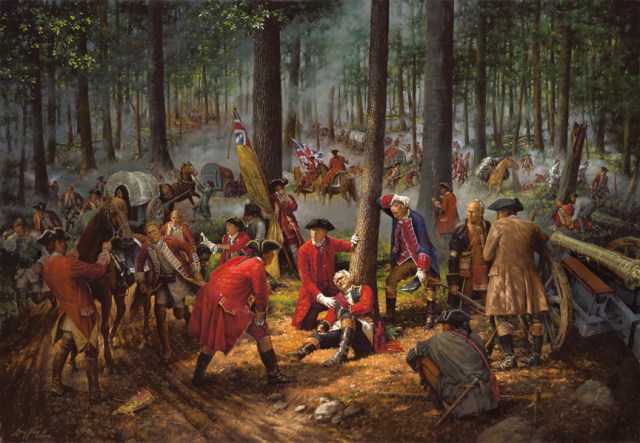
Edward Braddock’s expeditionary force of regulars and provincials crossed the Monongahela River on the morning of July 9, 1755 and precipitated a departure from Vegetius and Humphrey Bland’s strategic, operational, and tactical influence. Less than ten miles outside of Fort Duquesne, the 1,400-man column engaged and was easily defeated by a smaller force of Canadians and Indians fighting in an irregular manner. Braddock’s Defeat signaled an end to England’s classical style of linear warfare – it had officially met its match and was countered. Vegetius and Bland’s disciplined closed-rank formations had faltered. Vegetius wrote that, “The nature of the ground is often of more consequence than courage.”[8] However, this referred to terrain and its effect on the seven linear formations that Vegetius had presented. General engagements in Europe did not take place in thick vegetation. Maneuvering, let alone fighting, in closed-ranks was nearly impossible to accomplish smoothly in North America. As Braddock’s army had learned along the banks of the Monongahela, His Majesty’s Forces needed to adapt to the current conditions and nature of warfare in the colonies. To do so, officers needed to adjust tactically and borrow from the colonists and their Native American auxiliaries who were accustomed to loose formations and irregular warfare. Adapting meant completely altering preconceived tactical doctrine.




 In Charleston’s Marion Square, an odd chunk of limestone, sand, and oyster shells sits inside a wrought-iron fence just beyond the normal boundaries of the weekend market. While shoppers buy their weekly produce or shop for gifts, the food court along King Street tempts them with just about anything you can image. Someone usually plays live music on the park-side of the market—and there, nearby, sits the hunk of rock.
 Emerging Revolutionary War Era