August 8, 2016—James and Dolley Madison at Montpelier, the Madisons’ home in Orange County, Virginia. Cast in bronze, the lie-sized statues were sculpted by Brooklyn-based artist Ivan Schwartz and unveiled May 27, 2009. Madison sits on one end of a bench that gives visitors room to sit next to him for a photo op.
Emerging Revolutionary War is honored to welcome guest historian Zach Whitlow. Zach’s biography is at the bottom of this post.
August marks the 202nd anniversary of the Burning of Washington. On the heels of their astounding victory at Bladensburg, a British incursionary force under Major General Robert Ross and Rear Admiral George Cockburn occupied the American capital for about 24 hours on August 24th & 25th, 1814. Besides a small ambush at the Sewall House on Capitol Hill, in which two corporals and General Ross’ horse was killed, the British encountered no resistance in the city whatsoever. The Union Jack was triumphantly raised: Washington had fallen. Soon it would burn.
The burned out shell of the White House following the British occupation of Washington. (The President’s House, by George Munger, 1814-1815)
What followed were events that literally burned themselves into the American psyche. To remember this bleak moment in history, rangers from the National Mall & Memorial Parks are leading a series of walking tours in the month of August. Beginning at the newly designated Belmont-Paul Women’s Equality National Monument (the site of the ambush), visitors walk a total of 2.5 miles and retrace the British advance down Pennsylvania Avenue. Through the program, the rangers will sift through the modern paved environment and tell the stories of long gone places, such as the newspaper offices of the National Intelligencer and Barbara Suter’s tavern. The tour will also feature some of the surviving remnants of that time, such as the Octagon Museum.
The walking tour begins at Belmont-Paul Women’s Equality National Monument (144 Constitution Ave NE, Washington, DC 20002) every Saturday in August at 3:00 pm. There will also be programs on Wednesday, August 24th and Thursday, August 25th at 3:00 pm. Please bring comfortable shoes and plenty of drinking water.
*Zach Whitlow has an M.A. in Museum Studies from the George Washington University, a B.A. in History from California State University, Long Beach, and three A.A. degrees from Fullerton College. A lifelong historian, he currently works for the National Park Service at the National Mall & Memorial Parks in Washington, DC and the Office of Historic Alexandria in Alexandria, VA. Prior to this, Zach worked at the National Archives, George Washington’s Mount Vernon, and the Queen Mary in Long Beach, CA. He currently lives in Alexandria, VA with his girlfriend Teresa and their two cats, Max and Lizzie.
The financier. Those two words explain the importance of Robert Morris, the Liverpool, England born Pennsylvanian transplant. As George Washington engineered the pivotal campaign that culminated in the actions at Trenton on Christmas Day 1776 and Princeton in early January, Robert Morris was the man who made it happen.
Born on January 20, 1734, Morris was a 13-year old lad when he sailed for the British North American colonies. He was headed to Oxford, Maryland where his father had emigrated prior to. While living on his father’s tobacco-growing plantation, Morris was afforded the opportunity to have a tutor and showed his mental prowess, advancing rapidly in his studies.
Outgrowing his tutor, Morris was sent to a family friend in Philadelphia where it was arranged the young man would become an apprentice in the shipping and banking of future Philadelphia mayor Charles Willing. When Willing died in 1754, Morris was made partner. He was only 24 years old at the time.
After the establishment of Willing, Morris, and Company on May 1, 1757, Morris was set about establishing himself firmly in the upper society of Philadelphia, the largest city in the 13 British colonies. Yet, it was not until he was 35 years old in 1759 when he wed Mary White, who hailed from a prominent Maryland family. In time, the family grew to include five sons and two daughters. That same year, Morris and his partner Thomas Willing organized the first non-importation agreement in which the slave trade was ended for good in the Philadelphia region.
Robert Morris (courtesy of our friends at The Society of the Descendants of the Signers of the Declaration of Independence, http://www.dsdi1776.com)
Even before his marriage, Morris was active in politics. In 1765 he had served on a committee comprised of local merchants. Formed in protest to the Stamp Act, Morris was chosen to mediate a mass town meeting of protesters. Even though he personally felt the new acts were unconstitutional, Morris was remained steadfastly loyal to Great Britain. Continue reading “Six Signing Signers”→
By the spring of 1781, British military forces under the able command of General Charles, Lord Cornwallis, were moving north. It was clear that the southern campaign had not gone quite the way it was planned. Though successful initially in South Carolina in 1780 with the capture of Charleston and the subsequent battles of Camden and Hobkirk’s Hill, the British had been handed some setbacks by the end of the year. Twice had Lord Cornwallis lost his left wing through defeats at Kings Mountain in October and Cowpens in January 1781. In March, a contentious battle at Guildford Courthouse in North Carolina left the British in control of the field but badly mauled by American forces under General Nathaniel Green. By April, Cornwallis had devised a plan to move north, into Virginia, to conquer that province which he believed would be critical to achieving ultimate success and ending the war in favor of His Britannic Majesty.
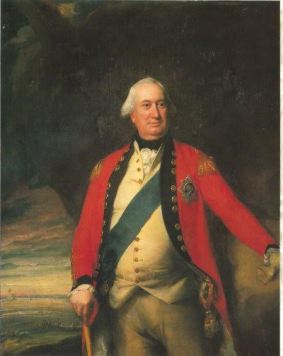
Lord Charles Cornwallis
By June 1781, Cornwallis was in Richmond. Joined by forces under the American turncoat Benedict Arnold and General Alexander Leslie, Cornwallis commanded a fighting force of around 7,000. To counter this threat were fewer than 1500 American soldiers under the young Marque de Lafayette.
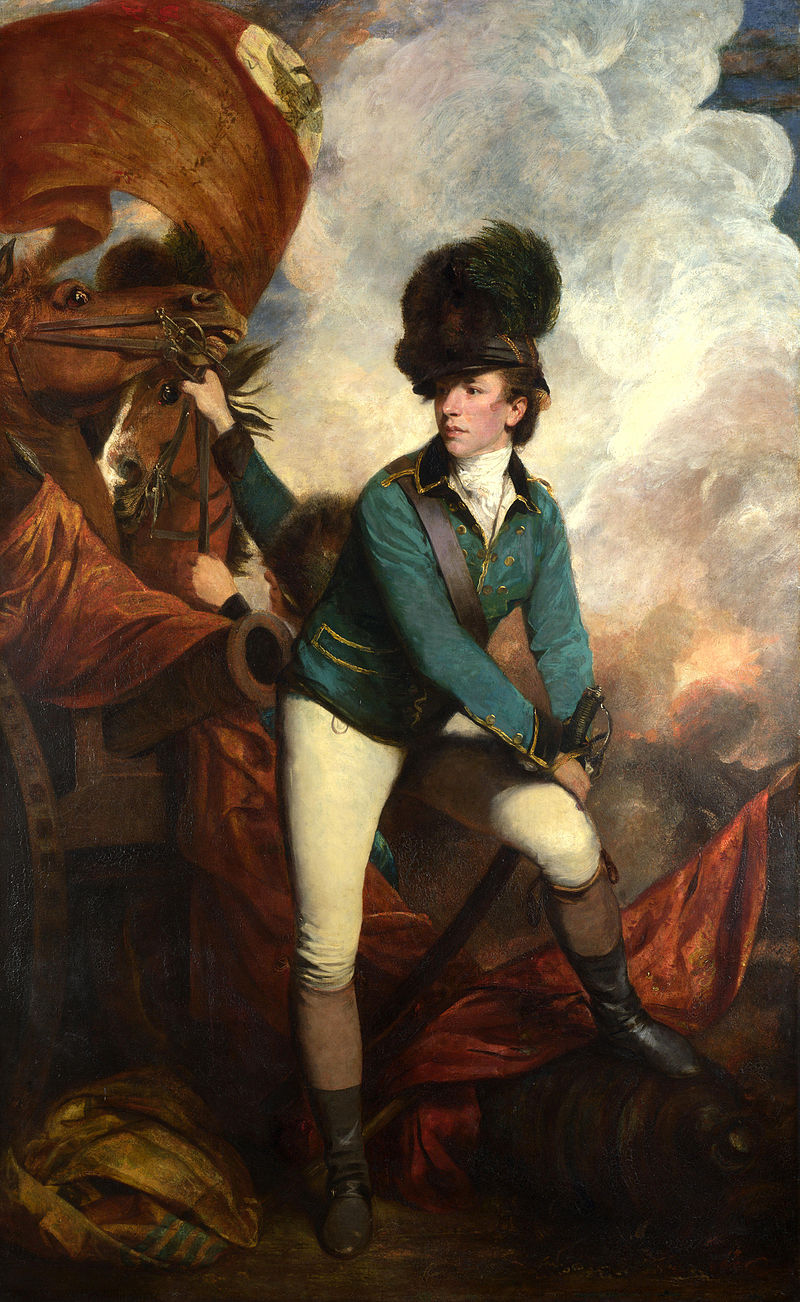
While encamped near Hanover Courthouse, Cornwallis learned that Virginia Governor Thomas Jefferson and the General Assembly had relocated to Charlottesville, around 50 miles west of Richmond. He decided to send the brash Colonel Banastre Tarleton there with a small strike force to bag the whole lot. On June 3, Tarleton’s force set out.
Today, as it was 235 years ago, June in Central Virginia is hot and almost unbearably humid. To avoid the extreme heat of the day, Tarleton decided to rest his men and resume the march after dark. His route would take him through Louisa County via modern Route 33. Just before halting for the night, Tarelton passed by Cuckoo Tavern, a small and out-of-the-way place that got its name from the cuckoo clock that once ticked off the minutes inside the tavern. Slumped against the picket fence in the tavern yard, trying to catch some sleep after a long day of work and a few drinks in the taproom, was a local lad by the name of Jack. John “Jack” Jouett, Jr., known as Captain Jack due to the military coat he was fond of wearing, routinely freighted produce from his family’s farm in Louisa to the tavern his father kept in the town of Charlottesville. The Swan Tavern was certainly a going concern and, at that moment, was playing host to several of the lawmakers of the Virginia General Assembly.
Captain Jack, 26 years old, had just returned to Louisa after a long round trip to the tavern. Sitting out in the yard that night, he was aroused by the sound of marching feet. He stood and there saw Tarleton’s column moving along to Louisa Courthouse. It wasn’t difficult for Jouett to figure the destination of these midnight marchers and he knew he couldn’t let them get to Charlottesville and capture the government. So once the soldiers had marched past, he saddled up his horse “Sally” and lit out for town.
Banastre Tarleton
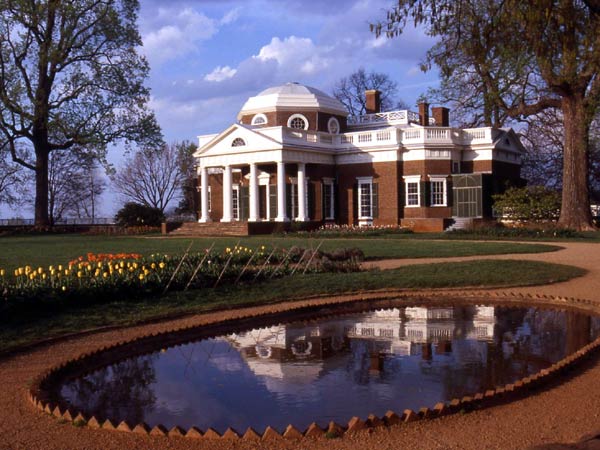
He rode all night, covering the 40 plus miles to Charlottesville ahead of the British. He traveled by narrow, little-used roads under low-hanging tree branches; paths certainly unknown by most save a few locals. By the time Jouett reached Charlottesville, his face and arms were scratched and bloody. He rode first to Monticello and warned Thomas Jefferson, although Jefferson took such a long time getting himself together that he narrowly escaped capture by Colonel Tarleton’s forces who came trotting up onto the west lawn of Monticello only minutes after Jefferson had finally departed.
Jouett went on to his father’s tavern where he warned several of the delegates staying there of Tarleton’s approach. The British were only 3 hours behind Jouett by the time he splashed across the Rivanna River and into Charlottesville. Even with this warning, several of the legislators were captured by Tarleton including a representative from Kentucky County by the name of Daniel Boone.
Monticello
Only a year after his ride, Jack Jouett left Louisa County and moved west to the Kentucky territory where he later flourished as a horse breeder and influential member of society for the rest of his life. Jouett died in Kentucky in 1821.
Today, Cuckoo is little more than a dot on a Virginia roadmap. The tavern is long gone; only an empty field now. Across the road stands Cuckoo, the brick, federal style home built by a family of physicians in 1819. Hard to believe that such a quiet place could have once been the scene of such high drama.
On August 2, 1776, in Philadelphia, Pennsylvania, the majority of the 56 men who would forever be known as the “Signers of the Declaration of Independence” placed quill to ink and affixed their signature.
On September 17, 1787, the men who persevered, haggled, and agreed on the United States Constitution, dipped a quill into ink and placed their signatures on that famous document.
If one looks closely and reads the names of the signers, six gentlemen’s names would appear on both documents. If one hazarded a quick guess, Thomas Jefferson, John Hancock, John or Samuel Adams, George Washington, and Benjamin Franklin would most likely be the first names to spill off the tongue.
Only one of those names would be correct; Benjamin Franklin. This post, the first in the series, will shed light on whose these men were, who had the great fortune–or luck?–to sign both famous political documents. The first of the “Six Signing Signers” is…..
The city of Boston, Massachusetts is steeped in American Revolutionary War history. The city has designed an entire trail–the “Freedom Trail”–a footpath that leads interested visitors around the city to the areas of most importance.
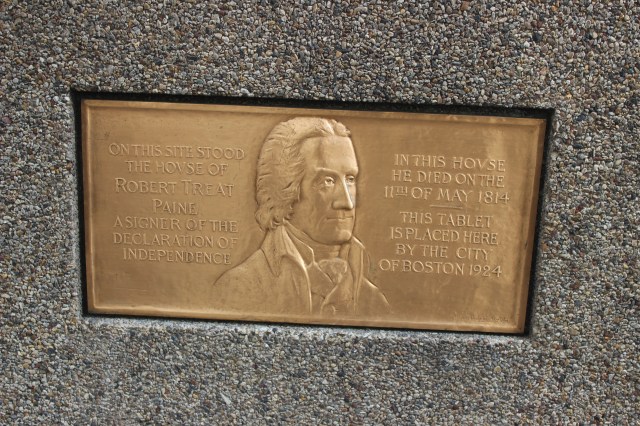
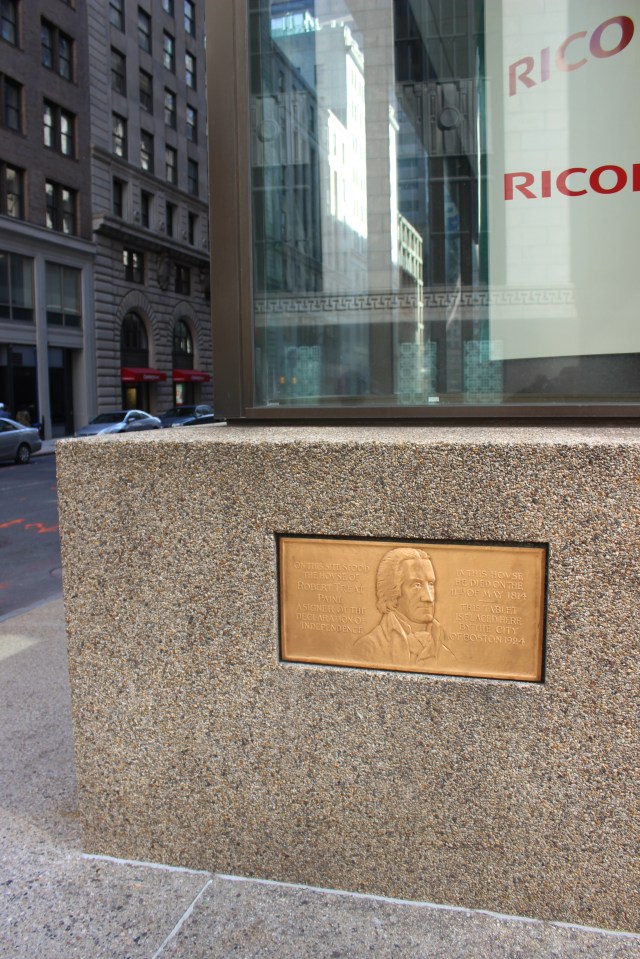
Yet, some history, is just, literally, stuck right on the walls of Boston. On the side of a modern office building, is situated the plaque below:
One of the 56 men that affixed his signature to the Declaration of Independence, Paine was born in Boston on March 11, 1731 and was actually given a middle name, a family tribute. His family legacy was well-established in the colonies and Paine himself was counted as an early advocate for the patriotic cause.
Yet, like the more famous John Adams, Paine also was a lawyer and dedicated to the law and order. He was the second attorney, along with the aforementioned Adams, to represent the British soldiers in the “Boston Massacre” trial. He continued to hope for reconciliation, hoping when he ventured to the Second Continental Congress, that the resolve of the colonies would bring the British Parliament to negotiate. On that same vein, Paine also put his signature on the Olive Branch Petition–the final attempt by the colonies to reach King George III and give their side of the story. When the king outright rejected the petition and did not even lay eyes on the document, Paine saw there was no hope and firmly planted himself in the camp of those clamoring for independence.
He became a vocal and valuable member of the Continental Congress and signed the Declaration of Independence on August 2, 1776. Returning to Massachusetts near the end of 1776, he became the Speaker of the Massachusetts House of Representatives the following year. In 1780 he was a member of the committee that drafted the state constitution and as attorney general he prosecuted members of Shays’ Rebellion in 1787.
His last public role was a justice of the Massachusetts Supreme Court from 1790 until his retirement in 1804. He was 83 years old when he died in the house that the plaque mentions. He was buried in the Granary Burying Ground in his native Boston, Massachusetts.
Another great patriot of the American cause, whose last house where his last days were spent, has a lasting memorial for those to discover. So, many historical treasures are just hanging there, waiting to be discovered in Boston.
Another view of the Robert Treat Paine plaque in Boston
As we have seen, two untrained, amateur, but very effective soldiers perfected the concept of the defense in depth during the campaigns of 1781. Morgan was the first to experiment with the concept, and he did so with great effect at Cowpens, thoroughly defeating Tarleton’s Legion and sending “Bloody Ban” flying in a wild panic. Greene then adopted the tactic and applied it on a much larger scale at Guilford Courthouse. Even though he lost the battle, he scored a major strategic victory by punishing Cornwallis’ army and inflicting enormous losses on it for little gain—Greene’s army escaped to fight another day. His stand at Guilford Courthouse set the stage f Continue reading “Defense in Depth as a Revolutionary War Battlefield Tactic”→
Part Three (click here for first two installments)
Determined to avenge his embarrassing defeat at Cowpens, Lt. Gen. Charles Lord Cornwallis set his army out in a determined pursuit of the American army. Knowing that he was too weak to face Cornwallis in a pitched battle, Maj. Gen. Nathanael Greene, the Southern Department commander, retreated northeastward from Salisbury, North Carolina toward the Virginia state line, where he hoped that additional militia troops would reinforce his army and he would receive supplies. The British chased Greene to the Dan River, near the Virginia border, but Greene wisely put the river between his army and the enemy. Cornwallis and his weary soldiers arrived at the rain-swollen river on February 15, too late to catch Greene’s army, which had finished crossing earlier that day. Frustrated, Cornwallis withdrew to Hillsborough, North Carolina.
Lord Charles Cornwallis
After receiving both the expected supplies and reinforcements, and after an opportunity to rest his command, Greene soon marched back into North Carolina to face Cornwallis’ tired and poorly supplied army, which now numbered less than 2000 men. After several weeks of skirmishing with Loyalist militiamen and a great deal of maneuvering Greene assumed a defensive position around Guildford Courthouse (near modern Greensboro, North Carolina) on March 14, 1781. Greene had more than 4000 Continentals, militiamen and cavalry, meaning that his army outnumbered Cornwallis’ by more than twice their strength. Continue reading “Defense in Depth as a Revolutionary War Battlefield Tactic”→
Last week marked the 235th anniversary of the Battle of Green Spring, which occurred near historic Jamestown in Virginia. A couple months ago, historians form many different Civil War battlefield parks went to Jamestown, Virginia to get a tour of the Green Spring battlefield. For many of these public historians, it was their first visit to the battlefield. The battlefield is very sparsely marked, has no interpretative trail, no formal or regular tours and not usually given much thought. However, with new initiatives like the Civil War Trust’s “Campaign 1776,” there has been a surge of Civil War historians looking to learn more about the War for Independence and the efforts to preserve its history and battlefields.
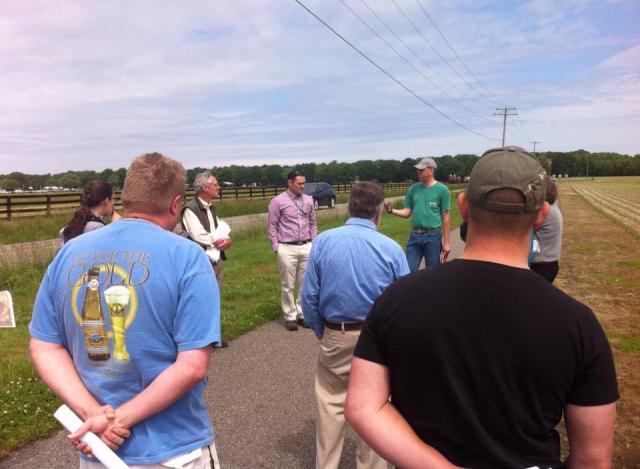
NPS historians Kirby Smith and Chris Bryce along with representatives of James City County lead a tour at the Battle of Green Spring battlefield in May 2016.
The Battle of Green Spring, while it is a little known footnote in the history of the Revolutionary War, was the largest open field battle of that war in the state of Virginia. The battle was fierce and bloody, and part of a chain of events that ultimately resulted in the George Washington’s victory at Yorktown.
On July 6, 1781, General Marquis de Lafayette was looking for an opportunity to catch General Charles Cornwallis’ army unaware. Cornwallis and his army of nearly 7,000 troops was near Jamestown Island and was looking to cross the James River. Lafayette with his much smaller army of only about 4,000 men was looking to attack and raise morale in the invaded state. He wanted to wait until Cornwallis’ army was in the middle of crossing the river, with half his force on the opposite side, and then launch an attack on the much smaller and cut off force.
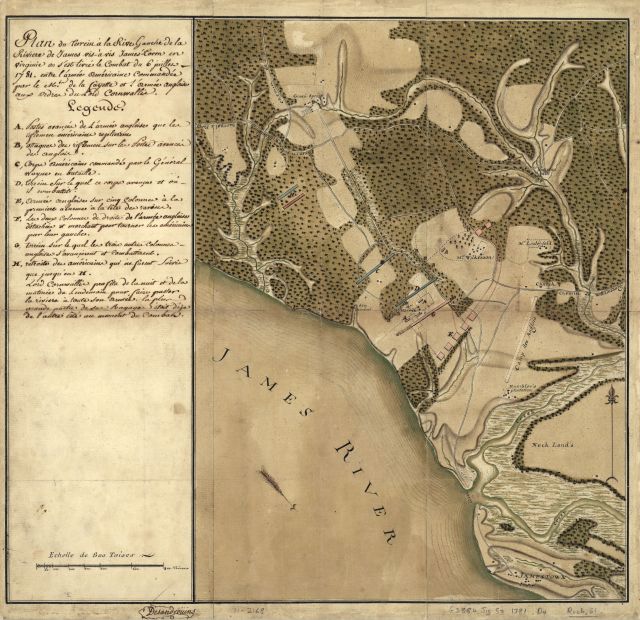
This map shows where the battle occurred near the James River and you can see marked the battle lines of the British and American troops. Historic Jamestown Island is at the bottom of the map.
Cornwallis, though was no fool and went about setting up a trap to deal with this annoying force of American troops that had been trailing him now for months. He planned to lure Lafayette’s army into bringing on an engagement with his entire British force. Lafayette took the bait.
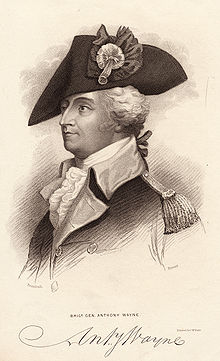
On July 6, 1781, Lafayette sent forward his army in a column formation with General “Mad” Anthony Wayne’s Pennsylvania regiments and Virginia militia (about 900 men) in the van. They began to engage British pickets on the road to Jamestown and pursued them towards the James River for a few miles, crossing over the 17th century Green Spring plantation. Wayne’s men made it to the Harris farm at about 5:00 in the afternoon. The 900 Pennsylvanians and Virginians were far in the advance of the rest of the American column when the British finally launched a withering counterattack on the heavily outnumbered American troops.
General “Mad” Anthony Wayne led the vanguard of the American force.
At this point, rather than fall back, General Wayne, in a very unconventional and bold decision ordered his outnumbered force to fix bayonets and advance on the British line. This advance momentarily stunned the British officers. Did Wayne know something they did not?
For the next few minutes the British line and the American line stood about 50 yards apart and fired volley after volley of musket fire into each other. With an effective range of 80 yards, this part of the battle became the most intense and most bloody. The skilled British regulars aimed low at the legs of the American. This way, when the musket fired and kicked back, the musket ball would go slightly higher and hit the enemy in the body. To have stood and fought in an open field at that range would have been an absolutely terrifying ordeal. But there they stood and fought. One contemporary later called it “Madness!” Troops after the battle could actually tell how close the lines stood based on bodies of the men killed and the torn cartridge tops that littered the field.
After a few minutes of this close fighting, the American troops were forced to fall back quickly, leaving two cannon on the field. The impromptu advance Wayne ordered though succeeded in stalling the British advance and allowing American reinforcements to cover their retreat. Lafayette successfully disengaged and fell back that night. Cornwallis chose not to give chase, and crossed successfully over the James River.
The battle was technically a British victory, but once again, as on many fields in the Revolution, the young American army had gone toe to toe and proved it was on par with British regulars. Lafayette and the American press heralded the bravery of the American troops and viewed Cornwallis’ movement as a retreat. Cornwallis would ultimately be forced to surrender that October at nearby Yorktown.
On July 6, 1781, the British suffered about 75 men killed and wounded and the American army suffered about 150 men killed and wounded. The battle and the land it was fought on soon became forgotten. Today, though, through the efforts of James City County, easements have been placed on much of the historic land and they and other organizations have bought and preserved much of the land where the fighting occurred. Work continues to ensure the hallowed ground is preserved for the future.
However, the site contains very little interpretation, with really only a state historic marker. Hopefully the site will get more attention in the coming years as an important historic site in a very historic area of Virginia. Just this year there have been a few events to mark that bloody battle.
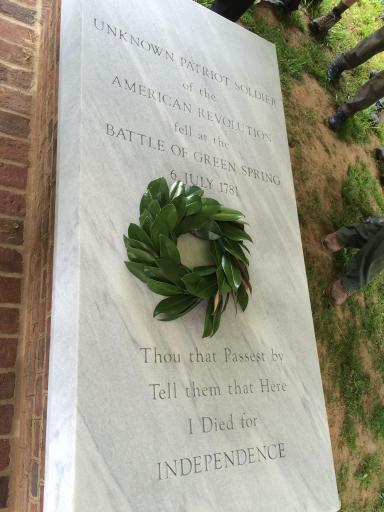
New tombstone for an unknown Revolutionary War soldier that was recently buried at the Church on the Main in May 2016. (Photo by Drew Gruber)
A couple months ago, archaeologist Dr. Alan Outlaw led a re-internment ceremony for one of the Pennsylvania continentals that was killed in action at Green Spring. His bones had been recovered over thirty years ago in the Harris farm. After being studied by the Smithsonian Institution and being properly identified as one of the Pennsylvania continentals, he was re-interred with a proper Christian burial near the battlefield in the graveyard of the Church on the Main.
Also this past Saturday, the National Park Service and the Friends of Green Spring held a Revolutionary War living history program at the Green Spring Plantation about the retreat of the American troops and the aftermath of the battle.
Next time you find yourself in historic area of Williamsburg, Yorktown or Jamestown, make a trip out to the Green Spring battlefield or the Church on the Main and reflect on the sacrifices that occurred there to secure our independence.
No military engagement fought in America prior to the Civil War was bloodier or more costly than the Battle of Carillon (Ticonderoga). For over four hours during the afternoon of July 8, 1758, British and French forces ruthlessly clashed in upstate New York atop the heights west of Fort Carillon, producing over 2,400 casualties – nearly 2,000 of them English. In a year of such memorable British triumphs this was truly an incredible and most tragic disaster. By nightfall, Major General James Abercromby’s army was in full retreat up Lake George, and the Marquis de Montcalm’s courageous Frenchmen remained behind their earthworks, celebrating one of the most miraculous victories ever won on the continent.[1]
It had been over four years since George Washington ordered his small detachment of Virginians and Mingo warriors to open fire on the French-Canadian party encamped within Jumonville Glen, and England’s military efforts against the French in North America were still abysmal. Seventeen fifty-eight was meant to turn the tide in favor of King George II. With William Pitt’s ascension to Secretary of State for the Southern Department, it became his duty to prosecute the war in earnest, sparing no expense. After the failed operation against Fortress Louisbourg and the capitulation of Fort William Henry the previous year, plans for a four-pronged offensive in North America began to formulate. These large-scale movements were directed against Forts Duquesne and Frontenac (located along the eastern shore of Lake Ontario), Louisbourg (yet again), and finally Fort Carillon atop the promontory between Lakes Champlain and George. The effort against the French at Carillon was to be led by the newly instated Commander-in-Chief of His Majesty’s Forces in North America, Major General James Abercromby.
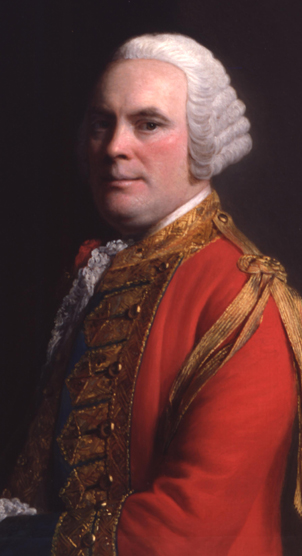
Major General James Abercromby
James Abercromby was born in 1706 in Glassaugh, Scotland and received his first commission as an ensign in 1717 with the 25th Regiment of Foot. He saw action and was wounded during the War of Austrian Succession, and by 1756 he held the rank of major general, serving under Lord Loudoun in North America. By December of the following year he was officially commissioned to replace Loudoun after his recall. To compliment Abercromby during his offensive against Fort Carillon, Brigadier General George, Viscount Howe (the older brother of Richard and William) was given the role of second-in-command for the expedition.[2]
During June 1758, Abercromby’s army of British Regulars and colonial provincials gathered along the southern shore of Lake George beside the still present ruins of Fort William Henry, which was burned by Montcalm following its capitulation the previous August. By July 5, when the army began its embarkation down Lake George, the British could count a total of 16,000 men amassed to assault Carillon – it was the largest military force ever assembled for a campaign on the North American continent. Nearly 10,000 provincials from New England, New Jersey, and New York had joined ranks with eight regiments of British Regulars. To oppose them over thirty-two miles to the north, Montcalm had roughly 3,500 men at his disposal with another 500 that would join him before the battle commenced.[3]
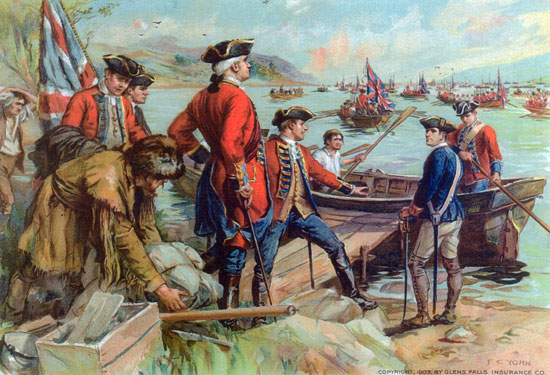
Embarkation of Abercromby’s Army, July 5, 1758
On July 5, nearly one-thousand small boats and other crafts departed from the shore of Lake George and headed north. The spectacle must have been amazing. Extending seven miles in four rows covering shoreline to shoreline, Abercromby’s army rowed towards its destiny, arriving at its debarkation point the following day around 10:00am. The landing party, consisting of Rogers’ Rangers, Thomas Gage’s 80th Light Infantry, and Phineas Lyman’s 1st Connecticut Regiment, staggered ashore with George Howe at the head of the advance. The men were immediately met with resistance and a running battle commenced that ran several miles to the north near Bernetz Brook. Leading on foot at the head of an advancing force is no place for the second-in-command of an army, but Howe was not your typical general and that is why his men adored him. At 4:00pm the fighting became the hottest it was all afternoon as the French continued their hasty withdraw back to Montcalm’s lines. During this contest, Howe lost his life. With their beloved leader now dead, confusion amassed and the British left the field and returned to the landing site. While the skirmishing yielded no true tactical significance, Montcalm was alerted of Abercromby’s landing and began to fortify the heights west of Fort Carillon, choosing to face the British in the field rather than defend against a siege with his army so outnumbered.[4]
The following day, Abercromby’s army marched to within a mile and a half or so of the French at Carillon and encamped for the evening. From this position near a saw mill the commander-in-chief added the finishing touches to his battle plan on the morning of July 8 – it was from here as well that he would observe the engagement, staying far behind the frontlines. With the loss of his trusted subordinate, Howe, and the information newly at hand that a large body of French reinforcements numbering 3,000 men was approaching Fort Carillon, Abercromby seemingly lost his wit. Rather than sending an experienced engineer such as Major William Eyre of the 44th Regiment of Foot to observe the French position, he instead ordered two of his personal aides, Captains James Abercrombie and Matthew Clerk to ride forward and report the situation. The two officers returned and suggested to the commanding general that the French earthworks were incomplete and that the position could easily be carried with a frontal assault. Abercromby accepted the report as gospel and began preparations for an attack.[5]
Truth be told, by the morning of July 8, the French had indeed completed their defensive works a half-mile to the northwest of the fort. The series of fallen logs – stacked some six to seven feet high with loopholes cut into them to fire out of from behind cover – extended from the lowland near the La Chute River to the south across the peninsula to Lake Champlain to the north. The area in front of the earthworks was cleared for about one-hundred yards, and a line of abatis was erected in front of the line to hinder the enemy’s advance. The earthworks were defended by seven regiments of French Regulars, each manning roughly a hundred yards of entrenchment. To the right of the line a company of Troupes de La Marine (Canadian Regulars) was positioned and a battery of six cannon was placed in a redoubt constructed on the left. Canadian militia defended the lowland near the La Chute River. This area was the weak point in Montcalm’s line, but Abercromby failed to exploit it. A battalion of the Regiment de Berry was left behind to man the fort and run ammunition to the front. While Montcalm had selected the best ground near the fort to make his stand, his position was nevertheless dangerous. His army was bottled up on a peninsula and if his defensive measure should fail his force would be trapped and surrounded by the overwhelming numbers of the British. Things could all begin tumbling down for Montcalm if his earthworks were blasted to splinters by the might of the English artillery before a frontal attack commenced. Lucky for him, however, Abercromby opted that an artillery barrage to precede the assault was unnecessary, and in fact, that no cannon would be needed at all to assist in carrying the French position.[6]
Louis-Joseph, Marquis de Montcalm
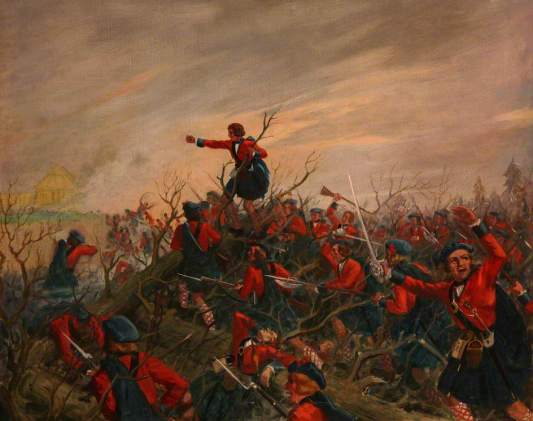
At half past noon, July 8, 1758, the 80th Light Infantry, Rogers’ Rangers, and a battalion of Massachusetts light infantrymen advanced forward to the abatis in a long skirmish line, driving the French pickets before them back to the earthworks. With the ground in front of the French position clear it was time to launch the grand European-style assault. Stepping out from the tree line at the base of the heights, over six-thousand men garbed in scarlet red moved forward in a line three ranks deep. The beating of drums and the shrill of the fifes pierced the air, and the wale of Scottish bagpipes reverberated from the musicians amongst the 42nd Regiment of Foot – the “Black Watch” – near the center of the line. Forward they went with undaunted courage only to be cut to pieces by French small arms fire upon reaching the abatis. There the dead and dying lay tangled amidst the branches as their comrades struggled to press forward. “The fire was prodigiously hot,” Captain Charles Lee (yes, that Charles Lee) of the 44th Regiment of Foot vividly remembered, “the slaughter of officers very great, almost all wounded, the men still furiously rushing forwards without any leaders.” Staring through the smoke up towards the French line, only the tops of the regimental standards were visible above the earthworks.[7]
The devastating effect of the French musketry forced the British lines to waiver. They could not obtain enough momentum to make their way into the enemy entrenchments, let alone even climb near them. Abercromby was no help during all of this. He remained behind at the sawmill camp delegating orders as his men were being sent into a meat grinder a mile and a half away. His decision to not order up his artillery to bombard the French or support his infantry’s attack was beginning to show how costly it truly was.
Again and again the regulars were ordered to advance, only to be met with the same result each attempt. Nearly four hours had passed since the initial line had stepped off and the situation was beginning to become desperate. In a last-ditch effort to pierce the French earthworks and turn the tide of the battle, the 42nd Regiment of Foot emerged from the abatis and with a terrible cry the “Ladies from Hell,” charged forward. As the “Black Watch” advanced up the heights, an officer of the 55th Regiment of Foot watched in admiration:
With a mixture of esteem, grief, and envy, I am penetrated by the great loss and immortal glory acquired by the Highlanders engaged in the late bloody affair. Impatient for the fray, they rushed forward to the entrenchments, which many of them actually mounted. Their intrepidity was rather animated and damped by witnessing their comrades fall on every side. They seemed more anxious to avenge the fate of their deceased friends than careful to avoid a like death….[8]
The “intrepidity” of the 42nd Regiment was not enough to carry the works. Their dedication and valor that day cost them tremendously. Of the 900 or so men that the regiment took into the field with them that bloody day, 647 were casualties – 314 of that number dead on the field. In any other battle of any other war fought in North America, only one other regiment, the 1st Maine Heavy Artillery at Petersburg on June 18, 1864, suffered a near greater loss of life in a single engagement. This is a sacrifice that needs to be better remembered.[9]
Assault of the 42nd Regiment of Foot “The Black Watch”
Around 5:00pm, Abercromby called off the attack and ordered his army to retire from the field. The men, battered and bruised, made their way back to the sawmill camp and later that night were led back down to the landing site from two days before. Rumors that Montcalm was following closely in pursuit to destroy the English army spread rapidly and the retreat became extremely hasty – if not an actual rout. The campaign was over.
Montcalm’s victory against the British at Carillon was nothing short of a miracle. His army was outnumbered four-to-one and had essentially trapped itself on the Ticonderoga peninsula in order to meet the English army in open combat to avoid a siege. Abercromby made zero use of his artillery to weaken or destroy the French defenses – which were somehow complete in less than two days and conveniently during the morning of the battle – and he failed to exploit any of the weak points on Montcalm’s flanks.
The British had failed to bag the French army at Fort Carillon and therefore left the enemy in possession of the crucial north-south waterway of Lake Champlain that offered direct access into the Richelieu River and henceforth Canada. The bloody defeat had cost Abercromby nearly 2,000 men with upwards of 800 of that number killed. Montcalm on the other hand incurred just fewer than 400 casualties – still roughly ten percent of his army present on the field that day. In the history of military conflict in America prior to the Civil War, only the Battles of Long Island and New Orleans come close to the 2,400 lost July 8, 1758.
The “Black Watch” Monument today on Carillon Battlefield (notice the position of the French earthworks in the rear of the photograph)
The Battle of Carillon was England’s most humiliating defeat of the French and Indian War. At no other battle during the conflict did a British/Provincial army outnumber its foe so greatly in both manpower and artillery, only to be beaten as terribly as Abercromby’s army was before the French entrenchments at Carillon. This defeat should not be put upon the shoulders of the brave men who fought with such rigor that July afternoon though. Their commanding general let them down. Abercromby’s failure to conduct proper reconnaissance and utilize his army’s artillery cost him the day. If George Howe had not been killed two days before, maybe things would have been different. But who knows? Lucky for Abercromby, the other three British offensives on the continent succeeded, so his defeat only cost him his job and not the war for his countrymen. He was replaced by Jeffrey Amherst two months later. The following year, another effort was made to take Fort Carillon with Sir Jeffrey at its head. The French ignited their powder supplies and abandoned the fort, blowing it up before a shot was fired in anger. France’s attention in North America had turned solely to defending Canada as James Wolfe’s army was threatening Quebec.
[1] William R. Nester, The Epic Battles of Ticonderoga, 1758 (Albany, NY: State University of New York Press, 2008), 156.
[3] Rene Chartrand, Ticonderoga 1758: Montcalm’s Victory against All Odds (New York: Osprey Publishing Ltd., 2000), 29.
[4] Fred Anderson, Crucible of War: The Seven Years’ War and the Fate of Empire in British North America, 154-1766 (New York: Vintage Books, 2000), 240-241; Nester, The Epic Battles of Ticonderoga, 1758, 126-131.
[6] Anderson, Crucible of War, 242; Nester, 139-140.
[7] Anderson, 243-244; Quoted in Stephen Brumwell, Redcoats: The British Soldier and War in the Americas, 1755-1763 (New York: Cambridge University Press, 2002), 28.
[8] Quoted in Archibald Forbes, The History of the Black Watch (N/A: Leonaur, 2010), 44.









 Emerging Revolutionary War Era