Hessian Camp, Reading, Pennsylvania: A Childhood Mystery Solved

I grew up in a suburb of Reading, Pennsylvania. Reading is the county seat of Berks County, and is located about sixty miles northwest of Philadelphia. Reading is an old town; Richard and Thomas Penn, the sons of William Penn, founded the town in 1743. It is situated on the banks of the Schuylkill River, and has always been an important logistics center as a result. German immigrants settled much of Berks County, and many in the area spoke the language. Today, Reading remains the gateway to the so-called Pennsylvania Dutch region.

There’s a part of the east side of the city, situated at the base of Mt. Penn, the dominating high ground that overlooks the city, called Hessian Camp. This is what a local newspaper writer said about that part of town a few years ago: “Reading’s Hessian Camp section is arguably the city’s finest neighborhood. Mansions line the curvy, hilly streets…The neighborhood, tucked into the side of Mount Penn, is hidden from the hustle and bustle of the downtown.” My mother’s favorite aunt and uncle lived in Hessian Camp.

Photo311820
Historical marker for the “Hessian Camp”

A historical marker erected by the Commonwealth of Pennsylvania in Hessian Camp stands out. As a child, I thought it an odd name, so I started asking questions. I eventually learned that it was the site of a Hessian prisoner of war camp during the Revolutionary War. That satisfied my youthful curiosity, but as an adult who has traveled back to Reading regularly since moving away in 1983, I retained my interest in it and remained curious about it. Consequently, I decided to tackle it and see what I could learn of it. Eventually, the story took shape.

After George Washington crossed the Delaware River and surprised Hessian mercenaries at the Battle of Trenton, the Hessian prisoners of war were take inland for detention. Due to the heavy German presence in Reading, it was a perfect place to house these men because so many of the locals spoke the language and could converse with these men. They also hoped that the Hessians would desert and take up residence—and perhaps their loyalty—with the Patriot cause. Further, as a result of Reading’s location, it would require a determined campaign to free the prisoners of war.

The initial prisoners of war were housed in a temporary prison along the banks of the Schuylkill River. They spent a cold, rough winter, and many died of disease and/or cold. After the Battle of Saratoga, when it became obvious that more Hessian prisoners of war would be heading to Reading for detention, the local citizenry demanded that the POW’s be moved to a more remote location. The original campsite was about 12 acres in size, and housed about 1,000 detainees—about the same as the permanent population of Reading. There was plenty of fresh water from a spring and plenty of lumber to construct huts, so the site was chosen.

There are two surviving accounts from German POW’s housed in Reading. Johann Bense, from the Duchy of Brunswick, arrived in Reading on June 16, 1781:

On the bank of the Schuylkill, we had been camping on a meadow in the open air for 8 weeks and were plagued by the great heat during the day and by rain and cold during the night. On August 9, we marched from the Schuylkill via Reading onto a high, rocky mountain.

We were supposed to build barracks there. But because we did not want to agree to that right away, but rather made ourselves straw huts, we were treated very severely. A sharp command from the corporal forced us to build the barracks and it was our good fortune because all our straw huts were consumed by fire on October 21, 1781.

Therefore, those who had not yet completed their barracks, had to do more now to get them ready. Through that, the men got some freedom to go into the country and work and so they kept their supplies. They are read out twice a month [report for roll call twice a month].

On April 26, 1782, we received money, linen trousers, shirts, and 1 pair of shoes from Lieutenant du Roi [of the Regiment Prinz Friederich]. Now, our situation was pretty good.

It did not last long, however, that they locked us up and all who were in the country and worked there, had to come in [to the city].

In the month of July, they read us an order from Congress. Any one of us wanting to be free, and that immediately, should give 80 silver talers [one British pound was worth 5 5/6 talers] as ransom and if he did not have that much money, a citizen should pay it for him with whom he should work in bondage for 3 years.

But if we wished to enter service with them [in the American army], each would get 8 silver talers as gratuity and after the end of the war, he would be given 100 acres of land. This now was voluntary, to be sure, but because our men did not want to agree to that, we were treated very harshly.

Since a few of us deserted, 356 men [of ours] were suddenly taken to the Reading jail and because there was not enough room, they had to lie in the court yard in the rain and the cold. They had to buy wood and water.

Two hundred of our men were sent to the prison in Lancaster; the artisans were also taken there. Afterwards another 100 men were taken into prison, among them was myself. Because a few non-commissioned officers deserted, 42 sergeants and non-commissioned officers were also taken to jail. These had to lie in the cellar and below in the dungeon [at Lancaster]. Many of our men who could not stand it entered [American] service or sold themselves as indentured slaves for 3 years. The rest, who had been prisoners since September 11, were let out on December 16 but each had to give 1 taler.

The non-commissioned officers were let out after 17 days but because some deserted right away again, those having been in jail before were quickly taken back to prison and had to remain there up to the exchange.

Some of our men took up service on a pirate ship which was captured immediately at its departure from Philadelphia, and taken to New York. In the last year of our captivity, we thus were the most wretched and most miserable men. None of us could go out and none of the inhabitants were allowed to see us…

On February 13, we had our first news of peace [from a Hessian Quartermaster]. We continued being in doubt until finally in March a French ship arrived in Philadelphia with the same message. It was made known to us at the barracks on the 26th that there was peace with France, Spain, Holland, and England and now we were daily hoping for our release. . . On April 16 in the afternoon, the non-commissioned officers came out of the city jail and [returned] to the barracks.

On April 21, which was also the second day of Easter, at 12 Noon, 13 cannon shots were fired for the 13 free colonies. The whole city was illuminated in the evening and fires were made on April 24. In the morning the English Commissary Maclean came to give us each a blanket. Other staff officers came and we prisoners found out we would march to New York.

 Bense departed Reading on May 3, 1783, and by May 10, had arrived in New York City. He eventually returned home to the Duchy of Brunswick,

The second account comes from a letter by Sgt.-Maj. Samuel Vaupel, who served in the Leib Company, Erbprinz Regiment of Hessen-Hanau. He reported to his commanding officer, Lt. Col. Lentz, in New York:

Your Excellency, I have a report to humbly send you, also a resolution from the Board of War of Congress and the address of Captain Thomas Bowen. From these, your Excellency will see in what a depressing situation we are in….We were told everyone must choose to either buy himself free or join the American service. The king would not help us, and our prince did not want us… Nobody [from the ranks] responded to this reading and speech. It was immediately ordered that now nobody could leave camp and the proclamation read three times daily. But our people pretty much stuck together. 

On August 7, 1782, we were visited by Major-General [Benjamin] Lincoln and Brigadier-General [Moses] Hazen from Lancaster. The Corps had to form up and we were reviewed but they didn’t speak. They rode our regimental street and around the barracks, then went on to Reading.

On the morning of the 10th instant, Brigadier-General Hazen returned with a German Captain [Anthony] Selin from his regiment. The troops had to turn out again and form a circle. The General spoke, which was translated by the above mentioned captain. We should choose to either make ourselves free by paying 80 Dollars or join the American army; the King of England did not care enough about us to exchange us or pay for our provisions; they cannot provide for us any longer when they have problems feeding their own men; and if we continue refusing to make our decision, serious measures will be taken.

After the speech we NCOs said that we could not agree to these conditions, and asked if he would allow two NCOs from our Corps to go to New York to report these conditions to our commanding officer. If he says all hope is gone and doesn’t need us any longer, then every man can do as he wishes. The general’s answer was: He wanted to report it to Congress, but we have not heard anything as of now and don’t expect to.

The above mentioned Captain Selin is Swiss-born and cannot be described badly enough; he was introduced to us as our commander. The new captain called together all the NCOs and gave orders that nobody will dare go 10 paces beyond the post without being termed a deserter and when the provost guard calls and they don’t stop, the guard should fire on them

The water is located just outside the post, but nobody may go for it alone. The NCO of the guard has to call for water and one of his armed guards goes along to the well. This captain has ordered the guard to allow nobody out of camp, not even a woman or child, without permission. [Some of for-hire soldiers were allowed to have wives and children with them.]

He also said he has forbidden the local residents into the camp. It is not permitted to openly bring us an apple. Since all this did not help, the above mentioned captain announced the NCOs were to blame for the lack of enlistments – that they discouraged the men from enlisting.

This lasted until September 7, when he unexpectedly came to the barracks at daybreak and gave the order to march; our people were to go to the mountain with sack and pack. We all packed our things and when we were formed up on the barracks mountain, the captain went from right to left without saying anything. Finally, with the Brunswickers, he began pulling young people from the ranks.

When he came to our regiment he only said the married men and NCOs should step forward. The remainder dressed ranks, were turned right and joined up with the Brunswickers to march to the jail in Reading.

There were 142 men of our regiments and 158 Brunswickers, 300 in all. They filled up the jail and the remainder had to camp in the jail yard. The first day these people had to pay 2 pence for a pail of water and also had to pay for firewood to cook with. They were in this jail through the 10th instant.

On the 11th instant 102 men from the regiment and 84 Brunswickers were taken to the jail in Lancaster. 

On the 24th instant, 21 men from the regiment and 25 Brunswickers were again taken to the jail in Lancaster. There is now nobody from the regiment in the Reading jail except the baker Muller from the Lt. Colonel’s Company.

Private Wiskermann of the Leib Company was employed in Reading by a rich widow. On September 2, the captain had him brought in from the widow and asked him to enlist, buy himself free, or be sent to an underground prison or dungeon as the English call it. He decided he would rather be free and the above mentioned madam, named Mifflin, ransomed him.

Fourteen men from the regiment who were employed at an iron smelter, have returned to the barracks. On September 23, 10 of these men were taken to the Reading jail. The other 4 men remained sick in the barracks; the other 10 men were taken, with others, on September 24 to Lancaster. They also had to each pay the jail keeper in Reading 1/4 Dollar for the one night lodging.

Concerning us here in the barracks, we expect daily and hourly to go to the jail. Captain Selin indicated, when the others went to jail, that at the slightest incident or attempt at desertion, the others would also go into the jail. We have to hear daily from this captain how our tyrannical prince no longer needs us and that we will not get any more clothing or money from him. We collectively humbly beg your Excellency to have mercy on us and rescue us from this unhappy and depressing situation.

Should this be impossible, we beg you to have the grace to send us uniforms, blankets, and money. Otherwise it will be impossible to withstand the coming winter as our blankets are torn and so little firewood is issued that we can’t make the fires small enough. . . nobody is allowed out to gather firewood.

Sergeant-Major Vaupel ransomed himself on or about December 8, 1782. His fate is unknown. The fates of the poor German soldiers sent to fight in North America remains a fascinating mystery.

Other than large, handsome houses, there is nothing left of the Hessian campsite in Reading. The historical marker and the name of the neighborhood are the only reflection of the former occupants of the area. However, the presence of those prisoners of war was among the earliest things to draw my interest in the Revolutionary War.

hessian
A map showing the location of the Hessian POW camp in Reading, PA.


*Source for quotes: Henry J. Retzer, “The Hessian POW’s in Reading Revisited,” Berks History Center, http://www.berkshistory.org/multimedia/articles/hessian/*
Lafayette—I Was There!

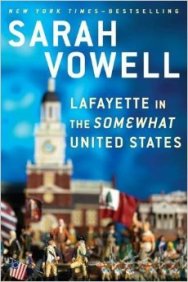
…at Lafayette College, that is. Last February I had the opportunity to join fellow members of51AZox6paLL._SY344_BO1,204,203,200_ the American Friends of Lafayette (yes, that’s a thing, and you can—and should—join by visiting this website) in the “reserved seating” section (that’s the second row, folks) of the absolutely packed Colton Chapel on the campus of Lafayette College in Easton, Pennsylvania. We were settled into the pews to hear Sarah Vowell discuss her New York Times bestseller, Lafayette in the Somewhat United States.

Lafayette College is, obviously, an apt place to hear someone expound upon the merits of Marie-Joseph Paul Yves Roch Gilbert du Motier, Marquis de Lafayette (say that five times fast). The college was founded in 1826 on the heels of the Marquis’ “Farewell Tour” of the United States, and aptly named for him “in memory and out of respect for the signal services rendered by General Lafayette in the great cause of freedom” (from the Charter of Lafayette College, Article I). Lafayette College isn’t the only place in the United States named for or out of respect of the Marquis—in her book, Vowell notes that “nowadays, Lafayette is a place, not a person,” and she makes an appropriate observation.  According to Lafayette scholar (and AFofL president) Alan Hoffman, over 80 localities in the United States have been named in honor of the Marquis, with Fayetteville, North Carolina being the very first in 1783.

Place and landscape are interesting lenses through which to examine Lafayette’s relationship with the United States. Though his final resting place is in Paris, Lafayette  is even buried in American soil–from Bunker Hill, as a matter of fact–collected in 1825.

Lafayette first ventured to the somewhat-not-yet-but-might-actually-be-if-Washington-can-keep-it-together United States in 1777. Lafayette’s first daybreak view was when he awoke in his bedchamber at Major Benjamin Huger’s home near Georgetown, South Carolina, after stepping off of the ship Victory the previous evening. Lafayette surveyed what was to him, a new world:

The next morning was beautiful. Everything around me was new to me, the room, the bed draped in delicate mosquito curtains…the strange new beauty of the landscape outside my windows, the luxuriant  vegetation—all combined to produce a magical effect.

Vowell describes how Lafayette, in 1777, in his enthusiasm and naiveté, wasn’t entirely sure what he was looking at, but loved it. Lafayette surveyed scenes outside of his window that were, true to Vowell’s title, somewhat the United States—Congress declared independence from Great Britain a year earlier, but Parliament had yet to recognized it. Similarly, the very physical landscape Lafayette described was, well, schizophrenic. Huger’s Georgian-inspired South Carolina home where the ultimate patriot awoke that morning was nestled near a town named after—who else–King George III, yet Georgetown was a hotbed of patriotism that contributed to the infamy of everyone’s favorite Revolutionary rascal Mel Gibson Francis Marion.

Vowell’s text weaves us through the rest of Lafayette’s tenure in the somewhat-but-becoming-ever-closer-to-actually-being United States, all the way to up to Lafayette’s participation in the Siege of Yorktown, the somewhat-last-battle of the American Revolution.

But Lafayette’s relationship with the somewhat United States didn’t end there. In 1824 at the invitation of President James Monroe, the Marquis, now the last surviving general of the American Revolution, embarked on a “Farewell Tour” of the country he so passionately helped establish. A bona fide rock star, Lafayette arrived in New York to an estimated 80,000 screaming fans.

Let’s take a break for some quantitative population analysis:


Year

1824 1964
Population of New York: 123,000 7,000,000
Number of Screaming Fans: 80,000 4,000
Percentage of Population: 65.04% 0.06%
52731772-f84f-4ce9-ada7-648fc978a8c0
The Marquis de Lafayette by Ary Scheffer, 1824.
beattles-arrive-1964
You know how these guys are. 1964


Who’s the rockstar now?! A-hem…as I was saying…

Lafayette’s Farewell Tour of the United States included visits to the very places named in his honor—Fayetteville, North Carolina received him in March 1825—and places were renamed because of the tour (further proof that Lafayette had a powerful impact on the physical landscape of the United States, somewhat or otherwise). And just as he did in 1777, in 1824 Lafayette reemerged as a hero of the American cause. As Vowell pointed out in her talk at Lafayette College, the Marquis was an apolitical unifier who ushered in a new era of patriotism when the (somewhat) United States needed it the most. When Lafayette arrived, the country was in the midst of a heated election season—one that many felt would either break the young nation or peacefully transition it into a new phase of her existence without living vestiges of the original Revolutionary population to guide it. As Vowell argues, an anxious American populous united in a rally around the hero, and both Lafayette’s visit and the election of 1824 highlight what historian Robert Hay called “the desperate desire of the American people to maintain for as long as possible some physical and spiritual connection with the Revolutionary generation.”

All of this is to say nothing about Lafayette’s influential views on abolition, women’s rights, and other important reforms that, if he didn’t support directly, he was eventually called down to support (e.g., Evelyn Wotherspoon Wainwright’s 1920 pleading to a statue of Lafayette in D.C.’s Lafayette Square to “Speak, Lafayette, dead these hundred years but still living in the hearts of the American people.”) As Vowell argues in Lafayette in the Somewhat United States, the American people, and the rights and liberties they enjoy, would not be ours without a little help from our friends (see what I did there?)–one friend, specifically—the Marquis de Lafayette, and his constant contributions to the somewhat, ever growing, ever discoursing, ever revolutionary United States. I encourage you to check out Sarah Vowell’s book, and learn more about why Lafayette is permanently fixed on the landscape of the United States of America—and in the hearts and minds of its citizens. No somewhat about it.

Read More!

Robert P. Hay, “The American Revolution Twice Recalled: Lafayette’s Visit and the Election of 1824,” Indiana Magazine of History, Volume 69, Issue 1, pp 43-62.

Sarah Vowell, Lafayette in the Somewhat United States, New York: Riverhead Books, 2015.


“A Gallant Defense”

236 years ago America suffered its worst defeat of the entire Revolutionary War.  On May 12, 1780, patriot General Benjamin Lincoln surrendered the city of Charleston (then, Charlestown) South Carolina and its garrison of about 6,000 troops to the British army under General Henry Clinton.

Sullivans-island-1050x777
The Siege of Charleston.  This image shows a view of the British works and the city of Charleston in the background.

The British had set their sights on the wealthy southern city after taking Savannah in 1778 and successfully defending it against French and American attacks in 1779.  The British expedition against Charleston was a joint effort by the Royal Army and Navy.  General Clinton advanced by land, while Admiral Mariot Arbuthnot blockaded the harbor.  Their combined force had about 13,000 men.  George Washington in New York dispatched the Virginia Continental Line from his army to reinforce the southern army stationed in the city of Charleston.  General Benjamin Lincoln had a difficult choice of whether or not to stay in Charleston (a very difficult location to defend as it was on a peninsula) or evacuate the city and save his 6,000 man army.  The citizens of Charleston stubbornly insisted that Lincoln stay in the city, and Lincoln deferred.

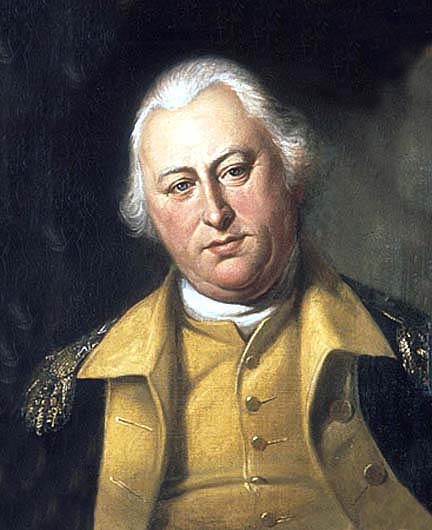
General_Benjamin_Lincoln-restored
General Benjamin Lincoln

Clinton moved down the peninsula and on April 1 began a classic siege of the city.  Lincoln got good news when on April 7 when the Virginia Continentals reinforced his army after marching nearly 700 miles.  Unfortunately, the noose around Charleston’s neck was just beginning to tighten.  The British dug earthworks inching closer and closer to the town while hundreds of American and British cannon fired at each other for 42 days.  This would end up being the longest siege of the entire war.  During this time there were also numerous infantry attacks and sorties as the Americans desperately tried to break the siege.  On April 24, a select group of Patriots sprang into the British works and bayoneted more than a dozen British soldiers.  During the fighting over the 42 days about 500 American and British troops would be killed and wounded and dozens of Charleston citizens would be killed from the bombardment.

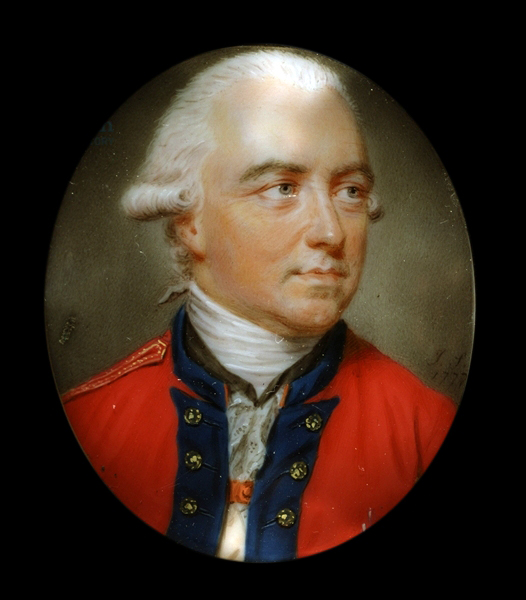
SirHenryClinton
General Henry Clinton

Ultimately, it became impossible to break through or escape.  On May 9th, the British unleashed a massive bombardment.  General William Moultrie remembered it clearly: “There was a tremendous cannonade (180-200 pieces of heavy cannon firing), it was a glorious sight, to see them like meteors crossing each other, and bursting in the air; it appeared as if the stars were tumbling down.  The fire was incessant almost the whole night; cannonballs whizzing and shells hissing continually amongst us; ammunition chests and temporary magazines blowing up, great guns bursting, and wounded men groaning along the lines: it was a dreadful night!”

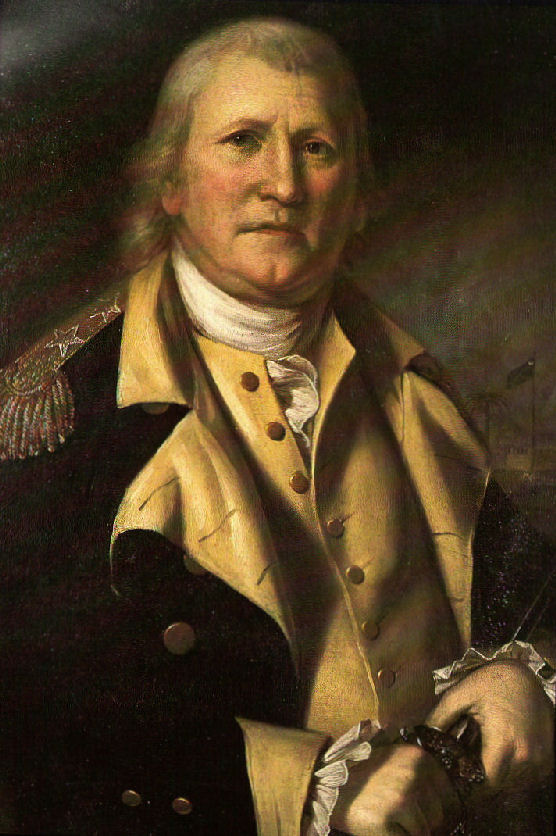
3-moultrie
General William Moultrie.  Moultrie’s brother, Thomas, was killed in the sortie on April 24.

On May 12, 1780 Lincoln formally surrendered his army to Henry Clinton, after what one British officer described as “a gallant defense.”  It was the largest defeat of the war for the Americans and the next time an American force this large surrendered to a foreign army was during World War II at Bataan.  The defeat was humiliating.  The captured Continental soldiers would ultimately be placed on prison ships in Charleston harbor where hundreds more would die of disease and hunger.

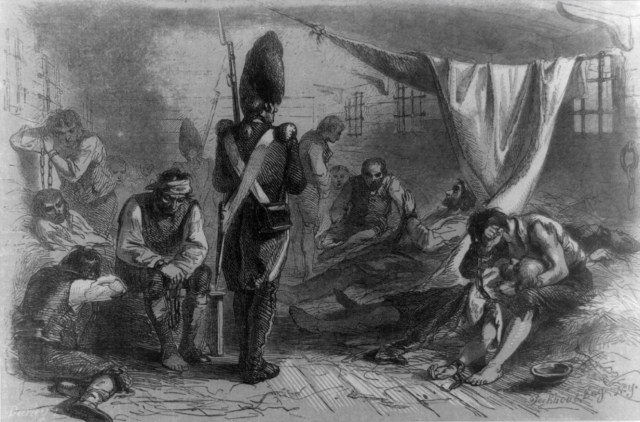
interior of old prison ship
View of conditions on board a prison ship during the Revolutionary War.  About 12,000 American prisoners of war died during the Revolutionary.  Most were imprisoned in New York harbor (depicted here) but many were imprisoned in Charleston harbor after 1780.

General Benjamin Lincoln was exchanged and was with Washington’s army a year and a half later at Yorktown.  When General Cornwallis was forced to surrender his army in the face of American siege works, he refused to attend the surrender ceremony.  His second in command, General Charles O’Hara went to surrender his sword to the French general Rochambeau, who refused it and directed he give it to Washington.  Washington, in turn refused, and directed he give it to none other than Benjamin Lincoln.  The disaster at Charleston had been avenged.  But it would be more than a year after the victory at Yorktown before the city of Charleston would be liberated from British control on December 14, 1782.

Surrender_of_Lord_Cornwallis
Surrender of the British at Yorktown.  General Lincoln is front and center on the white horse.  A similar scene, only reversed, occurred in Charleston in 1780.

This event has been vastly overlooked and little remembered throughout history.  Today the only reminders of this important event are a small piece of the ‘hornwork’ (part of the American defenses) which survived and a state historic marker that was placed six years ago today for the 230th anniversary of the surrender.  Most of the hallowed ground that made up the deadly no-mans-land and the locations of the American and British earthworks are now under the trendy upper King Street area in the city of Charleston.  There was no attempt to save this battlefield land after the war.  This exemplifies the importance preservation of battlefield land has on how we remember our history.  Next time you visit Charleston, remember the significant sacrifices made in 1780 in that part of the city, even with no battlefield set aside to honor those men who fought.  The events that occurred there showed just how close America came to defeat as late as 1780 and gives more luster to the names of the men who in the face of such daunting challenges and defeats fought, died, persevered and were eventually victorious.

mark_maloy1
Dedication of a marker on the site of the American surrender in 2010.

The Revolution’s Southwest Front

Emerging Revolutionary War is honored to welcome back historian Robert “Bert” Dunkerly. 

During a trip to Mobile, Alabama for some Civil War research, I came across a fascinating and lesser-known aspect of the American Revolution.  When I travel, I always keep my eye out for unusual finds and hidden history.  I was rewarded on my trip to Mobile with a great discovery.

Ft C
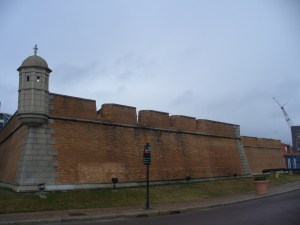
Fort Conde (author collection)

One of the main historic sites in downtown Mobile is the reconstructed Fort Conde.  This brick fort interprets the early history of Mobile and the region under the flags of France, Spain, and the United States.  Just outside the fort is a marker discussing the battle of Fort Charlotte.

Mobile was originally the capital of the French Louisiana Territory until the close of the French and Indian War.  As part of the settlement of that conflict in 1763, this French territory passed to the British.  Fort Conde, built in 1723, was renamed Fort Charlotte by its new owners.

Map
Map of Ft. Conde superimposed over modern Mobile streets, (photo by author)

Most of us know that the French were anxiously watching the American Revolution when the conflict broke out, hoping to score revenge against their English adversaries. Also watching with interest were the Spanish.

The British garrisons along the Gulf of Mexico coast (Pensacola, Mobile, Baton Rouge) were quite small and vulnerable.  The Spanish had been providing material aid and funds to the Americans, but finally declared war on Britain in 1779.  The Spanish were ambivalent about American independence, and unlike the French, did not recognize the United States, but did agree to help militarily.

Even before Spain’s entry into the war, New Orleans was a source of aid smuggled in for the American effort.  The Crescent City, and all the land west of the Mississippi, had been awarded to Spain at the close of the French and Indian War.  From here, supplies moved up the Mississippi to Fort Pitt at Pittsburgh, PA.  And from New Orleans, Governor Bernardo de Galvez attacked British posts up the Mississippi and along the Gulf Coast.

bernardo
General Bernardo de Galvez, (artist unknown)

A statue of the Spanish general who did much to wrest the Mississippi and Gulf coast areas away from the British stands near the World Trade Center in New Orleans.  A gift from Spain to the city of New Orleans, the statue is a reminder of this important but neglected aspect of the war.  A group known as Granaderos y Damas de Galvez are dedicated to preserving his memory and that of the Spanish role in the Revolution.

Oliver Pollock was a Philadelphia merchant with close ties in Cuba and New Orleans.  When the war broke out, he used his connections to aid the Revolutionary cause from the Crescent City.  In 1777 he was appointed “commercial agent of the United States at New Orleans” and used his fortune to finance American operations in the west, such as General George Rogers Clark.  When Spain entered the war he served as an aide to General Bernardo de Galvez.

Moving up from New Orleans, a force under General de Galvez, that included Spanish troops, American volunteers, Acadian settles, and free blacks, attacked and captured the British outpost of Fort Richmond at Baton Rouge on September 21, 1779.  Today a memorial with plaques and a cannon marks the site.

In February, 1780, Spanish troops and American volunteers under Governor Bernardo de  Galvez laid siege to the 300 British in Fort Charlotte at Mobile.  The siege lasted a month.  The garrison’s surrender gave the Spanish control of this important site, and removed all English military forces from the Gulf region.

This was one of the few actions of the war in which Spanish and American troops fought side by side.  Spain declared war on Britain but did not recognized the United States, their primary interest being to settle scores with the British.


For more information on these fascinating events, check the following websites: 

http://www.museumofmobile.com/ft_conde.php

http://granaderos.org/


Through the Lense of History: May 3, 1775


spy_-_page_1_0Often the study of history can ground us and make us feel less “unique.” This allows us to hopefully put our own experiences into perspective and be able to hopefully learn from lessons of the past.  Many today complain about how print and social media can distort facts to support a particular agenda.  This is not a modern phenomenon.  Many in the Sons of Liberty (such as Paul Revere) used print media to their advantage to promote resistance to and then independence from Great Britain.

Many pro-Patriot newspapers printed nothing less than propaganda pieces after the battles of April 19, 1775. Here is part of what was printed by the Massachusetts Spy on May 3, 1775.

Americans!  forever bear in mind the BATTLE of LEXINGTON!  where British Troops, unmolested and unprovoked wantonly, and in a most inhuman manner fired upon and killed a number of our countrymen, then robbed them of their provisions, ransacked, plundered and burnt their houses!  nor could the tears of defenseless women, some of whom were in the pains of childbirth, the cries of helpless, babes, nor the prayers of old age, confined to beds of sickness, appease their thirst for blood! – or divert them from the DESIGN of MURDER and ROBBERY!”

Obviously a historic study of the events on April 19, 1775 disputes much of what is claimed by the Massachusetts Spy.  But when you have a point to make, an agenda to promote and a local population to rally to a cause…why should truth get in the way?!  We have come a long way since 1775, but in many ways not much has changed.

DoolittleLexedit
The prints by Amos Doolittle of the events on April 19, 1775 did a lot to promote the Patriots cause in their “media war” war against the British.

The Greatest Leaders of the American Revolution You Have Never Heard Of

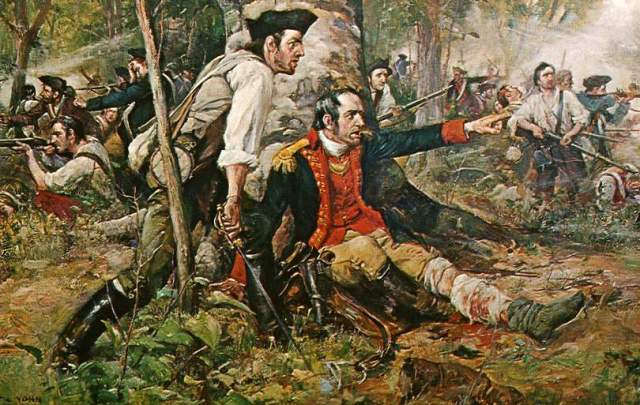
Sitting under a tree in north-central New York, suffering from a painful and mortal leg wound, yet still managing a successful defense after a powerful ambush, is a characteristic of a great military leader. All the while nonchalantly smoking his pipe!

OCHSherkimer200pix
General Nicholas Herkimer (courtesy of the NPS/Fort Stanwix and Oneida County (NY) Historical Society)

Nicholas Herkimer was the epitome of a successful militia commander. The Battle of Oriskany was a turning point. Herkimer, sitting on a once innocuous hillside, was a major reason why.

Even George Washington recognized the importance of Herkimer and made mention of his decision to not seek a commission in anything more than the militia of his home state. Not only that simple fact of service recognized by the commander-in-chief, but also his pivotal role in the Northern campaign of 1777.

“It was Herkimer who first reversed the gloomy  scene of the Northern campaign. The hero of the Mohawk Valley served from love of Country, not for reward. He did not want a Continental command or money.”

Herkimer would succumb to the mortal leg wound ten days after the battle, but his role in what was described as “one of the bloodiest battles of the war” solidified his place in the category of “greatest leaders of the American Revolution you have never heard of.”

Born in the Mohawk Valley of New York to Palatinate immigrants, Nicholas was described as a slender built, dark complexioned, dark haired individual. When he was finished growing, he stood near six feet tall, a rather tall height in 18th century Colonial America. He could also boast of being multilingual, fluently speaking English, German, and Iroquois.

He saw action in the French and Indian War, helping to repel the French and Native American attack on German Flatts, New York on November 12, 1757. Although a disastrous day for the German community, as many were taken prisoner by the French and Native Americans, Herkimer’s role led to his promotion to captain in the militia within two months of the fighting on January 5, 1758. Thirty-years after his promotion to captain the town would be renamed “Herkimer” for the actions of this New Yorker during the subsequent war.

In April of 1758, Herkimer was present and assisted in the successful repulse of the French and Indian force.

With peace established in 1763, Herkimer looked toward personal matters, building a house on the south side of the Mohawk River in 1764. He married two ladies, both named Maria. One died and the other would remarry and move north of the border to Canada, after Herkimer’s death in 1777.

With tensions increasing in the 1770s between Great Britain and the colonies, Herkimer led the Tryon County, New York Committee of Safety and was elected colonel of the local militia. The Provincial Congress on September 5, 1776 promoted him to brigadier general of the militia. One of his first roles was to meet with Joseph Brant, a Mohawk military and political leader in an effort to try and keep the Native Americans neutral in the conflict between the colonies and Great Britain. He was unsuccessful.

During the Northern Campaign of 1777, with the thrust southward by British General John Burgoyne being the main column on its way to its destiny at Saratoga, a secondary column entered the Mohawk Valley under British General Barrimore”Barry” St. Leger. The combined British, German, Loyalist, and Native American force laid siege to Fort Stanwix, in present-day Rome, New York.

Herkimer heard about this and marched his militia to help raise the siege. His force was ambushed on August 6, as they were nearing Fort Stanwix. After the initial surprise, in which Herkimer received his wound, the militia responded well and a drawn out battle ensued.

Part of the reason that the majority of the militia recovered from the shock and endured the ensuing bloody carnage was directly related to the inspired leadership of Colonel Samuel Campbell who led one of the militia regiments in the force and Herkimer himself.

Herkimer, after having his horse shot and receiving his mortal wound in the opening shots of the engagement asked to be propped under a tree on the hillside his forces had utilized for their defensive stand He then calmly lit a pipe and with a continued cool demeanor directed the rest of the engagement.

Herkimer_at_oriskany
Famous painting depicting the mortally wounded General Nicholas Herkimer directing his militia from his position seated under a tree, during the Battle of Oriskany on August 6, 1777. (Painting by Frederick C. Yohn)

After the day-long battle, Herkimer ensured he was the last to leave the field, after all the wounded that could be collected had been removed.

Although his wound was dressed on the field, the injury became infected and amputation was the only course of action. In the woods of western New York, the surgeon doing the operation was inexperienced and the wound bled tremendously. Herkimer would succumb to the wound on August 16, at the age of 49. He was buried near Little Falls, where he had built his home in the 1760s. The cemetery today is known as the “Herkimer Home Burial Ground.”


*Nicholas Herkimer’s role in the war and the Battle of Oriskany and the St. Leger campaign is described wonderfully by Michael O. Logusz in Volume 2 of “With Musket and Tomahawk” published by Savas Beatie LLC in March 2012.*


Campaign 1776 Presents….The Revolutionary War Animated Map

campaign-1776-logo-220Debuting yesterday, the Campaign 1776, an initiative by the Civil War Trust, released an animated map that covers the “entirety of the American Revolution,” according to Civil War Trust Communications Manager Meg Martin.

At eighteen minutes in length, the video is a “succinct and engaging” access to gaining an overview of the entirety of the American Revolution, from the first shots in Massachusetts at Lexington and Concord to the culmination of the Siege of Yorktown in 1781. The video even includes a segment entitled “The Twilight Years” which explains the two years the war continued on after the victory at Yorktown; from 1781 to 1783. One can also jump to different parts, as the video has subheadings at the bottom to break the eighteen minute video into segments.

The video combines modern photography,with “live-action footage, 3-D animation, and in-depth battle maps” to give the viewer a sense of what the American Revolution, the pivotal event that “shaped America” was like.

To check out the video, click here.

Furthermore, “The Revolutionary War” animated map is part of a larger series of animated battle maps of battles on Civil War battles, which can be found here.

This animated map may be the first in the series of American Revolution and War of 1812 battles that the Campaign 1776 and Civil War Trust team is contemplating doing. We will all have to stay tuned and find out.

Yet, this animated map, of the entire American Revolution, is a great beginning introduction, so sit back, dedicate eighteen minutes, and learn about this defining moment in American history.


*Emerging Revolutionary War would like to thank Meg Martin of the Civil War Trust for the information about this release.*

A Stop at Newtown

Newtown-BritishSpring has not get touched the tree-covered hills to the east of Elmira, New York, but the Chemung River sparkles in quiet anticipation as it flows between them. The Newtown Battlefield State Park won’t open for another few days or so—it operates seasonally May through October—but I have stopped nonetheless to see what might be here.

“I am very apprehensive our Expedition will not appear in History,” wrote Lt. Obadiah Gore, Jr., of the Continental Army.

And indeed Gore’s worries seem to have played out just that way. I know almost nothing about this Revolutionary War battle, although I have driven by the battlefield for decades. In fact, for two full years not so long ago, as I was doing my Ph.D. at Binghamton University, I drove through the battlefield four times a week on my way from and to Saint Bonaventure University, where I work. I really need to stop sometime, I kept telling myself.

For years, the old State Route 17 passed through the battlefield with little more than a sign telling motorists they were passing through and an arrow pointing up a road that could have been someone’s driveway. The expansion of Route 17 into Interstate 86 now gives motorists the chance to whisk right on by even faster, giving even less notice, despite signs that still say I am passing through.

But today, I’m finally stopping. Continue reading “A Stop at Newtown”

Reflections of April 19, 1775

On this date, 241 years ago, the first salvo of what would become the American Revolutionary War, was fired on Lexington Green and North Bridge in Concord.

Historian John Galvin once wrote about the Battles of Lexington and Concord that they were the “least known of all American battles.” I never really understood what Galvin meant, as I had read extensively about April 19, 1775 and thought I understood the details of that day in history.

Yet, until this past weekend, when I spent the better part of four days touring the sites and walking the trails, talking to the historians around the towns, I did not realize how much more there is to what actually happened on that April day.

For starters, did you realize that Paul Revere did not go town-to-town calling out, “The British are Coming” to homesteads and roadside taverns? Instead, he was the catalyst that started a chain reaction of messengers and runners to different towns throughout the countryside that cast the alarm in a wide net.

He also would have told farmsteads and meetinghouses along the way that the “Regulars are Coming,” since the colonists still thought of themselves as British.

Or that the unofficial birth of the United States Army is attributed to the militia that followed Colonel James Barrett and Colonel John Buttrick down the hill toward the British at the North Bridge?

IMG_6903
The field where the militia under Colonel James Barrett and Colonel John Buttrick began their advance from toward the North Bridge. The militia would be coming toward us to descend toward the span.

That was the first time that men, formed in regiments with officers, made an advance against what they perceived as an enemy force, and did so in a “very military manner.”

What prompted the various militia companies, which came from other towns than just Concord, to sally forth from the hill toward the now infamous North Bridge? The main reason was what was happening in Concord was the mistaken reason behind the smoke emanating from the town?

In the town, the British were burning military supplies and the wooden gun carriages found in the hamlet. Sparks landed one of the nearby dwellings and British soldiers actually put down their muskets to form a bucket brigade, with civilians, to help put out the flames. The smoke that billowed from the doused fires is what prompted the militia and minutemen response.

With water being dumped on the flames, smoke billowed up, which prompted milita Adjutant Joseph Hosmer to ask the officers; “Will you let them burn the town down?” That prompted the forward movement of the militia down the hill and against the British.

Or did you realize that some of the militia, from the nearby town of Acton, suffered some of the first casualties at North Bridge, including their militia captain, Isaac Davis, who was one of the first killed in the engagement?

IMG_0087
View of the Old Manse, built in 1770 for Reverend William Emerson. View from the Concord River/North Bridge direction.

Somewhere in the midst of the action in Concord was Reverend William Emerson, the grandfather of Ralph Waldo Emerson who would later write that the action on April 19, would be known as the “shot heard round the world” years later.

These are just a few of the interesting tidbits that I picked up this past weekend. Altogether, they reinforce the historic events that I knew unfolded on this day in American History. However, along with reflecting on what transpired in my visit to Massachusetts, these new tidbits of valuable information underscore the important stories and accounts that shape this spring day that are beckoning to be told.

There is so much to be gained by walking the grounds, talking to the historians and historical enthusiasts of the area, and just taking time to appreciate what this day, April 19th, meant to the future of the United States and the era it was leaving behind as part of the British Empire.

Announcing the New Emerging Revolutionary War Series

ERWS logoAlthough it’s been nearly 250 years since America’s founding, the Revolutionary era continues to capture people’s imaginations. To explore that story even further, the editors of Emerging Revolutionary War have partnered with publisher Savas Beatie, LLC, for a new book series that will highlight the key events, people, and stories of America’s foundational experience.

The Emerging Revolutionary War Series will offer overviews of battles, politics, and biographies aimed at general audiences. Each book will be supplemented with dozens of original photos and all-new maps.

“These books are modeled after our highly popular Emerging Civil War Series,” explains publisher Theodore P. Savas. “The books are reader-friendly, and offer the perfect introductory-level chance to explore some great stories.”

Continue reading “Announcing the New Emerging Revolutionary War Series”