Book Review: The Whiskey Rebellion: A Distilled History of an American Crisis (Yardley, PA: Westholme Publishing, 2023)

During the second half of the 18th century, the Forks of the Ohio, where the Monongahela and Allegheny Rivers come together to form the Ohio River, were a vortex of conflict that dramatically influenced the course of events in North America and the unfolding of a young United States.  In his latest book, The Whiskey Rebellion: A Distilled History of an American Crisis, historian Brady J. Crytzer adds to his already substantial body of work exploring the critical role the region played in American history.  It is a must read.

            In 1791, Congress passed a whiskey tax to raise revenue and pay off war debts.  Treasury Secretary Alexander Hamilton, whose brainchild the whiskey tax was, designed the tax to help consolidate capital for investment in the country’s infrastructure.  Small farmers, who constituted the bulk of distillers on the frontier, rebelled.  Their resentment of the tax was not driven merely by its existence, but also by its structure, which they argued discriminated against small farmers.   They had a point.  Whiskey, not just as commodity, was a medium of exchange because hard currency was scarce on the frontier.   Thus, in some ways, the whiskey tax resembled the stamp tax; one had to pay it to engage in normal commerce.  The tax could be levied both on stills and the amount of whiskey each distiller produced.  Large enterprises who ran their stills year-round could pay the tax.  Small farmers, however, primarily ran their stills for brief periods in order to convert grain crops to more readily transportable whiskey.   Moreover, the tax had to be paid in cash, which was scarce on the frontier.  As a result, the tax was regressive and more difficult for smaller farmer to pay than for large the large distillers.  

            Rebellion was in some ways the predictable outcome.  By 1791, the frontier was populated by people with a tradition of resisting governments they believed were run for the benefit of others.  Whether those elites were in far-off London or distant Philadelphia was immaterial.  Pittsburgh might be a federalist outpost as a frontier center for exercising the authority of the newly-established United States government, but the more populous surrounding countryside was dominated by small farmers and small communities.  They responded much in the same way Americans had before the Revolution: community meetings and remonstrances, isolated attacks on officials, intimidation of those cooperating with distant governments, destruction of property, the creation of new political institutions, and the old stand-by: tarring and feathering.  Events culminated in a two-day battle for General John Neville’s home and a large muster of rebels at the site of British Major General Edward Braddock’s defeat on the Monongahela River.

Continue reading “Book Review: The Whiskey Rebellion: A Distilled History of an American Crisis (Yardley, PA: Westholme Publishing, 2023)”
The first of three Artillery Engagements at the Battle of Trenton: December 26, 1776

Emerging Revolutionary War welcomes back guest historians Karl G. Elsea and William M. Welsch.

Part I

1770 drawing of Hessian three-pounder barrel
(Drawing of Hessian three-pounder gun, dated 1770, at Kriegskarten from Hessisches Staatsarchiv Marburg, Germany at http://www.digam.net/?str=177)

The Rall Artillery Detachment:

It is well known that the Battle of Trenton saved the American Revolution from defeat. What is not well known is the story of two of the three Hessian artillery detachments and the description of their field guns. This series of articles tells the story of the three Hessian artillery engagements at the First Battle of Trenton. These three fights largely determined the victory for the patriots.

The field guns used by the patriots in the artillery engagement at Trenton were fairly well documented. The Patriots used British Armstrong design M1736 six-pounders, British commercial iron four-pounder barrels on Patriot designed carriages, and the Common Pattern British designed three-pounders (looked like scaled down six-pounders).

The Hessian three-pounder field guns were primarily designed to be beautiful, symmetric and fill both the roles of field (light) artillery and garrison (medium) artillery. The “brass” barrel was one caliber (caliber was equal to 3.01 English inch) thick at the breech, one half caliber thick at the muzzle, and was twenty calibers long from breech ring to muzzle. This symmetry came at a price, namely, the barrel alone weighted over 700 pounds. As a comparison, the 1776 designed British Congreve three-pounder barrel had a weight of 212 pounds and was 12.4 calibers long while the “Common” pattern three-pounder barrel used by the Patriots was 287 pounds and 14.5 calibers long.[i] This flaw in the Hessian guns concerning the weight required four horses to pull each gun and made each gun more vulnerable to sinking in mud. Field guns were supposed to be” light,” something these Hessian guns were not.

Continue reading “The first of three Artillery Engagements at the Battle of Trenton: December 26, 1776”

“Rev War Roundatble with ERW” Discusses “The Cabinet” with Dr. Lindsay Chervinksy

George Washington’s first presidential cabinet included many luminaries of the American Revolutionary era; Thomas Jefferson as Secretary of State and Alexander Hamilton as Secretary of the Treasury to just name two. When studying the formation of the present United States government and the creation of cabinets that serve the president, we tend to gloss over it, as a sort of bygone conclusion, that this was a natural product out of this creation.

A closer reading of the United States Constitution, however, does not include the executive branch having a cabinet of secretaries to assist the president. George Washington, as first president, was entirely on his own in creating one, and the first cabinet meeting was not called into session until two and a half years into his first term.

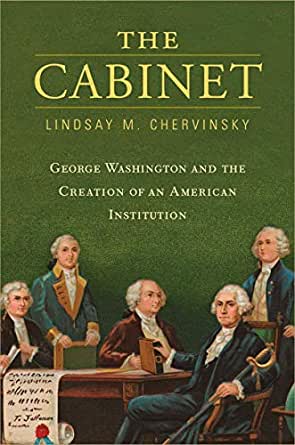
The creation of this American institution is the basis of this week’s “Rev War Revelry” as Emerging Revolutionary War welcomes historian and author Dr. Lindsay Chervinsky as she discusses the history in and surrounding her publication, The Cabinet, George Washington and the Creation of an American Institution.

When discussing the importance of the cabinet, Chervinsky said:

“The best way to better understand the creation of the presidency, presidential leadership, or Washington’s legacy is through the cabinet.”

But this story isn’t just one about the early Founding Era. As Chervinsky writes in her work, “we can’t evaluate the cabinet without examining Washington’s use of councils of war from the Revolution. He developed critical management strategies in the councils that he replicated as president. The war shaped Washington as president.”

Chervinsky is an early American historian and is currently the Scholar-in-Residence at the Institute for Thomas Paine Studies at Iona College and a Senior Fellow at the International Center for Jefferson Studies. In addition, she is teaches courses on the presidency at George Washington University’s School of Media and Public Affairs.

For a sneak peak into the book and its history, click here to access Chervinsky’s talk at the Virginia Historical Society.

“Rev War Roundtable with ERW” A Special Rev War Revelry: “HamiLive”

Unless you have been living under Plymouth Rock, the play Hamilton has come across your radar screen in one form or another. Late last month Disney+ announced they would begin hosting the play on their streaming channel. Over the Independence Day weekend many historic sites had programs, watch parties, etc about the production.

So, why is Emerging Revolutionary War doing something similar this Sunday, at 7p.m. on our Facebook page? We wanted to do our own take on it, by presenting a mix of historians and fans of the play for an hour long discussion. For those that have been our faithful followers and thank you for your commitment, you will know how excited one of our historians is for this particular Zoom history.

If you guessed, Mark Maloy, you are correct! In fact, he is the one that made sure our title followed the correct vernacular for a Hamilton-esque post.

Joining Mark on Sunday will be the triumvirate of great historians, two that have been a part of past “Rev War Revelry’s” and one making her inaugural appearance.

Felicia Abrams is the Manager for Onsite Education at the Jamestown-Yorktown Foundation and a member of the Virginia Association of Museums. She will be joined by another great historian and co-worker, Kate Gruber, the Curator of Special Exhibits for the Jamestown-Yorktown Foundation.

Liz Williams, Director of Gadsby’s Tavern in Historic Alexandria will also be returning to the revelry this Sunday evening.

ERW invites you to attend our historian happy hour on Hamilton this Sunday, on our Facebook page. If you have not seen it, now is the time to catch up do you can have your questions and comments ready for Sunday evening. Don’t forget your favorite brew too!

ERW Book Review: Washington’s End: The Final Years and Forgotten Struggle by Jonathan Horn

George Washington retired from public life at the end of his second presidential term on March 4, 1797. Twenty months and ten days later he died on December 14, 1799. In between Washington was also the first in the United States to be a former president, first to deal with securing his legacy as both a military hero and political figure, and having to see the country he sacrificed so much to create, lurch forward without him having an active part in it.

Until now, these years have been either excluded, glossed over, or an anti-climatic ending to a Washington biography. Until now. Joseph Horn, a former presidential speechwriter and the author of The Man Who Would Not Be Washington lends his talent to a new biography of Washington, examining those last few years in-depth.

The author has a valid point when he argues that, “for too long, the story of Washington’s last years has been squeezed into the margins of manuscripts, if included at all” (pg. 14). Channeling the method of famed Washington biographer Douglas Southall Freeman, Horn writes this biography in the “fog of war” style that affords the reader the opportunity to read the history “through the eyes of those who made it rather than through the hindsight of historians” (pg. 14).

Continue reading “ERW Book Review: Washington’s End: The Final Years and Forgotten Struggle by Jonathan Horn”

Gaming Away Social Distancing. Deal or Duel: An Alexander Hamilton Card Game

IMG_0611.jpeg
Game Box for Deal or Duel (Eric Sterner)

Among his many aphorisms, Ben Franklin reportedly said “games lubricate the body and the mind.”  Given the large number of quotes attributed to the sage, it is suspect.  But, his generation certainly understood games, both as a way of sharpening the mind and passing time in amicable company.  Franklin was fond of chess, but not above games of chance and gambling.  George and Martha Washington often played different card games with their guests.  George, of course, also made an occasional wager, particularly when traveling on business.  Even today, many parlors in restored colonial homes will contain a gaming table. Continue reading “Gaming Away Social Distancing. Deal or Duel: An Alexander Hamilton Card Game”

Alexander Hamilton’s “First” Duel

glc07167engweb_
Lt. Col. Alexander Hamilton at Yorktown, VA by Alonzo Chapel

Alexander Hamilton has reappeared as a modern pop star with the wide success of the Broadway musical “Hamilton.” Due to this success, most people today know that Alexander Hamilton met his end in a duel with Aaron Burr on the banks of the Hudson River. But this was not Hamilton’s first involvement in a duel, nearly 26 years earlier Hamilton found himself embroiled in a feud with one of highest ranking Continental officers, Maj. Gen. Charles Lee.

It all started on June 28, 1778 at the Battle of Monmouth. The beginning of the battle had gone against the Americans and Lee, who was in command of the vanguard was ordering a retreat in front of the British. Washington, seeing the retreat rode ahead and encountered Lee. What was said between the men has been debated since that day, but what is not indisputable is that Lee took offense. Continue reading “Alexander Hamilton’s “First” Duel”

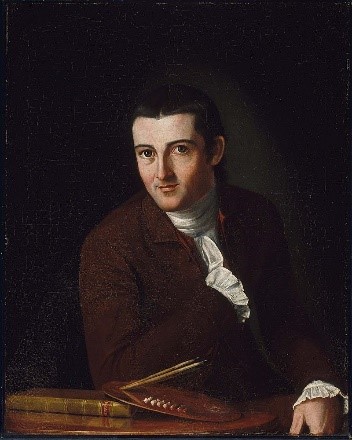
The Brush of John Trumbull

Emerging Revolutionary War welcomes back guest historian Michael Aubrecht

Trumbull
John Trumbull

John Trumbull’s paintings represent some of the most familiar depictions from the time of the American Revolution. Trumbull was a graduate of Harvard University and the gifted son of the Governor of Connecticut. As a child, Trumbull showed a remarkable talent for an attention to detail. This aptitude set his drawings apart from his contemporaries. Trumbull traveled to London in 1784 to study painting under the master Benjamin West. It was then that he started painting some of his most notable pieces. There he honed his expertise for realistic painting. A year later later Trumbull traveled to the City of Paris to do commissioned artworks. He later did portraits of George Washington, John Adams, Alexander Hamilton and Thomas Jefferson. In 1816, he was selected as the president of the American Academy of the Fine Arts where he would serve for 20 years. Emphasizing classic traditions Trumbull attempted to teach the skills he had acquired while overseas. Following his death in 1843 at the age of 87, Trumbull was buried beneath the Art Gallery at Yale University which he had designed. In 1867, his collection of artworks were displayed at the Street Hall building on the same grounds. He and his wife’s remains were later re-interred and buried on the grounds of that building. Trumbull’s approach to painting has been studied by art students around the world. Today Trumbull’s paintings remain some of the most cherished ever to be painted by an American artist.  Continue reading “The Brush of John Trumbull”

AfterWARd, the new exhibit at the American Revolution Museum at Yorktown. A visit with Curator Kate Gruber

IMG_20170927_153356397
The stacks of books reflect Knox’s role as a bookseller before the war.

If you have not made a trip to the new American Revolution Museum at Yorktown (the former Yorktown Victory Center) then you are missing out. Not only does the museum great exhibits on the causes of the war and the events leading up to Yorktown (with great technology), there is a changing exhibit gallery that allows for short term exhibits. The first exhibit opened in June and features the lives of four prominent Revolutionaries after the American Revolution. Continue reading “AfterWARd, the new exhibit at the American Revolution Museum at Yorktown. A visit with Curator Kate Gruber”

Three American Revolutionary War Luminaries

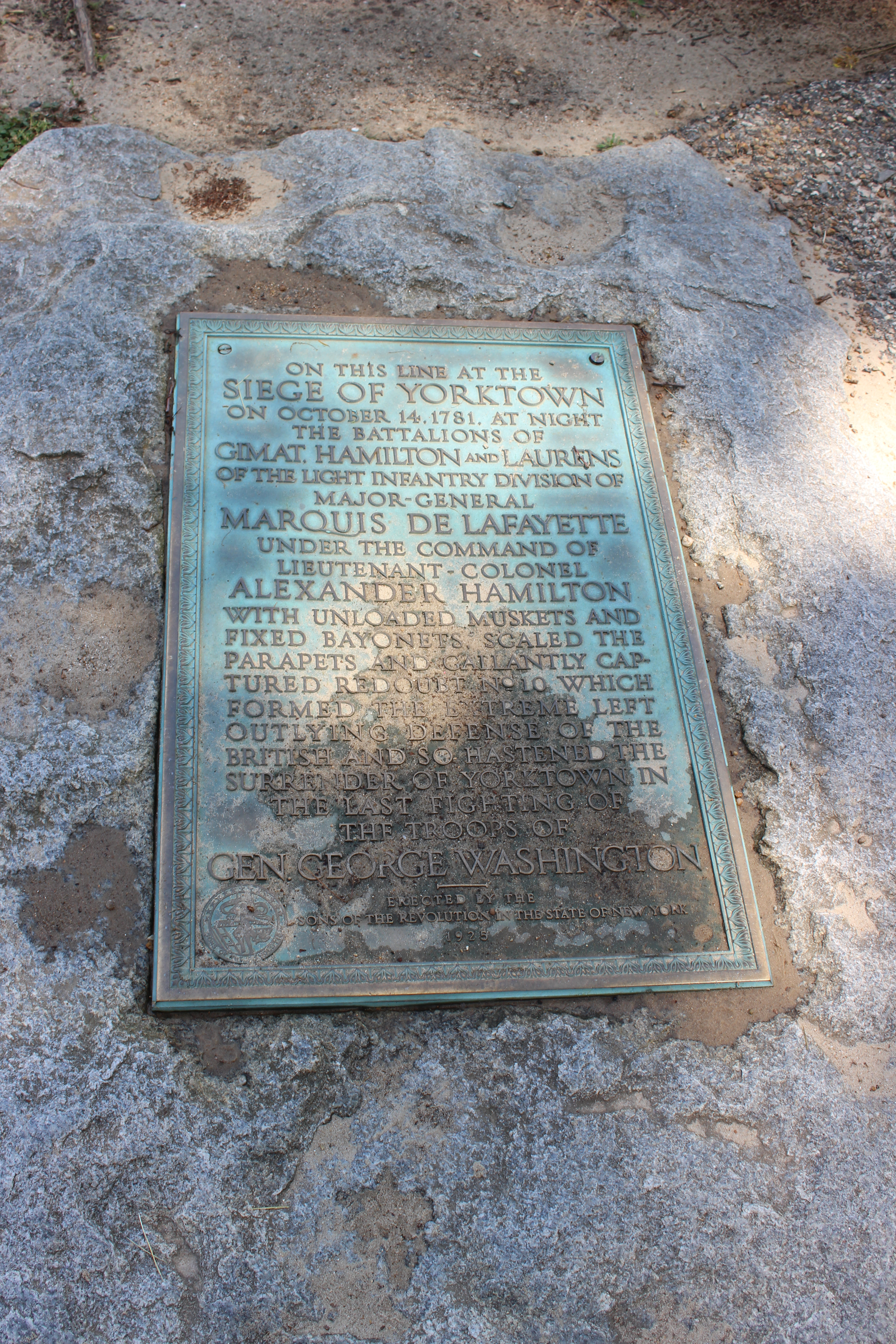
A few years ago I had the opportunity to visit Yorktown National Battlefield. This evening I was scrolling through my cache of American Revolution photos on an external hard drive, when I came across the picture below.

IMG_5993

A simple monument to three luminaries of the American Revolution. Three brilliant young men, one of which, John Laurens, would fall in one of the last small engagements of the war.

Could you imagine the conversation between the three that fateful October evening of 1781?