Robert Morris: Founding Father and Revolutionary Financier

Emerging Revolutionary War welcomes back guest historian Michael Aubrecht

To call Robert Morris “a political renaissance man” would be an understatement. He was vice president of the Pennsylvania Committee of Safety (1775–76) and was a member of the Continental Congress (1775–78) as well as a member of the Pennsylvania legislature (1778–79, 1780–81, 1785–86). Morris practically controlled the financial operations of the Revolutionary War from 1776 to 1783. He was a delegate to the Constitutional Convention (1787) and served in the U.S. Senate (1789–95). Perhaps most impressive is the fact that he signed the Declaration of Independence and the Articles of Confederation and later signed the U.S. Constitution.

At the start of the war Robert Morris was one of the wealthiest men in the colonies, but he would go on to claim bankruptcy after some catastrophic decisions. To fully appreciate the contributions of Robert Morris we must go back and examine him from the beginning.

Robert Morris

Robert Morris was born on January 31, 1734, in Liverpool, England, the son of Robert Morris, Sr., and Elizabeth Murphet Morris. His mother died when he was only two and he was raised by his grandmother. Morris’ father immigrated to the colonies in 1700, settled in Maryland and in 1738 he began a successful career working for Foster, Cunliffe and Sons of Liverpool. His job was to purchase and ship tobacco back to England. Morris Sr. was known for his ingenuity, and he was the creator of the tobacco inspection law. He was also regarded as an inventive merchant and was the first to keep his accounts in money rather than in gallons, pounds, or yards.

In 1750 tragedy would once again strike the Morris family. In July Morris Sr. hosted a dinner party aboard one of the company’s ships. As he prepared to depart a farewell salute was fired from the ship’s cannon and wadding from the shot burst through the side of the boat and severely injured him. He died a few days later of blood poisoning on July 12, 1750. The tragedy had a terrible effect on Morris who became an orphan at the age of 16. Looking for a change he left Maryland for Philadelphia in 1748. He was taken under the wing of his father’s friend, Mr. Greenway, who filled the gap left by the death of Morris’ father. Raised with a tremendous work ethic Morris flourished as a clerk at the merchant firm of Charles Willing & Co. 

Following in his father’s footsteps Morris was also gifted with successful ingenuity. In his twenties he took his earnings and joined a few friends in establishing the London Coffee House. (Today the Philadelphia Stock Exchange claims the coffee house as its origin.) Morris was sent as a ship’s captain on a trading mission to Jamaica during the Seven Years War (1756-1763). He was captured by a group of French Privateers but managed to escape to Cuba where he remained until an American ship arrived in Havana. Only then was he able to secure safe passage back to Philadelphia. 

Shortly after Morris’ return to the colonies Willing retired and handed the firm over to his son Thomas who offered him a partnership. This resulted in the formation of Willing, Morris & Co. The firm boasted three ships that were dispatched to the West Indies and England importing British cargo and exporting American goods. This relationship lasted for over 40 years and was immensely successful. At one point, Morris was ranked by the Encyclopedia of American Wealth, along with Charles Carroll of Carrollton, as the two wealthiest signers of the Declaration of Independence.

As influential merchants, Morris and Willing disagreed with the changes in tax policy. In 1765, the Stamp Act was passed and was met with massive resistance. Morris was at the forefront and led protests in the streets. His fervor was so striking that he convinced the stamp collector to suspend his post and return the stamps back to their origin. The tax collector stated that if he had not complied, he feared his house would have been torn down “brick by brick.” In 1769, the partners organized the first non-importation agreement, which forever ended the slave trade in the Philadelphia region.

Morris married Mary White on March 2, 1769, and they had seven children. In 1770, he bought an eighty-acre farm on the eastern bank of the Schuylkill River where he built a home he named “The Hills.” Due to his growing reputation Morris was asked to be a warden of the port of Philadelphia. Showing his tenacity, he convinced the captain of a tea ship to return to England in 1775.

Later on, Morris was appointed to the Model Treaty Committee following Richard Henry Lee’s resolution for independence on June 7, 1776. The resulting treaty projected international relations based on free trade and not political alliance. The treaty was eventually taken to Paris by Benjamin Franklin who transformed it into the Treaty of Alliance which was made possible by the Continental Army’s victory at Yorktown in 1781. 

Scholars disagree as to whether Morris was present on July 4 when the Declaration of Independence was approved. But when it came time to sign the Declaration on August 2 he did so. Morris boldly stated that it was “the duty of every individual to act his part in whatever station his country may call him to in hours of difficulty, danger and distress.” Until peace was achieved in 1783, Morris performed services in support of the war. His efforts earned him the moniker of “Financier of the Revolution.”

Michael is the author of “The Letters of Robert Morris: Founding Father and Revolutionary Financier.

The Adams Family Memorials in Quincy’s Merrymount Park

I want to take a moment to give a shout out to the Quincy Historical Society in Quincy, Massachusetts.

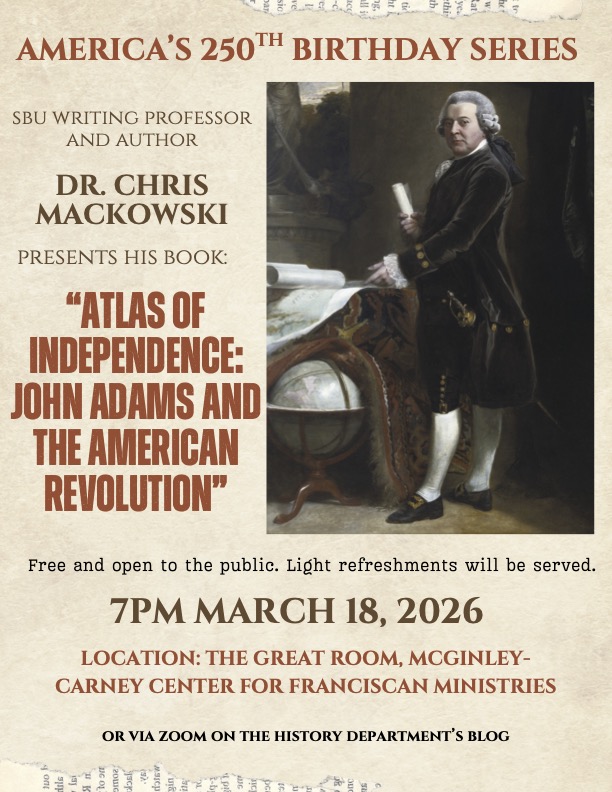
For my upcoming ERW Series book on John Adams in the Revolution, Atlas of Independence, I included an appendix that highlights a number of Adams-related sites in his hometown of Quincy: his birthplace; the home he first lived in with Abigail; his later-in-life home, Peacefield; the “Church of the Presidents,” which includes his crypt; and several other cool spots.

One of the places I direct people is to Merrymount Park, which features two monuments to Adams and members of his family. The newer of the two consists of a statue of John that stands across a small plaza from a dual statue of Abigail and a young John Quincy. The distance symbolizes the distance between John and his family for much of his public life.

Sculptor Lloyd Lillie created the Abigail and John Quincy statues first, in 1997. They stood together in downtown Quincy along Hancock Street. John was installed across from them in 2001, separated by traffic. When the city redesigned downtown and created the new Hancock-Adams Commons in 2022, the statues were relocated to Merrymount Park to join an older monument already standing there.

That older monument was a little harder to investigate.

The monument itself is made from Quincy granite, a longtime staple of the local economy. A bas relief bronze tablet mounted on the granite shows John and an adult John Quincy—both as presidents—seated together for an imagined conversation with each other. An inscription reads: “Father and Son, Second and Sixth Presidents of the Nation, Statesmen, Diplomats, Patriots, and Builders of our great Republic, they labored in the vanguard of human democracy on this soil.”

Beyond that, I knew the memorial had once been moved to the site where the John and John Quincy birthplaces stand along Franklin Street, but I didn’t know when and I didn’t know when the monument came back to Merrymount. I couldn’t even find the year of the monument’s dedication or the name of the sculptor. The internet didn’t seem to know these things, and none of my reference materials referenced them.

And so it was that I reached out to the Quincy Historical Society to see if they might have anything in their archives that could help me out.

Archivist Mikayla Martin went above and beyond to assist, sending me a neat little bonanza of stuff! Since she sent me more material than I had room for in the book, I thought I’d take the opportunity to share my windfall here so that you, too, could benefit from the Quincy Historical Society’s kindness.

The memorial, as it turned out, was dedicated in 1927. The chief of staff of the United States Army at the time, Maj. Gen. Charles P. Summerall, served as master of ceremonies for the event, according to a clipping from the Patriot Ledger the historical society sent me:

Photographer Warren S. Parker captured this image of the Adams Memorial on April 18, 1929. (courtesy of the Quincy Historical Society)

The Patriot Ledger hailed the memorial’s sculptor, Bruce Wilder Saville, as “One of Quincy’s most distinguished native sons.” Saville was best known in town for another of his works, the WWI “Doughboy” Memorial that stood in front of the Coddington School. The Quincy Historical Society included Saville’s obituary from the Patriot Ledger, which I’ll reproduce below, along with a photo of the Doughboy Memorial that the society sent me.

Another newspaper clipping revealed that the $5,000 memorial was a gift to the city of Quincy from the U.S. government. In 1961, city leaders voted to move the monument to the Adams birthplaces, but when the NPS took over management of the site 1979, the city returned the monument to Merrymount Park. I’ll reproduce a newspaper article related to that, as well (see below).

Every monument and memorial has a story of its own, and I find those stories fascinating. They can tell us a lot about the people they honor as well as the people who are doing the honoring.

Please consider supporting your own local historical society (and, if you’re so inclined, please consider supporting the Quincy Historical Society while you’re at it). Organizations like this provide invaluable services to researchers everywhere, but more importantly, they carry the torch for the history in your own back yard.

Holiday Kick-Off from Mt. Vernon….Place, Baltimore

On the first Thursday of December, the unofficial kick-off to the holiday season takes place in Baltimore, Maryland. This year, on December 4, was the 54th year of the celebration. The 178-foot-tall George Washington Monument, the construction of which started on July 4, 1815, and was completed in 1829, is graced with lights and fireworks that light up the city sky about the figure of Washington.

On both sides of the Washington Monument stand two equestrian statues grace the grounds. One is of a local American Revolutionary War hero, John Eager Howard, born in Baltimore County in 1752. On the other side is honorary American, the Honorable Marquis de Lafayette.

If you peer to the left of the Howard equestrian statue photo, you see the spire of a Victorian Gothic church. Built in 1872, the church stands on the location of the Howard residence. On January 11, 1843, Francis Scott Key died there, at the age of 63.

If you celebrate, Emerging Revolutionary War hopes your holiday season kicks off grandly as well. If I may, if looking for a gift for that history enthusiast, check out the Emerging Revolutionary War store here. Or the Emerging Revolutionary War Series, here.

A Letter from William Prescott to John Adams

Approximately two months after waging the defense of Breed’s Hill, on the Charlestown peninsula, against the British, Colonel William Prescott put quill to paper to write to John Adams. In this communique, he discussed the action at Breed’s Hill, known as the Battle of Bunker Hill, fought on June 17, 1775, to his fellow Massachusetts native. Take note that he even wrote his account about the orders he received and which hill that missive directed him to. Since the waft of smoke has drifted from the battle on that June day, veterans, officers, and historians have debated why Prescott and company chose Breed’s Hill instead of Bunker Hill. This letter is just another wrinkle in that timeless debate.

Camp at Cambridge August 25.1775

Sir

I have recd. a Line from my Brother which informs me
of your desire of a particular Account of the Action at
Charlestown, it is not in my Power at present to give so
minute an Account as I should choose being ordered to decamp
and march to another Station.

On the 16 June in the Evening I recd. Orders to march to Breeds
Hill in Charlestown with a party of about one thousand
Men consisting of 3 hundred of my own Regiment, Coll.
Bridge & Lieut Breckett with a Detachment of theirs, and
two hundred Connecticut Forces commanded by Capt.
Nolten, We arrived at the Spot the Lines were drawn by
the Enginier and we began the Intrenchmant about 12, o Clock
and plying the Work with all possible Expodition till Just
before sun rising, when the Enemy began a very heavy
Canonading and Bombardment, in the Interin [Interim] the
Enginier forsook me, having thrown up a small Redout,
found it necessary to draw a Line about 20 Rods in length
from the Fort Northerly, under a very Warm Fire from
the Enemys Artilary, About this Time the above Field
Officers being indisposed could render me but Little Service,
and the most of the Men under their Command deserted the
Party. The Enemy continueing an incessant Fire with their Artilary.
about 2, o Clock in the afternoon on the seventeenth the Enemy
began to land a northeasterly Point from the Fort, and I orderd
the Train with 2 field Pieces to go and oppose them and the
Connecticut Forces to support them but the Train marched
a different Course & I believe those sent to their support
followd, I suppose to Bunkers Hill, another party of
the Enemy landed and fired the Town, There was a party of
Hampshire in conjunction with some other Forces Lined
a Fence at the distance of three score Rods back of the Fort
partly to the North, about an Hour after the Enemy landed
they began to march to the Attack in three Columns,
I commanded my Lieut Coll. Robinson & Majr. Woods
Each with a detachment to flank the Enemy, who I
have reason to think behaved with prudence and Courage.

I was now left with perhaps 150 Men in the Fort, the Enemy
advanced and fired very hotly on the Fort and meating
with a Warm Reception there was a very smart firing
on
both sides. after a considerable Time finding our
Amunition was almost spent I commanded a sessation
till the Enemy advanced within 30 yards when we gave
them such a hot fire, that the [y] were obliged to retire
nearly 150 yards before they could Rally and come again
to the Attack. Our Amunition being nea [r ]ly exaustid could
keep up only a scattering Fire. The Enemy being numerous
surrounded our little Fort began to mount our Lines and
enter the Fort with their Bayonets, we was obliged to
retreat through them while they kept up as hot a fire
as it was possible for them to make we having very few
Bayonets could make no resistance, we kept the fort
about one hour and twenty Minutes after the Attack with
small Arms, This is nearly the State of Facts tho’ imperfect &
too general which if any ways satisfactory to you will
afford pleasure to your most obedient humble Servt.

William Prescott
To the honble John Adams Esqr.

Image of original letter from Prescott to Adams, courtesy of Massachusetts Historical Society

Nathaniel Greene: Washington’s Strategist or Pioneering Operational Artist

Emerging Revolutionary War welcomes guest historian Ben Powers

Introduction

   Nathaniel Greene is renowned for leading the Southern Department during the American Revolution, achieving significant strategic results against Lords Cornwallis and Rawdon, even though he lost several battles. Historian Theodore Thayer called him “the strategist of the American Revolution.”[1] Greene carefully planned his army’s movements to maximize maneuverability, chose to fight in situations with roughly equal numbers, strengthened support from auxiliary and irregular forces, and put the British in increasingly worse positions. His main goal was to keep his army active—success meant staying in the field and avoiding severe losses. This led Cornwallis to make decisions that resulted in his defeat at Yorktown, Virginia, in October 1781. Greene’s careful coordination of military actions to achieve strategic results hinted at what would later be called “operational art,” a concept later connected to leaders like Napoleon Bonaparte and Soviet theorists.[2] Greene’s skills showed the main elements of operational art, making him more than a strategist—he was an early example of an operational artist.

Some Definitions

  The “operational level of war” is a twentieth-century concept describing military activities between the tactical level (winning battles) and the strategic level (achieving national aims through armed force and other instruments of power). In current doctrine, tactics involve sequencing forces in time and space to accomplish missions like seizing terrain. Strategy is how national leaders and senior commanders use available means to achieve defined ends. The operational level connects these two, as theater commanders sequence campaigns to achieve strategic objectives, a concept relevant for analyzing Greene’s approach.

Continue reading “Nathaniel Greene: Washington’s Strategist or Pioneering Operational Artist”

Coming Soon: A Dear-Bought Victory: The Battle of Bunker Hill and the Siege of Boston 1775-1776

We’re excited to share one of the 2026 new releases in the Emerging Revolutionary War Series. Published by Savas Beatie, a sneak peek, including the cover, is below.

About the Book:

“I wish we could sell them another hill at the same price we did Bunkers Hill,” Nathanael Greene wrote to the governor of Rhode Island after the battle of June 17, 1775.

Actually fought on Breed’s Hill outside Boston, Massachusetts, the battle of Bunker Hill proved a pyrrhic victory for British forces. Confident in their ability to overwhelm the New England militia that opposed them, long lines of neatly uniformed British infantry and marines swept uphill toward a quickly built earthen redoubt defended by a motely collection of farmers, shopkeepers, and tradesmen.

“Don’t fire until you see the whites of their eyes!” the colonials urged each other—or did they?

By the end of the fight, the British gained the summit and Colonial forces scattered. One of the patriot leaders, Dr. Joseph Warren, lay dead—one of the first martyrs of the American Revolution. But for the British, the scene was far, far worse: it would be the greatest number of casualties they would ever suffer in any battle of the American Revolution. As British General Henry Clinton commented afterward, “A few more such victories would have surely put an end to British dominion in America.”

The siege of Boston would continue, but the sobering lesson of Bunker Hill changed British strategy—as did the arrival soon thereafter of a new commander-in-chief of Continental forces: General George Washington.

In A Dear-Bought Victory, historians Daniel T. Davis and Phillip S. Greenwalt separate the facts from the myths as they take readers to the slopes of Breed’s Hill and along the Boston siege lines as they explore a battle that continues to hold a place in popular memory unlike few others.

About the Authors:

Daniel T. Davis is the Senior Education Manager at the American Battlefield Trust. He is a graduate of Longwood University with a bachelor’s degree in public history. Dan has worked as a Ranger/Historian at Appomattox Court House National Historical Park and Fredericksburg and Spotsylvania National Military Park. He is the author or co-author of numerous books on the American Civil War. This is his first co-authored book in the Emerging Revolutionary War Series. Dan is a native of Fredericksburg, Virginia.

Phillip S. Greenwalt is the co-founder of Emerging Revolutionary War and a full-time contributor to Emerging Civil War. He is a graduate of Wheeling Jesuit University with a bachelor’s degree in history along with graduate degrees in American History and International Studies and Leadership from George Mason University and Arizona State University, respectively. He is the author of co-author of seven books on the American Revolutionary and Civil Wars. Phill has worked for the National Park Service for the last 17 years at numerous natural and cultural sites. He is a native of Baltimore, Maryland.

Liberty’s Words Ringing Hollow: Prince Whipple’s 1779 Petition for Freedom in New Hampshire

Emerging Revolutionary War welcomes guest historian Dr Lawrence Howard

Many people have not been taught that slavery was practiced in early America’s northern colonies, later states. Though fewer people were enslaved in the north than in the south, where the plantation economy was highly reliant on enslaved labor, people were also held in bondage in the north. Also not often taught is the contribution such enslaved persons made to the success of America’s Founding, though recent scholarship seeks to amend this. This article explores the 1779 Petition to the New Hampshire Government, written by Prince Whipple – born in Africa in 1750 and purchased by William Whipple of Portsmouth, New Hampshire at a young age. In this petition, twenty black men requested emancipation from slavery. The African American petitioners echoed some of the same political ideas that the delegates to the Second Continental Congress had staked their own lives on just three years earlier in the Declaration of Independence, announcing American political independence from Britain.

Moffatt-Ladd House, Portsmouth, NH, Author’s photo.

Continue reading “Liberty’s Words Ringing Hollow: Prince Whipple’s 1779 Petition for Freedom in New Hampshire”

ERW Recaps Ken Burns’ “American Revolution” -Nightly at 10pm!

There is a lot of anticipation on the upcoming Ken Burns’ documentary on the American Revolution. The series will run on PBS starting this Sunday at 8pm and running through Friday. Emerging Revolutionary War invites you to join us each night at 10pm on our Facebook page as we recap each episode with our Emerging Revolutionary War historians. These will be live streams, so join in on the discussion via the chat.

We have seen various previews of the documentary and we are excited about the potential this series might have on generating more public interest in the American Revolution and the 250th anniversary events over the next six years.

Be sure to join us and we hope to see you at 10pm on Sunday night!

“Void of Common Sense” George Washington and Guy Fawkes Day, 1775

In November 1775, as the American colonies were deep in rebellion against Britain, General George Washington faced not only the British army but also the task of shaping a new American identity. One revealing moment came on November 5, 1775, when Washington, then commander-in-chief of the Continental Army, issued an order forbidding his soldiers from celebrating Guy Fawkes Day, also known as Pope’s Day in colonial New England. This event—often overlooked in histories of the Revolution—offers insight into Washington’s leadership, his moral sensibilities, and his vision for the cause of American independence.

Guy Fawkes Night at Windsor Castle, 1775

Guy Fawkes Day had long been an English and colonial holiday commemorating the failed Gunpowder Plot of 1605, when Catholic conspirator Guy Fawkes attempted to blow up Parliament and assassinate King James I. In Protestant England and its colonies, November 5 became a day of noisy anti-Catholic demonstrations, bonfires, and the burning of effigies of the Pope and Fawkes. In Boston and other colonial towns, rival street gangs—often from the North and South Ends—would parade effigies, fight, and engage in destructive celebrations. It was, in short, a day of raucous Protestant triumphalism and sectarian hatred.

By 1775, however, the American Revolution had changed the stakes. The Continental Army, drawn from thirteen diverse colonies, was fighting not merely as British subjects in revolt but as Americans united against tyranny. Washington recognized that this unity could not rest on religious prejudice. Moreover, the colonies were seeking crucial support from Catholic France and from Catholic Canadians in Quebec. Anti-Catholic displays risked alienating potential allies. Thus, on November 5, 1775, Washington issued a General Order that firmly condemned the planned festivities.

John Fitzgerald, an Irish Catholic immigrated to Alexandria in 1773. He became good friends with Washington and like many other Catholics, provided great service to Washington. For a time he served as an aide-de-camp to Washington.

Washington’s order read, in part, that “at such a juncture, and in such circumstances, to be insulting their religion is so monstrous, as not to be suffered or excused.” He called on his troops to remember that “we are contending for the rights of mankind” and that the cause required dignity and respect for all faiths. The general’s tone combined moral rebuke with strategic foresight. By discouraging Pope’s Day, he sought to replace narrow sectarian loyalties with a broader, inclusive patriotism.

This moment also reflects Washington’s character and leadership style. He understood the importance of discipline and order in an army composed largely of volunteers. The elimination of destructive, drunken celebrations helped reinforce his insistence on professionalism. But more importantly, Washington saw the American cause as grounded in universal principles of liberty and justice—principles incompatible with the kind of bigotry Pope’s Day embodied.

In retrospect, Washington’s handling of Guy Fawkes Day in 1775 stands as an early statement of religious tolerance in American political life. His decision to forbid anti-Catholic celebrations prefigured later American commitments to freedom of conscience and the separation of church and state. What might have seemed a minor disciplinary order was, in fact, a symbolic act of leadership: it transformed an old English custom of division into an American lesson in unity. Through it, Washington began to shape not just an army, but a nation.

Early Preservation at Fort Ticonderoga

Emerging Revolutionary War welcomes back guest historian Evan Portman

Most historians credit Ann Pamela Cunningham with kickstarting the historic preservation movement with her purchase of Mount Vernon in 1858. However, preservation of historic sites began long before the Mount Vernon Ladies’ Association. In fact, the storied walls of Fort Ticonderoga became the object of a preservation movement 38 years before the Ladies’ Association purchased George Washington’s ancestral home.

Fort Ticonderoga—known as the Gibraltar of North America—played an integral role in both the French and Indian War and the American Revolution. The fort was originally constructed by the French in 1755 on a portage known to the Iroquois as ticonderoga, meaning a “land between two waters.” Fort Carillon, as it was known to the French, stood strategically between Lake Champlain and Lake George, thereby controlling both the Hudson River Valley and St. Lawrence River Valley. On July 8, 1758, an outnumbered French army successfully defended the fort against British forces in the bloodiest battle of the French and Indian War.[1] However, the following year British General Jeffery Amherst captured the fort and renamed it Fort Ticonderoga.[2]

By the American Revolution, the fort had fallen into disrepair but was still guarded by a small British garrison. In 1775, it was the scene of one of the most famous dramas in American history. On May 10, Col. Benedict Arnold and Col. Ethan Allen led a combined force of the Green Mountain Boys and Massachusetts and Connecticut militiamen across Lake Champlain to capture the fort. “Come out you old Rat!” Allen famously cried to the fort’s commander, Capt. William Delaplace, and demanded he surrender the garrison “in the name of the Great Jehovah and the Continental Congress.”[3] Delaplace agreed, and Ticonderoga quickly fell into American hands.

Continue reading “Early Preservation at Fort Ticonderoga”