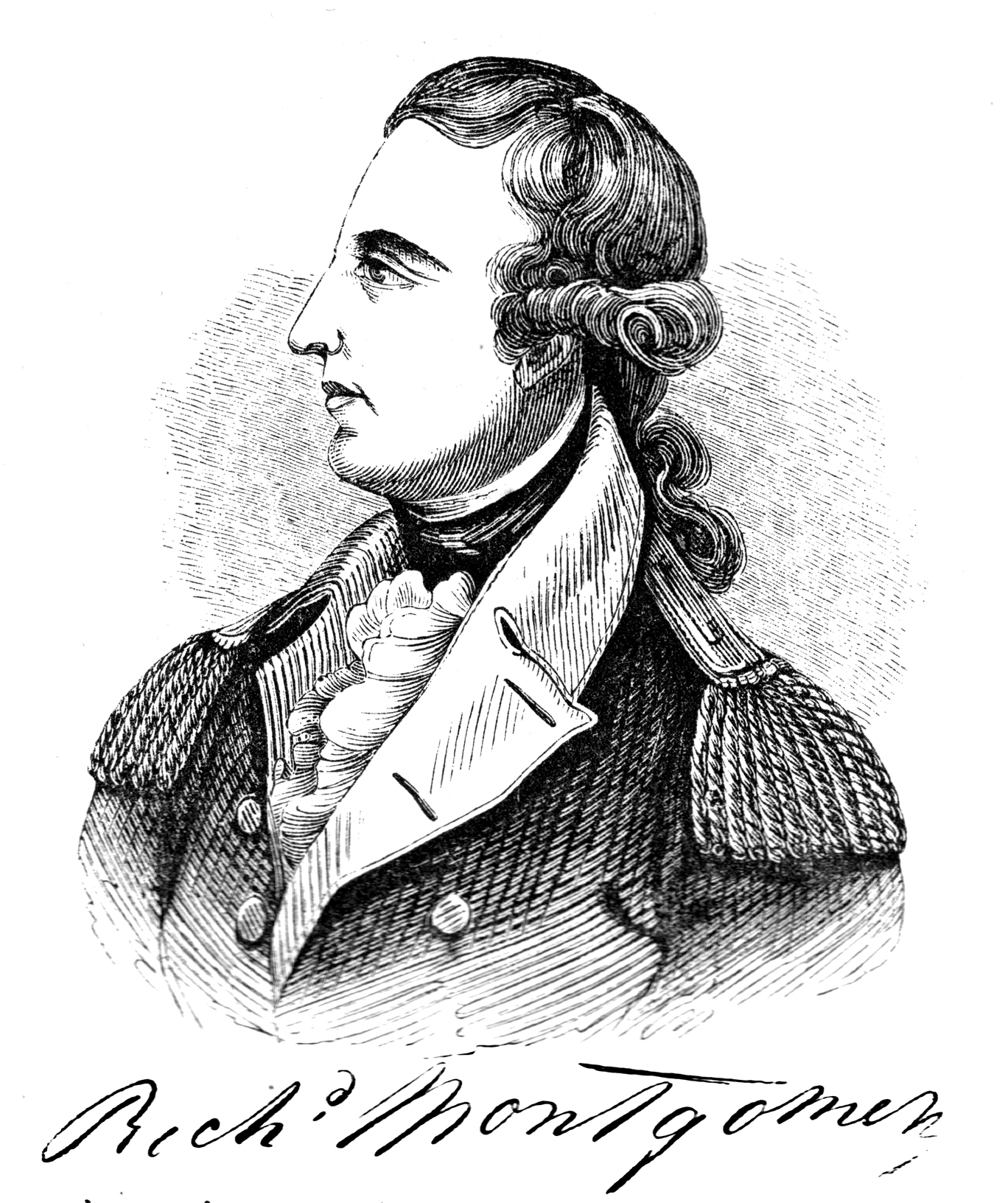
Continental General Richard Montgomery huddled over his desk outside the walled city of Quebec, clinging to candlelight as he wrote a letter to his wife. Wind howled and snow pelted the Continental forces preparing to attack the city on the St. Lawrence River. “I wish it were well over with all my heart, and I sigh for home like a New Englander,” Montgomery confessed to his wife, Janet. He had come a long way over the last few months—and even farther over the course of his life.
General Richard Montgomery
Like a New Englander, Montgomery wrote. Despite his rank in the Continental Army, he was no New Englander, but an Old Englander. His path to becoming an American hero resembled that of several Revolutionary leaders. Like George Washington, Horatio Gates, and others, Montgomery had served in the British Army during the French and Indian War. His road to an American generalship, however, was far from straightforward. Indeed, he was a latecomer to the American cause.
In honor of the 250th anniversary of the Battle of Quebec, we reshare guest historian Scott Patchan’s post on Daniel Morgan during the Canadian Campaign of 1775. This post originally posted in December 2015.
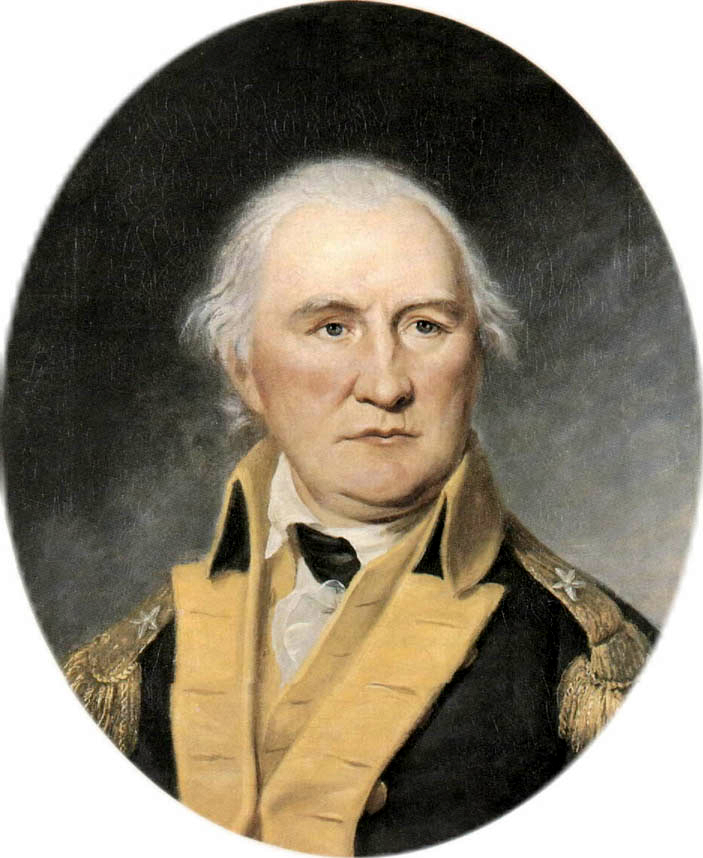
When the situation deteriorated to outright rebellion against the crown, Morgan raised a regiment of crack riflemen from Frederick County, and marched them to Boston in twenty-one days to take part in the siege of Boston. There, he served under his former commander from the French and Indian War, General George Washington. Morgan learned the hard way that orders must be followed. He once allowed his riflemen to exceed orders in firing upon British positions at Boston. Washington called Morgan on the disobedience, and Daniel thought that he would be cashiered from the army. Washington, however, relented the next day, but Morgan had learned a valuable lesson about following orders.
Daniel Morgan in the American Revolution
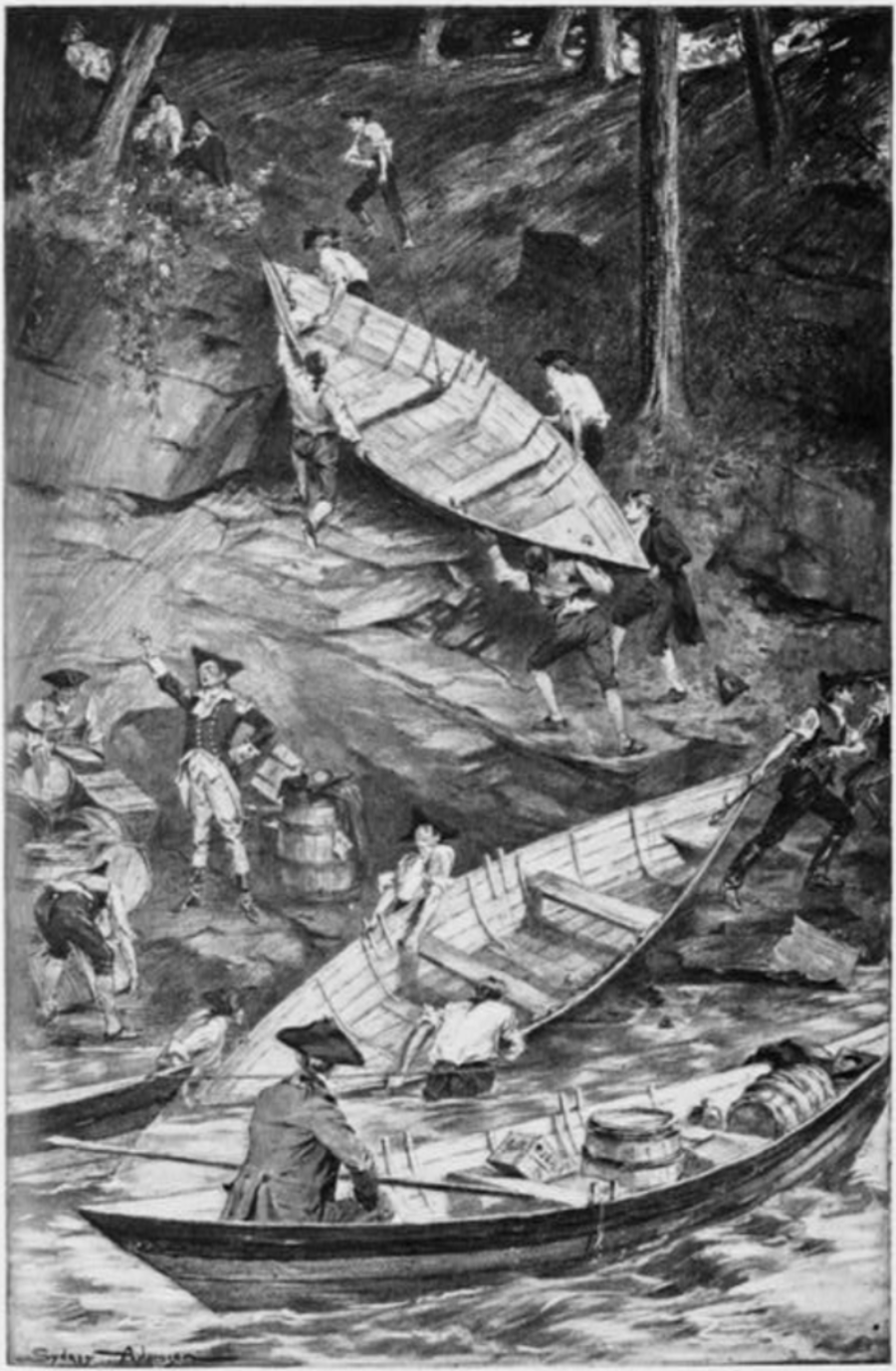
In the fall of 1775, Washington sent Morgan as commander of three companies of Continental riflemen on a mission to capture Quebec from the British. Morgan’s command marched with the column of Colonel Benedict Arnold. They traversed the Maine wilderness, rowing up stream to the “Great Carrying Place,” where carried their canoes and bateaux for great distances overland to another series of streams and lakes that took them to Quebec. As the cold weather set in, sickness and hunger overtook the column and Arnold sent those unfit for duty back to the rear. After covering 350 miles, the American arrived in front of Quebec in early November, surprising the British.
Although Morgan wanted to attack immediately and utilize the element of surprise, he was overruled and the small American force besieged Quebec, waiting for another column under General Richard Montgomery to arrive from the Hudson Valley. When a British party sallied forth and captured one of Morgan’s riflemen on November 18, Arnold believed the British would come out and fight in the open. As such, Arnold drew up his army in front of the fortifications to meet them. They declined his offer and instead looked down on the ragamuffin Americans from the ramparts and exchanged taunts and catcalls. The overall situation frustrated the irascible Morgan, and when his men complained that Arnold was not giving the riflemen their fair share of rations, the “Old Wagoner” violently argued with Arnold, and nearly came to blows with the future traitor. Morgan departed Arnold, leaving him with angry warning about poor treatment of the riflemen. From that time forward, Morgan’s command always received their fair share of the army’s rations.
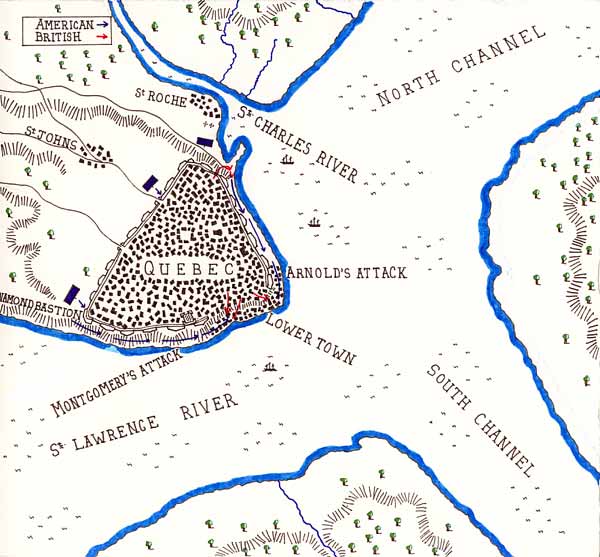
Montgomery’s column arrived on December 5, and the Americans commenced setting up his mortars and artillery outside of Quebec. The Americans finally attacked during a snowstorm in the early morning darkness of December 31, but their force numbered only 950 men. Arnold’s column came under fire as it moved toward the ramparts of Quebec, and a musket ball struck Arnold taking him out of action. Although Morgan was not the senior officer, the others insisted that he take command, having seen actual combat which they had not. Morgan later noted that this “reflected credit on their judgment.” At Morgan’s order, his riflemen rushed to the front, armed with both their Pennsylvania rifles and a spontoon for the assault while some carried ladders to storm the walls. They quickly drove a small force of British away and closed in on the walls.
Map of Battle of Quebec, 1775 (courtesy of British Battles)
Morgan ordered the men up the ladders and first one gingerly began the climb. Morgan sensed his hesitancy, pulled him down and scaled it himself, shouting, “Now boys, Follow me!” The men instantly complied, and Morgan reached the top of the wall where a volley of musketry exploded, knocking him back to the snow-covered ground. The burst burnt his hair and blackened his face; one ball grazed his cheek and another pierced his hat; but Morgan was otherwise unhurt. Stunned he laid motionless on the ground for a moment, and the attack stopped, his men thinking him dead. But he soon stirred and clambered up the ladder to the cheers of his men who followed suit. This time he stopped before reaching the top, and hurtled himself over the rampart into the midst of the enemy. He landed on a cannon and injured his back and found British bayonets levelled at him from all directions. While the British focused on Morgan, his riflemen poured over the wall and came to his rescue, driving off Morgan’s would-be impalers. Morgan kept up a close pursuit of the British who offered weak resistance to the attacking riflemen. Although Morgan had broken into Quebec, the main body of Arnold’s division failed to follow the riflemen over the wall and exploit the opportunity at hand. Morgan captured much of the lower portion of Quebec with only two companies of his riflemen. He later described the breakdown that occurred:
“Here, I was ordered to wait for General Montgomery, and a fatal order it was. It prevented me from taking the garrison, as I had already captured half of the town. The sally port through the (second) barrier was standing open; the guard had left it, and the people were running from the upper town in whole platoons, giving themselves up as prisoners to get out of the way of the confusion which might shortly ensue. I went up to the edge of the upper town with an interpreter to see what was going on, as the firing had ceased. Finding no person in arms at all, I returned and called a council of war of what few officers I had with me; for the greater part of our force had missed their way, and had not got into the town. Here I was overruled by sound judgment and good reasoning. It was said in the first place that if I went on I should break orders; in the next, that I had more prisoners than I had men; and that if I left them they might break out and retake the battery we had just captured and cut off our retreat. It was further urged that Gen. Montgomery was coming down along the shore of the St Lawrence, and would join us in a few minutes; and that we were sure of conquest if we acted with caution and prudence. To these good reasons I gave up my own original opinion, and lost the town.”
Montgomery never arrived; he had been killed in the first blast of musketry against his column, and his command broke. As time went on, the British regained their composure and pushed back against Morgan’s command. Morgan went back and brought up 200 New Englanders who joined the riflemen as they attempted to renew the attack. Now, the previously undefended point, was well manned, and daylight illuminated the paucity of Morgan’s numbers. Nevertheless, Morgan pressed them back further into the town to an interior fortification. A brave British officer led a counterattack, but Morgan personally shot him dead and disrupted the assault. Nevertheless, the time for action had passed. The British had become aware that Morgan’s was the only active American force in the city and closed in around him. In the meanwhile, additional British forces reoccupied the gates Morgan had initially taken and trapped him in the city. Morgan had no choice but to surrender his small command.
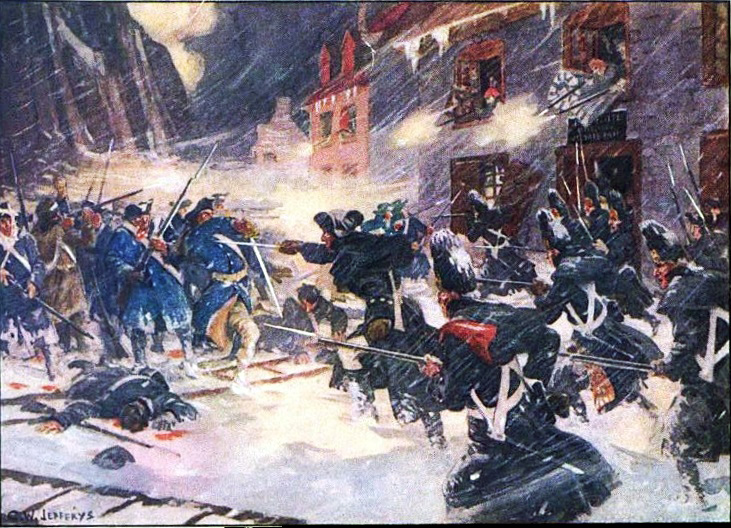
One artist’s depiction of the Battle of Quebec, 1775. Both forces are wearing blue overcoats. (courtesy of British Battles)
Morgan and the other officers enjoyed a liberal captivity with generous quarters in a seminary. The British officers visited them often and remained on friendly terms with the Americans. Morgan developed a dislike for some of his fellow officers whom he regarded as dishonest and scheming, and his fighting skills were brought to bear on at least one occasion when several men teamed up against big Dan Morgan. The imprisonment ended when the British returned the American officers on September 24, 1776, in New Jersey. Morgan returned to his wife and two daughters at his home outside of Battletown or Berryville, where he awaited his proper exchange. While there, he named his home “Soldier’s Rest,” as he recuperated from the trials of the taxing expedition to Quebec. The war was still young, and the Continental Army would soon be calling upon his services again. A special command of riflemen was being organized and Morgan would be its commander.
Emerging Revolutionary War welcomes guest historian Andrew J. Lucien. Brief bio of Andrew follows the post.
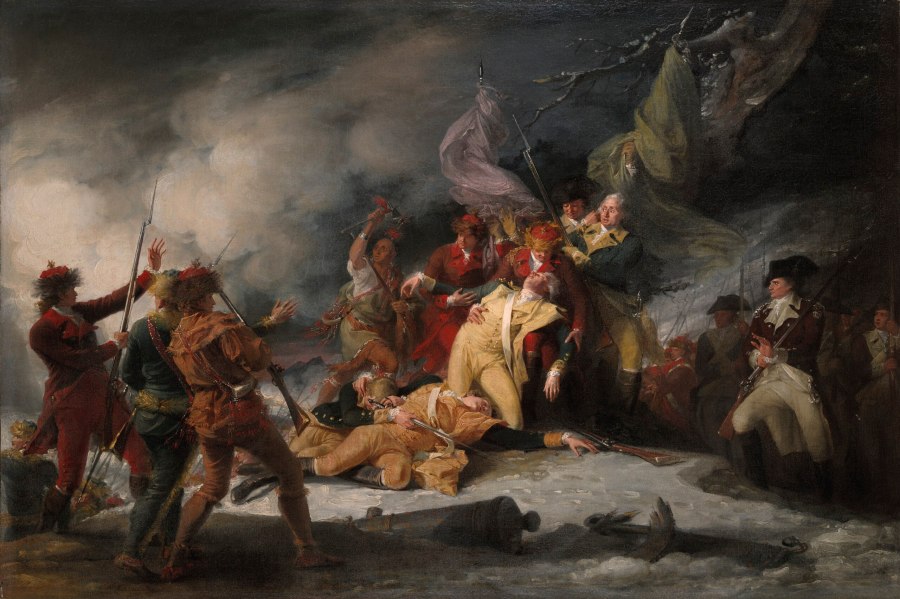
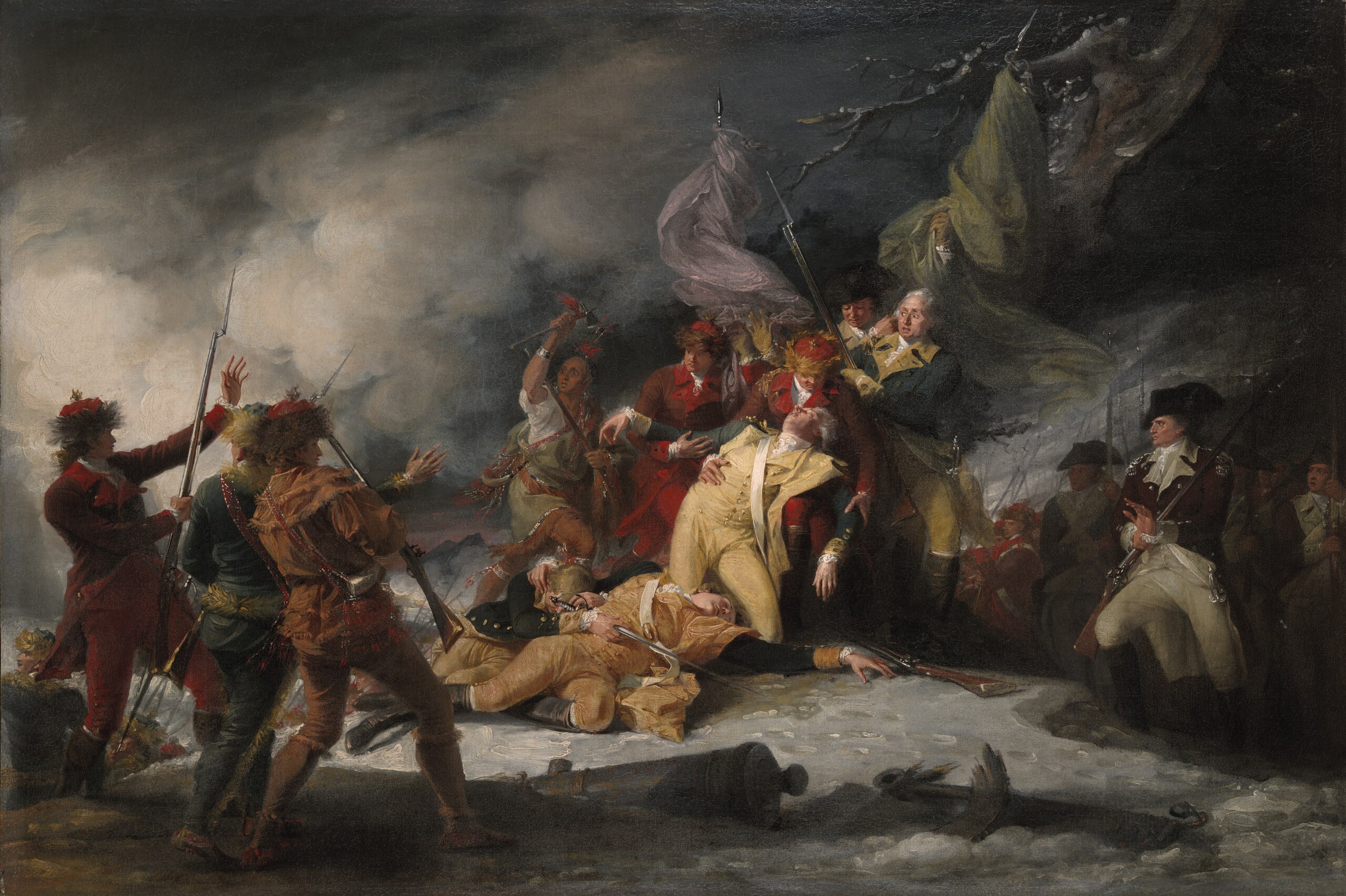
Death of General Richard Montgomery
Bunker Hill, Valley Forge, Yorktown, July 4, George Washington. These are the most common images that come to mind when the American Revolution is mentioned by most people. The collective unconscious of America has become steeped in the imagery of glorious American victories to win our independence from the superpower of the time. However, what many are unaware of is the unusual campaign that took place from 1775 to 1776, in an attempt to gain the support of Canada in our quest for independence. This campaign featured several battles, with the key one being the Battle of Quebec. This marked a significant turning point in the campaign and the war as a whole.
In 1775, the fate of the impending schism between Britain and its North American colonies was all but sealed. The colonial fervor had reached a climax at the Battles of Lexington and Concord in the spring of 1775, setting the mother country and its colony down a path of armed conflict. As tensions rose in 1775, Ethan Allan, along with Benedict Arnold, captured the British fort at Ticonderoga in early May, resulting in much-needed guns for the colonials. With successful action undertaken in the northern reaches of New York state, the Continental Congress approved plans to invade Canada. Intelligence led the patriots to believe that there were fewer than 700 British soldiers stationed in the Canadian territory and that the popular sentiment in the territory was in favor of rebellion, and that they, too, might take up arms against the British Crown.
By late September, Ethan Allan unsuccessfully attempted to capture Montreal. Near the same time, Benedict Arnold began to lead a force of around 1,100 men from Boston on an enterprise aimed at aiding in the capture of Canada (only about 600 would reach their destination). These men would eventually join forces with Richard Montgomery’s force around Quebec in December of 1775, “to finish the Glorious work you begun,” to quote George Washington. By the time Arnold’s men reached Canada, they were “in a very weak condition.” Montgomery’s force was moving north from Lake Champlain. His men captured Fort Chambly and Fort St. Johns. Following these captures, the force under Montgomery advanced on Montreal. The British governor, Guy Carlton, took approximately 150 men with him from Montreal to Quebec, believing it to be a more important and defensible position. Montreal was easily captured on the 13th. Montgomery did not rest long after capturing the fort, leaving a small garrison in Montreal and heading to join forces with Arnold’s men at Point aux Trembles. Montgomery, “…was anxious, after the capture of Chamblee, St. Johns and Montreal, to add Quebec, as a prime trophy to the laurels already won.”
With the combined force of Montgomery and Arnold now outside of Quebec, Montgomery sent Carlton multiple messages to surrender, which were all rejected. Upon hearing the refutation of his final offer, Montgomery was supposed to have said he would “dine in Quebec or Hell at Christmas.” Finally, with all other options seemingly exhausted, it was planned to forcibly take the city by sending Arnold’s corps to assault the lower town via St. Roque. Montgomery was to attack the lower town via Pres-de-Ville, near Cape Diamond. There was to be a fient east of St. John’s Gate under Colonel Livingston and one at Cape Diamond under Major Brown. The ultimate goal was to meet in the lower town, then storm the upper town.
Around midnight as the 31st began, clouds began to fill the sky and snow began to fall. This was a signal to the Americans to begin preparing for an assault, using the snowstorm as cover. By 2 a.m., the American troops began their movements. At about 4 a.m., Captain Malcolm Fraser saw flashes and lights on the Heights of Abraham. Fraser suspected that the lights were a sign of the American troops’ movement and ordered his guards to arm. The British began to play their drums and ring their bells to alert the men of Quebec to prepare for the city’s defense. The Americans launched two rockets to signal the beginning of their assault. With the rockets illuminating the early morning sky, the rebels began to fire their muskets into the British line. With the darkness of the morning still upon the soldiers, the British were unable to see their opponents, except when their muskets would flash and illuminate their heads. They used the flash of the muskets to guide their return volleys. The Americans began to launch artillery into Quebec from St. Roque. When Arnold saw the rockets in the morning sky, he led about 600 men from St. Roque to attack the British works at Saut-au-Matelot. Montgomery led his force of about 300 men to attack the works at Pres-de-Ville. Montgomery believed that this location was ripe for an escalade.
Arnold and the rest of his column advanced along the waterfront through St. Roque. The British sailors stationed there rained fire down on the Americans from atop the ramparts. The Americans “could see nothing but the blaze from the muzzles of their muskets.” As the Americans pressed forward, they lost the cover of the houses. Arnold was hit in the leg by enemy fire near the first barricade, and he was taken from the field by two men. Arnold tried to rally his men as he was taken away. Despite the setback, the Americans under Daniel Morgan pressed forward and used their ladders to scale and capture the first barricade at Saut-au-Matelot, along with 30 British troops. Here, the Americans found their muskets useless due to the snow. Many colonial troops resorted to confiscating British muskets. The Americans continued about 250-300 yards further to attempt to capture the second barrier, where they met opposition from the British. The Americans, on a narrow street, moved against the British, who had their own strong defenses, including a 12-foot-high barrier, cannons, and two lines of soldiers ready to repulse the attacking Americans. The British fired down on the Americans from the tops of the buildings. The colonial troops attempted to climb the barrier but were forced back by the British inside with their bayonets fixed. They then fired from under the cover of the houses, allowing the British to see them only as they moved from house to house. The attackers contemplated retreating; however, they tarried, ultimately a dire mistake. Carleton, aware of the developing assault, men to attack the flank of the Americans. With the Americans now flanked and facing stiff opposition in front, they surrendered to the British force.
Montgomery and his men suffered a far more deadly fate. As his column approached Pres-de-Ville, Captain Barnsfair had his men next to their guns and at the ready when the Americans arrived. The British had erected a barrier here with a battery. The Americans advanced within 50 yards of the British guns and halted, then resumed their advance, likely because they believed the soldiers were not on guard. Barnsfair “declared he would not fire till he was sure of doing execution, and… waited till the enemy came within… about thirty yards’ distance” and then called out, “fire!” “Shrieks and groans followed the discharge.” The fire of canister, grapeshot, and musketfire was deadly. When the fire stopped, the field of battle was clear with no rebels left standing on the field. Montogemery was one of the casualties of the action, found lying on his back with his arm still in the air. Seeing the folly of another assault, the remaining men retreated. An officer of Carlton’s declared the battle “a glorious day for us, and as compleat a little victory as was ever gained.” When the dust settled, the Americans suffered about 50 killed, 34 wounded, and 431 captured or missing, while the British defenders lost only 5 killed and 14 wounded. The fighting had lasted only around 4 hours.
Bibliography:
“An Account of the Assault on Quebec, 1775,” The Pennsylvania Magazine of History and Biography 14, no. 1 (1890): 47–63.
Blockade of Quebec in 1775–1776 by the American Revolutionists (les Bastonnais). Historical event, Quebec City, 1775–1776.
Caldwell, Henry. The Invasion of Canada in 1775. Quebec: Literary and Historical Society of Quebec, [microform].
Hatch, Robert McConnell. Thrust for Canada: The American Attempt on Quebec in 1775–1776. Boston: Houghton Mifflin, 1979.
Henry, John Joseph. Account of Arnold’s Campaign Against Quebec, and of the Hardships and Sufferings of That Band of Heroes Who Traversed the Wilderness of Maine from Cambridge to the St. Lawrence, in the Autumn of 1775. Albany: Joel Munsell, 1877.
Bio:
Andrew Lucien is a social studies curriculum director at the Cleveland Metropolitan School District, host of The Civil War Center podcast, and founder of thecivilwarcenter.com. He has written extensively on the Civil War and Revolutionary War.
Join us this Sunday, December 14th at 7pm as we return LIVE for this Rev War Revelry on the Canadian Campaign of 1775. We will discuss Arnold, Montgomery, Morgan and others on America’s attempt to capture Montreal, Quebec and create a “14th state.” From Arnold’s arduous march to Quebec through the wilds of Maine to Montgomery’s capture of Montreal, our historians Alex Cain and Mike Cecere will cover the entire campaign and answer the question “was the capture of Canada possible?”
This fall and winter mark the 250th anniversary of the campaign and the battles of Montreal and Quebec, and both of our speakers have taken part in the commemorative events. Grab a drink and watch live on our Facebook page, also add questions in the chat.
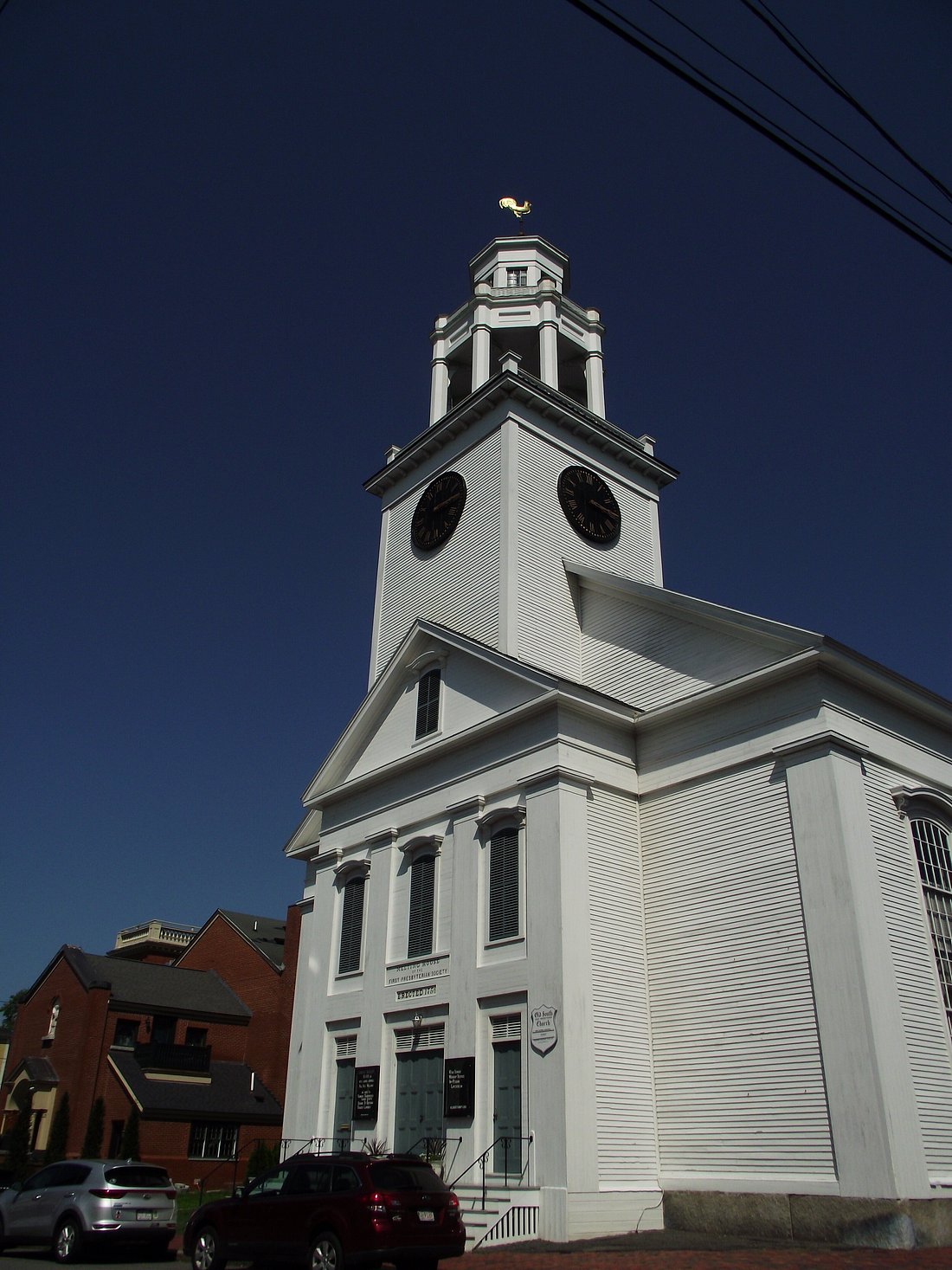
Modern view of the “Old South Presbyterian Church, Newburyport, MA
As Benedict Arnold assembled his small army of 1,100 men in Newburyport for his bold cooridinated strike on Canada (with General Richard Montgomery attacking via Montreal), there was one last stop before the men boarded the boats in the Merrimack River. From here they would hug the coast on their way to Maine, then overland to Quebec. It was a bold strategy for the inexperienced army and army commander. Though the was just started in April, and peace was still spoken by many political leaders, Washington approved this first American offensive. Strike the British forces in the Canadian colonies, with the hope of encouraging their northern colonial neighbors to join their cause.
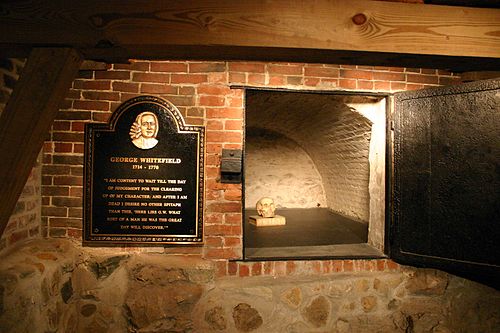
Arnold felt it was appropriate that his mission have the blessing of God, so hundreds of men squeezed into the First Presbyterian Church (now called Old South Presbyterian Church). One of the largest churches in the city, it was the spiritual home of the Great Awakening in New England. Here, evangelist preacher George Whitefield, preached from when the church was built in 1756 until his death in 1770. Whitefield was buried in the crypt of the church. His fame was well known to Arnold and others, Whitefield is considered one of the founders Methodism and a great public speaker.
What men could not fit into the church pressed up against the doors and windows. Today’s service, held on Wednesday, September 20, was a dedication service. To bless the men and their task at hand. Reverand Samuel Spring, a popular orator in his own right, and he was now to serve as chaplain of Arnold’s small army on its way to Canada.
The scene was recounted in J. T. Headley’s, 1864 “The Chaplains and Clergy of the Revolution“:
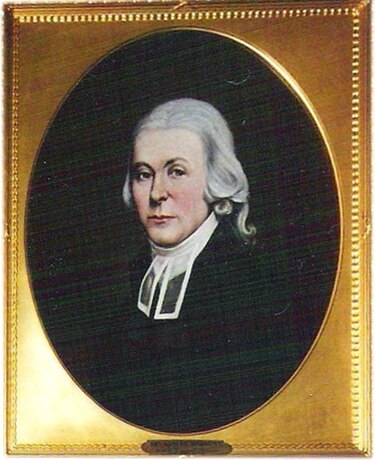
Reverand Samuel Spring
“There sat the fearless Arnold, the bold rifleman, Morgan, and a host of other brave men, who, notwithstanding their dauntless courage, felt that the perils of the untrodden, mysterious wilderness, they were about to penetrate, might be too great for human energy and endurance, and the hour come, that their only hope would rest in the God whose spirit the chaplain [Samuel Spring] invoked as their guide and stay. The citizens, who crowded the gallery, never forgot that sermon. It became the talk of the place, and was the cause of his eventually settling over them as their pastor.”
After the sermon, a surreal experience took place. Soon, someone on Arnold’s staff wanted to go to the crypt and see the tomb of Whitefield. Headley quoted Rev. Spring:
“I preached over the grave of Whitefield. After the service the general officers gathered around me. Some one requested a visit to Whitefield’s tomb. The sexton was hunted up, the key procured, and we descended to his coffin. It had lain in the tomb six years, but was in good preservation. The officers induced the sexton to take off the lid of the coffin. The body had nearly all returned to dust. Some portions of his grave-clothes remained. His collar and wristbands, in the best preservation, were taken and carefully cut in little pieces, and divided among them.”
A modern view of the crypt of Rev. George Whitefield
Headley continued; “The chaplain, with the haughty Arnold, the chivalrous Morgan, and group of officers, gathered in the dark vault around the tomb of Whitefield, formed a scene worthy of a painter. The clank of steel had a strange sound around the sainted sleeper, while the hallowed atmosphere filled all hearts with solemn awe and reverence.”
Now, with their good luck token from the grave of Whitefield, Arnold and his staff made their way to the shore where his men were boarding their boats in the Merrimack River. Arnold and his men saw their mission blessed by God, and wanted to tie their cause with that of the Great Awakening. They believed their cause was right and just. The process of visiting a tomb and taking pieces of a dead man’s clothing may seem a tad bit of “macbre” to us today, to Arnold it was a way to bless his mission. One that he believed would bring him and his men glory.
May it please your Excellency [General Washington]
My last of the 20th ultimo from Point aux Trembles, advising of my retiring from before Quebec, make no Doubt your Excellency has received. I continued at Point aux Trembles until the 3rd Instant, when to my great Joy General Montgomery joined us with Artillery and about 300 Men. Yesterday we arrived here, and are making all possible Preparation to attack the City, which has a wretched motley Garrison of disaffected Seamen, Marines & Inhabitants, the Walls in a ruinous Situation, & cannot hold out long. Inclosed is a Return of my Detachment amounting to 675 Men, for whom, I have received Cloathing of General Montgomery. I hope there will soon be Provision made for paying the Soldiers Arrearages, as many of them have Families, who are in Want. A continual Hurry has prevented my sending a Continuation of my Journal. I am with very great Respect Your Excellency’s Most obedient humble servant
Benedict Arnold
“To George Washington from Colonel Benedict Arnold, 5 December 1775,” Founders Online, National Archives, https://founders.archives.gov/documents/Washington/03-02-02-0445. [Original source: The Papers of George Washington, Revolutionary War Series, vol. 2, 16 September 1775 – 31 December 1775, ed. Philander D. Chase. Charlottesville: University Press of Virginia, 1987, p. 495.]
This article by ERW’s William Griffith first appeared on the American Battlefield Trust’s websiteon January 4, 2021.The original link can be found here.
The French and Indian War was in its fifth full year, and the tables had turned in Britain’s favor. As the larger conflict, the Seven Years’ War, raged throughout the globe, in North America, the British were one swift strike away from conquering the continent. The French in the Ohio River Valley, Great Lakes region, and Upstate New York had been thrown back on their heels and sent scurrying north into Canada leaving the road open for a British thrust against Montreal and Quebec. For the summer of 1759, the latter city, the capital of New France, would be placed in the crosshairs by an army commanded by Major General James Wolfe. If Quebec, situated along the most important water highway in Canada, the Saint Lawrence River, should fall, the French in North America would be squeezed into the region around Montreal. Pending any catastrophic failures by Britain’s army and navy and their allies elsewhere in the world, it would only be a matter of time than before New France was conquered.
James Wolfe and His Army
Thirty-two year old James Wolfe had served in the British Army for almost eighteen years when he was given command of the roughly 9,000-man force that was tasked with defeating the French in and around Quebec City in 1759. He was hard-nosed and did not always get along with his subordinate generals, Robert Monckton, George Townshend, and James Murray. The previous year he had been a brigadier general under Jeffry Amherst during the successful siege and capture of the fortress city of Louisbourg in Nova Scotia, and afterward led a campaign of destruction against the fishing villages of the Gulf of Saint Lawrence. He then returned to England and secured a major generalship and command of the Quebec expedition. He arrived in Halifax in April 1759 and began training his force and preparing plans for his campaign.
Wolfe’s army was composed predominantly of professional British soldiers. Several hundred North American ranger units also complimented his force, which he described as, “… the worst soldiers in the universe.” He did not have much respect for colonial troops. On June 26, Wolfe’s men began landing at Ile d’Orleans in the middle of the Saint Lawrence River just to the east of Quebec City. Across the river, the French commander, the Marquis de Montcalm, prepared to oppose them.
The Marquis de Montcalm and Quebec’s Defenders
Louis-Joseph, Marquis de Montcalm, had been in command of France’s regular troops in North America since 1756. During that time he had put together an impressive string of victories at places like Fort Oswego, Fort William Henry, and Fort Carillon. As the attack on Quebec loomed, he was given command of all military forces on the continent, including the Canadian militia and marines. The previous harvest had not been good in Canada, and his army and the civilians in the city were on short rations, but relief came during the spring of 1759 when ships arrived carrying food and supplies. With this, Montcalm was determined to hold onto the city at all costs. He dug trenches outside the city and along the Saint Lawrence’s northern shoreline extending for nearly ten miles, welcoming a frontal assault from Wolfe. His army, consisting of over 3,500 French regular troops, included thousands more Native American allies and Canadian militiamen who were not accustomed to fighting in open fields against professional enemy soldiers. This important disadvantage would play a large part in Montcalm’s ultimate defeat.
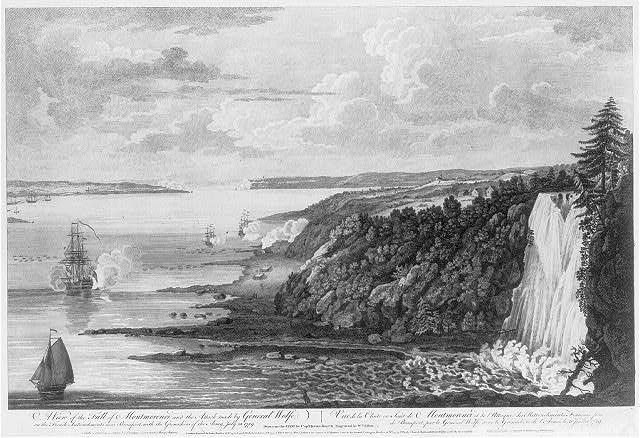
An engraving of General James Wolfe’s failed attack on the Montmorency River, July 31, 1859. Library of Congress
The Campaign
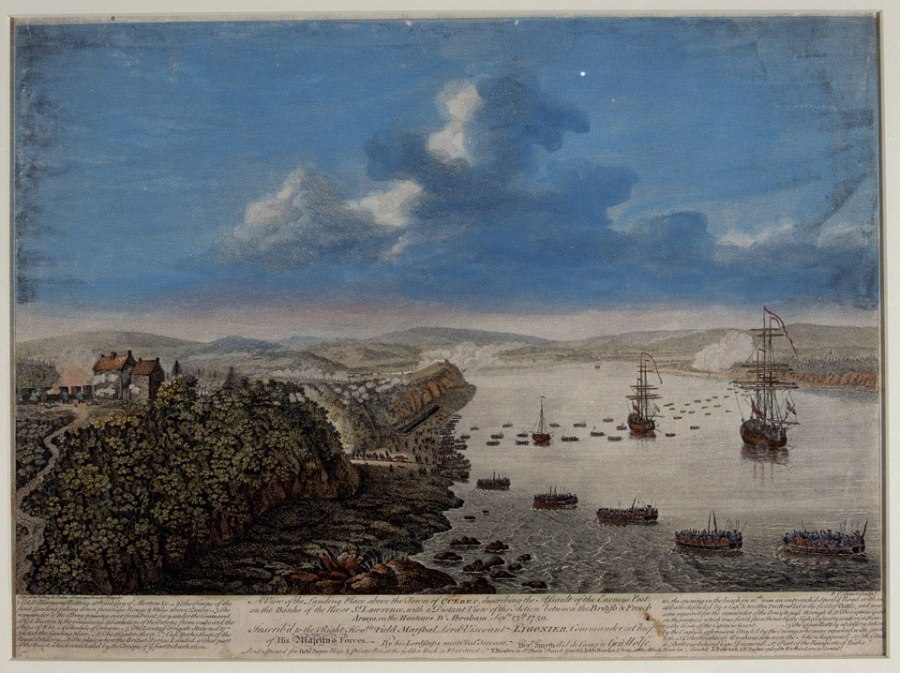
When General Wolfe’s army began landing at Ile d’Orleans and subsequently Point Levis (directly across the river from the city) to the east of Quebec, he had initially hoped to force a landing on the northern shore just a few miles downstream at Beauport. However, he quickly discovered that Montcalm had heavily fortified the landing site, throwing a monkey wrench into his plans. This did not deter Wolfe, however, and by July 12, he had placed ten mortars and cannon at Point Levis and began bombarding the city itself. More guns were brought up and the bombardment continued for weeks in an effort to demoralize those within Quebec City.
The best chance to defeat Montcalm was to force him out of his defenses and into an open field battle. Wolfe understood that his vigorously trained and superior disciplined regular troops would have the upper hand against lesser-numbered French regulars and their militia. His first attempt to accomplish this occurred on July 31, when he landed a force of grenadiers, light infantry, and rangers near Montmorency Falls further downstream from Beauport hoping to ford the Montmorency River and reach a position in the rear of the French lines. It failed miserably. Montcalm guessed correctly that an attack was coming from that direction and rushed men there to meet the enemy. The river’s tide prevented Wolfe from getting all of his troops in position on time and frontal assaults launched from the beach were beaten back with heavy losses. The British retreated, leaving behind 443 men killed and wounded. The first attempt to force a landing on the Quebec side of the river had failed, but it would not be the last. Wolfe turned his attention further upriver, where he hoped his prospects for victory would be more fruitful.
The Plains of Abraham
As the weeks passed following the debacle at Montmorency, the British probed the northern shore west of Quebec for a secure landing spot. During this time, Wolfe grew sick with a severe fever and kidney stones and believed his days were numbered. He recovered enough, however, to begin moving his army upriver about eight miles from the city not far across from Cap Rouge. It was decided that the landing would be made at Anse au Foulon, where a narrow gap and trail led to the top of the cliffs just two miles west of the city.
At four in the morning, September 13, Lieutenant Colonel William Howe (who would serve as the commander of the British Army in America during the Revolutionary War) came ashore with the light infantry and surprised and overwhelmed the enemy outpost above the landing site. The conditions for rowing the army into position that early morning had been perfect for Wolfe. Montcalm was caught off guard.
After securing the landing zone, Wolfe began moving his attack force of roughly 4,400 regulars onto the Plains of Abraham, an open field about a mile wide and a half a mile long in front of the city’s western defenses. Responding to the threat as quickly as could be done, Montcalm rushed some 1,900 French regulars and 1,500 militiamen and Native Americans to meet the British line. This was the open field fight that Wolfe had been yearning for ever since the campaign began.
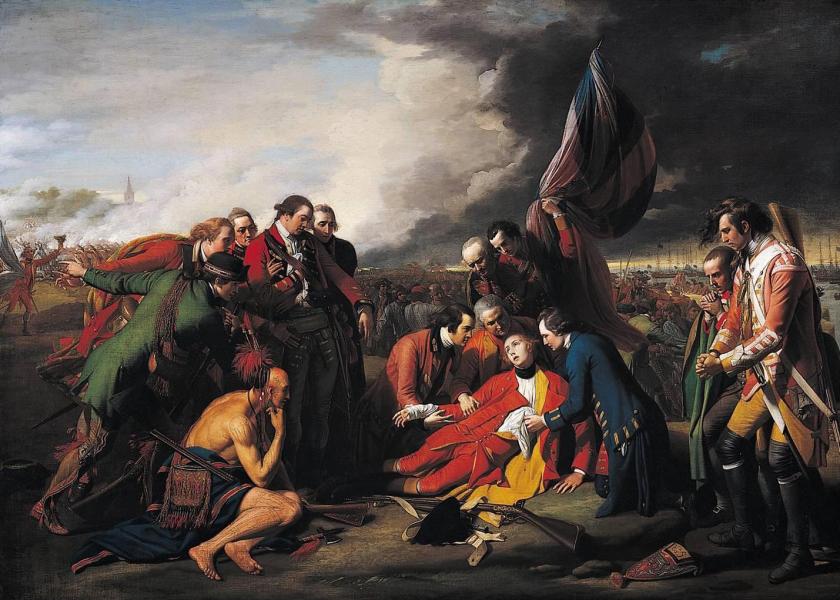
Benjamin West’s depiction of the death of British General James Wolfe during the Battle of Quebec, painted in 1770. Wikimedia Commons
As the French commander formed his men up in a line of battle, the British waited patiently across the field to receive their attack. Montcalm ordered his troops forward, and almost immediately his militiamen’s lack of experience and training in open combat became apparent as their formations wavered and some failed to advance close enough to the enemy line to fire effectively. One British participant described what happened next:
The French Line began … advancing briskly and for some little time in good order, [but] a part of their Line began to fire too soon, which immediately catched throughout the whole, then they began to waver but kept advancing with a scattering Fire.—When they had got within about a hundred yards of us our Line moved up regularly with a steady Fire, and when within twenty or thrity yards of closing gave a general [fire]; upon which a total [rout] of the Enemy immediately ensued.
The battle was over in just fifteen minutes as the British swept forward, claiming the field and capturing hundreds of prisoners. Both sides each lost over 600 men killed and wounded, including both respective commanders. Wolfe was mortally wounded and died a hero on the field. Montcalm, too, was hit by grapeshot in the abdomen and died the next morning. Five days later, Quebec surrendered. The French retreated further downstream to Montreal, attacked and failed to retake Quebec the next spring, and surrendered in whole on September 8, 1760, effectively ending all major military operations in North America during the French and Indian War. The battle for the continent between Britain and France was over.
Tell me I am not the only one that randomly goes on a car ride to a random town in their home state to just “see what is there?”
Regardless, that is what I decided to do on a sunny late April Sunday afternoon. I ended up in Rockville, Maryland. The town astride I-270 today was also on a major thoroughfare during both the 18th and 19th centuries that brought armies from the area, like General Edward Braddock’s in 1755 or General Jubal Early’s in 1864.
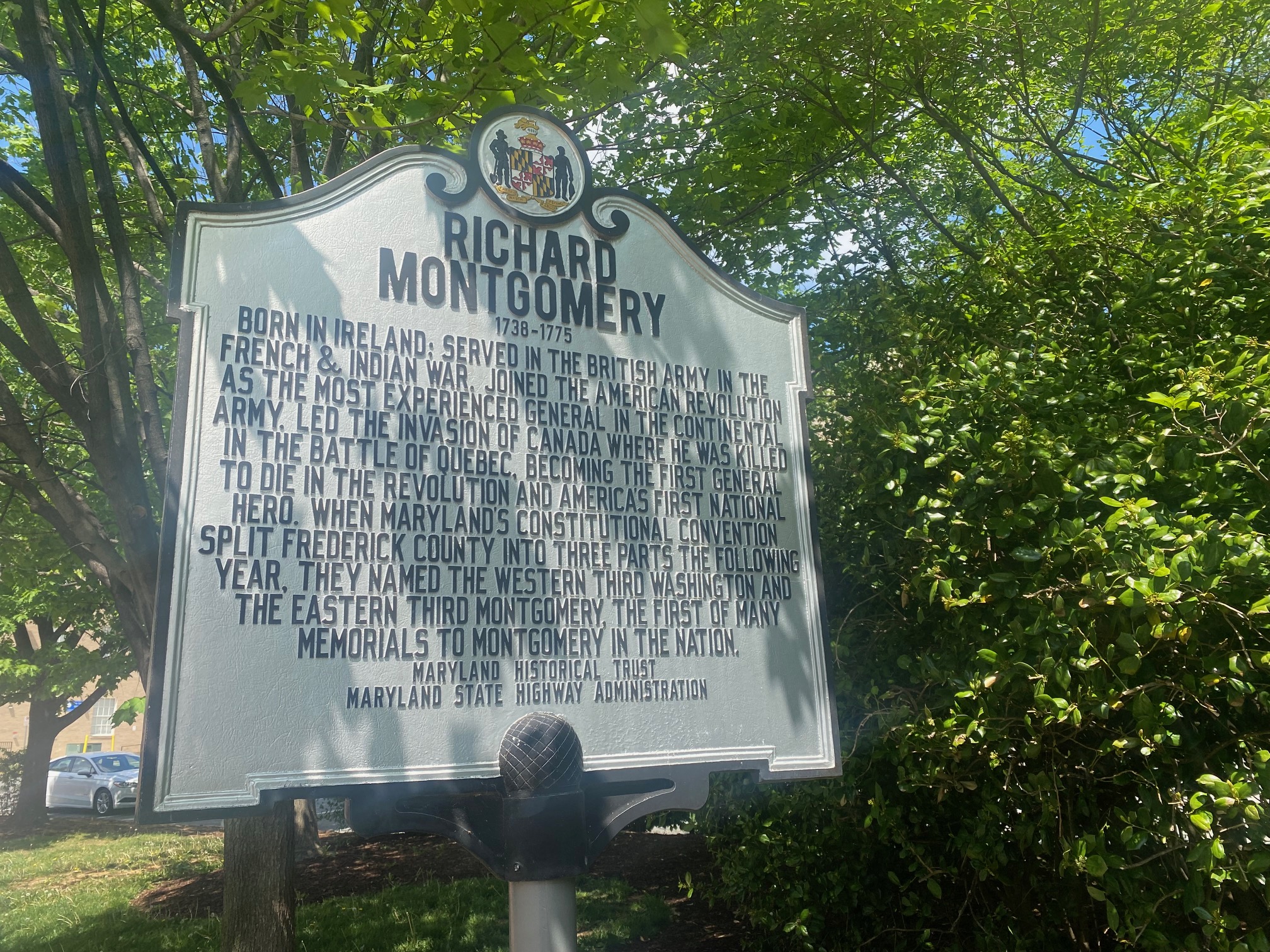
However, a different historical sign attracted my attention on this excursion.
I read the title and the first line, Richard Montgomery…Born in Ireland. Served..” Which was all I could read as I slowly drove by, since it is near the court house and county government buildings. Even though it was a Sunday still not wanting to speed through. So…Naturally, I pulled over, as evidenced by the vehicle you see in the background!
I knew Montgomery, as the sign reads, died at the Battle of Quebec in a futile attempt to take the city for the American cause. He was the first general–Continental–to die in the cause of American independence.
On September 6, 1776 Thomas Sprigg Wootton, who hailed from Rockville, introduced legislation in the Maryland Constitutional Convention to separate the Frederick County into three. The upper or most western half, to become Washington County, named in honor of George Washington and the lower half, or most eastern, to be named Montgomery, in honor of Richard Montgomery. The remaining middle portion would retain the name Frederick. This may be the first recorded instance in the rebellious British colonies of names of counties, towns, or cities that did not refer to something in British history or famous persons. Another act of defiance at the beginning of the American Revolution!
With a random Sunday excursion one never knows what one will find. History is all around us, beckoning to be explored.
Emerging Revolutionary War checks in with Tom Hand and Americana Corner. Here is what has has been published on that blog for the month of October.
Benedict Arnold and the Perilous March to Quebec October 4, 2022
Benedict Arnold’s expedition to the gates of Quebec City in the fall and winter of 1775 is widely regarded as one of the greatest military marches in history. Arnold, despite his sullied reputation due to his traitorous behavior later in the war, was one of America’s most gifted field commanders, and his tremendous leadership skills were put to the test on this perilous journey. Read More
Arnold’s Army Marches into Trouble October 11, 2022
When Colonel Benedict Arnold’s army reached the Great Carrying Place on October 11, 1775, they had been moving north on the Kennebec River for almost three weeks and had advanced eighty-four miles. The American militiamen were on their way to assault Quebec City, the crown jewel of British Canada. The time originally estimated for the entire journey to Quebec was about twenty days, and the anticipated distance was 180 miles. Neither Arnold nor the men were aware they had another 300 miles to go. Read More
Benedict Arnold’s Army Reaches Quebec October 18, 2022
After clearing the Height of Land, Colonel Benedict Arnold’s army on its way to capture Quebec City believed they were on the downhill slope to their destination, but their hardships were not finished. The area which they just entered was poorly mapped, and Arnold’s regiments paid the price for this lack of knowledge. Read More
Americans Commence Siege of Quebec October 25, 2022
With the capture of Montreal by General Richard Montgomery and the presence of Colonel Benedict Arnold’s force of 600 men on the Plains of Abraham, Britain’s foothold in Canada had dwindled to about one square mile, the area within the mighty walls of Quebec City. Now the defenses of that fortress would be tested by a band of determined Americans. Read More
Mention the words “artillery” and “American Revolution” and what name instantly pops into your mind? Henry Knox.
Rightfully so.
Yet, like George Washington, Knox needed competent officers under him to successfully organize, train, lead, and develop the artillery arm of the Continental Army.
Enter John Lamb.
John Lamb
Born on the first day of 1735 in New York City, he was destined to rebel. The reason he was even born in New York City was due to the fact that his father, a convicted burglar had been sentenced for deportation to the colonies in the 1720s.
His early upbringing saw him become a prosperous wine merchant and he quickly ingratiated himself into the burgeoning patriot movement by becoming an integral part of the Sons of Liberty in New York City. Continue reading “The Other Great Artilleryman”→


 Emerging Revolutionary War Era