“Soldiers and Countrymen…”

Before the horrific terrorist attacks that struck the United States on September 11, 2001, this date in American history saw the longest single day engagement with the highest number of combatants during the entire American Revolution fought in southeastern Pennsylvania.

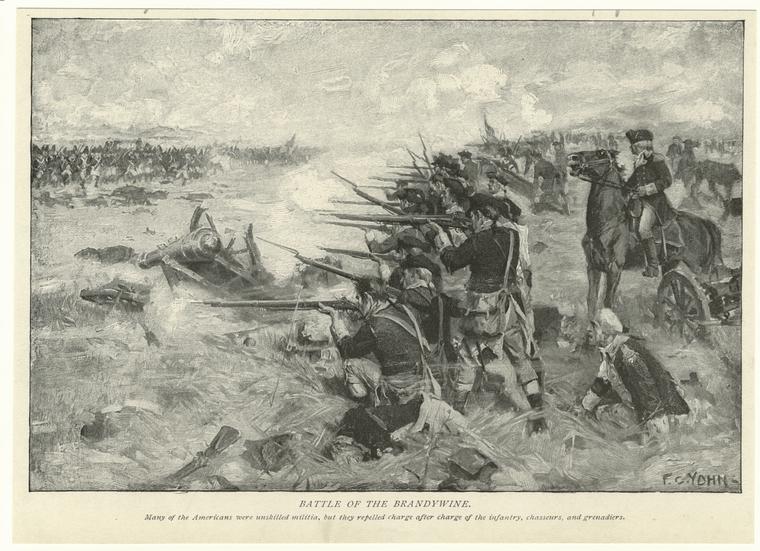
Known to history as the Battle of Brandywine, approximately 30,000 soldiers were involved and 1,887 became casualties, the majority, 1,300 being Americans. One of those 1,300 individuals was Reverend or Chaplain Joab Trout, from New Hampshire.

Battle of Brandywine
(courtesy of NYPL)

The night before the engagement, he gave the following sermon beat the evening call on the eve of battle. And 242 years later the words still echo with a sense of patriotism and stoicism for a cause that was worth fighting and dying for. Below is the full sermon:

“De Kalb has died, as he has lived, the unconquered friend of liberty”

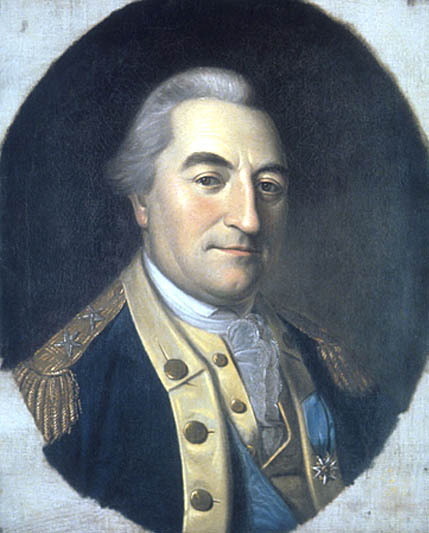
Johann_de_Kalb
Johann de Kalb (Charles Willson Peale)

On this date in 1780, Johann von Robias, Baron de Kalb, died of wounds received three days earlier during the Battle of Camden, South Carolina.

de Kalb, born on June 19, 1721 in the Principality of Bayreuth, was in charge of the American right wing during the engagement at Camden, leading the premier units, the Delawareans and Marylanders, of General Horatio Gates’ Southern Army.

When the left and center of the American line disintegrated, de Kalb’s force had to beat a hasty retreat before becoming completely surrounded. During this juncture of the fighting, the Baron’s horse was shot out from under him and the German was thrown to the ground. Before he could gain his feet, he was hit with three musket balls and bayoneted multiple times by approaching British soldiers. The wounds would prove mortal. Continue reading ““De Kalb has died, as he has lived, the unconquered friend of liberty””

On this date in….1776

A few random musings on the importance of this date in American Revolutionary history…

IMG_3597
President’s chair, Independence Hall, Independence National Historical Park (author collection)

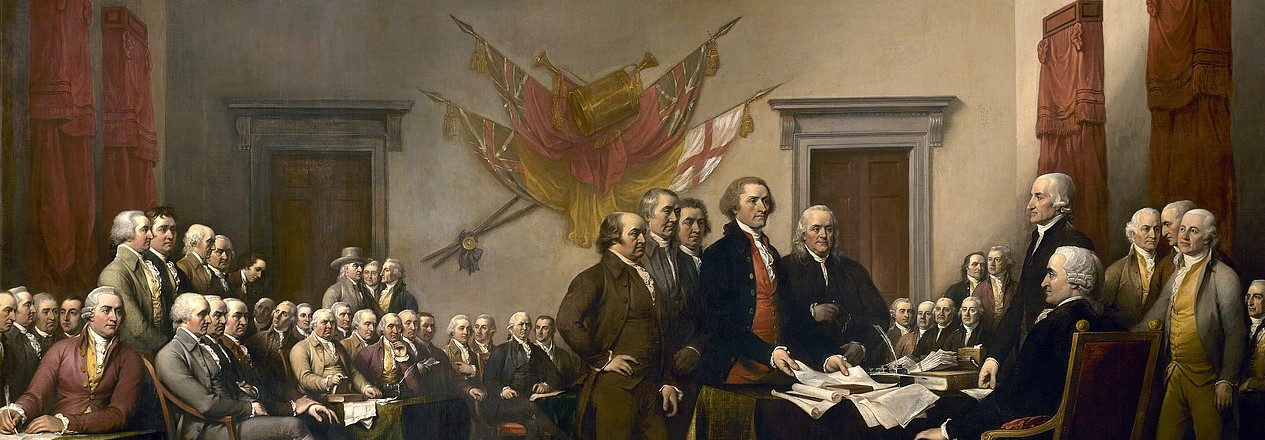
This day was the date that the assembled Second Continental Congress voted on the draft of a document that was Richard Henry Lee, a delegate from Virginia had put forth in a measure, in June, to be voted on declaring;

“That these United Colonies are, and of right out to be, free and independent States, that they are absolved from all allegiance to the British Crown, and that all political connection between them and the State of Great Britain is, and ought to be, totally dissolved.”

220px-Thomas_McKean_by_Charles_Willson_Peale
Thomas McKean by Charles Wilson Peale

On July 4, two days after this resolution passed, the final and formal version was approved by Congress. John Hancock, president of the Continental Congress affixed his signature boldly and largely at the bottom of the document. Eventually 55 other men would place their signature on the Declaration of Independence, with Thomas McKean, generally accepted, as the last to sign the document, possibly as late as January 1777.

Copies were made and four days later, on July 8, the first public reading occurred in Philadelphia. George Washington had the document read to the Continental Army in New York on the following day, July 9.

A18236.jpg
John Adams by Gilbert Stuart

For John Adams, future second president of the United States, the second day of July would and should be the day to remember American Independence, as he wrote;

“The most memorable Epocha, in the History of America. I am apt to believe that it will be celebrated, by succeeding Generations, as the great anniversary Festival…It ought to be solemnized with Pomp and Parade with shews, Games, Sports, Guns, Bells, Bonfires, and Illuminations from one End of this continent to the other from this Time forward forever more.”

And that is how many Americans choose to celebrate the anniversary of the Declaration of Independence, however, usually two days later on July 4th. Yet, it took another war; World War II, for July 4th to become a national paid holiday for workers of the Federal government when Congress approved it in 1941.

So, happy Independence Day!

*Feel free to add any interesting historical tidbits about the Second Continental Congress, the signers, or 1776 below!*


Thanksgiving with the Continental Army, 1777

Abraham Lincoln usually gets the credit for establishing Thanksgiving as a national holiday in 1863.  He deserves much of it for making it an annual event.  But, Lincoln was harkening back to an earlier practice of giving thanks amidst the trials and tribulations of war, whether it was going well or not.  The tradition predated the Revolutionary War generation, but they were as apt to a hold national day of giving thanks as any of their predecessors or successors in American history.  Continue reading “Thanksgiving with the Continental Army, 1777”

Uncovering the Continental Army in Morristown

Part of an ongoing series of about the Continental Army in Morristown, New Jersey. For the first post, click here.

Across the street from the Ford Mansion, the elegant home of the Jacob Ford, Jr. and his family, and the headquarters for George Washington during the winter encampment of 1779-1780, sits a small boulder with a iron plaque plastered on the side.IMG_0027

Erected in 1932 by the Tempe Wicke Society Children of the American Revolution, the monument commemorates the Life Guards that served as Washington’s headquarters command during the American Revolution. Although the unit went by different names and reorganized at least twice, including once during the winter encampment at Morristown, the company, numbering approximately 150 men, would be around for the duration of the war. Continue reading “Uncovering the Continental Army in Morristown”

Uncovering the Continental Army in Morristown

Part of an ongoing series about the Continental Army in Morristown, New Jersey. To read previous posts, click here.

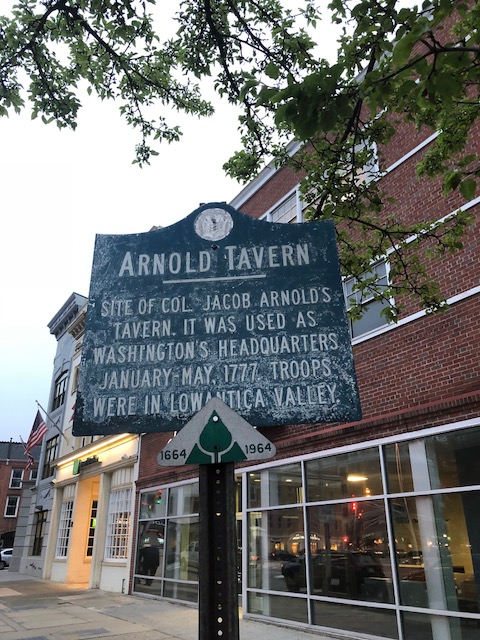
All that remains is a historical marker, on the side of North Park Place across the street from Morristown Green. For a few months, between January 1777 and May 1777, in this location, the headquarters of the Continental Army was located. Within that headquarters, obviously, was George Washington.

IMG_3024
Arnold’s Tavern historic sign (author’s collection)

Although no specific date of construction exists, it is believed that Arnold’s Tavern was built by Samuel Arnold between 1735 and 1750. By the time of the American Revolution owned by the son, Colonel Jacob Arnold. The structure was three stories high, with a wide hallway that bisected the building, a front and back parlor, barroom, dining room, and kitchen. Continue reading “Uncovering the Continental Army in Morristown”

Uncovering the Continental Army in Morristown

Part of an ongoing series of about the Continental Army in Morristown, New Jersey. For the first post, click here.

“The smallpox has made such head in every quarter that I find it impossible to keep it from spreading thro’ the whole army the natural way.” General George Washington wrote in February 1777.

By the time the Continental Army was encamped in Morrristown, Washington had become a firm believer in the inoculations for smallpox for the entire army. The inoculation process would entail the following: Continue reading “Uncovering the Continental Army in Morristown”

Uncovering the Continental Army in Morristown

Approximately one month ago, I took a temporary detail assignment to Morristown National Historical Park. The national park preserves the winter cantonments of the Continental Army during the American Revolution; including the harshest winter, weather-wise, of the entire war, in 1779-1780.

For parts of multiple winters and even during the campaigning season, Washington’s forces would come to Morristown, situated behind the Watchung Mountains, which provided safety but also a perch to monitor the British in the New York City.

The town still bears witnesses to this rich legacy of housing soldiers, with historic buildings and signs dotted around the spiraling town. On a walk the other day, I came across the house below, with a small plaque situated on the front of the dwelling.

IMG_2771

The home saw soldiers use it for their encampments throughout the majority of the war years. On his return to the United States the Marquis de Lafayette was welcomed with a reception in the building as well, which is in the photo below.

IMG_2772

Morristown is filled with tidbits of history from the American Revolution and I as spend the next few months there as a park ranger, I will share what I come across. So, stay tuned as I uncover the history of the place that “Saved America” according to the park’s unofficial slogan.


From Campaign 1776: Ten Crucial Days

Emerging Revolutionary War is pleased to share the following information from our friends at Campaign 1776 managed by the Civil War Trust. 

unnamed

“As many of you may know, this winter marks the 241st anniversary of the American victories at the battles of Trenton and Princeton. The Continental Army’s triumphs in the Ten Crucial Days campaign proved instrumental to rekindling Patriot morale and keeping the cause for American independence alive in the wake of early defeats. Continue reading “From Campaign 1776: Ten Crucial Days”

Review: Standing in Their Own Light: African-American Patriots in the American Revolution

ERW Book Reviews (1)

Emerging Revolutionary War welcomes guest historian Bill Backus to the blog. 


Fighting for Independence, Patriots commonly argued they were combating an attempt by the English Crown to reduce the American colonies to slavery.  The irony that most leaders crowing against “English slavery” owned enslaved African-Americans is one of the greatest contradictions of American history.  In a struggle about slavery, enslaved people played an important role.  In her new book, Standing in Their Own Light: African-American Patriots in the American Revolution, Professor Judith L. Van Buskirk explores African-American participation in the Patriot cause.

9780806156354_p0_v1_s550x406
“Standing in Their Own Light” by Judith L. Van Buskirk

The foundation for Van Buskirk’s study is the pension claims for nearly 500 soldiers made decades after the war.  To obtain a pension, veterans had to prove in a county court that they had served in the military during the war.  In addition to their recollection of when they enlisted, with whom they fought with, and where they campaigned, aspiring pensioners routinely recruited serving comrades and officers to offer testimony on their behalf.  While the pension records are an important source for historians, these documents were intended to prove wartime service and thus offered only a cursory examination of their military career.  The limitations of using these sources become apparent throughout the study

The book is divided into six chapters.  Van Buskirk first examines slavery prior to the American Revolution with South Carolina standing in for the Deep South, Virginia for the Upper South, Pennsylvania for the Middle Atlantic, and Massachusetts for New England.  In the second chapter, Van Buskirk utilizes the pensions to explore the life of an African-American patriot soldier, from enlistment, to camp life, and battle.  The subsequent two chapters explore two case studies of attempts to recruit, African-American soldiers: the segregated 1st Rhode Island Infantry and the story of the Laurens family connection of the recruit of African-Americans in South Carolina.  The final two chapters explore the pensions after the war.

The study on the 1st Rhode Island is outstanding. On May 14,1781, a detachment of the regiment on picket duty was ambushed outside of Peekskill, New York, by a local loyalist unit.  In the space of a few minutes, the Continentals lost eight killed, including both its colonel and major killed or mortally wounded, four wounded and twenty-four captured. The majority of the killed were black while those captured tended to be white.  Stories of the field officers either bayonetted or shot while in their beds added a salacious detail to this American disaster.  While its unknown if race played a crucial factor, the Battle of Pines Bridge foreshadowed the bloody battles involving African-American soldiers 80 years later in the Civil War.

While inconclusive , enough evidence survives in various pension claims that some of the first soldiers who entered the British fortifications at the Battle of Stoney Point weren’t officers, but black enlisted men.   Finally how subsequent generations of Americans used black soldiers involved in the Revolutionary War is another important contribution to the literature.

The limitation of the source material becomes evident in several places throughout the study.  For example in exploring the Battle of Stoney Point, Van Buskirk prefaces many observations with “probably” and “likely”.  At other sections, Van Buskirk generalizes the service of the men, an example being Jacob Francis and his military career.  Van Buskirk fleshes out Francis’ pension claim with an overly generalized overview of a battle experience in a Revolutionary Era army.  Sources for 18th century battles can be somewhat sparse compared with other events, but the qualifying terms that Van Buskirk uses diminishes some of the conclusions that she reaches

These quibbles aside, Standing in Their Own Light: African-American Patriots in the American Revolution is a tremendous addition to the historiography of the American Revolution, such as the sections about the 1st Rhode Island and black patriots after the war. Anyone interested in African-American history or the Continental Army should pick up this book.


 *Bio*

A native of Connecticut, Bill Backus graduated from the University of Mary Washington with a bachelor’s degree in Historic Preservation. Currently working as a historian for multiple Civil War sites in Northern Virginia, Bill has worked for the National Park Service at Vicksburg National Military Park and Petersburg National Battlefield. Bill currently resides in historic Brentsville, Virginia, with his wife, Paige, and their dog, Barley.