In the pantheon of American military leaders, Daniel Morgan’s place is definitely warranted. Innovative rifleman, heroic actions, backwoodsman, skillful tactician, and charismatic leader. He performed admirably at the Battle of Quebec in the winter of 1775, led the American forces at one of the climatic and complete victories of the war at the Battle of Cowpens in 1781, and distinguished himself in many a field and campaign in between.
For those reasons and a further discussion into the life and career of this American military hero, Emerging Revolutionary War invites you to listen and chime in during the next “Rev War Revelry” this Sunday at 7pm EST on our Facebook page.
In addition to the cadre of Emerging Revolutionary War historians, including Rob Orrison and Travis Shaw, there will be another talking head this weekend.
Joining ERW this Sunday will be historian Nathan Stalvey. He is the Director of the Clarke County Historical Association and a member of the Virginia Association of Museums Council. He started his 20-year career at the University of South Carolina’s McKissick Museum where he worked as the Curator of Traveling Exhibitions and Design. Nathan then served as the Director of Exhibitions and Head of Collections at the Louisville Slugger Museum & Factory in Louisville, Kentucky prior to his hiring in 2014 as the Director at CCHA. As Director, he oversees the operations of both a museum in downtown Berryville, as well as the historic 18th-century Burwell-Morgan Mill in Millwood.
As Daniel would have enjoyed an adult beverage in his day, make sure to bring one to this “Rev War Revelry” Sunday night!
Emerging Revolutionary War welcomes back guest historian Dan Davis
Like my last post at Emerging Revolutionary War on the “Race to the Dan”, the origins of this post lie in a conversation with blog co-founder, Phill Greenwalt. The topic of our discussion revolved around the aftermath of the British victory at the Battle of Camden. The engagement ultimately brought two American officers to the Southern Theater: Nathanael Greene and Daniel Morgan. Greene accepted the position as the new head of the Southern Department’s co two months to the day after the battle while commanding the post at West Point, New York. Morgan’s story, however, is much more fascinating.
In the spring of 1779, George Washington created a light infantry corps within the Continental Army. Such a command fit Morgan’s skillset. He previously commanded the army’s provisional rifle corps. Additionally, Morgan, then a colonel, had compiled a record that arguably warranted elevation to brigadier general. After fighting broke out at Lexington and Concord, Morgan led a rifle company to the aid to the American army besieging Boston. Morgan participated in Col. Benedict Arnold’s Canadian Expedition and was captured during the assault on Quebec. He also played a critical role in the Battles of Saratoga. Morgan’s home state of Virginia, however, had met its quota for general officers and a vacancy was not available.
On June 30, 1779, Morgan learned Brig. Gen. Anthony Wayne received command of the new corps. With his pride devastated, Morgan traveled to Philadelphia. There, on July 19, Congress read his resignation.
Emerging Revolutionary War welcomes guest historian Kevin Pawlak. A short bio follows the post below.
On May 25, 1775, the 62nd Regiment of Foot stood for review. The line of men, clad in their redcoats with buff facings, did not impress the reviewing officer. He called the regiment “very much drafted” and “very indifferent.” Despite the disparaging grade, in just over two years, the 62nd Foot commendably fought in one of the fiercest actions of the War for Independence.
John Anstruther courtesy of 62ndregiment.org
Scottish military man Lt. Col. John Anstruther led the 62nd Foot in the campaign of 1777. Anstruther faced no easy task; the 62nd was the junior British regiment in John Burgoyne’s army and most of its men were inexperienced in campaigning and battle. To make the situation even worse, roughly one-quarter of the 62nd Foot’s soldiers were German. Language barriers likely prevented complete cohesion within the unit. However, with a war on, nothing could be done to rectify the regiment’s defects as it marched south into New York.
Anstruther’s regiment was present for the operations around Fort Ticonderoga in early July 1777. After American forces abandoned the fort, the conglomerate and inexperienced 62nd remained behind to man Mount Independence overlooking Lake Champlain. As the rest of Burgoyne’s army continued campaigning, the men of the 62nd Foot spent time guarding themselves against rattlesnakes rather than the enemy. Their time came to rejoin the main army before the Battle of Saratoga commenced.
Emerging Revolutionary War welcomes back guest historian Daniel T. Davis.
Last month, I heard Emerging Revolutionary War co-founder Phill Greenwalt remark “when you think about retreats, victory is a word that doesn’t come to mind.” The period of January 18 to February 14, 1781 is the exception to the rule. During this time frame, the American army under Maj. Gen. Nathanael Greene and the British under Charles, Lord Cornwallis, marched across the backcountry of the Carolinas. Known as the “Race to the Dan”, this episode between the engagements at Cowpens and Guilford Courthouse, is a largely forgotten but consequential even in the Southern Campaign of 1781.
I’ve been intermittently visiting Winchester, VA for years, usually with an eye toward understanding its place in the Civil War. Tradition has it that no town changed hands more frequently. But, the town also has a prominent, if sometimes overlooked, role in America’s colonial and Revolutionary War history. In particular, it enjoyed a close relationship with George Washington and Daniel Morgan, helping shape both men.
George Washington as a Teenage Surveyor, Winchester, VA
Winchester, or Frederick Town, as it was then known, was the largest village in the lower Shenandoah Valley when Lord Thomas Fairfax decided to relocate from England to his land grant in northern Virginia and became a way-station of sorts for people traveling along the Great Wagon road that ran from Pennsylvania to North Carolina in the 18thcentury. So, when the Fairfax family hired a teenaged George Washington to help survey its grants in the Shenandoah, Winchester was a logical place for the surveying team to make its temporary home base. (In truth, surveying teams were constantly moving to maximize their efficient use of time: the saddle might be considered home.) While the teenager was less than impressed with most accommodations on the frontier, he was pleased with Fredericktown. He recorded in his diary: Continue reading “George Washington, Daniel Morgan, and Winchester, Virginia on Memorial Day”→
The sign at the first pull-off left me underwhelmed. Fortunately, my impression of the battlefield got better and better.
I know we’re getting close to the Cowpens battlefield when we pass Redcoat Drive and then Tory Trail. Unfortunately, my GPS takes us to the maintenance shed rather than the visitor center, but the park’s signage finally manages to get us where we need to go.
I know nothing about the battle of Cowpens, but my colleague Rob Orrison has strongly recommended I visit the battlefield. It involves some of the most colorful characters of the war, he tells me: Daniel Morgan and Banastre Tarleton. “The battle changed the course of the war in the Carolinas, in my humble opinion,” Rob adds.
That seems like a pretty ringing endorsement to me. My son and I, on our way back from Atlanta, decide to make the hop off I-85 for a visit. Continue reading “A Detour to Cowpens”→
As we have seen, two untrained, amateur, but very effective soldiers perfected the concept of the defense in depth during the campaigns of 1781. Morgan was the first to experiment with the concept, and he did so with great effect at Cowpens, thoroughly defeating Tarleton’s Legion and sending “Bloody Ban” flying in a wild panic. Greene then adopted the tactic and applied it on a much larger scale at Guilford Courthouse. Even though he lost the battle, he scored a major strategic victory by punishing Cornwallis’ army and inflicting enormous losses on it for little gain—Greene’s army escaped to fight another day. His stand at Guilford Courthouse set the stage f Continue reading “Defense in Depth as a Revolutionary War Battlefield Tactic”→
Part Three (click here for first two installments)
Determined to avenge his embarrassing defeat at Cowpens, Lt. Gen. Charles Lord Cornwallis set his army out in a determined pursuit of the American army. Knowing that he was too weak to face Cornwallis in a pitched battle, Maj. Gen. Nathanael Greene, the Southern Department commander, retreated northeastward from Salisbury, North Carolina toward the Virginia state line, where he hoped that additional militia troops would reinforce his army and he would receive supplies. The British chased Greene to the Dan River, near the Virginia border, but Greene wisely put the river between his army and the enemy. Cornwallis and his weary soldiers arrived at the rain-swollen river on February 15, too late to catch Greene’s army, which had finished crossing earlier that day. Frustrated, Cornwallis withdrew to Hillsborough, North Carolina.
Lord Charles Cornwallis
After receiving both the expected supplies and reinforcements, and after an opportunity to rest his command, Greene soon marched back into North Carolina to face Cornwallis’ tired and poorly supplied army, which now numbered less than 2000 men. After several weeks of skirmishing with Loyalist militiamen and a great deal of maneuvering Greene assumed a defensive position around Guildford Courthouse (near modern Greensboro, North Carolina) on March 14, 1781. Greene had more than 4000 Continentals, militiamen and cavalry, meaning that his army outnumbered Cornwallis’ by more than twice their strength. Continue reading “Defense in Depth as a Revolutionary War Battlefield Tactic”→
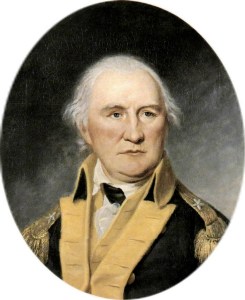
Brig. Gen. Daniel Morgan, the “Old Wagoner,” as he was known, commanded a light infantry corps assigned to Maj. Gen. Nathanael Greene’s southern army. Morgan met with Greene in Charlotte, North Carolina on December 3, 1780. Implementing a Fabian strategy, Greene split his army to harass the British while buying time to recruit additional soldiers. Greene ordered Morgan to use his 600-man command to forage and harass the enemy in the back country of South Carolina while avoiding battle with Lt. Gen. Charles Lord Cornwallis’ British army.
Once Cornwallis realized what was going on he dispatched Lt. Col. Banastre Tarleton’s British Legion to track down Morgan’s command and bring it to battle. Tarleton commanded a combined force of Loyalist American troops. The Legion consisted of fast-marching light infantry and dragoon units. At its peak strength, the Legion numbered approximately 200 infantry and 250 dragoons. It was known for its rapid movements and for its ruthless policy of giving the enemy no quarter. Patriot forces feared Tarleton and his Legion, and for good reason.
By January 12, Tarleton’s scouts had located Morgan’s army in the South Carolina back country, and Tarleton began an aggressive pursuit. Morgan hastily retreated to a position at the Cowpens, a prominent crossroads and pasturing grounds for cattle. The field was about 500 yards long and about as wide, dotted with trees, but devoid of undergrowth, which served as a food source for grazing battle.
Once Morgan learned that Tarleton was pursuing him, he spread the word for local militia units to rendezvous with him at the Cowpens. Through the night, South Carolina militiamen drifted into camp. Morgan visited their camps, encouraging them to stand and fight. Morgan’s words were particularly effective; the grizzled veteran knew how to motivate these men. They would need to be prepared, because they faced a stern task the next day.
January 17, 1781 dawned clear and very cold. After his scouts reported Tarleton’s approach, Morgan rode among his men, crying out, “Boys, get up! Benny’s coming!” Morgan designed a defense in depth that was intended to draw the British Legion in and then defeat them by pouncing on their exposed flanks. He knew that his militia had a reputation of being unreliable, and his ability to maneuver was limited, so he elected to design and implement a defense in depth that took advantage of the terrain features of the Cowpens.
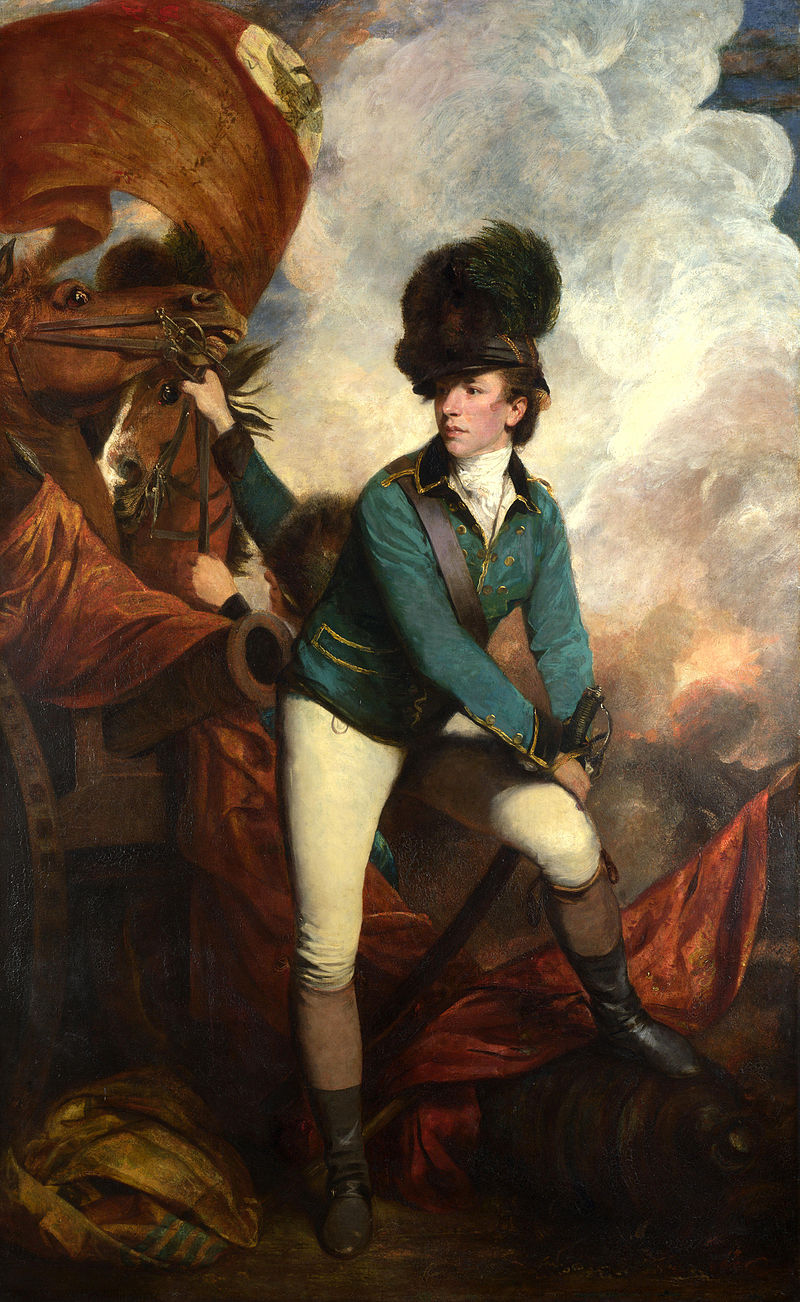
Banastre Tartleton, British commander at Cowpens
Tarleton was overconfident. He believed that Morgan’s command was hemmed in by the nearby Broad River and also believed that the cleared fields of the Cowpens were ideal ground for his dragoons, and concluded that Morgan must be desperate to fight in such a place.
Morgan had prepared three defensive positions. Selected sharpshooters out front and hiding behind trees manned the first line. They picked off a number of Tarleton’s dragoons as they advance, specifically targeting officers. Traditional accounts indicate that they downed 15 of Tarleton’s dragoons this way. Confused, the dragoons retreated.
Having accomplished their initial goal, the sharpshooters then fell back about 150 yards or so to join the second line, which consisted of Brig. Gen. Andrew Pickens’ militiamen. Morgan asked these men to stand long enough to fire two volleys, after which they were to fall back to the third—and main line—manned by Col. John Eager Howard’s Continentals, another 150 yards or so in the rear of the second line. Thus, Morgan had designed a textbook example of a defense in depth.
Andrew Pickens, commanded some of the South Carolina militia at Cowpens
Some of the militia got off two volleys and then most of the militia fell back to a spot behind the third line. Tarleton orders his dragoons to pursue the retreating militiamen, and as the dragoons bore down on them with their sabres drawn, Col. William Washington’s Continental cavalry suddenly thundered onto the field, seemingly from nowhere. They routed the surprised Loyalist dragoons, who fled the field with heavy losses.
The infantry then engaged. With their drums beating and their fifes shrilling, the British infantry advanced at a trot. Recognizing that the moment of crisis had arrived, Morgan cheered his men on, rode to the front and rallied the militia, crying out, “form, form, my brave fellows! Old Morgan was never beaten!”
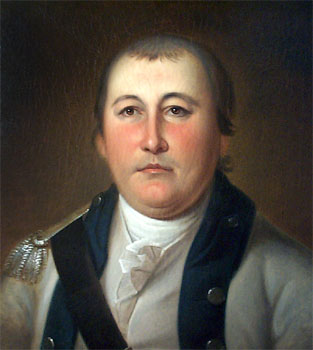
William Washington, commander of American cavalry at Cowpens and a distant relation to George Washington
Tarleton’s 71st Highlanders, a veteran unit made of Scotsmen, which had been held in reserved, now charged the Continental line, their skirling bagpipes adding to the cacophony of battle. Howard ordered his right flank to face slight right to counter a charge from that direction, but in the noise and chaos, was misunderstood as a call to retreat. As other companies along the line began to pull out, Morgan rode up to ask Howard if he had been beaten. Howard pointed at the orderly ranks of his retreat and assured Morgan that they had not been beaten. Morgan then put spurs to his horse and ordered the retreating units to face about and, on his order, to fire in unison. Their deadly volley dropped numerous British soldiers, who, sensing victory, had broken ranks in a determined charge. The combination of this volley and a determined bayonet charge by the Continentals turned the tide of battle in favor of the Americans.
At the moment, the rallied and re-formed militia and Washington’s cavalry attacked, leading to a double envelopment of the British, who began surrendering in masses. Tarleton and some his men fought on, but others refused to obey orders and fled the field in a panic. Finally, Tarleton realized that he had been badly beaten and fled down the Green River Toad with a handful of his men. Racing ahead of his cavalry, William Washington dashed forward and engaged Tarleton and two of his officers in hand-to-hand combat. Only a well-timed pistol shot by his young bugler saved Washington from the upraised saber of one of the British officers. Tarleton and his remaining forces escaped and galloped off to Cornwallis’ camp to report the bad news.
And bad news it was: Tarleton’s Legion lost 110 dead, over 200 wounded and 500 captured. By contrast, Morgan lost only 12 killed and 60 wounded. His perfectly designed and perfectly implemented defense had worked even beyond the Old Wagoner’s wildest dreams and highest hopes.
Knowing that Cornwallis would pursue him, Morgan buried the dead and then withdrew to the north to live and fight another day. Morgan reunited with Greene’s army and the combined force headed for North Carolina. Morgan, whose health was fragile, soon retired from further duty in the field, but he had left his mark. Cowpens was his finest moment, and set a precedent for Greene to follow two months later at Guilford Courthouse.
Battle of Cowpens (Courtesy of Campaign 1776/CWT)
*Suggestions for additional reading: for a superb book-length microtactical treatment of the Battle of Cowpens, see Lawrence E. Babits, A Devil of a Whipping: The Battle of Cowpens (Chapel Hill: University of North Carolina Press, 1998). This book is the primary resource consulted in drafting this article.
As a general statement, most people don’t think of the Revolutionary War as a testing ground for battlefield tactics. That assumption would not be correct. In fact, the Revolutionary War proved beyond doubt that traditional European set-piece battlefield tactics were largely ineffective against a determined enemy that was not bound by the traditional rules of war. As just one example, the extremely effective hit and run tactics used by the Minutemen to harass and deplete the British forces that marched to Lexington and Concord that were based on the tactics used by Native American fighters prove this beyond doubt. The British Regulars had no experience or training in dealing with these tactics, and they suffered as a result.
Also, in the European model, wherein gentlemen fought wars and assiduously avoided civilian casualties, it was considered impolite and improper to target the other side’s officers during the course of battle. American forces refused to comply with these rules, causing serious losses among the ranks of British officers, and the British had to adapt to these tactics also.
Another tactic adopted by American officers proved to be incredibly effective during the campaigns in the South in 1781. Brig. Gen. Daniel Morgan and Maj. Gen. Nathanael Greene, in particular, made extremely effective use of the defense in depth in carrying out their Fabian strategy during the Southern Campaigns of the Revolutionary War.
A Fabian strategy—named for its most famous practitioner, the Roman dictator, Quintus Fabius Maximus Verruscosus—avoids pitched battles and frontal assaults in favor of wearing down an opponent through a war of attrition and indirection. While avoided decisive battles, the side employing a Fabian strategy harassed the enemy through skirmishes to inflict losses, disrupt supply, and affect enemy morale. Typically, the employment of this strategy suggests that the side adopting it believes that time is on its side. George Washington was absolutely convinced that a Fabian strategy would ultimately wear down the British, and he was right.
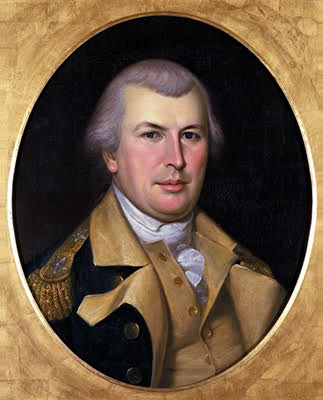
General Nathanael Greene, who mastered the Fabian strategy in the Southern Campaign of 1781
His protégé, Greene, also believed that a Fabian strategy was the way to defeat the British. Faced with the task of defending a large swath of the South with a small army, he had little choice. His subordinate, Brig. Gen. Daniel Morgan, a rough but extremely effective amateur soldier, pioneered the use of a defense in depth at the Battle of Cowpens in January 1781, and Greene then used it on a larger scale at the Battle of Guilford Courthouse about sixty days later. That two untrained amateur soldiers could develop and use such a tactic so effective demonstrates their genius.
A defense in depth, also known as a deep or elastic defense, seeks to delay, rather than prevent, the advance of an attacker, buying time and inflicting additional casualties by trading time for space. Instead of facing an attacker with a single, strong defensive position, a defense in depth relies upon the tendency of an attack to lose momentum and cohesion over time as it covers a larger area. Thus, a defender can yield lightly defended territory in an effort to outstrip an attacker’s logistics or spread out a numerically superior attacking force. Once that attacker has lost momentum, or has become spread out to hold territory, well-planned and well-placed counterattacks can be directed at the attacker’s weak points, with the objective of causing attrition warfare or driving the attacker back to its original starting position.
A conventional defensive strategy concentrates all of a defender’s military resources in a well-defended front line, which, if breached by an attacker, would expose the remaining troops in danger of being flanked, cut off, and surrounded, and leaving lines of supply, communications, and command vulnerable to being cut.
By contrast, a defense in depth requires that defenders deploy their resources, such as prepared fortifications, earthworks, and additional forces at and well behind the front line. Once an attacker breaches the weaker initial position, it continues to meet resistance as it presses on. As the attacker penetrates further, its flanks become vulnerable, and if the advance stalls, the attacking force can find itself completely surrounded and subject to being destroyed or forced to surrender. Thus, a defense in depth is particularly effective against an attacker that can concentrate its force to attack a small number of places along an extended defensive position.
In a well-designed and properly implemented defense in depth, the defending forces fall back to a succession of prepared positions designed to inflict a heavy price on the advancing enemy while minimizing the risk of being overrun or outflanked. By delaying the enemy’s advance, a defense in depth neutralizes manpower advantages and the element of surprise, and buys time for additional forces to be readied for well-timed counterattacks. A well-designed defense in depth will use its forces in mutually supporting positions and in appropriate roles. In this scenario, poorly trained soldiers—such as militiamen—can be used in static positions at the front line, while more experienced and better-trained soldiers can form a mobile reserve, or man the ultimate defensive position to be defended. Further, a well-designed defense in depth will make good use of the natural advantages offered by terrain features and other natural obstacles such as streams, ponds, etc.
General Nathanael Greene, who mastered the Fabian strategy in the Southern Campaign of 1781
There are disadvantages associated with the defense in depth. For one thing, constantly retreating can take a toll on the morale of defending forces. Further, these forces also require a high degree of mobility to accommodate those retreats, and also the space to do so.
Morgan designed and implemented a very effective defense in depth at Cowpens that proved so effective that Greene adopted that tactic and, while he lost the Battle of Guilford Courthouse, the heavy losses his army imposed on Lord Cornwallis’ army prompted Greene to note that the British, “have met with a defeat in a victory.”





 Emerging Revolutionary War Era