Review: Rethinking America From Empire to Republic by John M. Murrin

erw-book-reviews-11

In the introduction, Andrew Shankman narrows down the one word that has driven the history career of Dr. John M. Murrin; “Anglicization.” (page 1).  This process happened in a period of approximately 60 years, as the colonists along the eastern seaboard of North America became “in virtually every measurable way…more not less British in their attitudes, outlooks, and actions…” (page 1).

With that thought in mind, the collection of essays from the pen of Dr. Murrin comprise this single volume, Rethinking America, From Empire to Republic published by Oxford University Press. Understanding the history and historiography of these decades and the military, political, social, and economic sub-themes of the time period define the work. Yet, this is not history from just the top down; from the perspective of the elites nor from the bottom-up, but a melding of the various tiers of society.  Continue reading “Review: Rethinking America From Empire to Republic by John M. Murrin”
Uncovering the Continental Army in Morristown

Part of an ongoing series of about the Continental Army in Morristown, New Jersey. For the first post, click here.

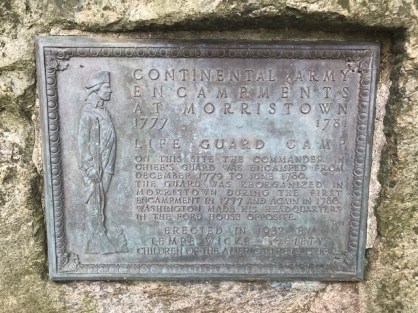
Across the street from the Ford Mansion, the elegant home of the Jacob Ford, Jr. and his family, and the headquarters for George Washington during the winter encampment of 1779-1780, sits a small boulder with a iron plaque plastered on the side.IMG_0027

Erected in 1932 by the Tempe Wicke Society Children of the American Revolution, the monument commemorates the Life Guards that served as Washington’s headquarters command during the American Revolution. Although the unit went by different names and reorganized at least twice, including once during the winter encampment at Morristown, the company, numbering approximately 150 men, would be around for the duration of the war. Continue reading “Uncovering the Continental Army in Morristown”

Washington’s Marshals

Emerging Revolutionary War welcomes back guest historian Michael Aubrecht

September 24 of each year is the anniversary date of the Judiciary Act of September 24, 1789. It also means that the United States Marshals Service is a year older. Along with the first federal law enforcement agency in the United States, President George Washington signaled the start of the entire federal judicial system with his signature on that date. It was a broad document covering many positions from judges to prosecutors. Sections 27 and 28 were specific to the U.S. Marshal’s roles and responsibilities. A segment of Section 27 specifically outlines their general powers. It states:

And be it further enacted, That a marshal shall be appointed in and for each district for a term of four years, but shall be to attend the district and circuit courts when sitting therein, and also the Supreme Court in the district in which that court sit. (b) And to execute throughout the district, all lawful precepts directed to him, and issued under the authority of the United States, and he shall have the power to command all necessary assistance in the execution of his duty, and to appoint as shall be occasion, one or more deputies… Continue reading “Washington’s Marshals”

Origins of a Revolutionary Orator

Studley state historical marker
State of Virginia historical marker for Studley

Nestled in Hanover County, VA, near where modern residential communities meet farm fields that have been worked for centuries, is the site of a colonial-era plantation home called Studley.  It was here on this site that Patrick Henry, the “Voice of the Revolution”, was born.

A 600-acre tobacco plantation, Studley was built in the 1720’s for its original owner, Colonel John Syme and his bride, Sarah, the former Sarah Winston.  The surrounding community, as it does today, took its name from the site. (By the mid-19th century, the Studley area was called Haws Shop, after a nearby blacksmith shop.  In the latter part of May, 1864, Union and Confederate cavalry units fought a dismounted action here just prior to the battle of Cold Harbor.  Prominent among the Union commanders engaged was Brig. Gen. George Armstrong Custer.)

Sketch of Studley
Sketch of Studley

Continue reading “Origins of a Revolutionary Orator”

Uncovering the Continental Army in Morristown

Part of an ongoing series about the Continental Army in Morristown, New Jersey. To read previous posts, click here.

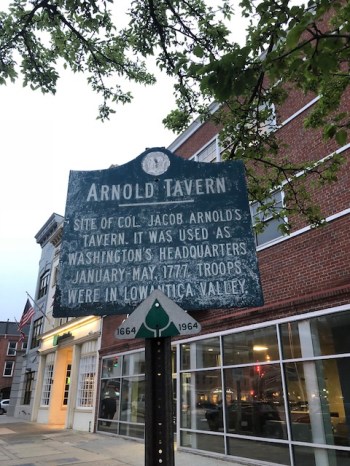
All that remains is a historical marker, on the side of North Park Place across the street from Morristown Green. For a few months, between January 1777 and May 1777, in this location, the headquarters of the Continental Army was located. Within that headquarters, obviously, was George Washington.

IMG_3024
Arnold’s Tavern historic sign (author’s collection)

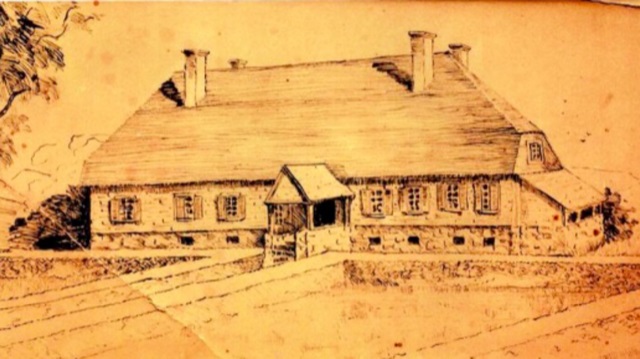
Although no specific date of construction exists, it is believed that Arnold’s Tavern was built by Samuel Arnold between 1735 and 1750. By the time of the American Revolution owned by the son, Colonel Jacob Arnold. The structure was three stories high, with a wide hallway that bisected the building, a front and back parlor, barroom, dining room, and kitchen. Continue reading “Uncovering the Continental Army in Morristown”

Uncovering the Continental Army in Morristown

Part of an ongoing series of about the Continental Army in Morristown, New Jersey. For the first post, click here.

“The smallpox has made such head in every quarter that I find it impossible to keep it from spreading thro’ the whole army the natural way.” General George Washington wrote in February 1777.

By the time the Continental Army was encamped in Morrristown, Washington had become a firm believer in the inoculations for smallpox for the entire army. The inoculation process would entail the following: Continue reading “Uncovering the Continental Army in Morristown”

A Very Special Message

A special announcement in the preservation world was made public today. The Civil War Trust, which the Campaign 1776 initiative spawned from, officially changed their name to the American Battlefield Trust. You can see their video announcement of the name change and what it means, here.

logoEmerging Revolutionary War sent an email inquiry to our friends at American Battlefield Trust to elaborate a little further on what this name change means and the impact to their current and future preservation efforts. Continue reading “A Very Special Message”

An Account of April 19, 1775

“the Country was an amazing strong one; full of Hills, Woods, stone Walls, & c., which the Rebels did not fail to take advantage of, for they were all lined with People who kept an incessant fire upon us…”

From the diary of Lieutenant Frederick Mackenzie who was part of the 23rd Regiment–the Royal Welch Fusiliers that survived the ordeal of April 19, 1775. He would keep a diary until the early 1790’s and chronicled his experiences in the American Revolutionary War. His account on April 19, of the retreat from Concord is most descriptive. The British did not just take the brunt of the firing as the marched hurriedly back toward Boston and safety, but;

“as we did too upon them, but not with the same advantage, as they were so concealed there was hardly any seeing them: in this way we marched between 9 and 10 miles, their numbers increasing from all parts…”

The column was led by Lieutenant Colonel Francis Smith and had been tasked by General Thomas Gage, British military leader in North America, to root out the military supplies being stored in Concord by the colonials. The mission, albeit supposedly secretive, did not remain so for long, and the colonials got word out to the countryside. After initial firing at Lexington Green and then at the North Bridge in Concord, the British had to march back through the countryside, facing arriving militia and minute men.

“while ours was reducing by deaths, wounds, and fatigue; and  we were totally surrounded with such an incessant fire as it is impossible to conceive; our ammunition was likewise near expended.”  

IMG_7229
Modern-day view along Battle Road, the route the British column retreated back toward Boston on (author collection)

Luckily, for Mackenzie and the other struggling British officers and rank-and-file, on a rise in the ground, outside the town of Menotomy, was a relief column, ready to provide a few moments’ respite.