Book Review: Young Washington by Peter Stark

erw-book-reviews-11Peter Stark, Young Washington: How Wilderness and War Forged America’s Founding Father, Kindle ed., (New York: HarperCollins, 2018).

While traveling in southwestern Pennsylvania, outdoor writer Peter Stark discovered the region’s deep history and the central role it played in transforming George Washington from a callow young man on the make to the kind of leader who could forge a nation. Stark was not accustomed to thinking about Washington on those terms.  He decided to study the younger man in greater detail, retracing Washington’s steps as a surveyor and explorer, messenger for Virginia’s colonial governor, defeated commander at Fort Necessity, aide to General Braddock, commander in the Virginia militia, honorary brigadier during the Forbes Campaign, frustrated suitor of his neighbor and best friend’s wife, and prickly colonial frustrated with ill treatment at the hands of the British empire.  While Stark includes chapters that cover Washington’s early life and the circumstances that brought him to the frontier, Young Washington revolves around the period of Washington’s service just before and during the French and Indian War. Continue reading “Book Review: Young Washington by Peter Stark”

Book Review: Bob Drury & Tom Clavin, Valley Forge, Kindle ed., (New York: Simon & Schuster, 2018).

erw-book-reviews-11

Bob Drury and Tom Clavin have spent years writing books, both individually and as a team.  Between the two of them, they have explored topics ranging from baseball and golf to the old west and America’s 20th century wars.  With Valley Forge (Simon & Schuster, 2018), Clavin and Drury have turned to the American Revolution.  The result is another successful collaboration. (I’m biased as I have enjoyed several of their earlier books.)

Valley Forge tackles the Philadelphia Campaign, the winter encampment at Valley Forge (and elsewhere in truth), and the Continental Army’s emergence as a quality army capable of fighting the British on their own terms, which it demonstrated at Monmouth.  The focus is on Washington and the main army with him.  The reader sees both of them grow as Washington defeats political attempts to undermine his leadership and struggles to hold the army together in the face of harsh conditions and insufficient support from the rebelling states, Continental Congress, and local farmers.  Meanwhile, the Army develops into a core of hard-bitten professionals suitably trained in European methods specifically adjusted for their circumstances. After undergoing Steuben’s training program, it had the military skills needed to match its fighting spirit. By and large, it marked a turning point in the war.  Thus, at the end, the authors argue, “For those who survived, not least their inspired and inspiring commander in chief, the hardships they overcame had not so much transformed their innate character as revealed it.”[i] Continue reading “Book Review: Bob Drury & Tom Clavin, Valley Forge, Kindle ed., (New York: Simon & Schuster, 2018).”

Press Release: Victory at Yorktown

ABT

Breaking on Friday, the 237th anniversary of the surrender of British Lord Charles Cornwallis’ surrender at Yorktown, there was another victory.

The American Battlefield Trust announced the successful acquisition of 49 acres of “hallowed ground associated with the 1781 battle.”

The full press release is at the link below!

Victory at Yorktown!

George Washington’s Greatest Speech?

On the morning of March 15, 1783, George Washington strode into the “New Building” or “Temple” as the structure was referred as, to address the assembled officers of the Continental Army. He asked General Horatio Gates if he could have the floor to say a few words and when he unfolded his pieces of paper on the podium, the words lost their importance.

Why? Continue reading “George Washington’s Greatest Speech?”

Summer Lecture on Summer of 1787

This past July I had the pleasure to attend and present at the American Battlefield Trust Teacher Institute. One of the keynote speakers was David O. Steward, the author of Summer of 1787: The Men Who Invented the Constitution. During his talk, there were a few points that stuck out to me and I share them with you.summer of 1787 stewart

  • 72 elected, 55 attended, and 35 delegates were probably there all summer.
  • Out of the 55 that attended, 39 affixed their signatures to the document

In reference to George Washington, Stewart candidly remarked he had “more influence by keeping his mouth shut” almost as if by his calm, quiet demeanor, he was displaying that “I trust in you and I’ll try and make it work” with whatever the delegates designed in that hot and stuffy room in Philadelphia.  Continue reading “Summer Lecture on Summer of 1787”

Captain John Asbhy

Part Two

Captain John Ashby and his fellow Virginians would face their greatest test of the war on the afternoon of September 11th, 1777 at the Battle of Brandywine. Following a wide flank march the bulk of the Crown forces emerged on Washington’s right flank, ready to trap and smash the Continental Army. Washington reorganized his line, drawing men north in a desperate attempt to meet the new threat. The Third Virginia was ordered into position far in advance of the American lines – their objective was to hold a wooded hill near the Birmingham Friends Meeting House in order to buy time for the rest of the American troops to take up position. Ashby and his fellow officers arranged their men among the buildings and woodlot of the Samuel Jones farm and awaited the attack that was certain to come.

The Battle of Brandywine, September 11, 1777 (American Battlefield Trust)

Continue reading “Captain John Asbhy”

Captain John Ashby

Emerging Revolutionary War welcomes guest historian Travis Shaw. 

Part One

As he looked northward across the open ground in front of his position, Captain John Ashby could see the advance guard of the British army moving steadily closer. They came on in a loose, open line, taking time to return the fire of Ashby’s men. Made up of red-coated light infantry and their German counterparts, the rifle-armed Jaegers, the advance guard were the cream of the Crown forces – men chosen for their fitness, marksmanship, and ability to endure hardship. Ashby and his men were veterans, so they must have known they’d be in for a fight. As the battle intensified around him, one wonders if Captain Ashby’s thoughts turned to home. The Brandywine Valley of Pennsylvania was a long way from his native Virginia Piedmont.

The Crooked Run Valley in northern Fauquier County looks much as it did when John Ashby lived there two centuries ago (Author_s photo)
The Crooked Run Valley in northern Fauquier County looks much as it did when John Ashby lived there two centuries ago (Author’s photo)

John Ashby was born in 1740 in northwestern Fauquier County, among the foothills of the Blue Ridge Mountains. The son of Robert Ashby and Rosanna Berry, he grew up at Yew Hill, the family estate that lay just a few miles from the Gap that bears the family’s name to this day[1]. John’s uncle and namesake, Captain “Jack” Ashby commanded a company of Virginia rangers during the French and Indian War, where he made the acquaintance (and drew the ire) of a young George Washington[2]. Continue reading “Captain John Ashby”

Uncovering the Continental Army in Morristown

Part of an ongoing series about the Continental Army in Morristown, New Jersey. To read previous posts, click here.

IMG_3370
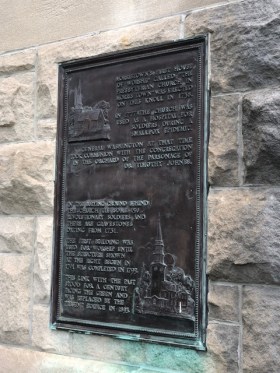
Plaque on wall of the Presbyterian Church

During the winter encampment, in 1777, at Morristown, George Washington ordered the inoculation for smallpox of the Continental Army. Although knowing the probability that some of his men would succumb to the disease when infected with even a small dosage of the puss, the commander-in-chief knew that the necessity of the process. By the end of the American Revolutionary War, more American soldiers would die of smallpox than British shot and shell.


With a population of 700 people and less than 70 dwellings, any public space of size was utilized to treat and quarantine the soldiers undergoing the smallpox inoculation. One of the religious establishments that was used was the Presbyterian Church across the street from Morristown Green, the center of town.

The Presbyterian Church already had a long history in Morristown, being the first congregation founded in the town, dating back to 1733 (the one you see today is actually the third to grace the same site).

IMG_3369

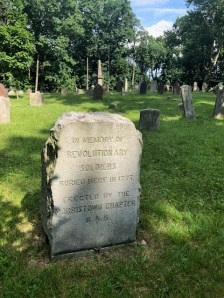
Behind the church is a graveyard referred to as “The Burying Ground” which holds the remains of over 1,700 individuals. Included in that number are the remains of numerous soldiers that succumbed to the smallpox inoculation during the winter encampment of 1777. From the burials that are known, 138 remains are those of soldiers from the American Revolution.IMG_3383

During the annual commemoration of Independence Day, the town of Morristown will offer guided programs of “The Burying Ground.” At other times throughout the year, the church itself will offer tours. You can find information about the church programs of the  cemetery here.

Whether you visit on a guided tour or independently stroll the ground, the though to keep in mind is; the men who died whether on the field of battle, succumbed to smallpox, or lived a long life as a veteran, the all helped make Morristown the placed where “America Survived.”

Uncovering the Continental Army in Morristown

Part of an ongoing series of about the Continental Army in Morristown, New Jersey. For the first post, click here.

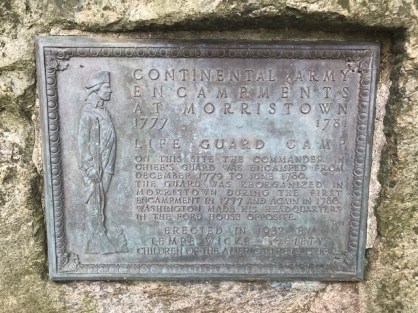
Across the street from the Ford Mansion, the elegant home of the Jacob Ford, Jr. and his family, and the headquarters for George Washington during the winter encampment of 1779-1780, sits a small boulder with a iron plaque plastered on the side.IMG_0027

Erected in 1932 by the Tempe Wicke Society Children of the American Revolution, the monument commemorates the Life Guards that served as Washington’s headquarters command during the American Revolution. Although the unit went by different names and reorganized at least twice, including once during the winter encampment at Morristown, the company, numbering approximately 150 men, would be around for the duration of the war. Continue reading “Uncovering the Continental Army in Morristown”

Washington’s Marshals

Emerging Revolutionary War welcomes back guest historian Michael Aubrecht

September 24 of each year is the anniversary date of the Judiciary Act of September 24, 1789. It also means that the United States Marshals Service is a year older. Along with the first federal law enforcement agency in the United States, President George Washington signaled the start of the entire federal judicial system with his signature on that date. It was a broad document covering many positions from judges to prosecutors. Sections 27 and 28 were specific to the U.S. Marshal’s roles and responsibilities. A segment of Section 27 specifically outlines their general powers. It states:

And be it further enacted, That a marshal shall be appointed in and for each district for a term of four years, but shall be to attend the district and circuit courts when sitting therein, and also the Supreme Court in the district in which that court sit. (b) And to execute throughout the district, all lawful precepts directed to him, and issued under the authority of the United States, and he shall have the power to command all necessary assistance in the execution of his duty, and to appoint as shall be occasion, one or more deputies… Continue reading “Washington’s Marshals”