On this date in 1776, Major Joseph Ward, serving as a staff officer for Major General Artemas Ward, second in command of the Continental Army that had just evicted the British from Boston, sat down at his desk to pen the following letter. The recipient was John Adams, a fellow Massachusettsan then serving in the Second Continental Congress in Philadelphia, Pennsylvania. Ward continued his correspondence of keeping Adams apprised of military affairs around Boston. In this letter, however, he makes the case for the colonies to “cut the Gordian knot” and declare independence, months before Richard Henry Lee’s proposal to call for independence in late June 1776.
Boston 23 March 1776
Sir,
The 17th Instant the Pirates all abandoned their Works in Boston and Charlestown and went on board their Ships, and on the 20th they burnt and destroyed the works on Castle Island. They now lye in Nantasket Road waiting for a fair wind; we keep a vigilant eye over them lest they should make an attack on some unexpected quarter. The particulars with regard to the Seige, the Stores taken, &c. you will receive from better authority, therefore it is unnecessary for me to mention them. Our Troops behaved well, and I think the flight of the British Fleet and Army before the American Arms, must have a happy and very important effect upon the great Cause we engaged in, and greatly facilitate our future operations. I wish it may stimulate the Congress to form an American Government immediately. If, after all our exertions and successes, while Providence offers us Freedom and Independence, we should receive the gloven cloven foot of George to rule here again what will posterity, what will the wise and virtuous through the World say of us? Will they not say, (and jusly) that we were fools who had an inestimable prize put into our hands but had no heart to improve it! Heaven seems now to offer us the glorious privilege, the bright preeminence above all other people, of being the Guardians of the Rights of Mankind and the Patrons of the World. It is the fault of the United Colonies (a rare fault among men) they do not sufficiently know and feel their own strength and importance. Independence would have a great effect upon the Army, some now begin to fear that after all their fatigue and hazards in the Cause of Freedom, a compromise will take place whereby Britain may still exercise a power injurious to the Liberty Peace and Safety of America: Cut the Gordian knot, and the timid and wavering will have new feelings, trimming will be at an end, and the determined faithful friends of their Country will kindle with new ardour, and the United Colonies increase in strength and glory every hour.
Yesterday I saw your Brother, who informed that Mrs. Adams and your Children were well.
General Ward, on account of his declining health, has wrote his Resignation to the President of the Congress. I expect the greatest part of the Army will march for New York, or the Southern Colonies as soon as the Fleet is gone to Sea; and the Troops that remain here will be employed in fortifying the most advantageous Posts to defend the Town and harbour. I do not much expect the Enemy will make any attempts to regain possession of Boston, for I think they are sufficiently convinced that they cannot penetrate the Country in this part of America; ’tis probable they will try their fortune to the Southward and if they fail there the game will be up with them. We hear many accounts about Commissioners coming from Britain to treat with the Colonies separately, or with the Congress. Many fear we shall be duped by them, but I trust the congress is too wise to be awed by the splendor or deceived by the cunning of British Courtiers.
I know not of one discouraging circumstance attending either our civil or military affairs in this part of the Continent. I have lately heard with pleasure that the Farmer is become an advocate for Independence.Wishing the Congress that Wisdom which is from above, I am Sir with much Respect Your most Humble Servant,Joseph Ward
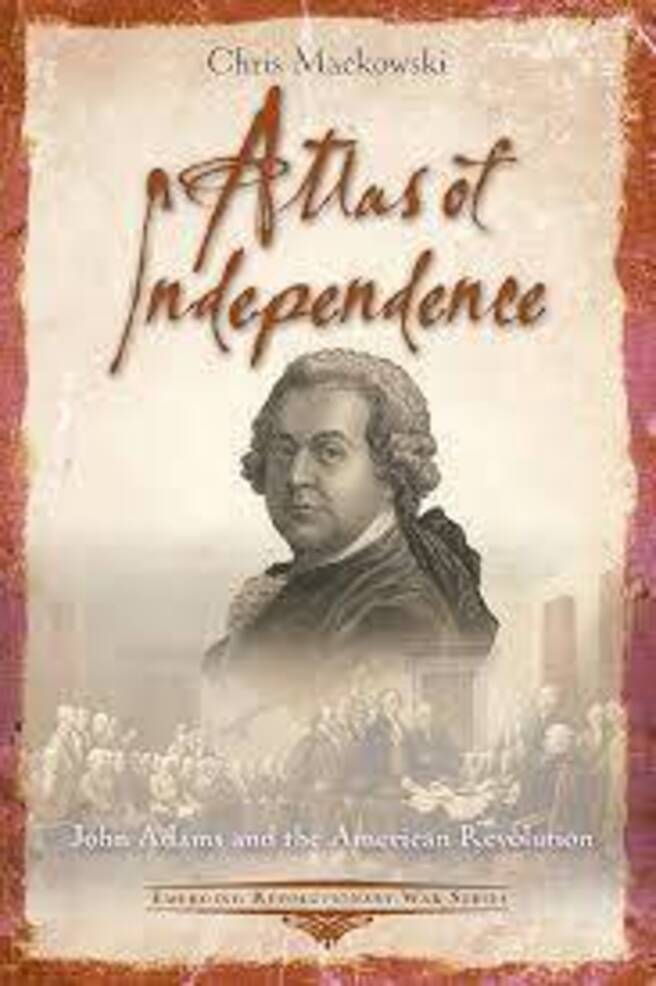
Join us this Sunday at 7pm LIVE on our Facebook page as we focus on ERW’s first 2026 book release, The Atlas of Independence: John Adams and the American Revolution by Dr. Chris Mackowski. Mackowski will discuss why Adams led him to write his first “Rev War book” and the much over looked impact Adams had during the war years. We will discuss some of the more “unique” relationships Adams developed through the war time years and of course his friendship with Thomas Jefferson and his close relationship with his wife Abigail.
To order a copy of “Atlas of Independence” visit Savas Beatie’s website at: https://www.savasbeatie.com/ . Again, this will be a LIVE broadcast on our Facebook page, so grab a drink and join in on the chat!
For good reason, much has been done, discussed, developed, and disseminated regarding the voluminous correspondence between Abigail and John Adams. Yet, her spouse was not the only recipient of the wisdom and insight that Abigail possessed. She also became friends with and communicated with Catherine Sawbridge Macaulay Graham in England.
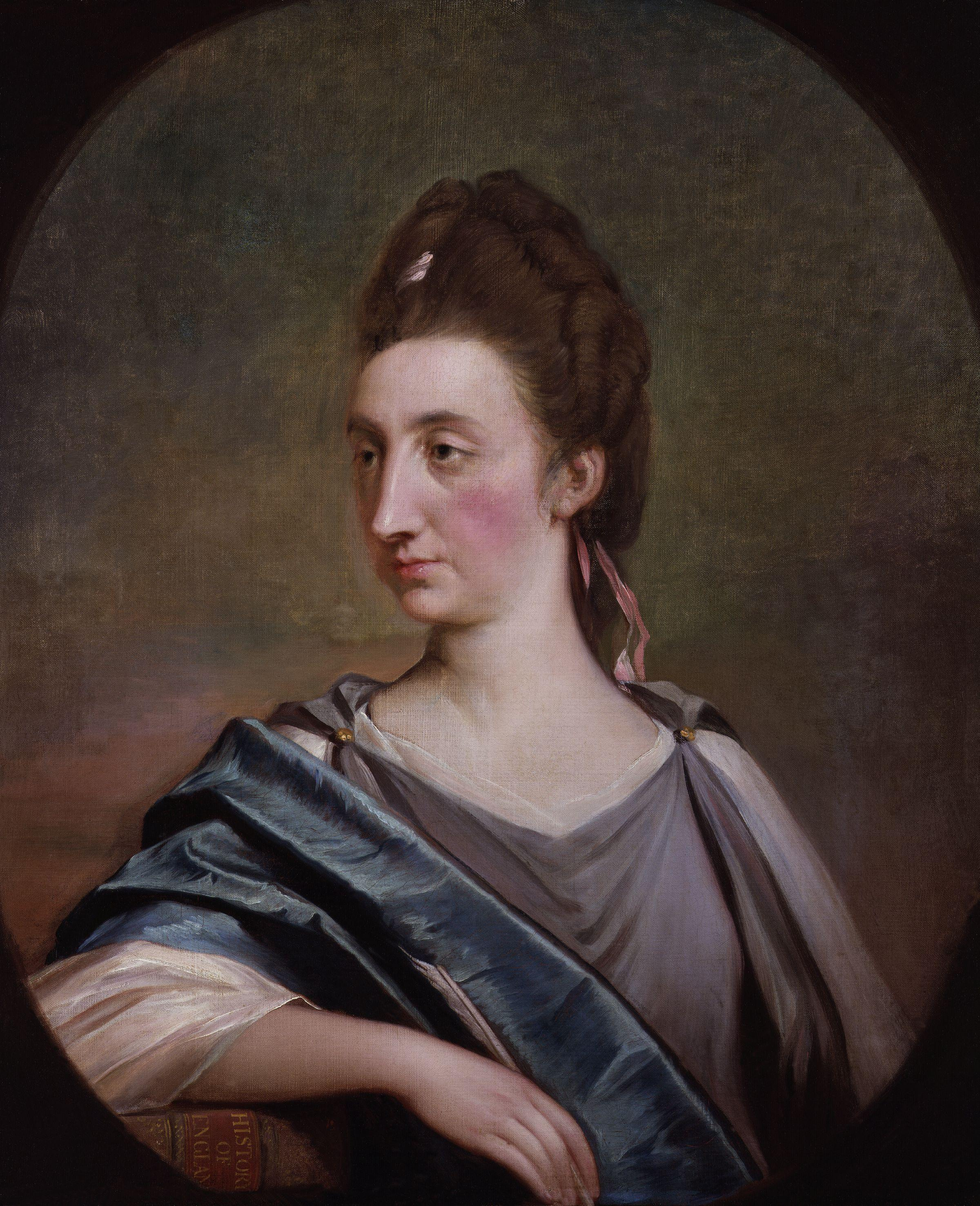
Catharine Sawbridge Macaulay Graham
Graham was a prominent English historian and writer, “at the forefront of radical transatlantic politics in the eighteenth century.” She was a prolific pamphleteer and considered one of England’s first major historians. She was a supporter of and wrote extensively on the American and French Revolutions. Through the cause of the former, she struck up a correspondence with Abigail Adams. Below is a letter from Abigail to Catherine in 1774 that highlights the current events in Massachusetts and also how close the two ladies on either side of the Atlantic Ocean had become in their letter writing. It is truly a remarkable letter that provides emotion and description of a friendship and life in Massachusetts on the cusp of revolution.
Madam
In the last Letter which Mr. Adams had the honour to receive from you, you express a Desire to become acquainted with our American Ladies.1 To them Mrs. Macaulay is sufficiently distinguished by her superior abilities, and altho she who is now ventureing to address her cannot lay claim to eaquil accomplishments with the Lady before introduced,2 yet she flatters herself she is no ways deficient in her esteem for a Lady who so warmly interests herself in the cause of America—a Cause madam which is now become so serious to every American that we consider it as a struggle from which we shall obtain a release from our present bondage by an ample redress of our Grieveances—or a redress by the Sword. The only alternative which every american thinks of is Liberty or Death.
“Tender plants must bend, but when a Goverment is grown to strength like some old oak rough with its armed bark it yealds not to the tug, but only nods and turns to sullen state.”
Should I attempt to discribe to you the complicated misiries and distresses brought upon us by the late inhumane acts of the British parliment my pen would faill me. Suffice it to say, that we are invaded with fleets and Armies, our commerce not only obstructed, but totally ruined, the courts of Justice shut, many driven out from the Metropolis, thousands reduced to want, or dependant upon the charity of their neighbours for a daily supply of food, all the Horrours of a civil war threatning us on one hand, and the chains of Slavery ready forged for us on the other. We Blush when we recollect from whence these woes arise, and must forever execrate the infamous memory of those Men whether they are Americans or Brittons, whose contagious Ambition first opened the pandoraen Box, and wantonly and cruelly scatterd the fatal ingrediants—first taught us filled with grief and anxiety to inquire
Are these thy deeds o Britton? this the praise
That points the growing Lusture of thy Name
These glorious works that in thy [better?] Days
fild the bright period of thine early fame
To rise in ravage and with arm prophane
From freedoms shrine each sacred Gift to rend
and mark the closing annals of thy reign
With every foe subdued, and every Friend.
You will think Madam perhaps from the account I have given you, that we are in great confusion and disorder—but it is far otherways. Tho there are but few who are unfealing or insensible to the general calimity, by far the greater part support it with that firmness, that fortitude, that undaunted resolution which ever attends those who are conscious that they are the injured not the injurer, and that they are engaged in a righteous cause in which they fear not to “bare their bold Breasts and pour their generous Blood.” Altho by the obstruction of publick justice, each individual is left at a loose, to do that which is right in his own Eyes, yet each one strives to shew his neighbour that the restraints of Honour and of conscience are more powerful motives, than the judiciary proceedings of the Law. Notwithstanding the inveterate Malice of our Enimies who are continually representing us, as in a state of anarchy and confusion, torn up with intestine broils, and guilty of continual riots and outrage, yet this people never saw a time of greater peace and harmony among themselves, every one uniting in the common cause, and strengthning each other with inconceivable constancy and sumpathetick ardor.
I mean always to Except those whose venal Souls barter freedom for Gold, and would sell their Country, nay gladly see an innocent land deluged with Blood, if they could riot upon its Spoils, which heaven Avert!—Tis with anxious Hearts and eager expectations that we are now waiting for the result of the united Supplications of America. Yet having so often experienced their Enefficacy we have little reason to hope. We think we have more to expect from the firm and religious observance of the association which accompanied them3—for tho it was formerly the pride and ambition of American[s] to indulge in the fashions and Manufactures of Great Brittain now she threatens us with her chains we will scorn to wear her livery, and shall think ourselves more decently attired in the coarse and plain vestures of our own Manufactury than in all the gaudy trapings that adorn the slave.—Yet connected as we are by Blood, by commerce, by one common language, by one common religion as protestants, and as good and loyal subjects of the same king, we earnestly wish that the three fold cord of Duty, interest and filial affection may not be snapped assunder. Tis like the Gordean knot. It never can be untied, but the sword may cut it, and America if she falls to use the words of the revered and ever honourd Mr. Pitt, will fall like a strong Man, will embrace the pillars of State and pull down the constitution along with her.
I must intreet your pardon Madam for Detaining you so long from the important Services in which you are engaged, but having taken up my pen I could not refrain giving utterance to some of those Emotions which have agitated my Bosom and are the cause of many anxious hours to her who begs leave to subscribe herself Dear Madam your great admirer & humble Servant,
Situated one block from where independence was declared, the structure was home to two presidents as the building served as the third residence of United States presidents. Built in 1767 by Mary Masters, the home was familiar with tenants of great importance. During the American Revolutionary War, British general Sir William Howe during the British occupation of the city. Months later Benedict Arnold, then a general in the Continental Army, moved in as he served as the military governor of Philadelphia.
After the war and a disastrous house fire, Robert Morris, the great financier, purchased the property and rehabilitated the structure. When the United States capital moved to Philadelphia, Morris offered the residence to President George Washington, and the Morris family moved next door to another property. Washington insisted that Morris receive rent for the use of one of his dwellings.
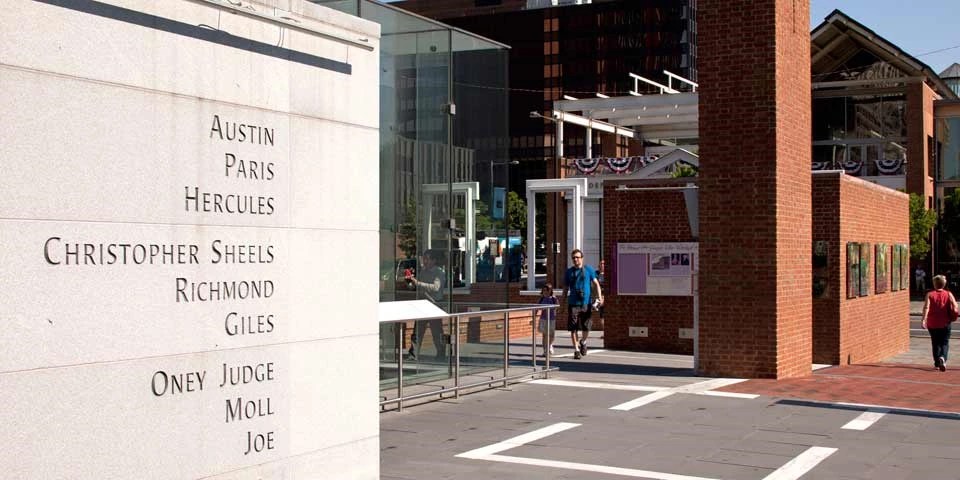
Months later, in November 1790, more people arrived to inhabit the house. Though unlike those previously mentioned, these souls did not come willingly. Washington brought eight enslaved African Americans from Mount Vernon to serve the needs of the first family, their guests, and maintain the house. One of the enslaved, Ona Judge, took the opportunity of being in a northern state to abscond from the Washingtons, never to be caught and returned. To avoid the Pennsylvania law, the Gradual Abolition of Slavery Act of 1780, which read that any enslaved person residing within the state boundaries for six months or longer owned by a non-resident would gain their freedom. Washington rotated the enslaved back to Mount Vernon in Virginia.
Besides Ona, who left the President’s House in May 1796 to gain her freedom and made her way to Portsmouth, New Hampshire. She did correspond with George and promised to return to the Washingtons’ under the condition that she would be freed upon their deaths. Belonging to Martha Washington, though, George did not have the legal right to agree to that promise. Judge created a life in New Hampshire, marrying and having three children before she passed away on February 25, 1848.
After Washington’s two-terms as president expired, John Adams, the second president of the United States, moved into the residence. On November 1, 1800, near the end of his four years, Adams relocated to the yet-unfinished White House in the new capital of the United States at Washington, D.C.
A century and a half later, the house’s remaining walls were accidentally demolished. Through the advocacy of historians and African American remembrance groups, the site was commemorated, with some of the foundation displayed under plexiglass covering. Information panels discussed those enslaved who served the house. A ghost structure showed the outline of the original structure, and the entire area was administered by the National Park Service.
The site became the center of attention again in January 2026 with the removal of those panels discussing the African American and enslaved experiences in the house that served presidents and hosted dignitaries. Their stories, though, remain as part of the fabric of the complete history of the United States. Very much including the role slavery and the enslaved played in the early American republic.
President’s House, with list of the enslaved to the left (courtesy of the NPS)
As this blog post publishes, the plight of the panels, the history of African-Americans in general, and the enslaved at the President’s House remain a topic of conversation and controversy. Continue to check the National Park Service website (click here) or other history-focused webpages for updates. Emerging Revolutionary War encourages dialogue and discussion on this topic.
The latest volume in the Emerging Revolutionary War Series is now available: Atlas of Independence: John Adams and the American Revolution. Publisher Savas Beatie is now offering exclusive signed copies available for pre-order. (Details here!)
As it happens, the publication of Atlas has origins deeply entwined with the origins of the Emerging Revolutionary War Series itself. One could easily argue that there would be no United States of America without John Adams; one could also argue there might not be an Emerging Civil War Series if not for Adams, either.
ERW started as “Rev War Wednesdays” on our sister blog, Emerging Civil War. Then we started up the ERW blog. Soon, co-founders Rob Orrison and Phill Greenwalt wanted to launch a book series similar to the Emerging Revolutionary War Series. The books would provide read-friendly overviews of important stories from the Revolutionary War era, with a focus on battles and leaders.
But how to start?
Rob and Phill approached me with the idea. I thought it was great. But at the time, I was underwater with projects (and, I guess, I still am!). I couldn’t take a direct hand in launching the series, but I did tell them I’d be glad to act in an advisory capacity…on one condition.
If we launched an Emerging Revolutionary War Series, I wanted to write a book about John Adams for the series.
I wasn’t sure when I’d be able to do it, but I wanted to plant my flag and stake my claim.
I’ve had a man-crush on Adams since first reading Joseph Ellis’s Pulitzer Prize-winning Founding Brothers, published in 2000. Ellis had a great fondness for Adams, which he readily admitted. It came across clearly in the book, and I found it infectious. Hooked by the bug, I turned to Ellis’s Passionate Sage: The Character and Legacy of John Adams, which painted a fascinating portrait of the lion in winter.
In 2001, David McCullough’s John Adams biography appeared. It, too, won the Pulitzer Prize. For Adams’s legacy, the book was a game-changer. It transcended history circles to become a cultural phenomenon all its own. It was an “It” book. It became a heady time to be an Adams fan.
My Adams journey led me through all sorts of readings and site visits. I got to know and love the Adams family. I grew to know and respect (but also bear a bit of a grudge toward) Adams’s opposite pole in the Revolution, Thomas Jefferson. I read letters and diaries and other primary sources. I became deeply steeped in the politics of the Independence movement. Most people know me as a Civil War writer, but this has been my other area of historical interest, my secret fascination.
Rob and Phill agreed to my one condition, and so we set out to start the new book series. Hannah Gordon, a former student of mine, came on as initial editor. Rob and Phill wrote about Lexington and Concord. The book series was underway!
It took my a while to get started on my Adams book, though. I have too many ideas for writing projects and not enough time. Not until 2021 did I get the decks cleared enough to start working on the book, but it proceeded in fits and starts as other projects and other ECW and ERW demands jockeyed for my time.
As a result, it took me almost exactly four years to write Atlas of Independence. (For me, that’s an incredibly long amount of time to write 50,000 words!) During that time, even as I worked on other projects, I kept reading John and Abigail’s correspondence with each other and with other people, familiarizing and re-familiarizing myself with the sources. It felt like extra time with treasured friends. The book and I are both better off for it.
I tried to present a fair and balanced account of Adams’s life during the Revolution, although, like Ellis, my fondness for Adams is apparent. I made sure to avoid the sort of hagiography Adams himself detested, though. History, he believed, should not fall victim to the weakness of romance, even if that’s the way people preferred to remember their history.
With the 250th anniversary of American Independence creeping up on me, I knew I had to get the book over the finish line. Adams was central to that story, and I did not want to miss the chance to tout his role. I buckled down last year and finished the manuscript, and the staff at Savas Beatie generously worked with me to get the book to press in time for the dawn of the anniversary year.
And so now here we are. Two hundred and fifty years ago, Adams was discovering the newly published pamphlet Common Sense; today, we get to discover the newly published Atlas of Independence.
I hope you find John Adams to be excellent company. I certain have!
Signed copies of Atlas of Independence are available for pre-order from Savas Beatie for $16.95 plus shipping. Orders 1–100 will be personally signed; orders 101+ will come with an autographed book plate. Click here for details and to order your copy.
It’s hard to overemphasize how important Common Sense was as a tool of persuasion.
Sure, we all know about it. “The idea that Common Sense played a pivotal role in moving the nascent revolutionary movement toward independence is universally acknowledged today,” says historian Jett B. Conner.[1]
Yet I’ve found that, beyond its generally accepted place in American history, most people don’t quite “get” Common Sense. Reading the document today—like anything written 250 years ago—poses a challenge for modern readers. The language doesn’t catch for us the way it did for readers of its time. We aren’t living in the same political context they were. We marinade in a much different, much more immersive media environment. These factors all remove us from the visceral impact Common Sense had.
In the early days of my teaching career, I taught public relations classes. I had been a PR professional prior to that, enticed to the academy, but I wanted my classes to be grounded in the professional standards established by the Public Relations Society of America (PRSA). They had criteria for academic programs that wanted PRSA certification. My university didn’t qualify because we didn’t have a specific major in PR at the time, but I nonetheless used their standards as the model for my classes. One of the standards at the time advocated teaching the history of PR.
Several PR milestones sprang from the political arena: Andrew Jackson’s first use of a press secretary in the White House; Teddy Roosevelt’s bully pulpit; the WWI-era Creel Commission; FDR’s fireside chats; the WWII-era Office of War Information, etc.
Common Sense made the list as the most significant piece of American writing to that point—a track specifically aimed at public persuasion. And boy, did it succeed! “Common Sense was the most radical and important pamphlet written in the American Revolution and one of the most brilliant ever written in the English language,” assesses historian Gordon Wood.[2]
Prior to Common Sense’s publication in January 1776, John Dickinson’s Letters from a Farmer in Pennsylvania in 1767–8 held the record as the most influential piece of public writing. Published in 19 of the 23 major newspapers in the colonies—as well as appearing in England and France—the letters opposed Parliament’s Townsend Acts, which imposed tariffs. Dickinson, a lawyer rather than a farmer, became one of the most famous men in America because of his twelve letters, which did much to unify the colonies in common cause against British taxation.
“Farmer’s Letters captured the spirit of the moment and Americans’ imaginations like nothing before,” says Dickinson biographer Jane E. Calvertt, “selling more copies than any other pamphlet to date. The response was immediate and resounding, going far beyond anything Dickinson could have anticipated.”[3]
Thomas Paine’s Common Sense eclipsed Dickinson exponentially—some 100 times larger, according to historian John Ferling.[4]
Timing helped. Bloodshed on Lexington Green, at the North Bridge in Concord, and all along the road back to Boston added urgency to public discussions. Closure of the port of Boston and the October firebombing of Falmouth, Maine—and the foreboding message it suggested to other colonies—heightened tensions even more. England was no longer some abstract entity across the ocean, but an intrusive force ready to impose its will through violence if necessary. “It was successful because it came precisely the time when people were ready for its message,” says historian Alfred F. Young.[5]
“The suppressed rage that animated Paine’s writing in Common Sense was another important factor in its success,” contends historian Scott Liell, who said “Paine felt, and made his readers feel, ‘wounds of deadly hate.’”[6]
Through 1775, the Continental Congress remained undecided on a course of action, with factions pushing for independence and others pushing for rapprochement. Therefore, news from Philadelphia did little to provide clear guidance for public sentiment.
“[T]he idea of independence was familiar, even among the common people,” John Adams later pointed out.[7] The idea just hadn’t yet crystallized.
Common Sense—first published on January 10, 1776, as a 46-page pamphlet—became that crystal.
“[T]here is something absurd, in supposing a continent to be perpetually governed by an island,” Paine wrote. Paine made such sentiments seem like statements of the obvious. Of course a continent shouldn’t be ruled by an island. Of course one honest man was worth more to society and in the sight of God than all the crowned ruffians that ever lived. Of course.
That was the genius of Paine’s writing.
To read it today, one wouldn’t appreciate how accessible it was to common folks or realize how often people read it aloud in taverns and inns so that even people who could not read could hear its ideas and engage in discussions. A reader today wouldn’t grasp just how hungry readers of 1776 were for Common Sense’s ideas.
“In weighing the influence of a tract, the active role of the reader is often underappreciated,” Young points out.
Reading is an act of volition. A person had to buy the pamphlet; one shilling was cheap as pamphlets went but costly to a common carpenter who might make three shillings a day or to a shoemaker had made even less and out of the question for a common laborer who earned one-eighth of a shilling a day. Or a person had to borrow the pamphlet, seeking out an owner, or respond to someone’s blandishments to read it. When it was read aloud, as it was in taverns and other public places, a person had to make a decision to come to listen or to stay and hear it out.[8]
In other words, readers had to actively want to read it—and they sometimes went to great lengths and expense to do so.
Common Sense sold somewhere around 125,000 copies within its first three months and, within its first six months, went through thirty-five printings—an astounding success considering the population of the American colonies totaled just under 3 million people.[9] A translation appeared for Pennsylvania’s German communities, and editions appeared in England and France.
Sales figures probably only scratch the surface of the pamphlet’s total circulation. “As its reputation and popularity spread,” says historian Scott Liell, “individual copies were read and re-read to countless assembled groups in public houses, churches, army camps, and private parlors throughout the colonies.”[10]
“Its effects were sudden and extensive upon the American mind,” pronounced Philadelphia physician Dr. Benjamin Rush, a friend of Paine’s who had suggested the title. Suddenly, the pearl-clutching in Congress became open, vigorous, public debate. (See Kevin Pawlak’s January 9, 2026 post for more info on the public reactions.) “The controversy about independent was carried into the news papers . . .” Rush recalled. “It was carried on at the same time in all the principal cities in our country.”[11] Indeed, in was in early February 1776 in a New York City bookshop—on his way from Boston to Philadelphia—that Adams first found Common Sense. (Adams would have his own complicated history with the pamphlet, which I’ll explore in a future blog post.)
To this day, Common Sense has never been out of print. It exists today as an icon, a relic, a foundational text we’ve all heard of. We accept its primacy as fact. But few people actually read it, and fewer successfully tune in to its urgency and immediacy. In commemoration of its 250th birthday, I invite you to take a closer look at a document you certainly know and think you know, and see what new sense you may be able to draw from it. (Read it here!)
[1] Jett B. Conner, John Adams vs. Thomas Paine: Rival Plans for the Early Republic (Yardley, PA: Westholme, 2018).
[2] Gordon Wood, “Thomas Paine, America’s First Public Intellectual,” Revolutionary Characters (New York: Penguin, 2006), 209.
[3] Jane E. Calvert, Penman of the Founding: A Biography of John Dickinson (London: Oxford University Press, 2024), 184.
[5] Aldred F. Young, “The Celebration and Damnation of Thomas Paine,” Liberty Tree: Ordinary People and the American Revolution (New York: New York University Press, 2003), 271.
[6] Scott Liell, 46 Pages: Thomas Paine, Common Sense, and the Turning Point to Independence (Philadelphia: Running Press, 2003), 20.
[9] Young says, “Scholars have generally accepted a circulation of 100,000 to 150,000 copies (although none of them make clear how they reached their conclusions).” Liberty Tree, 270.
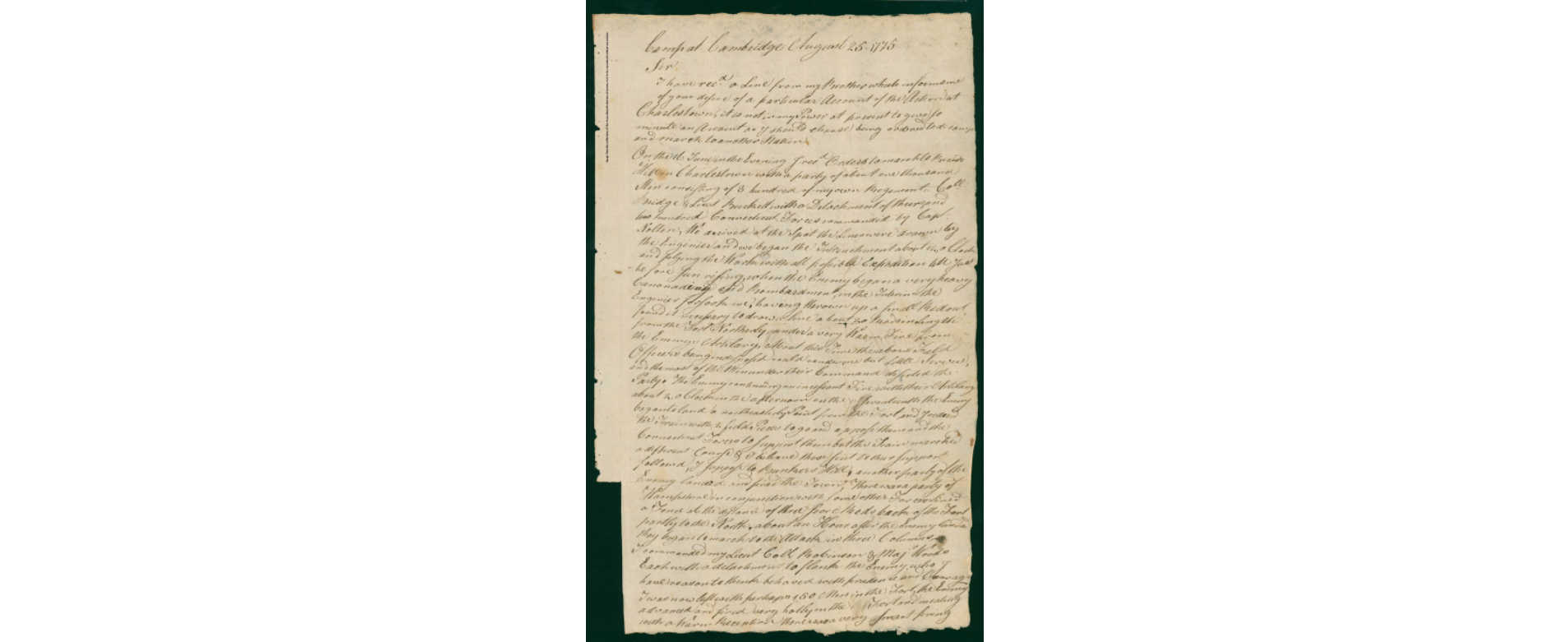
Approximately two months after waging the defense of Breed’s Hill, on the Charlestown peninsula, against the British, Colonel William Prescott put quill to paper to write to John Adams. In this communique, he discussed the action at Breed’s Hill, known as the Battle of Bunker Hill, fought on June 17, 1775, to his fellow Massachusetts native. Take note that he even wrote his account about the orders he received and which hill that missive directed him to. Since the waft of smoke has drifted from the battle on that June day, veterans, officers, and historians have debated why Prescott and company chose Breed’s Hill instead of Bunker Hill. This letter is just another wrinkle in that timeless debate.
Camp at Cambridge August 25.1775
Sir
I have recd. a Line from my Brother which informs me of your desire of a particular Account of the Action at Charlestown, it is not in my Power at present to give so minute an Account as I should choose being ordered to decamp and march to another Station.
On the 16 June in the Evening I recd. Orders to march to Breeds Hill in Charlestown with a party of about one thousand Men consisting of 3 hundred of my own Regiment, Coll. Bridge & Lieut Breckett with a Detachment of theirs, and two hundred Connecticut Forces commanded by Capt. Nolten, We arrived at the Spot the Lines were drawn by the Enginier and we began the Intrenchmant about 12, o Clock and plying the Work with all possible Expodition till Just before sun rising, when the Enemy began a very heavy Canonading and Bombardment, in the Interin [Interim] the Enginier forsook me, having thrown up a small Redout, found it necessary to draw a Line about 20 Rods in length from the Fort Northerly, under a very Warm Fire from the Enemys Artilary, About this Time the above Field Officers being indisposed could render me but Little Service, and the most of the Men under their Command deserted the Party. The Enemy continueing an incessant Fire with their Artilary. about 2, o Clock in the afternoon on the seventeenth the Enemy began to land a northeasterly Point from the Fort, and I orderd the Train with 2 field Pieces to go and oppose them and the Connecticut Forces to support them but the Train marched a different Course & I believe those sent to their support followd, I suppose to Bunkers Hill, another party of the Enemy landed and fired the Town, There was a party of Hampshire in conjunction with some other Forces Lined a Fence at the distance of three score Rods back of the Fort partly to the North, about an Hour after the Enemy landed they began to march to the Attack in three Columns, I commanded my Lieut Coll. Robinson & Majr. Woods Each with a detachment to flank the Enemy, who I have reason to think behaved with prudence and Courage.
I was now left with perhaps 150 Men in the Fort, the Enemy advanced and fired very hotly on the Fort and meating with a Warm Reception there was a very smart firing on both sides. after a considerable Time finding our Amunition was almost spent I commanded a sessation till the Enemy advanced within 30 yards when we gave them such a hot fire, that the [y] were obliged to retire nearly 150 yards before they could Rally and come again to the Attack. Our Amunition being nea [r ]ly exaustid could keep up only a scattering Fire. The Enemy being numerous surrounded our little Fort began to mount our Lines and enter the Fort with their Bayonets, we was obliged to retreat through them while they kept up as hot a fire as it was possible for them to make we having very few Bayonets could make no resistance, we kept the fort about one hour and twenty Minutes after the Attack with small Arms, This is nearly the State of Facts tho’ imperfect & too general which if any ways satisfactory to you will afford pleasure to your most obedient humble Servt.
William Prescott To the honble John Adams Esqr.
Image of original letter from Prescott to Adams, courtesy of Massachusetts Historical Society
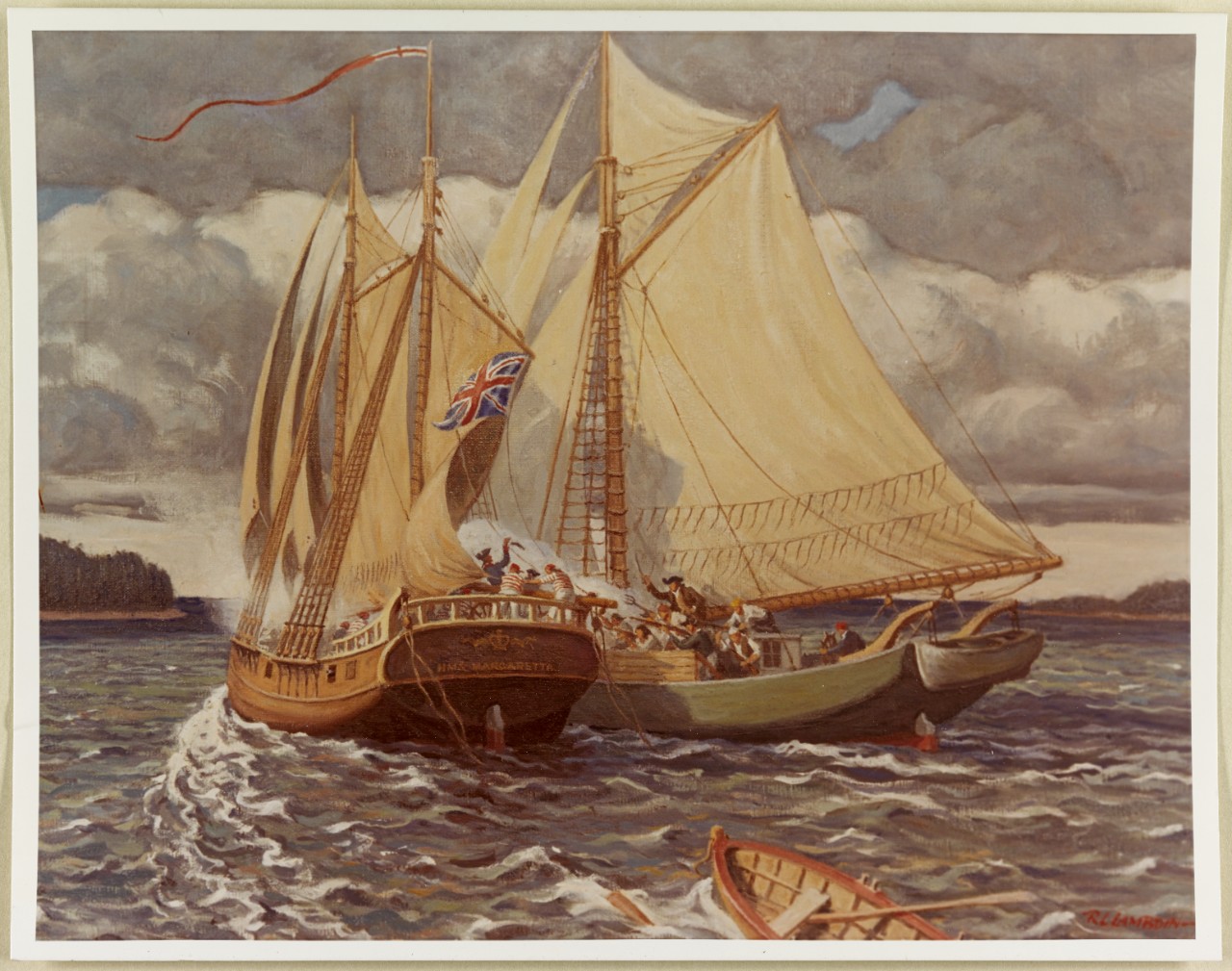
Unity vs. Margaretta, 12 June 1775 by Robert Lambdin (Naval History and Heritage Command). Margaretta was a Royal Navy vessel captured off Machias, then part of Massachusetts but now in Maine. The image illustrates the relatively small sizes of vessels involved in creating the early American navy.
During the first six months of the American rebellion, the colonies inched toward some means of dealing with Britain’s naval superiority. Over the summer the Americans had already waged a sort of whaleboat war among the estuaries and islands around Boston, mainly to deprive the British army couped up there of forage and fodder. Efforts escalated as the war continued. A confrontation between small Royal Navy vessels and the Massachusetts town of Machias over the summer serendipitously resulted in a small Massachusetts Navy created by capture in June 1775.[1] In June, Rhode Island’s General Assembly voted to charter two ships and outfit them for naval operations to protect the colony’s trade, essentially by contesting the Royal Navy’s control of Narragansett Bay.[2] In September, Colonel John Glover in the Continental Army offered his fishing schooner, Hannah, as a charter to wage war on the sea. George Washington naturally accepted, limiting its operations to capturing unarmed supply ships serving the British army.[3] The army had essentially created its own navy out of necessity.
Emerging Revolutionary War welcomes guest historian and reviewer Al Dickenson
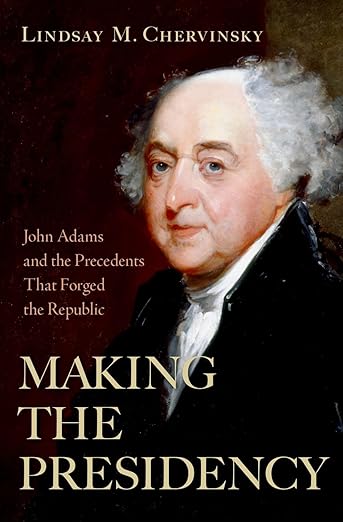
No president has an easy job. But imagine holding the position of president immediately after undoubtedly the best president the United States has ever had.
That was John Adams’ conundrum. Additionally, it is the subject of renowned historian Lindsey Chervinsky’s new book, Making the Presidency: John Adams and the Precedents That Forged the Republic. Initially released last year, in the midst of a politically fraught election season, Chervinsky places the modern world into a context we should all understand better: the history of the 1790s.
After a brief introduction regarding the Revolutionary War, the early republic, and George Washington’s presidency, readers are thrown into John Adams’ presidency. Federalists opposing Democratic-Republicans (commonly referred to as simply “Republicans” in Chervinsky’s text, as they referred to themselves), the Americans opposing the French, the North opposing the South, Federalists opposing Federalists: it seemed there could be no peace in the nation so split apart. Yet the nation stood for another 220 years. Why is that?
Chervinsky argues that the reason we are a nation today relies on how John Adams served his presidency, specifically the power sharing he enacted in his cabinet amongst Republicans (like Vice President Thomas Jefferson), Federalists (like Secretary of State Timothy Pickering), and Archfederalists (like Secretary of War James McHenry), the successful navigation of foreign affairs (see the ongoing French Revolution, specifically the XYZ Affair), and the peaceful transfer of power.
The final focus of Chervinsky’s book, Adams’ loss in the 1800 election, perhaps offers the most original outlook on Adams’ presidency. Being the loser of the election, and being the first incumbent president to lose an election, historians have often treated Jefferson a little kindlier than Adams. Where Chervinsky’s work shines, however, is in showing how these great, powerful men, the leaders of their respective parties, differed in how they saw power, and in how they wielded it.
Little scholarship focuses on Jefferson’s machinations to gain the presidency. Rarely researched are his Virginia and Kentucky Resolutions, which called for nullifying federal law, even though these ideas were eventually adapted into various Confederate causes and mentalities in the following decades. Nor are the essentially political and emotional blackmail Jefferson laid on Federalist members of Congress who refused to vote for him over Aaron Burr. Jefferson threatened the members of Congress with, in essence, secession of Republican states if they did not pick a president soon, given that this was the only election in American history where the House of Representatives made the presidential selection. The dirty tricks of politics manifested themselves in this election, including smear campaigns against Adams and unfounded warnings that the Federalist Party would forego the will of the people and simply appoint a new, Federalist president.
Compare this to John Adams, who, while certainly desirous of a second term, largely laid low during the turmoil occurring on the other side of the Capitol. When presented with suggestions to keep himself as president, he refused. When asked to annul the election, Adams refused. When asked to stand for himself and campaign in the final months of the election season, and during the contingent election in the House between Jefferson and Burr, Adams refused and stayed silent. He did not cling to power, nor did he view his opinion better than that of the American people who voted for a Republican and the House members who would choose the next presidency. Though he was a lame duck president in every sense of the word, he held true to his convictions of propriety in politics, though privately he fumed.
In this way, though history often sheds more light on the winner, makes historians wonder what other ways “losers” of an election may have impacted our politics and history. An interesting study question for any intrigued historian, but one that Chervinsky shows is vital to understanding American history and modern politics alike.
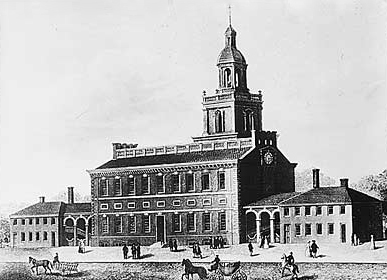
Pennsylvania State House, ca. 1770. Courtesy of the National Park Service
On May 10, 1775, the delegates convened their Second Continental Congress in Philadelphia. Unlike the First Continental Congress held a year before, this Congress had more delegates and met in the Pennsylvania State House and not Carpenters Hall. Also, events spiraled out of control since 1774, and the northern colonies were in outright rebellion with the battles of Lexington and Concord and the capture of Fort Ticonderoga. The delegates dived into several heavy topics as now blood was shed and an army of several thousand besieged the British in Boston.
Just before the Congress met John Adams wrote “our prospect of a Union of the Colonies, is promising indeed. Never was there such a Sprit.” It is evident that there were many discussions in the taverns around Philadelphia among the delegates that showed the feelings of many had changed since 1774. Though there were still a large portion of the colonies that were not ready to give up reconciliation with Great Britain. This tug in pull between men like John Adams and men like John Dickenson (more on the side of reconciliation) is shown in two documents passed by the Congress in early July. The “Olive Branch Petition” and the “Declaration of the Causes and Necessity of Taking Up Arms” reflect the mixed views of the Congress and the colonies as a whole of —conciliation and confrontation. Together, they illustrate the ideological crossroads at which the colonies stood, torn between loyalty to the British Crown and the growing necessity of armed resistance.
The “Olive Branch Petition”, drafted primarily by John Dickinson of Pennsylvania and approved by the Continental Congress on July 5, 1775, was a final attempt by the colonies to avoid a full-scale war with Great Britain. Despite the ongoing military engagements at Lexington, Concord, and Bunker Hill, many colonial leaders still hoped for a peaceful resolution to the growing conflict. The petition expressed loyalty to King George III and implored him to intervene in the escalating tensions caused by his ministers and Parliament.
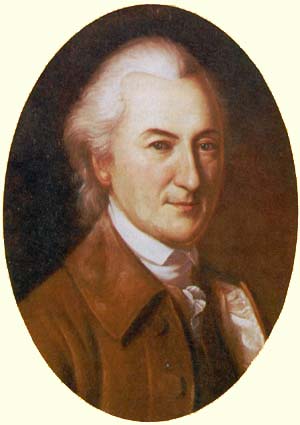
John Dickinson was the leader of the moderates of the Second Continental Congress. Dickinson has the distinction of serving in the Congress as a representative from Pennsylvania and then Deleware. Courtesy of the National Park Service.
The document was rooted in the belief that reconciliation was still possible. It portrayed the colonies as loyal subjects who had been forced into resistance by the oppressive acts of the British government. The petition requested the King to repeal the Coercive Acts and halt hostilities, suggesting that harmony could be restored without further bloodshed.
Key to understanding the “Olive Branch Petition” is the deep-seated colonial belief in the distinction between the King and Parliament. Many colonists viewed Parliament as the source of tyranny but retained faith in the monarch as a potential protector. This petition, therefore, was not revolutionary but reformist. It sought to open a dialogue rather than sever ties.
However, the petition was rejected outright by King George III, who had already declared the colonies in open rebellion in August 1775 (before the Olve Branch petition arrived in London). He refused to read the document and issued the Proclamation of Rebellion, affirming Britain’s intent to suppress the colonial uprising by force. Many believed that the blood shed at Bunker Hill (226 killed and 828 wounded) combined with the fighting on April 19th backed the King into a corner. How could he accept peace when British soldiers were killed by rebels, especially since by the time he received the petition all the colonies were under arms against him. The rejection marked a turning point: it signaled the end of any realistic hopes for a peaceful compromise and pushed more colonists toward the idea of independence.
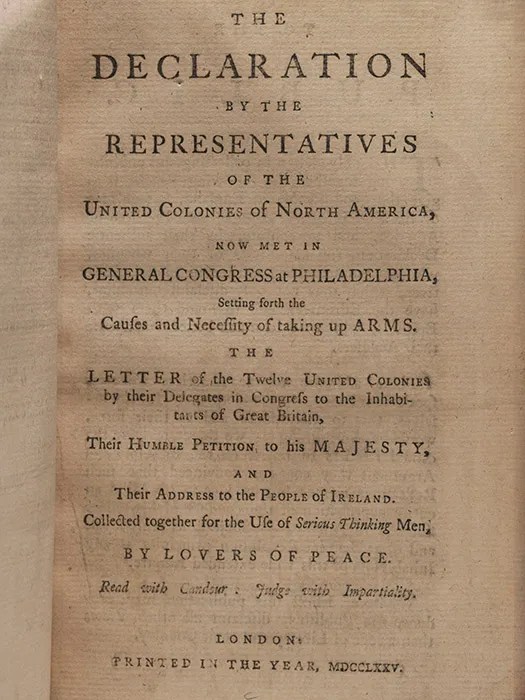
In stark contrast, the “Declaration of the Causes and Necessity of Taking Up Arms”, approved on July 6, 1775, just one day after the “Olive Branch Petition”, presented a much more assertive stance. Drafted by a committee including Thomas Jefferson and John Dickinson, the document aimed to justify the colonies’ decision to resist British authority through armed force.
The Declaration opened with a powerful assertion of the colonists’ natural rights and their entitlement to resist tyranny. It traced the history of British oppression, citing the Intolerable Acts, the imposition of taxes without consent, the quartering of troops, and the use of military force to suppress civil liberties. Unlike the Olive Branch Petition, which appealed to the King’s mercy, this document framed the conflict as a necessary defense of liberty and justice.
Although it still professed allegiance to the Crown, the Declaration was far more militant in tone. It acknowledged the seriousness of taking up arms but asserted that the colonies had been left with no other choice. It stated:
“Our cause is just. Our union is perfect. Our internal resources are great, and, if necessary, foreign assistance is undoubtedly attainable.”
This language revealed a shift in colonial thinking—from grievances to justification, from negotiation to resistance. The document was an attempt to rally public support and unify the colonies behind a common cause, portraying the struggle not as a rebellion but as a righteous defense against despotism.
Courtesy of Special Collections, University of Delaware Library
The coexistence of these two documents reflects the political complexity and emotional turmoil of the time. The Continental Congress, representing a wide spectrum of colonial opinion, tried to navigate between diplomacy and defiance. The “Olive Branch Petition” sought to appeal to moderates and loyalists who feared war, while the Declaration of the Causes aimed to galvanize patriots and articulate a coherent justification for resistance.
This dual approach was not merely political hedging but a reflection of genuine uncertainty. Many colonists still considered themselves British and hoped to remain within the empire, albeit under reformed governance. At the same time, the continued military aggression from Britain made armed resistance increasingly inevitable.
Ultimately, the failure of the “Olive Branch Petition” and the intensification of British military efforts helped consolidate revolutionary sentiment. The rejection by King George III confirmed to many that reconciliation was no longer possible. Over the following months, radical voices like Thomas Paine’s in Common Sense would build upon the groundwork laid by the “Declaration of the Causes” and push for full independence, culminating in the Declaration of Independence in July 1776.
The “Olive Branch Petition” and the “Declaration of the Causes and Necessity of Taking Up Arms” encapsulate the American colonies’ transition from loyal subjects to revolutionaries. They demonstrate how, in the face of unyielding imperial power, a people once desperate to avoid conflict found themselves compelled to fight. These documents not only reflect the diplomatic and ideological struggles of the Revolutionary era but also serve as enduring symbols of the tension between peace and justice in times of crisis.


 Emerging Revolutionary War Era