On the morning of March 15, 1783, George Washington strode into the “New Building” or “Temple” as the structure was referred as, to address the assembled officers of the Continental Army. He asked General Horatio Gates if he could have the floor to say a few words and when he unfolded his pieces of paper on the podium, the words lost their importance.
Emerging Revolutionary War welcomes guest historian Travis Shaw.
Part One
As he looked northward across the open ground in front of his position, Captain John Ashby could see the advance guard of the British army moving steadily closer. They came on in a loose, open line, taking time to return the fire of Ashby’s men. Made up of red-coated light infantry and their German counterparts, the rifle-armed Jaegers, the advance guard were the cream of the Crown forces – men chosen for their fitness, marksmanship, and ability to endure hardship. Ashby and his men were veterans, so they must have known they’d be in for a fight. As the battle intensified around him, one wonders if Captain Ashby’s thoughts turned to home. The Brandywine Valley of Pennsylvania was a long way from his native Virginia Piedmont.
The Crooked Run Valley in northern Fauquier County looks much as it did when John Ashby lived there two centuries ago (Author’s photo)
John Ashby was born in 1740 in northwestern Fauquier County, among the foothills of the Blue Ridge Mountains. The son of Robert Ashby and Rosanna Berry, he grew up at Yew Hill, the family estate that lay just a few miles from the Gap that bears the family’s name to this day[1]. John’s uncle and namesake, Captain “Jack” Ashby commanded a company of Virginia rangers during the French and Indian War, where he made the acquaintance (and drew the ire) of a young George Washington[2]. Continue reading “Captain John Ashby”→
Part of an ongoing series of about the Continental Army in Morristown, New Jersey. For the first post, click here.
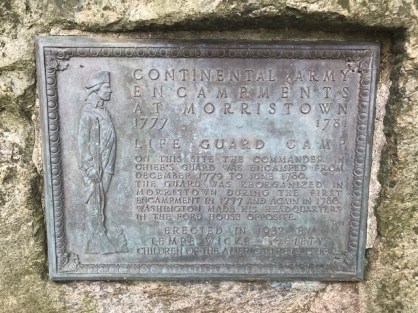
Across the street from the Ford Mansion, the elegant home of the Jacob Ford, Jr. and his family, and the headquarters for George Washington during the winter encampment of 1779-1780, sits a small boulder with a iron plaque plastered on the side.
Erected in 1932 by the Tempe Wicke Society Children of the American Revolution, the monument commemorates the Life Guards that served as Washington’s headquarters command during the American Revolution. Although the unit went by different names and reorganized at least twice, including once during the winter encampment at Morristown, the company, numbering approximately 150 men, would be around for the duration of the war. Continue reading “Uncovering the Continental Army in Morristown”→
19th century print of the Battle of Harlem Heights. The image shows the Americans attacking the British right flank.
After the Battle of Long Island, American forces evacuated to Manhattan Island. But with the British in command of the waters around New York, they easily could land their forces anywhere along Manhattan Island. On September 15th, the British crossed the East River north of New York City and landed at Kip’s Bay, easily pushing aside the American forces there. American forces in New York City were nearly cut off, but quickly retreated up Manhattan Island to Harlem Heights and began to dig in. On the morning of the next day, British troops arrived in front of the American lines at Harlem Heights. Washington expected an attack and decided to take the initiative.
Washington ordered a small party of 150 men called “The Knowlton Rangers” under the command of Lt. Col. Thomas Knowlton to move out and reconnoiter the British position. Knowlton quickly recognized the British were not planning a major assault but his force had brought about the attention of the British light infantry, soon the Knowlton Rangers were outnumbered and quickly retreated back to the American lines. When Knowlton reached safety, the British light infantry paused, placing them out in front of their main lines. Washington seized the opportunity and ordered an assault on their rear by Knowlton’s men and a reinforcement of 200 Virginia riflemen from the Third Virginia under Major Leitch.
Though the American attack was supposed to be in the rear of the British light infantry, but because of confusing terrain and attacking too soon, the flanking column instead hit the British in their flank. The effect still had an adverse effect on the British light infantry as they began to fall back. The Americans fought with determination and bravery. Knowlton went down mortally wounded. Colonel Griffith wrote of Leitch “He conducted himself on this occasion in a manner that does him the greatest honor, and so did all of his party.” Washington wrote the next day that “The General most heartily thanks the troop commanded yesterday by Major Leitch, who first advanced upon the enemy, and the officer who so resolutely supported them.”
At the head of the attacking column both Knowlton and Leitch led their men forward to attach the British flank. Early in the attack both men went down wounded. Knowlton died on the battlefield, Leitch took three musket balls to the abdomen and was carried off the field. At first most reported his condition as improving and he was thought to survive his ordeal. Washington wrote “Majr Leitch of Weedons Regiment (Third Virginia) had three balls through his side, and behaved exceedingly well – he is in fair way of recovery.”
Soon the British began to retreat back to their main line. Washington then ordered an attack along his line and the British light infantry fell back to the main line in confusion. Soon the entire British line began to give way. After about a 90 minute fight, Washington learned that more British forces were arriving on the field and ordered his men back to the main line. Though not a major victory, the American army had finally stood up to the British and even for a moment, pushed them off the field in combat. The British suffered 14 killed and an estimated 154 wounded, with the Americans suffering 30 killed and 100 wounded.
Though most believed that Leitch was recovering from his wounds, by September 20th Gen. Horatio Gates wrote “Major Leitch of Maryland was wounded and despaired of.” As his condition worsened, there was little for regimental surgeon David Griffith could do but to try to ease Leitch’s pain. Griffith wrote to Leitch family friend Richard Henderson on October 3rd that “[I] disagreeable duty of informing Mrs. Leitch through you, of the death of her husband is imposed upon me. He expired yesterday morning at Hackinsack Bridge where he had been removed for his better accommodation…But on the 28th Sept he was seized by lock’d jaw – with spasms about his neck and throat so violent as to baffle every effort to minister to him by medicine.” It seems the death of Leitch was a tough and unexpected blow to his fellow officers in the Third Virginia Regiment.
Where Major Leitch’s remains are today is a mystery. Captain John Chilton wrote on
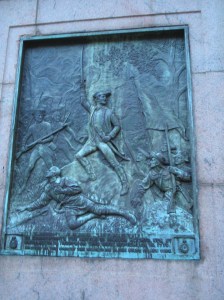
Commemorative Plaque showing the wounding of Knowlton and Leitch
October 4, 1776 that “the brave Major Leitch who died of his wounds received the 16th was interred yesterday by the side of Major Henly.” We know the general area of the American camps in the fall of 1776, but this burial location is long lost to history. In 1897, historian Henry Johnston wrote in his account of the Battle of Harlem Heights that Knowlton and Leitch are probably buried somewhere “on St. Nicholas Avenue, between 135th St and 145th St.” in New York City. Of course the land has changed a lot since then and whatever remains were left were destroyed by modern development.
Today the area of the Harlem Heights battlefield is now under the campus of Columbia University in New York City. Today there is a simple plaque on the wall on the eastside of Broadway north of 117th Street. This plaque commemorates the Battle of Harlem Heights and depicts Major Andrew Leitch as well as Lt. Col. Thomas Knowlton (who was mortally wounded in the same attack as Leitch). Near here is where Leitch was mortally wounded turning the flank of the British line.
The search for Andrew Leitch continues. His contribution to the American Revolution is well documented through the letters of George Washington and others. When he moved to Dumfries, VA and where he lived is still unknown. We do know that he was influential enough to be elected to Prince William County’s Committee of Correspondence in 1774 and involved in the efforts to raise men and funds for local companies of troops. Continued research in his widow’s pension cases as well as researching contemporary archives may turn up new information. For now, he is honored with a plaque in New York City and a small park here in Virginia. My hope is that this story will end with an appropriate understanding and remembrance of a man who gave his life for our nation’s independence.
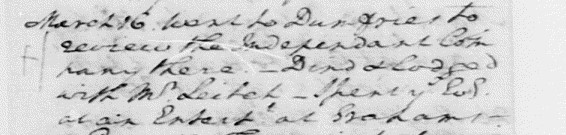
Entry in George Washington’s Papers for March 16, 1775: “Went to Dumfries to review the Independent Company there, Dined and Lodged with Mr. Leitch…”
For Further Reading:
Johnson, Henry. The Battle of Harlem Heights. New York: Macmillan Company, 1897.
Peters, Joan. The Third Virginia Regiment of Foot, 1776-1778, Volumes 1-2. Westminster (MD): Heritage Books, 2008.
From all of us here at Emerging Revolutionary War, we want to wish you and yours a “Happy Thanksgiving.” Below is the official proclamation by President George Washington dedicating a day of “public thanksgiving.” in 1789.
Federal Hall, New York City, where George Washington was sworn in as president in 1789.
By the President of the United States of America. a Proclamation.
Whereas it is the duty of all Nations to acknowledge the providence of Almighty God, to obey his will, to be grateful for his benefits, and humbly to implore his protection and favor—and whereas both Houses of Congress have by their joint Committee requested me “to recommend to the People of the United States a day of public thanksgiving and prayer to be observed by acknowledging with grateful hearts the many signal favors of Almighty God especially by affording them an opportunity peaceably to establish a form of government for their safety and happiness.”
Now therefore I do recommend and assign Thursday the 26th day of November next to be devoted by the People of these States to the service of that great and glorious Being, who is the beneficent Author of all the good that was, that is, or that will be—That we may then all unite in rendering unto him our sincere and humble thanks—for his kind care and protection of the People of this Country previous to their becoming a Nation—for the signal and manifold mercies, and the favorable interpositions of his Providence which we experienced in the course and conclusion of the late war—for the great degree of tranquillity, union, and plenty, which we have since enjoyed—for the peaceable and rational manner, in which we have been enabled to establish constitutions of government for our safety and happiness, and particularly the national One now lately instituted—for the civil and religious liberty with which we are blessed; and the means we have of acquiring and diffusing useful knowledge; and in general for all the great and various favors which he hath been pleased to confer upon us.
and also that we may then unite in most humbly offering our prayers and supplications to the great Lord and Ruler of Nations and beseech him to pardon our national and other transgressions—to enable us all, whether in public or private stations, to perform our several and relative duties properly and punctually—to render our national government a blessing to all the people, by constantly being a Government of wise, just, and constitutional laws, discreetly and faithfully executed and obeyed—to protect and guide all Sovereigns and Nations (especially such as have shewn kindness unto us) and to bless them with good government, peace, and concord—To promote the knowledge and practice of true religion and virtue, and the encrease of science among them and us—and generally to grant unto all Mankind such a degree of temporal prosperity as he alone knows to be best.
Given under my hand at the City of New-York the third day of October in the year of our Lord 1789.
Andersonville. Bataan. Auschwitz. All conjure up images of disillusion, devastation, and death.
All are infamously known as harsh prisoner-of-war camps. When those words are read, images flash through your mind and memory of hollow faces attached to gaunt bodies staring blankly in the direction of the cameraman.
With Robert P. Watson’s new history, The Ghost Ship of Brookly, An Untold Story of the American Revolution, one can add another word to the lexicon of prison camp vernacular.
Our enthusiastic congratulations to Emerging Revolutionary War’s William Griffith on the release of his new book, The Battle of Lake George, England’s First Triumph in the French and Indian War. The book, published by Arcadia Publishing and The History Press, is now available for sale in books stores and online.
From the press release of the book,
“In the early morning of September 8, 1755, a force of French Regulars, Canadians and Indians crouched unseen in a ravine south of Lake George. Under the command of French general Jean-Armand, Baron de Dieskau, the men ambushed the approaching British forces, sparking a bloody conflict for control of the lake and its access to New York’s interior. Against all odds, British commander William Johnson rallied his men through the barrage of enemy fire to send the French retreating north to Ticonderoga. The stage was set for one of the most contested regions throughout the rest of the conflict. Historian William Griffith recounts the thrilling history behind the first major British battlefield victory of the French Indian War.”
Recently, ERW had the chance to sit down and talk with William about the book.
Q: This book fills an important gap in the French and Indian War, why has this campaign been overlooked for a publication like this?
W: I think that the Battle of Lake George has been overlooked for multiple reasons. When we think of the opening years of the French and Indian War we tend to immediately think of the events transpiring in western Pennsylvania (i.e. Jumonville Glen, Fort Necessity, and the Battle of the Monongahela), and do not really place Lake George at the forefront until the surrender of Fort William Henry in 1757. The significance of the Battle of Lake George has also been up for debate by historians, many whom believe it was a stalemate or inconsequential engagement, but in my opinion they are entirely incorrect. Because of these sentiments, when looking at the year 1755 the predominant focus has been placed on Braddock’s Defeat. Tragedy draws attention, and that is exactly what the Battle of the Monongahela was. Not only has scholarship relating to the Battle of Lake George been placed on the backburner to Edward Braddock, but it has also been pushed aside by the Siege of Fort William Henry and the subsequent “Massacre” – another tragic event. The Battle of Lake George is a prime example of history overshadowing history, and hopefully my book will be able to bring the event out of the darkness and into mainstream French and Indian War scholarship.
Q: Why did you choose the campaign to Lake George as your first book?
W: Even before I was born my family vacationed every year along the western shore of Lake George. When I was five years old my father brought me to my first historic site – Fort William Henry – and from then on my passion for history began to blossom. After that each trip to the lake during the summer caused my interest in upstate New York’s colonial history to grow and it soon became a big part of my life. There are some places on this earth that have the power to transport you to another time or place. Lake George is one of them. It truly forms a connection with people and for me, so did its history – especially the 1755 battle, which I could find no substantial work done on. In a quest for myself to learn more about the event, I determined in high school that when I was to write my first book it would be on the long neglected battle. I ended up writing it a lot sooner than I imagined I would.
Q:If there was only one thing a reader took away from this book, what would you want it to be?
W: An interest in the French and Indian War and a desire to learn more about this period in our history. If a visit to Amazon, the bookstore, or Lake George occurs after reading my work, then I succeeded.
Q:How accessible are the sites attributed to the campaign to visitation?
W:Extremely accessible. All three sites associated with the Battle of Lake George are preserved to some extent or at least enough so to interpret and visit. The battlefield of the main engagement fought during the afternoon is the largest and is preserved as the Lake George Battlefield Park at the southern end of the lake astride the reconstructed Fort William Henry and busy Lake George Village. Interpretation here is really bad though. Only one sign actually explains the 1755 battle although there is an impressive monument serving as the centerpiece of the site. Along present day Route 9 roughly three miles or so south of Lake George is the site of the morning engagement, the “Bloody Morning Scout,” and an obelisk dedicated to Colonel Ephraim Williams of the 3rd Massachusetts Regiment who was killed during the opening engagement. About a mile or so closer to the lake along Route 9 is a pond with signage interpreting it as “Bloody Pond,” the site of the final confrontation during the battle. It is possible that this could be the actual pond, but there is speculation that it was actually located several hundred yards further into the woods and is now dried up
Q:What is next book or publication you are working on?
W: I am currently not working on any publications. As I complete my master’s degree at Norwich University this next year and a half or so I plan on focusing on my studies, maybe doing a bit of research here and there when I am free. I do have aspirations to publish more, however, and would like to write a biography of George B. McClellan (my historical idol) focusing on his life from November 1862, when he was removed from command of the Army of the Potomac, to his death in 1885. I would also like to create some sort of guidebook for the Battle of Lake George, Siege of Fort William Henry, Battle of Carillon, and the 1759 British capture of Fort Ticonderoga.
Q:How does one get a copy?
W: The History Press usually distributes locally, so if you live in the upstate New York area near Albany/Lake George you can probably run down to your nearest bookstore and purchase one. If not, then it is available on Amazon and other major retailers online. If you happen to attend a signing or talk that I am doing then you can certainly also pick one up from me.
I was recently reading the superb book by Patrick O’Donnell on Washington’s Immortals, which brought me back to a talk I did about the same Marylanders in the American Revolution a few years back. Below is an excerpt of that talk and highlights the second last stand for a regiment with a tradition of being steadfast when deadly duty called.
On March 15, 1781, approximately 20 men stood in the 1st Maryland Continental Regiment staring at the an eerie and familiar scene. It must have seemed that history was cruelly repeating itself once again. These men had survived the forlorn assault in New York in 1776, the ugly repulse at Camden in 1780, and now stood on third line of General Nathanael Greene’s defense at Guilford Court House.
Famous painting of the 1st Maryland at the Battle of Guilford Court House by H. CHarles McBarron, Jr.
Besides the 20 men who could be traced back to that fateful day in New York, the men that shouldered muskets in line with them were all veterans of indefinite periods of service as well.
The 1st Maryland and the men they confronted, 2nd Guards Battalion of Guards, were very similar, according to historian Lawrence Babits, who states that “the 1st Maryland was arguably one of the finest regiments produced by the Continental Army.
What ensued next was the defining moment of the battle and in essence the campaign. As the Guards officers gathered their men into a new line, the Marylanders came on at a rush. The Guards responded largely without specific commands…facing the oncoming Continentals, who fired several platoon volleys as they came. At a range of less than 12 yards, both lines fired again, so close that muzzle flashes overlapped into a wide sheet of flame and the heat from the volley could be felt.
Casualties mounted and at close range the musket balls shattered bone and even passed through the bodies of their targets.
Modern view from the location of Greene’s Third Line which the 1st Maryland held. Coming up the slight rise toward the photo was how the British approached.
The two sides then resorted to the bayonet and Williams recounted “the first Regiment embraced the opportunity…bayoneted and cut to pieces a great number of the British.”
Although the melee only lasted a few minutes, the Marylanders had checked the advance and with the dragoons of William Washington, allowed for Greene to begin to pull back and start the retreat. In another important position, Williams helped lead the rear-guard away from Guilford C.H. The Marylanders lost 15 killed, 42 wounded and 97 missing. Most of the missing could have came from the 2nd Maryland which broke in disorder on the left flank of the 1st Maryland.
Not only did the Marylanders suffer on that fateful March day in 1781, they did so with a lack of, well, everything. According to one inventory report, the entire regiment, numbering little over 300 men had not a single jacket, two-thirds were without proper footwear, and every man was destitute of a full complement of clothing. In addition, the men had served, fought courageously, and bled tremendously, without receiving one cent as pay.
A remarkable “band of brothers” that “held the line for independence.”
Which, in case you were wondering, was the name of the talk.
*Guilford Court House National Military Park is now preserved by the National Park Service, to plan your visit, click here.
*For information on Mr. O’Donnell’s book, click here.
Sitting under a tree in north-central New York, suffering from a painful and mortal leg wound, yet still managing a successful defense after a powerful ambush, is a characteristic of a great military leader. All the while nonchalantly smoking his pipe!
General Nicholas Herkimer (courtesy of the NPS/Fort Stanwix and Oneida County (NY) Historical Society)
Nicholas Herkimer was the epitome of a successful militia commander. The Battle of Oriskany was a turning point. Herkimer, sitting on a once innocuous hillside, was a major reason why.
Even George Washington recognized the importance of Herkimer and made mention of his decision to not seek a commission in anything more than the militia of his home state. Not only that simple fact of service recognized by the commander-in-chief, but also his pivotal role in the Northern campaign of 1777.
“It was Herkimer who first reversed the gloomy scene of the Northern campaign. The hero of the Mohawk Valley served from love of Country, not for reward. He did not want a Continental command or money.”
Herkimer would succumb to the mortal leg wound ten days after the battle, but his role in what was described as “one of the bloodiest battles of the war” solidified his place in the category of “greatest leaders of the American Revolution you have never heard of.”
Born in the Mohawk Valley of New York to Palatinate immigrants, Nicholas was described as a slender built, dark complexioned, dark haired individual. When he was finished growing, he stood near six feet tall, a rather tall height in 18th century Colonial America. He could also boast of being multilingual, fluently speaking English, German, and Iroquois.
He saw action in the French and Indian War, helping to repel the French and Native American attack on German Flatts, New York on November 12, 1757. Although a disastrous day for the German community, as many were taken prisoner by the French and Native Americans, Herkimer’s role led to his promotion to captain in the militia within two months of the fighting on January 5, 1758. Thirty-years after his promotion to captain the town would be renamed “Herkimer” for the actions of this New Yorker during the subsequent war.
In April of 1758, Herkimer was present and assisted in the successful repulse of the French and Indian force.
With peace established in 1763, Herkimer looked toward personal matters, building a house on the south side of the Mohawk River in 1764. He married two ladies, both named Maria. One died and the other would remarry and move north of the border to Canada, after Herkimer’s death in 1777.
With tensions increasing in the 1770s between Great Britain and the colonies, Herkimer led the Tryon County, New York Committee of Safety and was elected colonel of the local militia. The Provincial Congress on September 5, 1776 promoted him to brigadier general of the militia. One of his first roles was to meet with Joseph Brant, a Mohawk military and political leader in an effort to try and keep the Native Americans neutral in the conflict between the colonies and Great Britain. He was unsuccessful.
During the Northern Campaign of 1777, with the thrust southward by British General John Burgoyne being the main column on its way to its destiny at Saratoga, a secondary column entered the Mohawk Valley under British General Barrimore”Barry” St. Leger. The combined British, German, Loyalist, and Native American force laid siege to Fort Stanwix, in present-day Rome, New York.
Herkimer heard about this and marched his militia to help raise the siege. His force was ambushed on August 6, as they were nearing Fort Stanwix. After the initial surprise, in which Herkimer received his wound, the militia responded well and a drawn out battle ensued.
Part of the reason that the majority of the militia recovered from the shock and endured the ensuing bloody carnage was directly related to the inspired leadership of Colonel Samuel Campbell who led one of the militia regiments in the force and Herkimer himself.
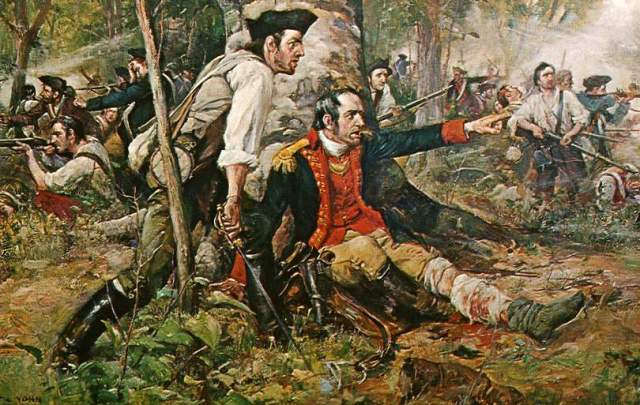
Herkimer, after having his horse shot and receiving his mortal wound in the opening shots of the engagement asked to be propped under a tree on the hillside his forces had utilized for their defensive stand He then calmly lit a pipe and with a continued cool demeanor directed the rest of the engagement.
Famous painting depicting the mortally wounded General Nicholas Herkimer directing his militia from his position seated under a tree, during the Battle of Oriskany on August 6, 1777. (Painting by Frederick C. Yohn)
After the day-long battle, Herkimer ensured he was the last to leave the field, after all the wounded that could be collected had been removed.
Although his wound was dressed on the field, the injury became infected and amputation was the only course of action. In the woods of western New York, the surgeon doing the operation was inexperienced and the wound bled tremendously. Herkimer would succumb to the wound on August 16, at the age of 49. He was buried near Little Falls, where he had built his home in the 1760s. The cemetery today is known as the “Herkimer Home Burial Ground.”
*Nicholas Herkimer’s role in the war and the Battle of Oriskany and the St. Leger campaign is described wonderfully by Michael O. Logusz in Volume 2 of “With Musket and Tomahawk” published by Savas Beatie LLC in March 2012.*








 Emerging Revolutionary War Era