

North Carolina’s Response to the 1775 Battle of Lexington and Concord

Emerging Revolutionary War welcomes guest historian Travis Copeland

Rumors roared throughout the Colonies in the Spring of 1775. From Watertown, Massachusetts with an earnest pen, a letter was taken down at 10am on Wednesday Morning, April 19, 1775. Reports had been sent to New London, Rhode Island, and we’re beginning to extend south to the Carolinas. There were reports that, “action had happened between the King’s Troops and the inhabitants of Boston.” The shot fired in Lexington, Massachusetts on April 19 was “heard around the world,” and North Carolina would be no exception. The above, brief sentence recount of the battle was enclosed with the expanded statement,

To All Friends of American Liberty let it be known,

That this morning before break of day a [British] Brigade consisting of about one thousand or twelve hundred men landed at Phipp’s farm in Cambridge, and marched to Lexington, [Massachusetts] where they found a Company of our Colony Militia in arms upon whom they fired without any provocation and killed six men and wounded four others. By an Express from Boston we find that other Brigades are upon their march from Boston supposed to be about one thousand…I have spoken with several who have seen the dead and wounded.[1]

In the age of foot-speed news, a letter penned on April 19 could take weeks to reach the inhabitants of North Carolina. From the Massachusetts committee of safety, the letter was dispatched with earnest haste to Worcester and then beyond the Massachusetts borders. Connecticut, New York, and British Canada were given a recount of the events by April 25, although news by mouth spread as rapid as fire.[2] In the last week of April, no news had yet reached deep South. New Jersey and Maryland were informed by pen just before April became May, but the southern colonist was still much in the dark. Finally, on Friday, April 28th at 8pm colonists from Alexandria, Virginia sent the statement and letter to Fredericksburg and from there to Surry County, Chowan, and Onslow, North Carolina. A flurry of exchange between Virginia and North Carolina created a clamor. War! 

Each county repeated to the next, “disperse the material passages through all your parts.”[3] On May 3, Edenton and Chowan passed-on the news of the clash with his Majesty’s troops.[4] The delegates at Craven County received the news on May 6th. It was ordered that they, “in haste have sent to request you will pursue the enclosed papers and you will do by opening the packet herewith sent the moment it comes your house.”[5] No more important news than the coming of the Revolution, although unknown in the fullest sense, could create such an exasperated command. Yet, the Bath delegates were not done with their orders. They further demanded that Craven county, “get three or four of your Committee to write a line and send the whole enclosed to the next Southward Committee with the utmost dispatch.”[6]

The clamor of excitement came from a colony that was thought to be deeply sympathetic to the British. Regards for the crown were certainly present in the Southern colonies, but the circular letter’s earnest nature displays the patriotic fervor that ran through the colonists. Finally, the letter was directed to Abner Nash, who represented the provision rebel government in North Carolina. As the news reached the upper echelons of society, directions were given to extend the news to anyone using a horse or bearer.[7] Cornelius Harnett, prominent Patriot politician in Wilmington, directed those who would receive the letter to, “for God’s sake send the man on without the least delay and write…to forward it by night and day.”[8] Others shared Harnett’s tone, writing, “Pray don’t neglect a moment in forwarding” and “I cannot avoid writing to you to beg you to forward the Paper containing such important news and pray order the express you send to ride night and day.”[9] Finally, directions were given to move the letter to South Carolina, “to be forwarded to Charlestown.”[10]

Several weeks after the initial fury of letter exchange, another letter was written from Lieutenant Governor Bull of South Carolina to the Earl of Dartmouth. The provisional governor allied with the Crown reflected on the disposition of the Carolinas. Despite the growing desire to show British force against the rebellious colonists, Lt. Gov. Bull stated plainly that, “The account of the Skirmish or Engagement between the King’s Troops and the Provincials of Massachusetts near Lexington on the 19th of last month, seems to produce effects here [the Carolinas] very different from intimidation.”[11] The southern colonist of North and South Carolina would not be thrown back or made afraid by the acts of British commanders and their regulars in the North.

The Continental Congress would not be intimated. It’s North Carolina representatives William Hooper, Joseph Hewes, and Richard Casewell issued a circular letter which shared the tone of Lt. Gov. Bull’s correspondence. They stated plain, with the April 19, 1775 battles of Lexington and Concord in mind, 

Heaven seems to have assumed the protection of the injured insulted Colonists and signally to have appeared in their Favour: when in the last Battle at Lexington six hundred raw, undisciplined Provincials defeated eighteen Hundred regular Troops and pursued them into their Camp…It becomes the duty of us in whom you have deposited the most sacred trusts to warn you of your danger and of the most effectual means to ward it off. It is the Right of every English Subject to be prepared with Weapons for his defense. We conjure you by the Ties of Religion Virtue and Love of your Country to follow the Example of your sister Colonies and to form yourselves into a Militia. The Election of the officers and the Arrangement of the men must depend upon yourselves. Study the Art of Military with the utmost attention, view it as the Science upon which your future security depends.[12]

The colony of North Carolina and its leadership was moved by the initial recount of battle and the circular letter’s news of Massachusetts. The waters of Revolution were rising and the Patriot leaders were beginning to call for more than just a uniform exchange of words. They desired for the state to take its formidable place in as rebels in the South. Further, the flurry of response to the Lexington engagement shows the prominent place of North Carolina in the revolution from the earliest days. Leaders in the South did not wait until the war moved South in 1779, 1780, and 1781 to throw their pens, support, and persons behind the cause of Gen. Washington, the Continental Congress, and the New England colonies. North Carolina was revolutionary from the start.

Sources:

[1] “Letters Concerning the News of the Battle of Lexington in Massachusetts, April 20 – May 9, 1775,” Colonial and State Records of North Carolina, vol. 9, p. 1234.

[2] “Letters Concerning the News of the Battle of Lexington in Massachusetts, April 20 – May 9, 1775,” Colonial and State Records of North Carolina, Documenting the American South, https://docsouth.unc.edu/csr/index.php/document/csr09-0412. vol. 9, p. 1230-31.

[3] “Letters Concerning the News of the Battle of Lexington in Massachusetts, April 20 – May 9, 1775,” Colonial and State Records of North Carolina, vol. 9, p. 1236.

[4] “Letters Concerning the News of the Battle of Lexington in Massachusetts, April 20 – May 9, 1775,” Colonial and State Records of North Carolina,. 9, p. 1237.

[5] “Letters Concerning the News of the Battle of Lexington in Massachusetts, April 20 – May 9, 1775,” Colonial and State Records of North Carolina, vol. 9, p. 1237.

[6] “Letters Concerning the News of the Battle of Lexington in Massachusetts, April 20 – May 9, 1775,” Colonial and State Records of North Carolina, vol. 9, p. 1237.

[7] “Letters Concerning the News of the Battle of Lexington in Massachusetts, April 20 – May 9, 1775,” Colonial and State Records of North Carolina, vol. 9, p. 1238.

[8] “Letters Concerning the News of the Battle of Lexington in Massachusetts, April 20 – May 9, 1775,” Colonial and State Records of North Carolina, vol. 9, p. 1238.

[9] “Letters Concerning the News of the Battle of Lexington in Massachusetts, April 20 – May 9, 1775,” Colonial and State Records of North Carolina, vol. 9, p. 1238.

[10] “Letters Concerning the News of the Battle of Lexington in Massachusetts, April 20 – May 9, 1775,” Colonial and State Records of North Carolina, vol. 9, p. 1239.

[11] “Letter from William Bull to William Legge, Earl of Darmouth, May 15, 1775,” Colonial and State Records of North Carolina, Documenting the American South, https://docsouth.unc.edu/csr/index.php/document/csr09-0426. vol. 9, p. 1258-1260.

[12] “Letter from William Hooper, Joseph Hewes, and Richard Casewell to the Inhabitants of North Carolina, June 19, 1775,” Colonial and State Records of North Carolina, Documenting the American South, https://docsouth.unc.edu/csr/index.php/document/csr10-0011. vol. 10, p. 20-23.

Travis Copeland is a North Carolina native with a love for early American history. He holds a B.A in History and Humanities and is studying for a postgraduate history degree. His research interests include North Carolina history and the early southern United States from the Revolutionary War to the Civil War with a particular interest in military conflict, political-social integration, and local history. When not researching and writing, he enjoys teaching, the outdoors, gardening, and good food and beer. Travis lives and teaches in North Carolina.


“God willing and the Creek don’t rise.”

If you are from a certain geographical area of the United States the title of this post is a saying you have heard numerous times. Heck, you may even use it yourself. I’ll admit that I have found usage of this American style vernacular a few instances in my lifetime.

Did you know that there is one version that connects the popular saying to a figure in American history and has its origin dating back into the 18th century?

While reading a history of Osceola, I came across the mention of Benjamin Hawkins and as many of you know, did some internet research, consulted other books on the Seminoles, Creeks, and other Native Americans and the research took off from there. This is just a brief overview of Hawkins and his possible, albeit tenuous, connection to this saying.

A possible first mention of the saying above is attributed to Hawkins, whose name probably does not ring a bell for a large segment of people, historians included. Hawkins, born in North Carolina on August 15, 1754 into a family of six, was a gifted individual who attended the College of New Jersey, now known as Princeton University with an aptitude for linguistics, which apparently including learning Native American dialects.

Continue reading ““God willing and the Creek don’t rise.””

“Judiciously Designed and Vigorously Executed”: The March to the Dan River

Emerging Revolutionary War welcomes back guest historian Daniel T. Davis. 

Last month, I heard Emerging Revolutionary War co-founder Phill Greenwalt remark “when you think about retreats, victory is a word that doesn’t come to mind.” The period of January 18 to February 14, 1781 is the exception to the rule. During this time frame, the American army under Maj. Gen. Nathanael Greene and the British under Charles, Lord Cornwallis, marched across the backcountry of the Carolinas. Known as the “Race to the Dan”, this episode between the engagements at Cowpens and Guilford Courthouse, is a largely forgotten but consequential even in the Southern Campaign of 1781.

13615353_10154159045361343_4661891239939243645_n
The Dan River (courtesy of Rob Orrison)

Continue reading ““Judiciously Designed and Vigorously Executed”: The March to the Dan River”

Press Release: US Founding Father may have contributed to forgotten ship wreck – study

Benjamin Franklin, one of the Founding Fathers of the United States, could have contributed to a forgotten shipwreck narrative, according to new research.

benjamin franklin
Benjamin Franklin

Based on studies of Franklin’s early life as a printer, Dr Hazel Wilkinson claims there are clues which provide information about Benjamin Franklin’s activities during his first visit to London as an 18-year-old printer.

Dr. Wilkinson – from the University of Birmingham, in the UK – suggests a previously unobserved connection between the young Franklin and Richard Castelman, an English theatre manager with an intriguing past. Continue reading “Press Release: US Founding Father may have contributed to forgotten ship wreck – study”

Rise and Fight Again for Southern Revolutionary History

From our friends at American Battlefield Trust (ABT). To learn more about the ABT, click here.

ABT

At stake are 31 acres associated with two Southern Campaign Revolutionary War battlefields, Hanging Rock in South Carolina and Guilford Courthouse in North Carolina.

At Hanging Rock, generous battlefield preservationists like you have already secured 141 acres. These 30 acres in the part of the battlefield where the initial Patriot attack began will add significantly to the land we have saved there already.

At Guilford Courthouse, the half-acre tract at stake may be small, but it’s part of a larger strategy to deal with the modern development crowding in on this battlefield from all points of the compass. Our plan is to buy up plots of battlefield land – including small ones and those with non-historic structures on them like this one – remove all non-historic structures and restore the battlefield. The Guilford Courthouse National Military Park has generously agreed to take responsibility for demolishing and removing the house on this plot, a considerable cost that we would typically need to cover. Continue reading “Rise and Fight Again for Southern Revolutionary History”

A Visit to Moores Creek

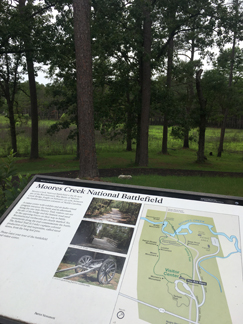
Moores Creek-trail mapThe Moores Creek battlefield manages to look simultaneously well manicured and primordial. Encompassing only 87 acres, it’s a landscape from before the dinosaurs that happens to have a rubberized pathway winding through its tall, thin pines.
Tucked away in a forest some 22 miles northwest of Wilmington, North Carolina, the battlefield sits along a darkwater creek that spills its banks into even darker patches of swamp. This is Moores Creek itself, where, in February 1776, Patriots and Loyalists squared off with muskets, broadswords, and a pair of cannons. (And, yes, I did say “broadswords.”) Continue reading “A Visit to Moores Creek”

The Battle of Kings Mountain, From Those Who Were There

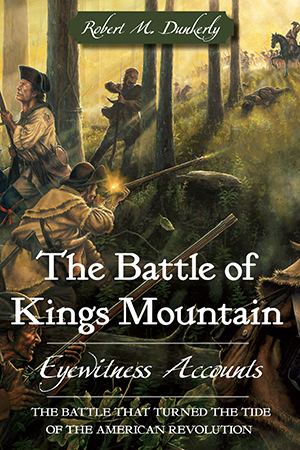
Emerging Revolutionary War welcomes back historian Bert Dunkerly. The accounts below come from Mr. Dunkerly’s book on the battle.

9e68818e-8f86-4871-83ad-e24e9f58afb9
“The Battle of Kings Mountain, Eyewitness Accounts” by Bert Dunkerly  (Acadia Publishing)

The battle of Kings Mountain was an intense, one-hour battle fought just below the North Carolina-South Carolina border.  The October 1780 engagement pitted about 900 American militia from five states (Virginia, the two Carolinas, Georgia, and modern-day Tennessee) against 1,100 Loyalists under Maj. Patrick Ferguson.  With Ferguson’s wounding late in the action, command fell to his subordinate, Captain Abraham DePeyster.  As the Americans closed in, the Loyalists surrendered.

Eyewitness accounts provide details of the battle, especially its lesser known aspects like the conclusion of the battle and subsequent Loyalist surrender.  Here are a few detailed accounts, presented with original spelling and grammar.

Virginia militiaman Leonard Hice had quite an experience in the battle, being wounded four times.  He would spend two years recovering:

“I was commanded by Captain James Dysart where I was dreadfully wounded, I received two bullets in my left arm and it was broken.  We were fighting in the woods and with the assistance of my commander who would push my bullets down, I shot 3 rounds before I was shot down.  I then received a bullet through my left leg.  The fourth bullet I received in my right knee which shattered the bone by my right thigh and brought me to the ground.  When on the ground I received a bullet in my breast and was bourne off the ground to a doctor.”

Andrew Cresswell was a militiaman from Virginia who found himself too far in front during the final phase of the battle.  He also was fortunate to witness the surrender and provided one of the only accounts of Captain Abraham DePeyster surrendering to Colonel William Campbell.  His account also speaks to the brutal nature of the fighting between Loyalist and Whig.

“I saw the smoke of their guns and as I saw but one man further round than myself I  spoke to him and told him we had better take care least we might make a mistake.  I retreated about ten paces where I discharged my gun. About that moment they began to run.  I waited for nobody.  I ran without a halt till I came to the center of their encampment at which moment the flag was raised for quarters.  I saw Capt. DePeyster start from amongst his dirty crew on my right seeing him coming a direct course towards me.  I looked round to my left I saw Col. Campbell of Virginia on my left DePeyster came forward with his swoard hilt foremost.  Campbell accosted him in these words “I am happy to see you Sir.  DePeyster, in answer swore by his maker he was not happy to see him under the present circumstances at the same time delivered up his sword – Campbell received the sword, turned it round in his hand and handed it back telling him to return to his post which he received.  Rejoining these words, God eternally damn the Tories to Hell’s Flames and so the scene ended as to the surrender.”

Lt Anthony Alliare was a New York Loyalist in Ferguson’s command.  He recounts the experience of the New York detachment, which launched a series of unsuccessful bayonet charges early in the battle.  His reference to the “North Carolina regiment” refers to local Loyalist troops fighting alongside his men.

“The action continued an hour and five minutes, but their numbers enabled them to surround us.  The North Carolina regiment seeing this, and numbers being out of ammunition, gave way, which naturally threw the rest of the militia into confusion.  Our poor little detachment, which consisted of only seventy men when we marched to the field of action, were all killed and wounded by twenty, and those brave fellows were soon crowded as close as possible by the militia.’

Ensign Robert Campbell of Virginia also witnessed the close of the battle, and recounts a white flag being raised.

“It was about this time that Colonel Campbell advanced in front of his men, and climbed over a steep rock close by the enemy’s lines to get a view of their situation and saw they were retreating from behind the rocks that were near to him.  As soon as Captain Dupoister observed that Colonel Ferguson was killed, he raised flag and called for quarters.  It was soon taken out of his hand by one of the officers on horseback, and raised so high that it could be seen by our line, and the firing immediately ceased.  The Loyalists, at the time of their surrender, were driven into a crowd, and being closely surrounded, they could not have made any further resistance.”

Isaac Shelby, from the Carolina frontier (modern Tennessee) was a militia commander in the battle.  He also provides insights in the battle’s final moments.

“They were ordered to throw down their arms; which they did, and surrendered themselves prisoners at discretion.  It was some time before a complete cessation of the firing, on our part, could be effected. Our men, who had been scattered in the battle, were continually coming up, and continued to fire, without comprehending in the heat of the moment, what had happened; and some, who had heard that at Buford’s defeat the British had refused quarters to many who asked it, were willing to follow that bad example.  Owing to these causes, the ignorance of some, and the disposition of other to retaliate, it required some time, and some exertion on the art of the offices, to put an entire stop to the firing.  After the surrender of the enemy, our men gave spontaneously three loud and long shouts.”

In one hour, the entire Loyalist force of 1,100 was killed, wounded, or captured.  October 7 marks the anniversary of this battle which, in the words of Thomas Jefferson, was the “turn of the tide of success.”

SANYO DIGITAL CAMERA
Plaque at Kings Mountain National Military Park


Robert M. Dunkerly (Bert) is a historian, award-winning author, and speaker who is actively involved in historic preservation and research. He holds a degree in History from St. Vincent College and a Masters in Historic Preservation from Middle Tennessee State University. He has worked at nine historic sites, written eleven books and over twenty articles. His research includes archaeology, colonial life, military history, and historic commemoration. Dunkerly is currently a Park Ranger at Richmond National Battlefield Park. He has visited over 400 battlefields and over 700 historic sites worldwide. When not reading or writing, he enjoys hiking, camping, and photography.

Mercer’s Grenadier Militia

RevWarWednesdays-header


Emerging Revolutionary War and Revolutionary War Wednesday is pleased to welcome back guest historian Drew Gruber.

Part 1

When we think about American militia during the Revolutionary War, the image of an untrained rifle-toting citizen turned soldier comes to mind. This stereotype of the American soldier, popularized by movies like The Patriot is not completely false but such generalizations should give us pause and inspire us to investigate the roll of American militia, independent companies, and ‘irregular’ troops a bit closer. For example, how was it that on October 3, 1781 a group of Virginia militiamen defeated an elite British force? The story of Lieutenant Colonel John Mercer’s Grenadier Militia during the battle at Seawell’s Ordinary has been told and retold since 1781, however the formation of this illustrious group is often ignored and deserves a closer look. Continue reading “Mercer’s Grenadier Militia”

The Other German

RevWarWednesdays-header

Baron Frederich Wilhelm August Heinrich Ferdinand Steuben or Frederich Wilhelm Ludolf Gerhard Augustin von Steuben or more simply Baron von Steuben, may be the most recognizable German to serve with the American army during the American Revolution.*

Portrait of Baron Johann de Kalb  (by Charles W. Peale)
Portrait of Baron Johann de Kalb
(by Charles W. Peale)

His merits, pedigree, and how he came to America has been questioned and studied by many scholars and historians.

Another German has not fared so well in terms of recognition of his invaluable services to the American cause.

This post is about that other German-speaking military officer. He did something von Steuben did not.

Baron Johann von Robais de Kalb not only offered his services to the fledgling American Continental Army, he also gallantly gave his life for his adopted-cause.

Born June 19, 1721 in Huttendorf, near Erlangen in Bavaria, de Kalb led a life of privilege, learning multiple languages before earning a commission in the French army in the Loewendal Regiment. He served admirably in the War of Austrian Succession and the Seven Years War, in the later, he won the Order of Military Merit and gained his baronetcy.

Continue reading “The Other German”