“The Sword is Now Drawn…” The Powder Incident, Lexington and Concord moves Virginia to Revolution

download
Battle of Lexington by Amos Doolittle, December, 1775

One of the most amazing parts of the events on April 19, 1775 is just how sophisticated the colonial information network was. As soon as Lt. Col. Francis Smith’s British Regulars began to move across the Charles River, riders fanned out from Boston and to neighboring towns. Each town then had more riders that spread out and soon dozens of men were riding through the New England countryside warning of the fighting that took place. Soon information spread to the mid-Atlantic colonies and Philadelphia on April 24th. In the age of no electricity, the complexities and speed that news traveled from Boston to the other colonies was pretty amazing. Stories grew from person to person and it would take months and even years to decipher truth from exaggeration. It was imperative for both the “Patriots” and General Thomas Gage to get their version of the events of April 19th out as fast as possible. Facts or not, the importance of the public relations was of utmost importance to both sides to win the hearts and minds of the other colonies.

As the news reached Virginia, the colony was already at a crossroads with their

Sir_Joshua_Reynolds_-_John_Murray,_4th_Earl_of_Dunmore_-_Google_Art_Project_Square
Virginia Lt Governor, John Murray, 4th Earl of Dunmore

Governor. The last House of Burgesses that met in Williamsburg was dissolved in August 1774 over their vocal support of the people of Massachusetts after the Boston Port Act. The once popular Governor, John Murray, 4th Earl of Dunmore (Governor Dunmore), was angered over their overt support and ordered them dissolved and returned home. The legislature defied his orders and met soon after at the nearby Raleigh Tavern, thus constituting the “First Virginia Convention.” With questionable legal authority, the Convention called for solidarity and non-importation of British goods. They also agreed to meet again in the future. The “Second Virginia Convention” met in March of 1775 in Richmond, a safe distance from the Governor’s influence in Williamsburg. It was at this Convention that Patrick Henry made his famous “Give me Liberty or Give me Death” speech on March 23. Though considered radical at the time, the speech energized the Convention and set the tone. When the Governor learned of the Convention and especially Henry’s speech, he made a fateful decision to remove the gunpowder stored in the magazine in Williamsburg. Continue reading ““The Sword is Now Drawn…” The Powder Incident, Lexington and Concord moves Virginia to Revolution”

The Post Script

At 3:00 in the afternoon on April 21, 1781 Virginia militia Colonel James Innes sat down to write a letter near Hickory Neck Church, just shy of the halfway point between Virginia’s old colonial capitol at Williamsburg and its new capitol at Richmond. Perhaps with a heavy heart and a weary hand, Innes picked up his pen to scrawl a letter to Governor Thomas Jefferson. The situation in Virginia was bleak. It had only been a year since, in apprehension of a British attack, the Virginia Assembly voted to move the seat of government from the Peninsula west to Richmond, and along with it the public stores for outfitting, equipping, and otherwise supporting Virginia’s patriot forces in the fifth and sixth years of the war with the British. The gamble hadn’t paid off. January 1781 saw Benedict Arnold’s forces sacking Richmond. Everywhere they went, it seems, a new combined force of British, Hessian, and Loyalist forces left destruction in its wake.

he approximate landing site of the the main body of British soldiers with Col. Simcoe’s detachment landing further downstream in an effort to catch the Virginians by surprise. “…On a signal given, they all, except the gun-boat turned and rowed rapidly towards the point where the landing was to take place…” (author collection)
Continue reading “The Post Script”

The Journal of Nicholas Cresswell, Part 5

Escape from America

Finally, in the spring of 1777, Cresswell again decided to try returning to England.  Thomson Mason, who had already intervened with two Committees of Safety to protect the Englishman, offered to help with Virginia authorities once more, provided that Cresswell swear not to join the British Army.  Cresswell did.  The best plan was to leave Leesburg, travel overland to Alexandria, then take a schooner down the Potomac and Chesapeake for Williamsburg and Hampton, where it might be possible go aboard a ship bound for British-occupied New York.  As he made his preparations, the local Committee of Safety arrived on April 16 to search his possessions for treasonable items.  They seized a shot pouch, powder horn, and bearskin he acquired from the Delaware Indians.  Cresswell decided not to contest the seizure lest it complicate his departure.

Continue reading “The Journal of Nicholas Cresswell, Part 5”

The Journal of Nicholas Cresswell, Part 4

A Loyalist under House Arrest

Having failed to reach the British Army in New York, Cresswell spent a miserable autumn and winter of 1776/1777 in northern Virginia, often arguing with his host, James Kirk, a Patriot and the only man who had ensured the Englishman could keep clothes on his back and a roof over his head.  Cresswell’s loyalist proclivities and extensive travels were widely known and on November 28, three men of the Committee of Safety in Alexandria “waited on me and informed me that the committee did not think it prudent to let me go out of the Country at this time and hoped that I would give  my word of honour not to depart this Colony for three months.  Otherwise they would confine me.  I was obliged to do the first as the lesser evil of the two.  They were polite enough not to search my chest.”[i]  Depressed as ever and suspecting Kirk of arranging the entire affair in order to keep him in Virginia, Cresswell did what he usually did when he was unhappy.  He got drunk.

Continue reading “The Journal of Nicholas Cresswell, Part 4”

The Journal of Nicholas Cresswell, Part 3

A Loyal Englishman in a Hostile Country

Part 2 click here.

When he arrived in Alexandria, Virginia in October 1775, Nicholas Cresswell, an Englishman visiting the colonies in search opportunity, found himself in dire straits.  The war had cut off his father’s money, while his loyalist principles strained his acquaintances and put him in an awkward position.  He summed it up: “if I enter into any sort of business I must be obliged to enter into the service of these rascals and fight against my Friends and Country if called upon.  On the other hand, I am not permitted to depart the Continent and have nothing if I am fortunate enough to escape the jail.  I will live as cheap as I can and hope for better times.”[i]

Continue reading “The Journal of Nicholas Cresswell, Part 3”

The 245th Anniversary of "Give Me Liberty or Give Me Death"

On this date, in 1775, Virginian Patrick Henry, a delegate to the Second Virginia Convention from Hanover County, Virginia sat in on the ongoing debate at St. John’s Episcopal Church in Richmond, Virginia.

Patrick Henry

The 28-year old then stood to give his defense of his proposed amendments to the petition then being debated. Below is the last few lines of his now famous statement, with the last sentence being the one most remembered;

If we were base enough to desire it, it is now too late to retire from the contest. There is no retreat but in submission and slavery! Our chains are forged! Their clanking may be heard on the plains of Boston! The war is inevitable and let it come! I repeat it, sir, let it come.

Continue reading “The 245th Anniversary of "Give Me Liberty or Give Me Death"”

March Presentations

Emerging Revolutionary War (ERW) would like to highlight from time to time some of the lectures, presentations, talks, and events that our historians are apart of.

This month, ERW historians are giving the following presentations:

Bert Dunkerly

March 27th: “The Brown’s Island Explosion Victims” at the Virginia Forum, Richmond, Virginia

Kate Gruber

March 13th: “Tenacity: Women in Jamestown and Early Virginia” Shenandoah Lyceum Lecture Series, Harrisonburg, Virginia. For more information click here.

Travis Shaw

March 29th: “Lord Dunmore.” Aldie, Virginia

George Washington’s Birthday Celebration

During George Washington’s lifetime and maybe because he was such a great man, he had two birthdays beginning in the 1750’s. Born under the Julian calendar, George was born on February 11, 1731/32. When the English Parliament decreed in 1750 that two years hence England would switch calendars and adopt the Gregorian, used by the majority of countries/states in Europe, there was a discrepancy. So, 11-days was added (some believe that the old calendar was off by a year and a eleven days thus the slash in “1731/32” above).

Regardless, Washington’s birthday was moved to what we, in the United States, are taught now, that it fell on February 22, 1732. Just don’t tell his mother, who believed to her dying day that he was born on the aforementioned date. And who argues with mothers?

What we cannot argue with is that certain birthdays were celebrated at Gadsby’s Tavern, in Alexandria (a city a young George surveyed and helped lay out), Virginia. On October 6, 1796, John Gadsby leased the City Hotel from John Wise and quickly became the epicenter of social and political discourse in Alexandria.

Today the Gadsby Tavern and Museum is open to the public and run by Historic Alexandria a department within the City of Alexandria. For more information and to plan your visit, a bite to eat, or celebrate a birth night ball like George click here.

The balcony where musicians would sit and play at Gadsby’s Tavern (author’s collection)
The hall at Gadsby’s Tavern, which can still be rented out today for celebrations and ceremonies. (author’s collection)

McColloch’s Leap

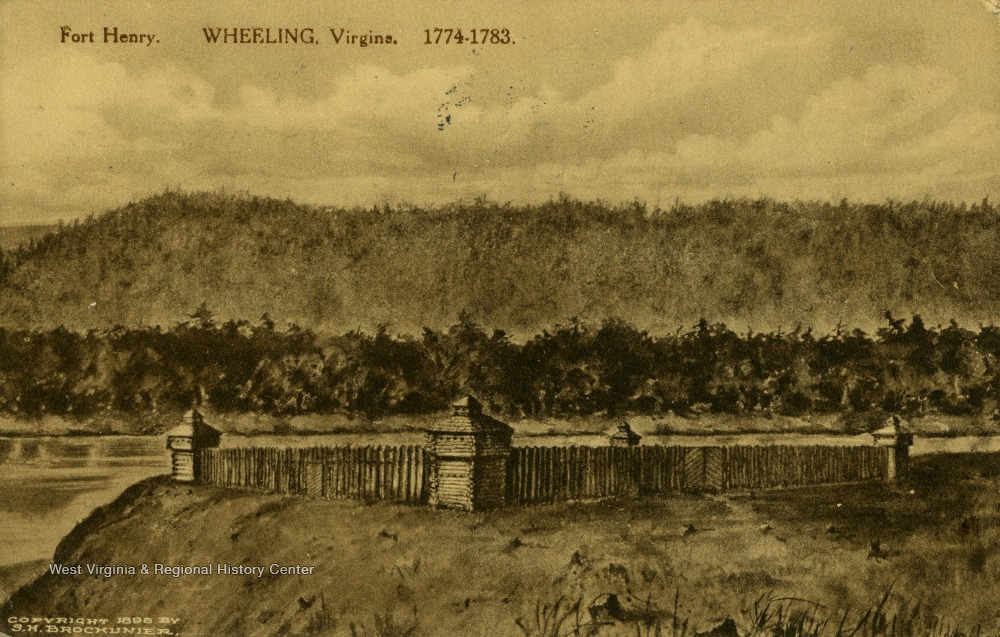
“By no means comparable with the feats of a similar character” and “performed an act of daring” and “nay, desperate horsemanship” and “seldom been equaled by man or beast.” All these describe the amazing escape of Major Samuel McColloch in September 1777 during the attack on Fort Henry around where present-day Wheeling, West Virginia.

I first encountered this amazing, daring, and crazy eluding of capture when I took my own, well not as risky, but still a leap, moving to Wheeling to attend university there. Parents were 3,000 miles away in England and I was attempting to juggle basketball, studies, getting re-acclimated to life in the United States, and unknowingly, a left knee that was about to explode. Being a history major, this was one of the first accounts learned in a freshman year seminar class about local history to inspire the incoming students to explore the area outside of campus.

Fort Henry, built in 1774, was originally named Fort Fincastle, one of the titles of Lord Dunmore, the royal governor of Virginia. When the colonies revolted, the fortification was renamed in honor of Patrick Henry.

Fort Henry
courtesy of West Virginia History OnView
https://wvhistoryonview.org/catalog/041457
Continue reading “McColloch’s Leap”

Using the King’s Highway to Trap a King’s Army

A few weeks ago, heading to the airport after the first Emerging Revolutionary War symposium, fellow ERW historian Rob Orrison made a pit stop in a residential neighborhood in Prince William County, Virginia.

To the average traveler to the Ronald Reagan International Washington National Airport this slight detour would not be normal. Yet, for two historians of early American history, these detours are rarely common.

This particular detour took us to a portion of the King’s Highway that has been preserved by the Prince William County Historic Preservation Division. Along this stretch soldiers in the French Army under Comte de Rocambeau and Continentals under General George Washington traversed on their way to Yorktown to entrap the British under General Lord Charles Cornwallis.

Thus, one king’s soldiers, King Louis XVI took a route named for monarch to assist rebels in trapping the ground forces of another king, that of Great Britain by using a road named for the British monarch. Interesting to think about the naming of the road in those terms.

Portions of this route are still preserved today, other sections have been modernized and blacktopped to be Route 1.

Below are a few photos I snapped, including the size 14 Nike shoe belonging to yours truly, re-enacting marching down the thoroughfare like the patriots of 1781.