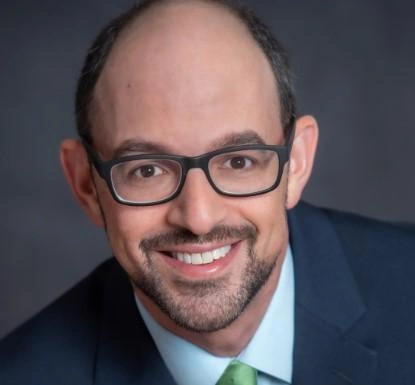
There are arguably many moments along the road towards war with England that greatly shaped that road’s trajectory. Perhaps among the top contenders on that list would be the Boston Tea Party. Join historian Benjamin Carp and ERW’s Dan Welch as we dig in with the author of one of the best books on that pivotal moment. Dr. Benjamin L. Carp is the author of The Great New York Fire of 1776: A Lost Story of the American Revolution, and Defiance of the Patriots: The Boston Tea Party and the Making of America (2010), which won the triennial Society of the Cincinnati Cox Book Prize in 2013; and Rebels Rising: Cities and the American Revolution (2007). His book, Defiance of the Patriots, will be the focus of Sunday’s book chat.
With Richard D. Brown, he co-edited Major Problems in the Era of the American Revolution, 1760-1791: Documents and Essays, 3rd ed. (2014). He has written about nationalism, firefighters, Benjamin Franklin, and Quaker merchants in Charleston. He has also written for Colonial Williamsburg, the Wall Street Journal and the Washington Post. He previously taught at the University of Edinburgh and Tufts University. He was born and raised in New York State and each of his parents earned two CUNY degrees. See you Sunday at 7 p.m. EDT on Emerging Revolutionary War’s Facebook page!
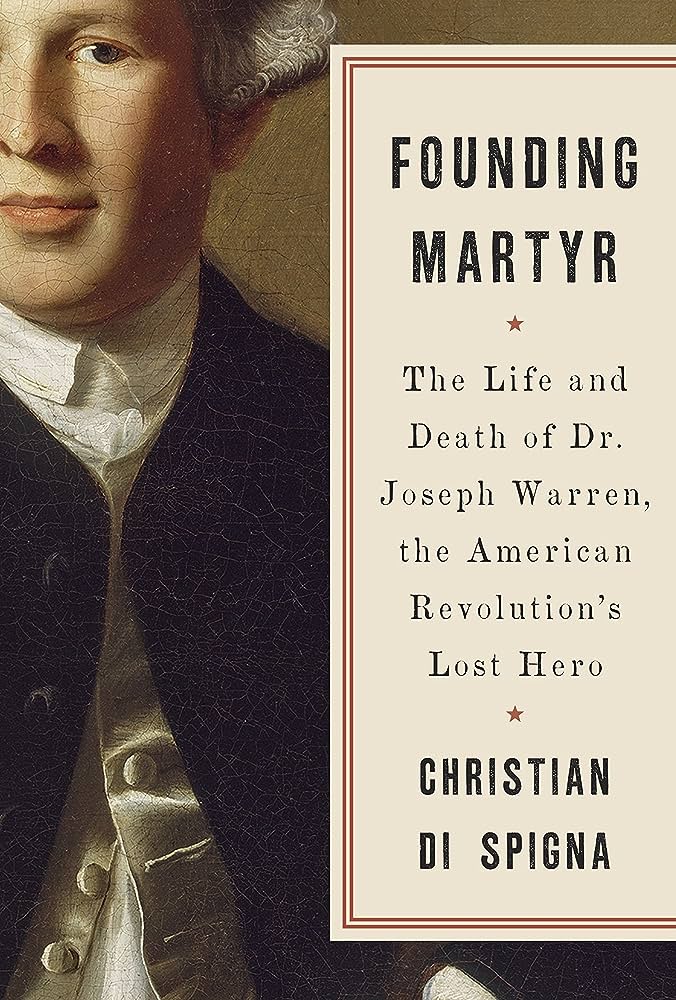
Dr. Joseph Warren is considered by many “the lost hero of the American Revolution.” Warren was the brainchild of the revolution movement in Boston. Warren was involved in almost every major insurrectionary act in the Boston area for a decade, from the Stamp Act protests to the Boston Massacre to the Boston Tea Party, and his incendiary writings included the famous Suffolk Resolves, which helped unite the colonies against Britain and inspired the Declaration of Independence.
Joining Emerging Revolutionary War will be historian and author Christian Di Spigna. He is the author of Founding Martyr: The Life and Death of Dr. Joseph Warren, the American Revolution’s lost hero. He is the Executive Director of the Dr. Joseph Warren Foundation and is the vice chairman for the Revolution 250 committee of Massachusetts Freemasons. He also serves on the board of the Bunker Hill Monument Association.
As we approach the 250th commemoration of the Boston Tea Party, we will focus on Warren’s life, his role in the Boston Tea Party and his lasting impact on the Revolution. Grab a drink and join us as we talk with author and historian Di Spigna about Warren, the patriot who once said…
“When Liberty is the prize, who would shun the warfare? Who would stoop to waste a coward thought on life?”
See you Sunday at 7 p.m. EDT on Emerging Revolutionary War’s Facebook page!
Major General Horatio Gates, “Hero of Saratoga” was tasked with saving the American effort in the south. Credit NPS
On August 15, Maj. Gen. Horatio Gates began to finalize his plans to move against Camden, SC. Gates, appointed as the new commander of the Southern Department the previous month, believed the British garrison in Camden was weak. Gates was receiving intelligence gathered by partisan commander Thomas Sumter who was acting in and around Camden. He informed Gates that the American army outnumbered the British post and that a large portion of the men at Camden were taken ill and not fit for duty (on this account, Sumter was correct). Sumter did not provide the intelligence that Lord Cornwallis was now in Camden with reinforcements and was taking personal command of the British force in Camden.
Modern day image of the area at Rugeley’s Mills, with modern day Flat Rock Road following the historic trace of the Great Wagon Road. Credit Rob Orrison
With this information, Gates felt confident in his ability to take on the British in Camden. He developed a plan that involved a three-part movement. He would leave his force south to Saunder’s Creek (about six miles north of Camden) and establish a strong defensive position. He also ordered Francis Marion and his men to the southeast. Gates wanted Marion to take command of the Williamsburg militia, watch the British movements, and destroy boats in the Santee River that a defeated Cornwallis might need to retreat from Camden to Charleston. The third prong he ordered a few days earlier on August 13. Gates, under the encouragement of Thomas Sumter, decided to send 100 Maryland Continentals and 300 Carolina militiamen (as well as two brass three pounders) to join Sumter and move down the western side of the Wateree. From this location Sumter could attack supplies and reinforcements going into Camden from Ninety Six to the west. Gates’s confidence was evident.
South Carolina militia Brig. Gen Thomas Sumter. Credit New York Public Library
As Gates made his final disposition to move south, Sumter’s militia along with his Continental detachment met some success west of Camden. The Wateree River flowed south just one mile west of Camden. Near the important Wateree Ferry that served the major route west from Camden, Loyalist Lt. Col. James Cary built a small fort on his farm near the ferry. Sumter was aware of the fort and decided to see if he could capture it. When Col. Thomas Taylor of Sumter’s command launched the attack, most of the defenders inside were asleep, and the others were deceived by Patriot militia dressed just like those occupying the fort. The Loyalists immediately surrendered. Sumter reported that his men killed 7 and captured 30 prisoners, including Cary. Also included in the loot were 38 wagons of supplies and nearly 300 head of cattle. After capturing Cary’s Fort, Sumter was also able to attack and capture a relief column from Ninety Six to Camden. Sumter’s spoils from this attack numbered nearly 70 prisoners and numerous wagons. Sumter also reaffirmed his earlier intelligence to Gates by writing that the British in Camden “do not exceed two thousand, and not as many as one thousand of the militia, who aregenerally sickly, and much dispirited.” Sumter’s intelligence, though not accurate, gave Gates encouragement on the upcoming movement toward Camden. At 10pm on August 15, Gates had his army on the road south towards Camden.
Gates was flush with optimism, at that same time Cornwallis had his army on the road north. Though the British forces were about half the size of Gates, they were more than Gates expected and consisted of some of the best men in the British army led by one of their most accomplished generals. Soon, due to a twist of fate, these two armies collided along the Great Wagon Road in the long life pine forest of South Carolina. The result was one of the worst days in the history of the United States Army.
Authors Rob Orrison and Mark Wilcox’s new book “All That Can Be Expected: The Battle of Camden and the British High Tide in the South, August 16, 1780” is due out August, 2023 and available at: https://www.savasbeatie.com/
On this date 266-years ago, the infamous Massacre at Fort William Henry took place along the southern shore of Lake George, New York. After a week-long siege by the Marquis de Montcalm’s army of French Regulars, Canadians, and Native Allies, the British and Provincial garrison inside and outside the walls of Fort William Henry capitulated. The terms of surrender that followed were more than honorable. British, Colonial Provincials (from Massachusetts, New Hampshire, New Jersey, and New York) and their camp followers would be allowed to withdraw, under French escort, to Fort Edward with full honors of war and were allowed to keep their muskets and a lone symbolic cannon. These men were not allowed to serve again for 18 months, and French prisoners were ordered to be turned over within the next three months.
On August 10, the column left the entrenched camp outside the fort (within modern-day Lake George Battlefield State Park) and entered the military road that would take them south to Fort Edward over a dozen miles away. What transpired next has been made famous by the novel and movie adaptations of James Fenimore Coopers The Last of the Mohicans. The French-allied Native Americans fell upon the column and the “Massacre” ensued. By the end of it, an estimated 185 men, women, and children had been killed, with countless others drug off in captivity.
Montcalm Trying to Stop the Massacre, 1877.
The British colonies were outraged. Those viciously attacked at the rear of the column were colonial provincials. The event became a rallying cry. What follows is a contemporary reaction from New York written in the wake of the Siege of Fort William Henry and reprinted in the Maryland Gazette on September 1, 1757. Its contents are extremely graphic in nature:
New-York, August 22
FORT WILLIAM HENRY, being on the third Instant besieged by a great Army of the French, was on the 9th Instant, after a vigorous Resistance, obliged to yield to the superior Force of the Enemy. Thus far is certain; but as to some Circumstances attending what follows, we wait for Confirmation. What at present is generally received among us, as Truth is, That the Enemy consisted of at least Eight Thousand Men; some make the Number much great, and carry it even to Fourteen or Fifteen Thousand: That the greatest Part were REGULAR TROOPS, to these were added about a Thousand FRENCH INDIANS, and that the Rest of their Army were CANADIANS. That our Garrison consisted of between two and three Thousand: That they sustained the Siege till they could hold no longer, and had burst the greatest Part of their Cannon, and spent almost all their Ammunition. How many of the Garrison were lost in the Siege, is not yet known (some say about One Hundred) nor the Number of the Enemy that were slain (but it is said about fourteen or fifteen Hundred:) That the Fort submitted upon a Capitulation, with Leave to march out with their Arms and Baggage, some Ammunition, one Piece of Cannon, and all the Honours of War. That the French IMMEDIATELY after the Capitulation, MOST PERSIDIOUSLY, let their INDIAN BLOOD-HOUNDS loose upon our People; whereupon a few ran off with their Arms, and light Cloathing that they had upon their Backs during the Siege, and were pursued by the Indians six or seven Miles on their Way to Fort-Edward; all the rest were despoiled of their Arms;—The most were stripped stark-naked; many were killed and scalped, Officers not excepted. All the English Indians and Negroes in the Garrison were seized, and either captivated or slain. The Throats of most, if not all the Women, were cut, their Bellies ripped open, their Bowels torn out, and thrown upon the Faces of their DEAD or DYING Bodies; and ‘tis said, that all the Women are murdered one Way or other: That the Children were taken by the Heels, and their Brains beat out against the Trees or Stones, and not one of them saved. Some of the Fugitives that reached New-York on this Day, affirm this, as what they saw, in the whole, or in great Part, executed before they escaped: The Report of such Cruelty and barbarity could hardly be believed, were we not assured of the terrible Massacre of several Hundreds of General BRADDOCK’s wounded men; of whom we hear not of one that survived the Carnage; were we not ALSO assured of the Murder of all the Sick and Wounded of the Garrison at Oswego, not withstanding the previous Capitulation.
‘Tis certain that the Growth of the British Colonies has long been the grand Object of FRENCH ENVY; and ‘tis said that their Officers have Orders from their Superiors, to check it at all Events, and to that End, to make the present War as bloody and destructive as possible! ‘Tis evident, that all their Measures tend the Way. Who can tell, that One of the Two Hundred that fell into their Hands in the last Month near Ticonderoga, has been spared? And is not every News-Paper still stained with the innocent Blood of Women and Children, and of unarmed Sufferers, who were plowing their Land, or gathering their Harvest, on our Frontiers?
To what a Pitch of Perfidy and Cruelty is that French Nation arrived! Would not an ancient Heathen shudder with Horror, on hearing so hideous a Tale! Is it the MOST CHRISTIAN KING that could give such Orders? Or could the most savage Nations ever exceed such French Barbarities! Besides this, was it ever known in the Pagan World, That Terms of Capitulation were not held inviolably sacred!
Surely, if any Nation under the Heavens was ever provoked to the most rigid Severities in the Conduct of a War, it is ours!—It is hard for an Englishman to kill his Enemy that lies at his Feet begging his Life: But will it not be STRICTLY JUST, and ABSOLUTELY NECESSARY, from henceforward, that we (for our own Security and Self-preservation, and to prevent the further shedding on innocent Blood) make some severe Examples of our inhuman Enemies when they fall into our Hands? Will not our armed Men be obliged for the future to reject all Terms of Capitulation, and not to as Quarter; but on the contrary, to fell their Lives as dear as they can! CONSIDER OF IT, my Countrymen, TAKE ADVICE, AND SPEACK YOUR MINDS….
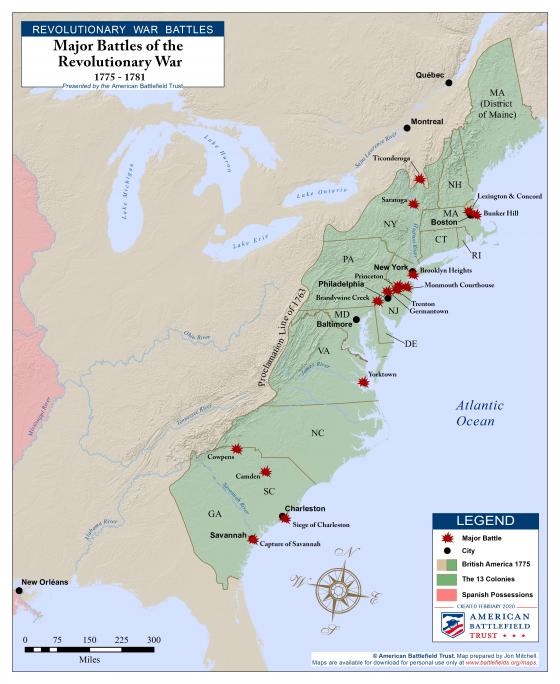
Lexington and/or Concord or both? Same question, Trenton or Princeton or both? Guilford Court House? Yorktown Battlefield? Ask any historian or history enthusiast of the American Revolutionary War period what their favorite battlefield is and you may get one of the places above. Or some other hallowed ground.
This Sunday, at 7 p.m. EDT, join Emerging Revolutionary War on our Facebook page for a panel discussion on our favorite battlefields of the American Revolution. Discussion will also include the successes, pitfalls, or failure of preservation and what one can see or not see at these sites. We look forward to a lively conversation and your comments on what is the battlefield of choice.
On December 16, 1773, a protest orchestrated by the Sons of Liberty in Boston, Massachusetts turned words into action. Upset over recently passed legislation and the belief that “no taxation without representation” 116 people dumped 342 chests of tea owned by the British East India Company into Boston Harbor. The event was one of the milestones on the way to the American Revolution and American independence. As the Boston Tea Party, as it is known to history, closes in on its 250th anniversary, Emerging Revolutionary War will invite Evan O’Brien, the creative director for the Boston Tea Party Ships and Museum this Sunday, June 25, evening for the next “Rev War Revelry.”
We hope you can join us at 7 p.m. EDT on Emerging Revolutionary War’s Facebook page for a discussion of the history behind and on December 16, 1773 and the efforts to commemorate and interpret that time frame. If you are contemplating venturing up to Boston in December to be in the city for the 250th anniversary of this event, you will not want to miss this discussion, as Evan will share some of what the museum has been planning to commemorate when Boston Harbor became a “tea-pot.”
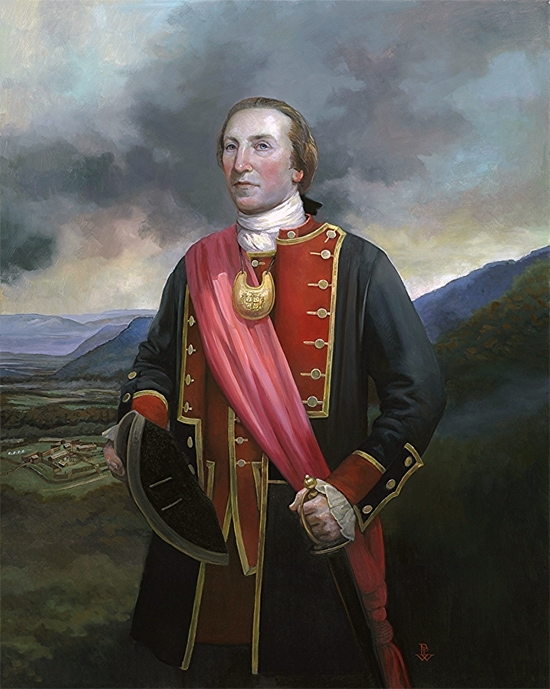
Young George Washington’s performance in the French and Indian War is largely viewed as one of failure and recklessness. His actions in the Ohio River Valley ignited a conflict in North America that in turn lit the world ablaze. He could boast of no great military laurels, other than that he had emerged unscathed from the bloody battle of the Monongahela, and that he had commanded colonial provincials in Gen. John Forbes’ successful campaign against Fort Duquesne. He left military service following the latter event, with his hopes of receiving a commission in His Majesty’s Army worthy of his merit dashed years before.
“Young George Washington” by Pamela Patrick White, White Historic Art (whitehistoricart.com)
However, one aspect of Washington’s service in the French and Indian War has been widely neglected. The commander of the Virginia Regiment was tasked with defending the western frontier from enemy raiding parties. It was an unenviable position that he tackled with limited resources. It was during this period that Washington began to develop the leadership qualities that would inspire others to follow him into the depths of Hell some twenty years later. On the last day of 1758, as Washington prepared to pursue a life outside of military greatness, the officers of the Virginia Regiment drew-up a heartfelt petition to urge the now 26 year-old colonel they had grown to admire to rescind his resignation. Below is that document:
“To George Washington Esqr. Collo. of the Virginia Regiment & Commander of all the Virginia Forces The humble Address of the Officers of the Virginia Regiment
Fort Loudoun, Dec. 31st 1758
Sir,
We your most obedient and affectionate Officers, beg Leave to express our great Concern, at the disagreeable News we h⟨ave received⟩ of your Determination to resign the Command of that Corps, in which we have under you long ⟨served⟩.
The ⟨happine⟩ss we have enjoy’d and the Honor we have acquir’d, together with the m⟨utua⟩l Regard that has always subsisted between you and your Off⟨icers,⟩ have implanted so sensible an Affection in the Minds of us all, that we cannot be silent at this critical Occasion.
In our earliest Infancy you took us under your Tuition, train’d us up in the Practice of that Discipline which alone can constitute good Troops, from ⟨the⟩ punctual Observance of which you never suffer’d the least Deviation.
Your steady adherance to impartial Justice, your quick Discernment and invarable Regard to Merit, wisely intended to inculcate those genuine Sentiments, of true Honor and Passion for Glory, from which the great military Atcheivements have been deriv’d, first heighten’d our natural Emulation, and our Desire to excel. How much we improv’d by those Regulations, and your own Example, with what Alacrity we have hitherto discharg’d our Duty, with what Chearfulness we have encounter’d the severest Toils, especially while under your particular Directions, we submit to yourself, and flatter ourselves, that we have in a great Measure answer’d your Expectations.
Judge then, how sensibly we must be Affected with the loss of such an excellent Commander, such a sincere Friend, and so affable a Companion. How rare is it to find those amiable Qualifications blended together in one Man? How great the Loss of such a Man? Adieu to that Superiority, which the Enemy have granted us over other Troops, and which even the Regulars and Provincials have done us the Honor publicly to acknowledge! Adieu to that strict Discipline and order, which you have always maintain’d! Adieu to that happy Union and Harmony, which has been our principal Cement!
It gives us an additional Sorrow, when we reflect, to find, our unhappy Country will receive a loss, no less irreparable, than ourselves. Where will it meet a Man so experienc’d in military Affairs? One so renown’d for Patriotism, Courage and Conduct? Who has so great knowledge of the Enemy we have to deal with? Who so well acquainted with their Situation & Strength? Who so much respected by the Soldiery? Who in short so able to support the military Character of Virginia?
Your approv’d Love to your King and Country, and your uncommon Perseverance in promoting the Honor and true Interest of the Service, convince us, that the most cogent Reasons only could induce you to quit it. Yet we with the greatest Deference, presume to entreat you to suspend those Thoughts for another Year, and to lead us on to assist in compleating the Glorious Work of extirpating our Enemies, towards which so considerable Advances have been already made. In you we place the most implicit Confidence. Your Presence only will cause a steady Firmness and Vigor to actuate in every Breast, despising the greatest Dangers, and thinking light of Toils and Hardships, while lead on by the Man we know and Love.
But if we must be so unhappy as to part, if the Exigencies of your Affairs force you to abandon Us, we beg it as our last Request that you will recommend some Person most capable to command, whose Military Knowledge, whose Honor, whose Conduct, and whose disinterested Principles we may depend upon.
Frankness, Sincerity, and a certain Openness of Soul, are the true Characteristics of an Officer, and we flatter ourselves that you do not think us capable of saying anything, contrary to the purest Dictates of our Minds. Fully persuaded of this, we beg Leave to assure you, that as you have hitherto been the actuating Soul of the whole Corps, we shall at all times pay the most invariable regard to your Will and Pleasure, and will always be happy to demonstrate by our Actions, with how much Respect and Esteem we are, Sir, Your most affectionate & most obedt humble Servants.”[i]
[i] “Address from the Officers of the Virginia Regiment, 31 December 1758,” Founders Online, National Archives, https://founders.archives.gov/documents/Washington/02-06-02-0147. [Original source: The Papers of George Washington, Colonial Series, vol. 6, 4 September 1758 – 26 December 1760, ed. W. W. Abbot. Charlottesville: University Press of Virginia, 1988, pp. 178–181.]
On September 14, 1814, United States forces defending Fort McHenry in Baltimore repelled the British attempt to capture the city. Flying defiantly over the brick parapets was a 30 x 42 -foot the following day, clearly seen by the British and one captive American, Francis Scott Key. Over 100 years later the poem Key began writing on September 15 became the national anthem of the United States of America. But, what about the flag that the military commander of Fort McHenry, Major George Armistead had made? Well, this iconic flag became a part of the Armistead family for almost the next century as well.
Now, historian Tom McMillan, who has written on another member of the Armistead family, returns with his latest publication, Our Flag Was Still There: The Star-Spangled Banner that Survived the British and 200 Years–and the Armistead Family Who Saved It. This fascinating read, tracing the flag and its intertwined connection with the Armistead family, will be the subject of this week’s “Rev War Revelry.” McMillan gave a bit of a teaser to entice you to listen in on Emerging Revolutionary War’s Facebook page Sunday at 7 p.m. EDT.
“OUR FLAG WAS STILL THERE details the improbable two-hundred-year journey of the original Star-Spangled Banner — from Fort McHenry in 1814, when Francis Scott Key saw it, to the Smithsonian in the 21st century – thanks to three generations of an enduring military family, the Armistead’s, who defended, kept, hid, and ultimately donated the most famous flag in American history.”
We hope you grab your favorite beverage and tune in. The book is now available for purchase and Tom will have details on how to attain a copy!
Thomas Paine wrote the line used as the title for this post in his pamphlet titled “American Crisis” in 1776. Most people recognize the opening lines that Paine penned in that same essay.
“These are the times that try men’s souls: The summer soldier and the sunshine patriot will, in this crisis, shrink from the service of their country; but he that stands it now, deserves the love and thanks of man and woman.”
However, on this Memorial Day, while reading through his essay, I was struck by the line I used for the title. Furthermore, by the far too numerous men who served in the militia and Continental service that lay in unknown or unmarked graves throughout the eastern United States. To them that gave the ultimate sacrifice in pursuit of the principles they held most dear, we remember on this day. To them and the thousands that came after and paid with their lives so others can have “life, liberty, and the pursuit of happiness” we also remember today on this Memorial Day.
One of the main objectives of Emerging Revolutionary War is to visit the sites attributed to the American Revolutionary War era and to provoke interest and expand learning on the people, places, and history. That includes remembering those that lay in these unmarked graves “known only to God.”
The Battle of Waxhaws, fought on May 29, 1780, was a lopsided British victory by Lieutenant Colonel Banastre Tarleton’s British cavalry over American Colonel Abraham Buford’s Continental forces in Waxhaws South Carolina. Buford lost 316 of 350 men with the British losing less than 20. Known popularly as “Buford’s Massacre,” Continental leaders used the battle as a propaganda tool against the Crown forces in the south. But, was it really a massacre?
Join us as we welcome historian and author Dr. Jim Piecuch as we discuss his research and theory about the Battle of Waxhaws and its aftermath. Dr. Piecuch has written several books on the Southern Campaign of the American Revolution including his book “Blood Be Upon Your Head: Tarleton and the Myth of Buford’s Massacre.” This Rev War Revelry will be pre-recorded and posted on May 28th at 7pm. Grab a drink and a good seat and enjoy this great presentation on one of the most controversial battles of the American Revolution.