On this date in 1776, Major Joseph Ward, serving as a staff officer for Major General Artemas Ward, second in command of the Continental Army that had just evicted the British from Boston, sat down at his desk to pen the following letter. The recipient was John Adams, a fellow Massachusettsan then serving in the Second Continental Congress in Philadelphia, Pennsylvania. Ward continued his correspondence of keeping Adams apprised of military affairs around Boston. In this letter, however, he makes the case for the colonies to “cut the Gordian knot” and declare independence, months before Richard Henry Lee’s proposal to call for independence in late June 1776.
Boston 23 March 1776
Sir,
The 17th Instant the Pirates all abandoned their Works in Boston and Charlestown and went on board their Ships, and on the 20th they burnt and destroyed the works on Castle Island. They now lye in Nantasket Road waiting for a fair wind; we keep a vigilant eye over them lest they should make an attack on some unexpected quarter. The particulars with regard to the Seige, the Stores taken, &c. you will receive from better authority, therefore it is unnecessary for me to mention them. Our Troops behaved well, and I think the flight of the British Fleet and Army before the American Arms, must have a happy and very important effect upon the great Cause we engaged in, and greatly facilitate our future operations. I wish it may stimulate the Congress to form an American Government immediately. If, after all our exertions and successes, while Providence offers us Freedom and Independence, we should receive the gloven cloven foot of George to rule here again what will posterity, what will the wise and virtuous through the World say of us? Will they not say, (and jusly) that we were fools who had an inestimable prize put into our hands but had no heart to improve it! Heaven seems now to offer us the glorious privilege, the bright preeminence above all other people, of being the Guardians of the Rights of Mankind and the Patrons of the World. It is the fault of the United Colonies (a rare fault among men) they do not sufficiently know and feel their own strength and importance. Independence would have a great effect upon the Army, some now begin to fear that after all their fatigue and hazards in the Cause of Freedom, a compromise will take place whereby Britain may still exercise a power injurious to the Liberty Peace and Safety of America: Cut the Gordian knot, and the timid and wavering will have new feelings, trimming will be at an end, and the determined faithful friends of their Country will kindle with new ardour, and the United Colonies increase in strength and glory every hour.
Yesterday I saw your Brother, who informed that Mrs. Adams and your Children were well.
General Ward, on account of his declining health, has wrote his Resignation to the President of the Congress. I expect the greatest part of the Army will march for New York, or the Southern Colonies as soon as the Fleet is gone to Sea; and the Troops that remain here will be employed in fortifying the most advantageous Posts to defend the Town and harbour. I do not much expect the Enemy will make any attempts to regain possession of Boston, for I think they are sufficiently convinced that they cannot penetrate the Country in this part of America; ’tis probable they will try their fortune to the Southward and if they fail there the game will be up with them. We hear many accounts about Commissioners coming from Britain to treat with the Colonies separately, or with the Congress. Many fear we shall be duped by them, but I trust the congress is too wise to be awed by the splendor or deceived by the cunning of British Courtiers.
I know not of one discouraging circumstance attending either our civil or military affairs in this part of the Continent. I have lately heard with pleasure that the Farmer is become an advocate for Independence.Wishing the Congress that Wisdom which is from above, I am Sir with much Respect Your most Humble Servant,Joseph Ward
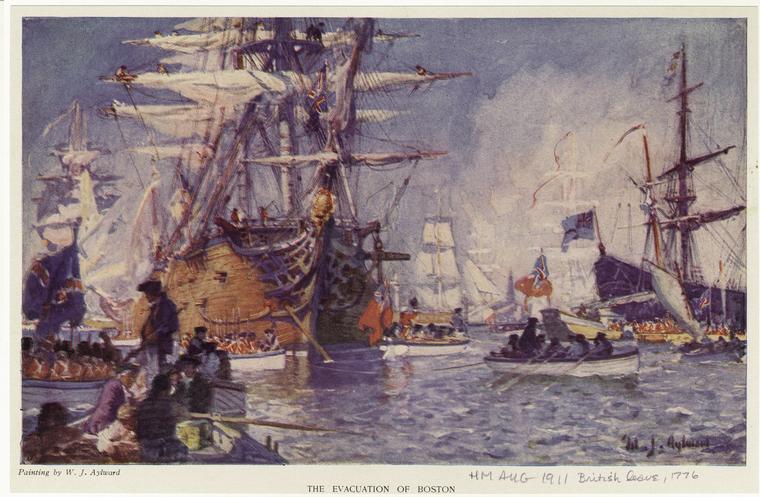
Since the besieged British soldiers in Boston under General William Howe’s command awoke on the morning of March 5, 1776, and saw American cannon overlooking the city from Dorchester Heights, Howe prepared to evacuate Boston. Orders to prepare the embarkation of the troops and military stores and depart Boston went out to his command of 9,000 soldiers on March 7. It took days to organize the large-scale movement, and the British Navy did not have enough space on their ships to carry everything the army had. Decisions had to be made, supplies had to be destroyed or left behind. The military had to make room for loyalists wanting to depart the city as well.
After unfavorable winds delayed the original departure date of March 13, British troops formed into marching columns at 4 a.m. on March 17. Four hours later, General Howe’s army rocked aboard boats in Boston Harbor, abandoning their hold on the American seaport city. General George Washington’s Continental Army did not interfere with the British evacuation, honoring an agreement trading a pause in military action for a promise that British troops would not harm the city as they departed.
While morale sagged on the British boats, Patriots in Boston were jubilant that their city was free from British army. Boston selectman Timothy Newell recorded in his journal the momentous day of Boston’s freedom from British occupation:
This morning at 3 o’clock, the troops began to move–guards, chevaux de freze, crow feet strewed in the streets to prevent being pursued. They all embarked at about 9 oclock and the whole fleet came to sail. Every vessel which they did not carry off, they rendered unfit for use. Not even a boat left to cross the river.
Thus was this unhappy distressed town (through a manifest interposition of divine providence) relieved from a set of men whose unparralleled wickedness, profanity, debauchery and cruelty is inexpressible, enduring a siege from the 19th April 1775 to the 17th March 1776. Immediately upon the fleet’s sailing the Select Men set off through the lines to Roxbury to acquaint General Washington of the evacuation of the town. After sending a message Major Ward, aid to General Ward, came to us at the lines and soon after the General himself, who received us in the most polite and affectionate manner, and permitted us to pass to Watertown to acquaint the Council of this happy event. The General immediately ordered a detachment of 2000 troops to take possession of the town under the command of General Putnam who the next day began their works in fortifying Forthill, etc., for the better security of the town. A number of loaded shells with trains of powder covered with straw were found in houses left by the Regulars near the fortifycation.
Emerging Revolutionary War welcomes back guest historian Drew Palmer. He is the founder of Revolutionary Maryland; click here to learn more about that blog.
(Vallejo Image Galleries)
In the early evening of March 5, 1776, two armed boats left Annapolis to patrol the Chesapeake Bay. Captain John Pitt and Joseph Middleton were patrolling to prevent any British ships nearby from entering Maryland’s waters. As they patrolled, they discovered an alarming sight: three British warships heading directly towards Annapolis. Middleton and Pitt rushed off to the Maryland Council of Safety’s chambers in Annapolis to report the startling news.1 In the coming days, Maryland was tested for the first time in the growing Revolutionary conflict.
The American rebellion had become a full-scale war by the spring of 1776. In early March, the siege of British-held Boston was about to end. Hundreds of miles south in Philadelphia, the Declaration of Independence was only four months away. In Maryland, politicians worked hard to maintain Maryland’s isolation from the worst of the conflict. In Virginia, a raiding war had already begun. Only two months before, the town of Norfolk, Virginia, was bombarded, leading to the destruction of the town. Along with Norfolk’s destruction, British attacks and raids were carried out throughout the lower Chesapeake Bay, along with a blockade. 2
Participating in British operations in the lower Chesapeake was Captain Mathew Squire of the British Royal Navy. For several months, Squire’s vessel, the Otter, served as the headquarters of the exiled Virginia Governor, Lord Dunmore. From the Otter, British attacks and raids were launched on Patriot strongholds in the lower Chesapeake. By March, Squire had gained a reputation as a competent officer and ruthless raider of American shipping.3 Squire was heavily involved in the bombardment of Norfolk and an attempted attack on Hampton, Virginia. Though Squire’s area of operation had been centered on the lower Chesapeake, new intelligence pulled him northward into Maryland.
Timothy Newell kept a very vivid diary of life in Boston in 1775 and 1776. He started the entry below on this date, 250 years ago, by copying the “sundry papers lent me…relative to the Siege and Evacuation of Boston in 1775…”
To the Commanding Officer at Roxbury
March 8, 1776
As His Excellency Gen Howe is determined to leave the Town with the troops under his command, a number of the respectable Inhabitants, being very anxious for its preservation and safety, have applied to General Robertson for this purpose, who at their request have communicated the same to his Excellency Gen Howe, who has assurred him, that he has no intention of destroying the Town, unless the Troops under his command are molested, during their embarkation, or at their departure by the armed force without; which declaration he gave General Robertson leave to communicate to the Inhabitants. If such an opposition should take place, we have the greatest reason to expect the Town will be exposed to entire destruction. As our fears are quieted, with regard to General Howe’s intentions, we beg we may have some assurances, that so dreadful a calamity may not be brought on by any measures without. As a testimony of the truth above we have signed our names to this Paper, carried out by Mess Thomas and Jonathan Amory, and Peter Johonnet, who have at the earnest entreaties of the Inhabitants, through the Lieu Governor solicited a flag of truce for this purpose.
John Scollay 2. Timothy Newell 3. Thomas Marshall 4. Samuel Austin
*The General Robertson mentioned above was Brigadier General James Robertson, who commanded the 4th Brigade during the Siege of Boston
In March 1776, a quiet hill overlooking Boston Harbor became one of the first turning points of the American Revolutionary War. Dorchester Heights, rising above the southern approaches to Boston in what is now South Boston, played a decisive role in forcing the British Army to evacuate the city. The dramatic occupation and fortification of the Heights by American forces under General George Washington transformed a long, grinding siege into a strategic victory that reshaped the war’s momentum.
After the battles of Lexington and Concord in April 1775 and the bloody clash at Bunker Hill in June, British forces under General Thomas Gage and then William Howe found themselves effectively trapped in Boston. Surrounding militia units from Massachusetts and neighboring colonies formed a loose ring around the city, beginning what became known as the Siege of Boston. When George Washington arrived in July 1775 to take command of the newly formed Continental Army, he inherited a force that was determined but poorly supplied and short on artillery.
Throughout the fall and winter of 1775–1776, Washington searched for a way to break the stalemate. A direct assault on Boston would have been costly and risky. Instead, he looked to geography. Dorchester Heights, commanding sweeping views of the harbor and the city, offered a strategic advantage. If American forces could fortify the Heights with cannon, they would threaten both the British fleet and the troops stationed in Boston. Control of this high ground would make the British position untenable. The British Navy had encouraged British General Howe (now commanding the British forces in Boston) to take the position due to the Navy’s vulnerability if the Americans were able to command the heights with artillery. Howe underestimated the importance of the heights and also believed the Americans lacked the proper artillery and strength to hold it.
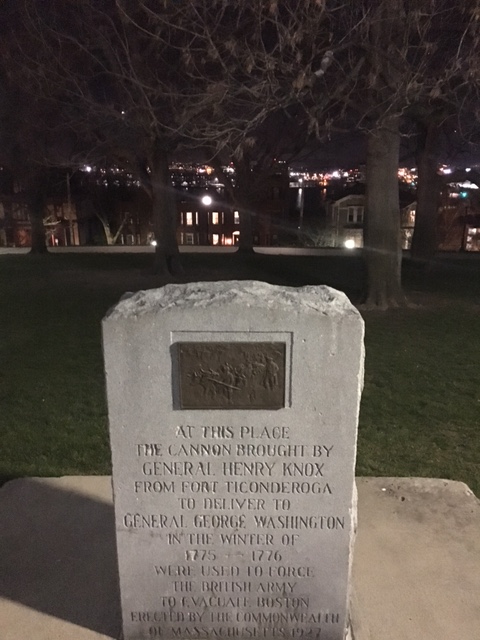
Knox marker on Dorchester Heights
The key to Washington’s plan lay in artillery. In late 1775, Colonel Henry Knox undertook an audacious mission to transport heavy cannons captured from the British at Fort Ticonderoga in upstate New York. Over the winter, Knox and his men hauled approximately 60 tons of artillery—an operation later dubbed the “Noble Train of Artillery”—over 300 miles of frozen rivers and snow-covered terrain to Cambridge, Massachusetts.
These cannons provided Washington with the firepower necessary to implement his strategy. By early March 1776, conditions were ripe. The ground was still frozen, making it easier to move heavy equipment and but would challenge their skills at building fortifications.
On the night of March 4, American troops moved silently toward Dorchester Heights. Under the cover of darkness and diversionary bombardments from other positions, they began constructing fortifications with remarkable speed. Using pre-prepared materials—fascines (bundles of sticks), chandeliers (wooden frames filled with earth), and hay bales—they built defensive works capable of withstanding British cannon fire.
By dawn on March 5, the anniversary of the Boston Massacre, British sentries were stunned to see formidable American fortifications atop the Heights, bristling with cannon aimed at the city and harbor. General Howe reportedly exclaimed that the rebels had accomplished more in one night than his army could have done in months. The strategic implications were clear. From Dorchester Heights, American artillery could rain fire down on British ships and troop positions. The Royal Navy, essential to British supply and mobility, was now vulnerable. Remaining in Boston was a risk that Admiral Molyneux Shuldham was not willing to take and pushed Howe to respond quickly.
General Howe initially planned a counterattack to dislodge the Americans. However, a fierce storm on March 6 disrupted preparations and made an amphibious assault difficult. Also, Washington got word of the planned British assault and increased his manpower on Dorchester Heights to nearly 6,000. The memory of heavy British casualties at Bunker Hill also weighed heavily. Dorchester Heights were even stronger and more defensible than Breed’s Hill had been the previous year.
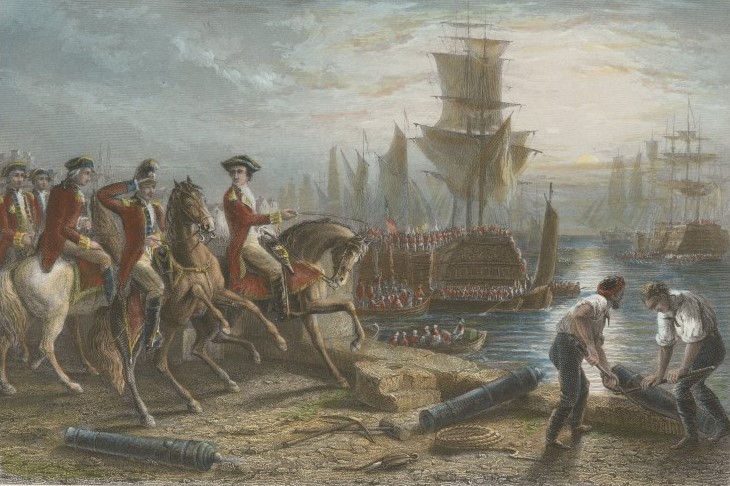
Howe evacuating Boston, courtesy New York Public Library
Facing the prospect of severe losses and an increasingly precarious situation, Howe reconsidered. Negotiations—informal and indirect—suggested that if the British evacuated Boston without destroying the town, American forces would not attack during the withdrawal.
On March 17, 1776, British troops and Loyalists began evacuating the city. More than 11,000 soldiers and nearly 1,000 Loyalists boarded ships and sailed to Halifax, Nova Scotia. The Siege of Boston was over, and the city was firmly in American hands for the remainder of the war.
The occupation of Dorchester Heights marked the first major strategic victory for the Continental Army under Washington’s leadership. It demonstrated the effectiveness of coordinated planning, logistical ingenuity, and the intelligent use of terrain. Rather than launching a costly frontal assault, Washington had leveraged geography and artillery to compel the enemy’s withdrawal.
This victory also boosted American morale at a critical time. The war was far from won—indeed, it would intensify dramatically later in 1776 with British campaigns in New York—but the successful eviction of British forces from Boston showed that the Continental Army could achieve meaningful results.
Moreover, Dorchester Heights solidified Washington’s reputation as a capable commander. His cautious but decisive approach, combined with Knox’s logistical triumph, set a pattern for future operations. The event underscored the importance of high ground in military strategy, a lesson that had already been evident at Bunker Hill but was applied with even greater effect in March 1776.
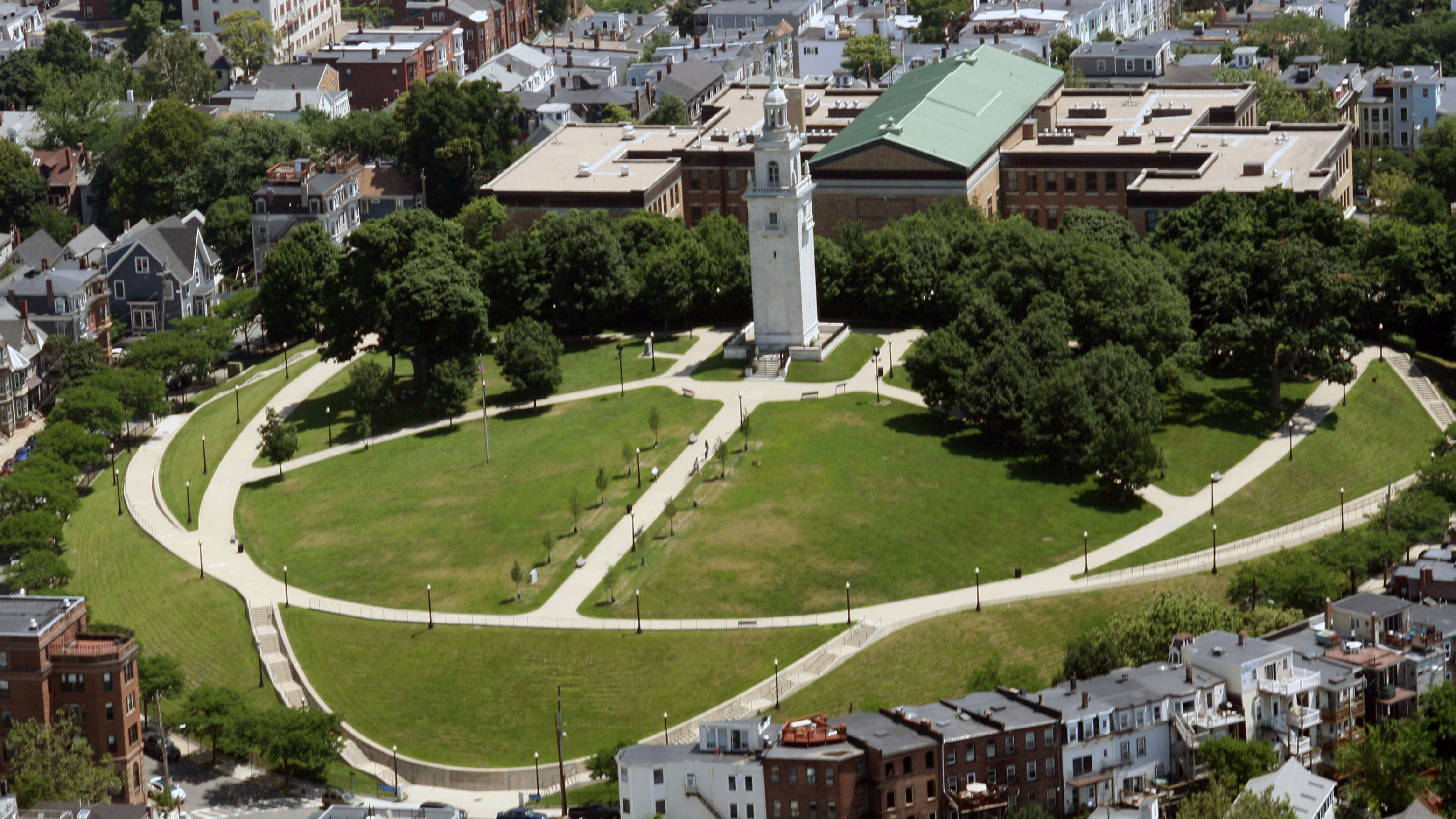
Dorchester Heights and the 1902 monument today, part of the Boston National Historical Park, courtesy of NPS
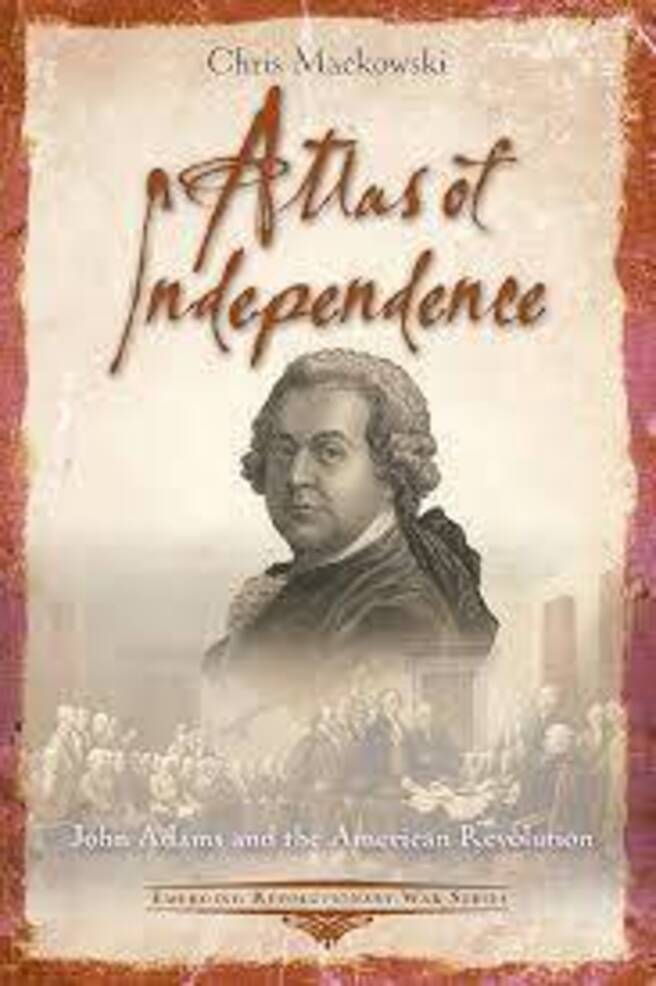
Join us this Sunday at 7pm LIVE on our Facebook page as we focus on ERW’s first 2026 book release, The Atlas of Independence: John Adams and the American Revolution by Dr. Chris Mackowski. Mackowski will discuss why Adams led him to write his first “Rev War book” and the much over looked impact Adams had during the war years. We will discuss some of the more “unique” relationships Adams developed through the war time years and of course his friendship with Thomas Jefferson and his close relationship with his wife Abigail.
To order a copy of “Atlas of Independence” visit Savas Beatie’s website at: https://www.savasbeatie.com/ . Again, this will be a LIVE broadcast on our Facebook page, so grab a drink and join in on the chat!
By the summer of 1775, North Carolina’s royal governor, Josiah Martin, was an outcast among the land he presided over. Forced to flee the mainland by Patriot sympathizers, Martin believed his colony was not lost to rebels. His prompting initiated a British expedition to North Carolina and excited the loyalists present there enough to rise up. Descendants of Scottish Highlanders who settled large areas of North Carolina put on their kilts and broadswords and marched for King George III toward Wilmington to the tune of bagpipes.
Patriot regulars from North Carolina stood in their way about 15 miles northeast of Wilmington. On February 27, 1776, the Scots and Tories attacked the North Carolinians behind Moore’s Creek. The brief fight turned out to be another victory for the Patriot cause in the south (preceded by the Battle of Great Bridge). Though small by later standards of the Revolutionary War, the battle received widespread coverage throughout the American colonies. Below is a transcript of one of the earliest newspaper accounts of the Battle of Moore’s Creek Bridge, published on March 15, 1776, in Williamsburg’s Virginia Gazette.
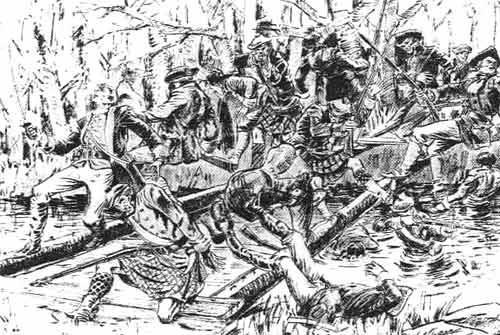
An artist’s depiction of the failed attack at the Battle of Moore’s Creek Bridge
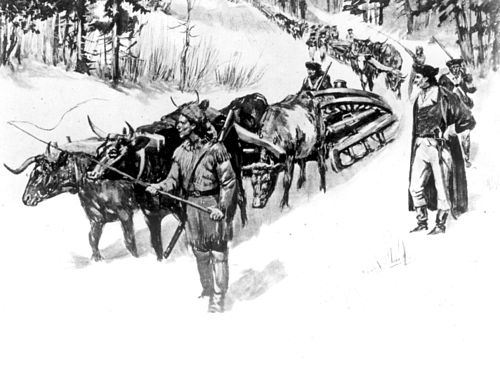
In December 1775, Henry Knox wrote to General George Washington, “I hope in 16 or 17 days to be able to present your Excellency a noble train of artillery”. However, the train of artillery would not arrive until the end of January 1776. Still an impressive feat, as Knox with his team moved 60 tons (119,000 pounds) of artillery over 300 miles from upstate New York to the environs of Boston in 70 days in the midst of winter.
This impressive feat enabled Washington to evict the British from Boston, winning the siege and giving the fledgling rebellion a victory to build momentum from.
To discuss this amazing feat and part of American military history, Emerging Revolutionary War welcomes Dr. Phillip Hamilton, a professor of history at Christopher Newport University. A historian of the American Revolutionary and Early Republican periods, he has edited and written “The Revolutionary War Lives and Letters of Lucy and Henry Knox.”
Although the program is pre-recorded, Emerging Revolutionary War hopes you still tune in on Sunday, February 22 at 7 p.m. EDT. We promise the revelry will be enlightening. If you have any questions, please drop them in the chat during the program, and we will ensure Dr. Hamilton receives them.
It’s hard to overemphasize how important Common Sense was as a tool of persuasion.
Sure, we all know about it. “The idea that Common Sense played a pivotal role in moving the nascent revolutionary movement toward independence is universally acknowledged today,” says historian Jett B. Conner.[1]
Yet I’ve found that, beyond its generally accepted place in American history, most people don’t quite “get” Common Sense. Reading the document today—like anything written 250 years ago—poses a challenge for modern readers. The language doesn’t catch for us the way it did for readers of its time. We aren’t living in the same political context they were. We marinade in a much different, much more immersive media environment. These factors all remove us from the visceral impact Common Sense had.
In the early days of my teaching career, I taught public relations classes. I had been a PR professional prior to that, enticed to the academy, but I wanted my classes to be grounded in the professional standards established by the Public Relations Society of America (PRSA). They had criteria for academic programs that wanted PRSA certification. My university didn’t qualify because we didn’t have a specific major in PR at the time, but I nonetheless used their standards as the model for my classes. One of the standards at the time advocated teaching the history of PR.
Several PR milestones sprang from the political arena: Andrew Jackson’s first use of a press secretary in the White House; Teddy Roosevelt’s bully pulpit; the WWI-era Creel Commission; FDR’s fireside chats; the WWII-era Office of War Information, etc.
Common Sense made the list as the most significant piece of American writing to that point—a track specifically aimed at public persuasion. And boy, did it succeed! “Common Sense was the most radical and important pamphlet written in the American Revolution and one of the most brilliant ever written in the English language,” assesses historian Gordon Wood.[2]
Prior to Common Sense’s publication in January 1776, John Dickinson’s Letters from a Farmer in Pennsylvania in 1767–8 held the record as the most influential piece of public writing. Published in 19 of the 23 major newspapers in the colonies—as well as appearing in England and France—the letters opposed Parliament’s Townsend Acts, which imposed tariffs. Dickinson, a lawyer rather than a farmer, became one of the most famous men in America because of his twelve letters, which did much to unify the colonies in common cause against British taxation.
“Farmer’s Letters captured the spirit of the moment and Americans’ imaginations like nothing before,” says Dickinson biographer Jane E. Calvertt, “selling more copies than any other pamphlet to date. The response was immediate and resounding, going far beyond anything Dickinson could have anticipated.”[3]
Thomas Paine’s Common Sense eclipsed Dickinson exponentially—some 100 times larger, according to historian John Ferling.[4]
Timing helped. Bloodshed on Lexington Green, at the North Bridge in Concord, and all along the road back to Boston added urgency to public discussions. Closure of the port of Boston and the October firebombing of Falmouth, Maine—and the foreboding message it suggested to other colonies—heightened tensions even more. England was no longer some abstract entity across the ocean, but an intrusive force ready to impose its will through violence if necessary. “It was successful because it came precisely the time when people were ready for its message,” says historian Alfred F. Young.[5]
“The suppressed rage that animated Paine’s writing in Common Sense was another important factor in its success,” contends historian Scott Liell, who said “Paine felt, and made his readers feel, ‘wounds of deadly hate.’”[6]
Through 1775, the Continental Congress remained undecided on a course of action, with factions pushing for independence and others pushing for rapprochement. Therefore, news from Philadelphia did little to provide clear guidance for public sentiment.
“[T]he idea of independence was familiar, even among the common people,” John Adams later pointed out.[7] The idea just hadn’t yet crystallized.
Common Sense—first published on January 10, 1776, as a 46-page pamphlet—became that crystal.
“[T]here is something absurd, in supposing a continent to be perpetually governed by an island,” Paine wrote. Paine made such sentiments seem like statements of the obvious. Of course a continent shouldn’t be ruled by an island. Of course one honest man was worth more to society and in the sight of God than all the crowned ruffians that ever lived. Of course.
That was the genius of Paine’s writing.
To read it today, one wouldn’t appreciate how accessible it was to common folks or realize how often people read it aloud in taverns and inns so that even people who could not read could hear its ideas and engage in discussions. A reader today wouldn’t grasp just how hungry readers of 1776 were for Common Sense’s ideas.
“In weighing the influence of a tract, the active role of the reader is often underappreciated,” Young points out.
Reading is an act of volition. A person had to buy the pamphlet; one shilling was cheap as pamphlets went but costly to a common carpenter who might make three shillings a day or to a shoemaker had made even less and out of the question for a common laborer who earned one-eighth of a shilling a day. Or a person had to borrow the pamphlet, seeking out an owner, or respond to someone’s blandishments to read it. When it was read aloud, as it was in taverns and other public places, a person had to make a decision to come to listen or to stay and hear it out.[8]
In other words, readers had to actively want to read it—and they sometimes went to great lengths and expense to do so.
Common Sense sold somewhere around 125,000 copies within its first three months and, within its first six months, went through thirty-five printings—an astounding success considering the population of the American colonies totaled just under 3 million people.[9] A translation appeared for Pennsylvania’s German communities, and editions appeared in England and France.
Sales figures probably only scratch the surface of the pamphlet’s total circulation. “As its reputation and popularity spread,” says historian Scott Liell, “individual copies were read and re-read to countless assembled groups in public houses, churches, army camps, and private parlors throughout the colonies.”[10]
“Its effects were sudden and extensive upon the American mind,” pronounced Philadelphia physician Dr. Benjamin Rush, a friend of Paine’s who had suggested the title. Suddenly, the pearl-clutching in Congress became open, vigorous, public debate. (See Kevin Pawlak’s January 9, 2026 post for more info on the public reactions.) “The controversy about independent was carried into the news papers . . .” Rush recalled. “It was carried on at the same time in all the principal cities in our country.”[11] Indeed, in was in early February 1776 in a New York City bookshop—on his way from Boston to Philadelphia—that Adams first found Common Sense. (Adams would have his own complicated history with the pamphlet, which I’ll explore in a future blog post.)
To this day, Common Sense has never been out of print. It exists today as an icon, a relic, a foundational text we’ve all heard of. We accept its primacy as fact. But few people actually read it, and fewer successfully tune in to its urgency and immediacy. In commemoration of its 250th birthday, I invite you to take a closer look at a document you certainly know and think you know, and see what new sense you may be able to draw from it. (Read it here!)
[1] Jett B. Conner, John Adams vs. Thomas Paine: Rival Plans for the Early Republic (Yardley, PA: Westholme, 2018).
[2] Gordon Wood, “Thomas Paine, America’s First Public Intellectual,” Revolutionary Characters (New York: Penguin, 2006), 209.
[3] Jane E. Calvert, Penman of the Founding: A Biography of John Dickinson (London: Oxford University Press, 2024), 184.
[5] Aldred F. Young, “The Celebration and Damnation of Thomas Paine,” Liberty Tree: Ordinary People and the American Revolution (New York: New York University Press, 2003), 271.
[6] Scott Liell, 46 Pages: Thomas Paine, Common Sense, and the Turning Point to Independence (Philadelphia: Running Press, 2003), 20.
[9] Young says, “Scholars have generally accepted a circulation of 100,000 to 150,000 copies (although none of them make clear how they reached their conclusions).” Liberty Tree, 270.
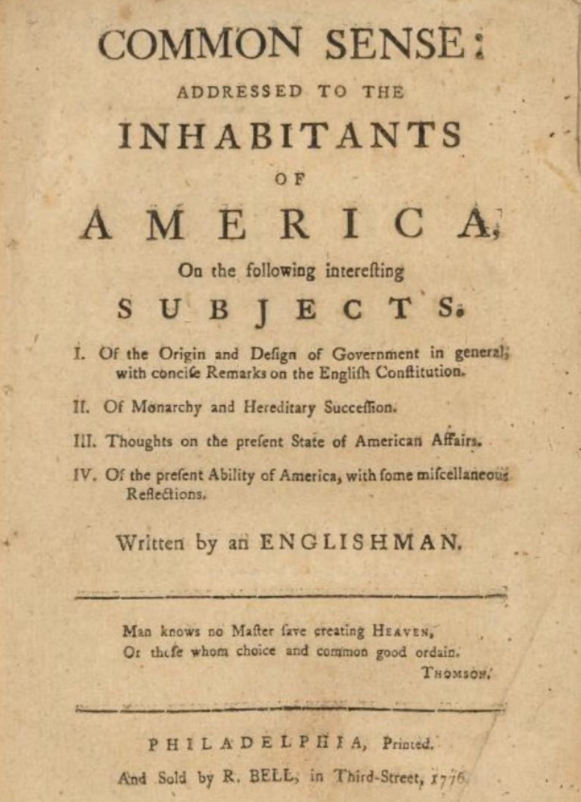
Virginian Landon Carter was vocal about the latest pamphlet sweeping through the American colonies in 1776. In several diary entries from the first four months of that momentous year, he commented on Common Sense, written anonymously “by an Englishman.” Carter described its contents in February as “rascally and nonsensical as possible, for it was only a sophisticated attempt to throw all men out of principles.” By April, as he continued to criticize the work, he reached a conclusion about its author: “I begin now more and more to see that the pamphlet called Common Sense, supporting independency, is written by a member of the Congress …” Carter could not have been further from the truth.
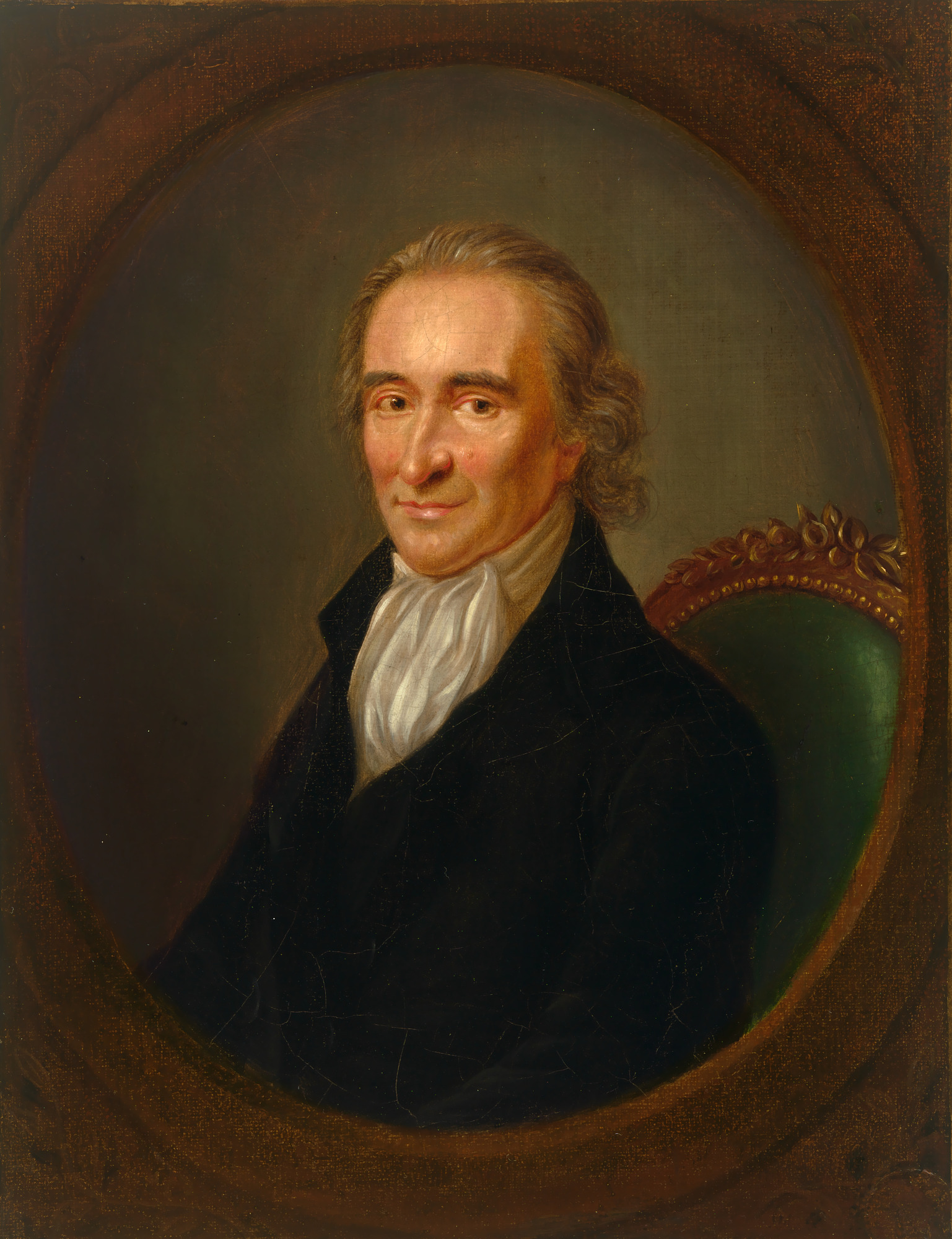
“An Englishman” was, in fact, an apt description for the author of Common Sense, first advertised to the American public on January 9, 1776, and first released on January 10. Thomas Paine was an Englishman—born there and, by most measures, matured there as a failure. He failed at his corset-making business. Teaching, collecting taxes, privateering, and working as a grocer—none of these occupations suited him either. He married twice (his first wife died in childbirth), and his second marriage collapsed. Amid this string of failures, Paine found success with the written word, which caught Benjamin Franklin’s attention in England in 1774. With little left for him in England, Paine embarked for America, arriving later that year. There, he scraped by as a writer, publishing essays in Philadelphia newspapers.


 Emerging Revolutionary War Era