The Saratoga Campaign and Battle of Saratoga sit near the top of numerous “Turning Points of the Revolutionary War” lists. It is a story that has been told many times. New research has shed additional light on the campaign’s well-known and trivial parts.
Join Saratoga National Historical Park interpreter and historian Eric Schnitzer for Emerging Revolutionary War’s Revelry on October 2, 2022, at 7 pm to learn about new research being conducted about the campaign.
We hope you can join us on Sunday at 7 p.m EDT on our Facebook page for this historian happy hour.
June 28, 1878, marked the centennial of the battle of Monmouth, and the anniversary did not pass without commemoration in the town of Freehold, New Jersey, the original location of Monmouth Courthouse. Local newspapers reported that over 20,000 people attended the various ceremonies, orations, and performances that were held, with local and state politicians, and veterans of the War of 1812, Mexican-American War, and the recent Civil War in attendance. George B. McClellan, former commanding general of the Union Armies and the Army of the Potomac, then serving as New Jersey’s governor, reviewed state troops and participated in the cornerstone laying of the Monmouth Battle Monument. The ceremony was the center of the commemorations that day. Although the 94-foot-tall monument crowned by a statue of “Colombia Triumphant,” would not be completed and dedicated until November 1884, those who attended the centennial events understood the significance of what it would represent. After all, it had only been thirteen years since the end of the previous war—one that was fought to save the republic that those who had bled at Monmouth fought themselves to establish. The symbolism was not lost on Enoch L. Cowart, a veteran of the 14th New Jersey Volunteers, which was trained at Camp Vredenburgh around the old battlefield. On July 4, 1878, an original poem he had written, “Centennial of the Battle of Monmouth,” was published in the Monmouth Democrat. Here is that poem below:
Enoch L. Cowart’s poem published in the Monmouth Democrat
On September 12, 1814, approximately 4,700 soldiers, a mix of British infantry and marines, were landed on the North Point peninsula, a jut of land between the Back and Patapsco River and on a direct line of march toward Baltimore. While the infantry and marines advanced toward the city, the British Navy’s task was to subdue the American fortifications in Baltimore harbor. The latter was foiled by the stout defense of Fort McHenry which served as the backdrop for the future national anthem, the Star-Spangled Banner.
Less is known about the accompanying land engagement, fought at North Point between the British and American militia. That battle, which cost the life of Major General Robert Ross, the British commander, saw the American militia retreat, but in order, and stymied the initial approach of the British toward Baltimore. Furthermore, the battle gave the Americans more time to add to their defenses.
To shed light on this aspect of the Battle of Baltimore, Emerging Revolutionary War will be joined by two historians, both of who have worked on volunteered at Fort McHenry National Monument and Historic Shrine.
Jim Bailey is now the Chief of Visitor Services and Education at Manassas National Battlefield Park but is a former park ranger at Fort McHenry. The other guest historian is Chris Boyle who has been a National Park Service volunteer at Fort McHenry National Monument & Historical Shrine since 2005 in both the Fort McHenry Guard living history program and as an historical interpreter focusing on the Fort’s history from the War of 1812 through the Civil War. While not a native Baltimorean, he has called the city home for the last 20 years.
We hope you can join us on Sunday at 7 p.m EDT on our Facebook page for this historian happy hour.
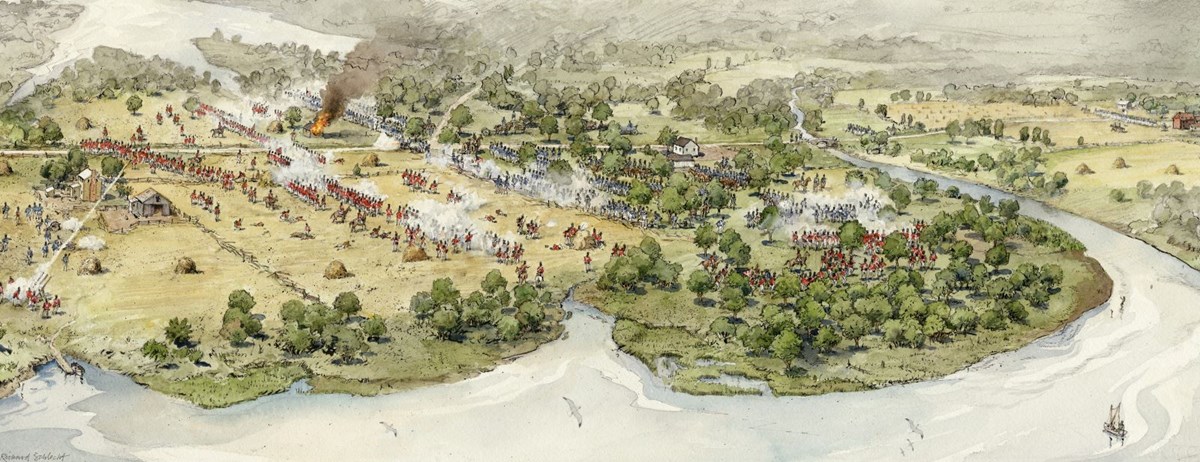
Major General Charles Lee’s role in the battle of Monmouth Courthouse and his subsequent court-martial is perhaps one of the Revolutionary War’s most controversial subjects. His conduct during the battle on June 28, 1778 can be both ridiculed and praised. Although he failed to pin the enemy rearguard into place before Washington could arrive with the rest of the American army, he successfully organized a delaying force at the Hedgerow that temporarily slowed the British pursuit and provided time for the army to form a strong defensive line atop Perrine Ridge. When the guns fell silent and the British retired from the field, Lee, then four miles away at Englishtown, immediately began to grow angry and slighted by the famous confrontation that occurred between himself and the commander-in-chief when the latter arrived on the field earlier that afternoon. It is possible that Lee’s performance would have avoided severe scrutiny—after all, Monmouth had been a tactical victory for the Continental Army. However, the eccentric and egotistical Lee could not bite his tongue. In a series of incredible letters addressed to Washington, he sealed his ultimate fate. Choosing honor above all else, Lee criticized and downright offended his superior. By the end of the exchange Lee demanded, “that on the first halt, I may be brought to trial.” Washington obliged him.
Washington Arrives on the Monmouth Battlefield
Below is the first letter written by Lee in the correspondence that would eventually lead to his removal from the army:
Camp English Town [30 June 1778]
Sir
From the knowledge I have of your Excys character—I must conclude that nothing but the misinformation of some very stupid, or misrepresentation of some very wicked person coud have occasioned your making use of so very singular expressions as you did on my coming up to the ground where you had taken post2—They implyed that I was guilty either of disobedience of orders, of want of conduct, or want of courage. Your Excellency will therefore infinitely oblige me by letting me know on which of these three articles you ground your charge—that I may prepare for my justification which I have the happiness to be confident I can do to the army, to the Congress, to America, and to the world in general. Your excellency must give me leave to observe that neither yourself nor those about your person, could from your situation be in the least judges of the merits or demerits of our measures—And to speak with a becoming pride, I can assert that to these manouvers the success of the day was entirely owing—I can boldly say, that had we remained on the first ground, or had we advanced, or had the retreat been conducted in a manner different from what it was, this whole army and the interests of America would have risked being sacrificed. I ever had (and hope ever shall have the greatest respect and veneration for General Washington) I think him endowed with many great and good qualities, but in this instance I must pronounce that he has been guilty of an act of cruel injustice towards a man who certainly has some pretensions to the regard of every servant of this country—And I think Sir, I have a right to demand some reparation for the injury committed—and unless I can obtain it, I must in justice to myself, when this campaign is closed, [(]which I believe will close the war) retire from a service at the head of which is placed a man capable of offering such injuries. But at the same time in justice to you I must repeat that I from my soul believe, that it was not a motion of your own breast, but instigaged by some of those dirty earwigs who will for ever insinuate themselves near persons in high office—for I really am convinced that when General Washington acts from himself no man in his army will have reason to complain of injustice or indecorum. I am, Sir, and hope I ever shall have reason to continue your most sincerely devoted humble servt
[1] “To George Washington from Major General Charles Lee, 30 June 1778,” Founders Online, National Archives, https://founders.archives.gov/documents/Washington/03-15-02-0651. [Original source: The Papers of George Washington, Revolutionary War Series, vol. 15, May–June 1778, ed. Edward G. Lengel. Charlottesville: University of Virginia Press, 2006, pp. 594–595.]
Opportunity knocked for Horatio Gates with the fall of Charleston, South Carlina in May 1780. A devastating loss for the Americans, with nearly 6,000 men of the Southern Army under Benjamin Lincoln surrendered to Sir Henry Clinton. Unless something wasn’t done soon, the entire southern colonies could fall and the revolution along with it. Congress needed someone who could inspire men to join the war effort and a trusted leader with a positive record. Washington put Nathaniel Greene’s name forward, but Congress in a rare move went against Washington’s wishes and appointed Horatio Gates as commander of the Southern Department on June 13th.
Major General Horatio Gates, ca. 1794 by Gilbert Stuart
The road from his victory at Saratoga to the Southern Department wasn’t an easy one for Gates. He sought independent field command and many believe he wanted Washington’s position as commander in chief. His allies in Congress and the Continental Army lobbied heavily on Gates’ behalf and were able to have Gates appointed to the powerful Board of War (the defacto Department of Defense). Though an important role (and serving as Washington’s civilian superior), Gates believed he belonged in the field. Though his role in the famous “Conway Cabal” is still debated today, he was implicated via letters in criticizing Washington’s leadership. Whether his involvement was real or not, the relationship between him and Washington (and Washington’s inner circle) was seriously damaged. Due to the situation, Gates resigned from the Board of War and accepted appointment as department commander of the Northern Department. In this role he was responsible to look after the New York Highlands and watch from British incursions from Canada or New York city. Gates was unhappy in this role and proposed another American invasion of Canada. Washington and Congress disagreed and rejected his plans. He disliked his task of dealing with enemy native tribes in the region and dragged his feet in following orders. Finally, that fall, Gates took command of American forces in New England with his headquarters in Boston. Though excited by this appointment, he quickly realized that this post was not where the action would be. The British left Boston in 1776 and since the city was peaceful and not a welcome place for a man seeking glory and military action. Finally, after much frustration, Gates asked to return to his farm in Virginia and arrived there by December 1779. Gates found himself a hero without an army and continued to brood over his situation.
Join ERW historians on our Facebook page this Sunday night at 7 p.m. as we discuss the Battle of Monmouth, which took place on June 28, 1778. In preparation for our trip to Monmouth Battlefield State Park next week, and our annual bus tour in November, we will focus on the journeys of both armies from Valley Forge and Philadelphia, the transformations each had experienced during the winter and spring, and the decisions made by the commanders on the road to Monmouth and on the battlefield that hot summer day in June. We hope you can join us as we begin our commemoration events of what most historians declare the “battle that made the American Army.”
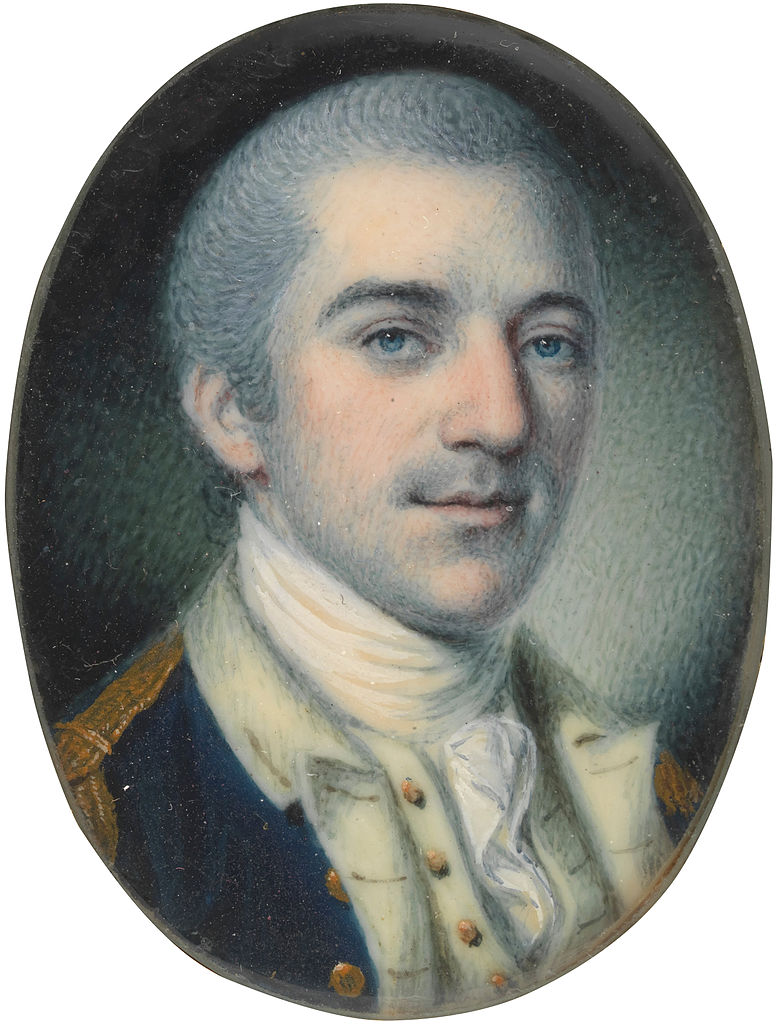
Lieutenant Colonel John Laurens of South Carolina had served as part of George Washington’s military family since early August 1777. Just 23-years-old during the summer of 1778, Laurens had established himself as one of Washington’s most trusted aides, as well as a close friend to Alexander Hamilton and the Marquis de Lafayette.
During the Battle of Monmouth Courthouse, fought June 28, 1778, Laurens was sent ahead of the army early in the morning to assist Baron von Steuben in reconnoitering the British Army’s position around the village. The party was fired upon and chased westward by the Queen’s Rangers back to a hedgerow defended by New Jersey militiamen. When the battle began in earnest later in the morning, Laurens found himself back at the same hedgerow assisting Continental troops in conducting a delaying action to by time for Washington to establish a strong defensive position further to the west. It was during this action that the young officer from the Palmetto State lost his mount.
The following letter was written by Lt. Col. Laurens on June 30, 1778, to his father, Henry Laurens, who was then serving as the President of the Continental Congress. It is a fascinating look at one soldier’s experience during a battle in which he was right in the thick of things, selflessly exposing himself to the enemy.
Portrait of John Laurens painted in 1780 by Charles Wilson Peale.
“HEAD QUARTERS, ENGLISH TOWN, 30th June, 1778.
My Dear Father:
I was exceedingly chagrined that public business prevented my writing to you from the field of battle, when the General sent his dispatches to Congress. The delay, however, will be attended with this advantage, that I shall be better able to give you an account of the enemy’s loss; tho’ I must now content myself with a very succinct relation of this affair. The situation of the two armies on Sunday was as follows: Gen’ Washington, with the main body of our army, was at 4 miles distance from English Town. Gen’ [Charles] Lee, with a chosen advanced corps, was at that town. The enemy were retreating down the road which leads to Middle Town; their flying army composed (as it was said), of 2 [battalions] of British grenadiers, 1 Hessian [grenadiers], 1 [battalion] of light infantry, 1 regiment of guards, 2 brigades of foot, 1 [regiment] of dragoons and a number of mounted and dismounted Jägers. The enemy’s rear was preparing to leave Monmouth village, which is 6 miles from this place, when our advanced corps was marching towards them. The militia of the country kept up a random running fire with the Hessian Jägers; no mischief was done on either side. I was with a small party of horse, reconnoitering the enemy, in an open space before Monmouth, when I perceived two parties of the enemy advancing by files in the woods on our right and left, with a view, as I imagined, of enveloping our small party, or preparing a way for a skirmish of their horse. I immediately wrote an account of what I had seen to the General, and expressed my anxiety on account of the languid appearance of the Continental troops under Gen’ Lee.
Some person in the mean time reported to Gen’ Lee that the enemy were advancing upon us in two columns, and I was informed that he had, in consequence, ordered Varnum’s brigade, which was in front, to repass a bridge which it had passed. I went myself, and assured him of the real state of the case; his reply to me was, that his accounts had been so contradictory, that he was utterly at a loss what part to take. I repeated my account to him in positive distinct terms, and returned to make farther discoveries. I found that the two parties had been withdrawn from the wood, and that the enemy were preparing to leave Monmouth. I wrote a second time to Gen’ Washington. Gen’ Lee at length gave orders to advance. The enemy were forming themselves on the Middle Town road, with their light infantry in front, and cavalry on the left flank, while a scattering, distant fire was commenced between our flanking parties and theirs. I was impatient and uneasy at seeing that no disposition was made, and [endeavored] to find out Gen’ Lee to inform him of what was doing, and know what was his disposition. Ile told me that he was going to order some troops to march below the enemy and cut off their retreat. Two pieces of artillery were posted on our right without a single foot soldier to support them. Our men were formed piecemeal in front of the enemy, and there appeared to be no general plan or disposition calculated on that of the enemy; the nature of the ground, or any of the other principles which generally govern in these cases.
The enemy began a cannonade from two parts of their line; their whole body of horse made a furious charge upon a small party of our cavalry and dissipated them, and drove them till the appearance of our infantry, and a judicious discharge or two of artillery made them retire precipitately. Three regiments of ours that had advanced in a plain open country towards the enemy’s left flank, were ordered by Gen’ Lee to retire and occupy the village of Monmouth. They were no sooner formed there, than they were ordered to quit that post and gain the woods. One order succeeded another with a rapidity and indecision calculated to ruin us. The enemy had changed their front and were advancing in full march towards us; our men were fatigued with the excessive heat. The artillery horses were not in condition to make a brisk retreat. A new position was ordered, but not generally communicated, for part of the troops were forming on the right of the ground, while others were marching away, and all the artillery driving off. The enemy, after a short halt, resumed their pursuit; no cannon was left to check their progress. A regiment was ordered to form behind a fence, and as speedily commanded to retire. All this disgraceful retreating, passed without the firing of a musket, over ground which might have been disputed inch by inch. We passed a defile and arrived at an eminence beyond, which was defended on one hand by an impracticable fen, on the other by thick woods where our men would have fought to advantage. Here, fortunately for the honour of the army, and the welfare of America, Gen’ Washington met the troops retreating in disorder, and without any plan to make an opposition. He ordered some pieces of artillery to be brought up to defend the pass, and some troops to form and defend the pieces. The artillery was too distant to be brought up readily, so that there was but little opposition given here. A few shot though, and a little skirmishing in the wood checked the enemy’s career. The Gen’ expressed his astonishment at this unaccountable retreat. Mr. Lee indecently replied that the attack was contrary to his advice and opinion in council. We were obliged to retire to a position, which, though hastily reconnoitered, proved an excellent one. Two regiments were formed behind a fence in front of the position. The enemy’s horse advanced in full charge with admirable bravery to the distance of forty paces, when a general discharge from these two regiments did great execution among them, and made them fly with the greatest precipitation. The grenadiers succeeded to the attack. At this time my horse was killed under me. In this spot the action was hottest, and there was considerable slaughter of British grenadiers. The General ordered Woodford’s brigade with some artillery to take possession of an eminence on the enemy’s left, and cannonade from thence. This produced an excellent effect. The enemy were prevented from advancing on us, and confined themselves to cannonade with a show of turning our left flank. Our artillery answered theirs with the greatest vigour. The General seeing that our left flank was secure, as the ground was open and commanded by it, so that the enemy could not attempt to turn it without exposing their own flank to a heavy fire from our artillery, and causing to pass in review before us, the force employed for turning us. In the mean time, Gen’ Lee continued retreating. Baron Steuben was order’d to form the broken troops in the rear. The cannonade was incessant and the General ordered parties to advance from time to time and engage the British grenadiers and guards. The horse shewed themselves no more. The grenadiers showed their backs and retreated every where with precipitation. They returned, however, again to the charge, and were again repulsed. They finally retreated and got over the strong pass, where, as I mentioned before, Gen’ Washington first rallied the troops. We advanced in force and continued masters of the ground; the standards of liberty were planted in triumph on the field of battle. We remained looking at each other, with the defile between us, till dark, and they stole off in silence at midnight. We have buried of the enemy’s slain, 233, principally grenadiers; forty odd of their wounded whom they left at Monmouth, fell into our hands. Several officers are our prisoners. Among their killed are Co’ Moncton, a captain of the guards, and several captains of grenadiers. We have taken but a very inconsiderable number of prisoners, for want of a good body of horse. Deserters are coming in as usual. Our officers and men behaved with that bravery which becomes freemen, and have convinced the world that they can beat British grenadiers. To name any one in particular wd be a kind of injustice to the rest. There are some, however, who came more immediately under my view, whom I will mention that you may know them. B. Gen’ Wayne, Col. Barber, Col. Stewart, Col. Livingston, Col. Oswald of the artillery, Capt. Doughty deserve well of their country, and distinguished themselves nobly.
The enemy buried many of their dead that are not accounted for above, and carried off a great number of wounded. I have written diffusely, and yet I have not told you all. Gen’ Lee, I think, must be tried for misconduct. However, as this is a matter not generally known, tho’ it seems almost universally wished for, I would beg you, my dear father, to say nothing of it.
You will oblige me much by excusing me to Mr. Drayton for not writing to him. I congratulate you, my dear father, upon this seasonable victory, and am ever
Your most dutiful and affectionate
JOHN LAURENS.
The [Honorable] Henry Laurens, Esqr.
We have no returns of our loss as yet. The proportion on the field of battle appeared but small. We have many good officers wounded.”
This March brings the 241st Anniversary of the pivotal battle of Guilford Courthouse, NC. While this battle is of immense importance to the Southern Campaign, several smaller battles leading up to it have been largely overlooked. Through February and early March of 1781, detachments of the American and British armies maneuvered across the modern-day counties of Alamance, Guilford, Orange, Chatham, and Caswell. The is the third in a series of three articles.
The last of the skirmishes occurred at Weitzel’s Mill, also spelled as Wetzel’s, and Wiley’s. Cornwallis was becoming more determined to strike at the Americans to either force a general battle, which he felt his veteran army could win, or destroy the isolated detachments operating near him.
This March brings the 241st Anniversary of the pivotal battle of Guilford Courthouse, NC. While this battle is of immense importance to the Southern Campaign, several smaller battles leading up to it have been largely overlooked. Through February and early March of 1781, detachments of the American and British armies maneuvered across the modern-day counties of Alamance, Guilford, Orange, Chatham, and Caswell. This is the first of a series of three articles.
Having unsuccessfully chased General Nathaniel Greene’s small, ragged army across North Carolina, British forces under Lord Charles Cornwallis moved to the state capital at Hillsborough to announce their liberation of the state and call Loyalists to come forward and support them. Greene’s army retreated across the Dan River into Virginia, where he awaited supplies and reinforcements.
On January 17, 1781, General Daniel Morgan and his mixed force of Continental soldiers and militia defeated the British under the command of Lieutenant Colonel Banastre Tarleton. This victory for the patriots in northwestern South Carolina had major implications on the southern theater and the main British force under General Lord Charles Cornwallis. The battle, named after the use of the fields in which it was fought, Cowpens, also included one of the only instances in American history of a successful double envelopment.
On Sunday, at 7 p.m. EDT, Emerging Revolutionary War will be joined by American Battlefield Trust’s Kristopher White, Deputy Director of Education and Daniel Davis, Education Manager, in a discussion about the history and preservation of the Battle of Cowpens.
Round out your January weekend by joining us on our Facebook page for this live historian happy hour.







 Emerging Revolutionary War Era