War on the American frontier was generally brutal, but few incidents inflamed American passions in the country’s early history as much as the torture and execution of Colonel William Crawford in June 1782 in Northwestern Ohio. Crawford’s death marked the emotional climax of another patriot attempt to neutralize British power at Detroit, generally exercised through Native American proxies who had their own reasons for fighting the Americans, and halt the raids against American settlers on the frontier. The Huron and Wyandot who lived about the Sandusky River, and the Shawnee to their South on the Scioto and Miami Rivers, both occasionally aided by various clans of the Delaware and Mingo tribes, were particularly troublesome in the Ohio River valley. Colonel Crawford’s campaign, which resulted in his death, was meant to punish the tribes for past raids to forestall future raids.
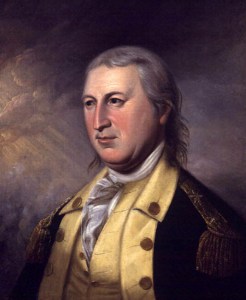
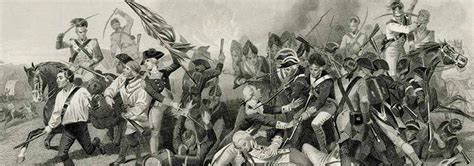
238 years ago today the United States military suffered one of its worst defeats. The Battle of Camden, fought on August 16, 1780 just a few miles north of Camden, SC was a total defeat for the American “Grand Army” under popular General Horatio Gates. The British under Lord Cornwallis inflicted nearly 1,900 casualties (out of 4,000) at a loss of only 300. One of the biggest losses was the death of General Baron Johann de Kalb, a popular foreign general in the American army. Though a strategic defeat for Gates, it was the retreat that would lead to Gates’ demise. As the militia broke and ran, Gates was caught up in the panic and fled the field as half of his army was still fighting.
Writing several days later from Hillsborough, NC Gates submitted his account of the battle to Congress. Already, reports of cowardice were starting to spread about Gates’ conduct during the battle. Gates decision to fight and his decision to leave the field during the battle have been debated ever since that August day in 1780. Below is a portion of Gates’ letter.
“In the deepest distress and anxiety of mind, I am obliged to acquaint your excellency with the defeat of the troops under my command. I arrived with the Maryland line, the artillery, and the North-Carolina militia, on the 13th instant at Rugeley’s, thirteen miles from Camden; and took post there, and was the next day joined by General Stevens, with seven hundred militia from Virginia…. Having communicated my plan to the general officers in the afternoon of the 15th, it was resolved to march at ten at night, to take post in a very advantageous situation, with a deep creek in front, seven miles from Camden; the heavy baggage, &c. being ordered to march immediately by the Waxhaw road. At ten the army began to march in the following order: Colonel Armand’s legion in front, supported on both flanks by Colonel Porterfield’s regiment, and the light infantry of the militia; the advanced guard of infantry, the Maryland line, with their artillery, in front of the brigades, the North-Carolina militia, the Virginia militia, the artillery, &c. and the rear guard. Having marched about five miles, the legion was charged by the enemy’s cavalry, and well supported on the flanks, as they were ordered, by Colonel Porterfield, who beat back the enemy’s horse, and was himself unfortunately wounded; but the enemy’s infantry advancing with a heavy fire, the troops in front gave way to the first Maryland brigade, and a confusion ensued, which took some time to regulate. At length the army was ranged in line of battle, in the following order: General Gist’s brigade upon the right, with his right close to a swamp, the North-Carolina militia in the center, and the Virginia militia, with the light infantry and Porterfield’s corps, on the left; the artillery divided to the brigades; and the first Maryland brigade as a corps de reserve, and to cover the can non in the road, at a proper distance in the rear. Colonel Armand’s corps were ordered to the left, to support the left flank, and oppose the enemy’s cavalry. At daylight the enemy attacked and drove in our light party in front, when I ordered the left to advance and attack the enemy; but to my astonishment, the left wing and North -Carolina militia gave way. General Caswall and myself, assisted by a number of officers, did all in our power to rally the broken troops, but to no purpose, for the enemy coming round the left flank of the Maryland division, completed the rout of the whole militia, who left the continentals to oppose the enemy’s whole force. I endeavoured, with General Caswall, to rally the militia at some distance, on an advantageous piece of ground, but the enemy’s cavalry continuing to harass their rear, they ran like a torrent, and bore all before them. Hoping yet, that a few miles in the rear they might recover from their panic, and again be brought into order, I continued my endeavour, but this likewise proved in vain. The militia having taken the woods in all directions, I concluded, with General Caswall [sic], to retire toward Charlotte.”
Approximately one month ago, I took a temporary detail assignment to Morristown National Historical Park. The national park preserves the winter cantonments of the Continental Army during the American Revolution; including the harshest winter, weather-wise, of the entire war, in 1779-1780.
For parts of multiple winters and even during the campaigning season, Washington’s forces would come to Morristown, situated behind the Watchung Mountains, which provided safety but also a perch to monitor the British in the New York City.
The town still bears witnesses to this rich legacy of housing soldiers, with historic buildings and signs dotted around the spiraling town. On a walk the other day, I came across the house below, with a small plaque situated on the front of the dwelling.
The home saw soldiers use it for their encampments throughout the majority of the war years. On his return to the United States the Marquis de Lafayette was welcomed with a reception in the building as well, which is in the photo below.
Morristown is filled with tidbits of history from the American Revolution and I as spend the next few months there as a park ranger, I will share what I come across. So, stay tuned as I uncover the history of the place that “Saved America” according to the park’s unofficial slogan.
Emerging Revolutionary War welcomes back guest historian Bill Backus
The American Revolution ultimately set in motion a chain of events that transformed not only society in the Americas but also back in the Old World. Six years after the United States gained independence, revolution broke out across France. While Americans focused on building a new nation, across the Atlantic the French Revolution sparked a series of wars subsequently known as the French Revolutionary Wars. Eventually after many years of combat and political chaos, a young army officer named Napoleon Bonaparte emerged as the new Emperor of France. Led by the Emperor the French army and nation embarked on a series of new wars that spread from Spain to Russia. From the beginning of the French Revolution to the defeat of Napoleon at Waterloo, Europe was at war for nearly 26 years, or nearly the entire lives of people born during the American Revolutionary period.
European Armies of the French Revolution, 1789–1802 (Campaigns and Commanders Series) by Frederick C. Schneid
While Napoleon’s French Empire is widely known on both sides of the Atlantic, the wars that allowed Napoleon’s ascent to power are less prominent. Concerned that revolution could spread to the rest of continental Europe, Revolutionary France found itself engaged fighting the European status co intent on restoring the Bourbon monarchy in France. Over the course of years war and peace ebbed and flowed in Europe, with war sometimes sparked by the French in hopes of unifying a splintered public. In “European Armies of the French Revolution, 1789-1802”, historian Frederick Schneid has organized a study exploring the role of some of the prominent European armies in this period. Collaborating with noted scholars in their respective fields, the essays explore the armies of the nation-states of France, Prussia, Austria, Russia, Great Britain, Spain, and the Ottoman Empire, along side the various German principalities and the armies of the Italian states. Continue reading “Review: European Armies of the French Revolution, 1789–1802 (Campaigns and Commanders Series) Edited by Frederick C. Schneid”→
A special announcement in the preservation world was made public today. The Civil War Trust, which the Campaign 1776 initiative spawned from, officially changed their name to the American Battlefield Trust. You can see their video announcement of the name change and what it means, here.
Emerging Revolutionary War sent an email inquiry to our friends at American Battlefield Trust to elaborate a little further on what this name change means and the impact to their current and future preservation efforts. Continue reading “A Very Special Message”→
Emerging Revolutionary War welcomes back guest historian Michael Aubrecht
John Trumbull
John Trumbull’s paintings represent some of the most familiar depictions from the time of the American Revolution. Trumbull was a graduate of Harvard University and the gifted son of the Governor of Connecticut. As a child, Trumbull showed a remarkable talent for an attention to detail. This aptitude set his drawings apart from his contemporaries. Trumbull traveled to London in 1784 to study painting under the master Benjamin West. It was then that he started painting some of his most notable pieces. There he honed his expertise for realistic painting. A year later later Trumbull traveled to the City of Paris to do commissioned artworks. He later did portraits of George Washington, John Adams, Alexander Hamilton and Thomas Jefferson. In 1816, he was selected as the president of the American Academy of the Fine Arts where he would serve for 20 years. Emphasizing classic traditions Trumbull attempted to teach the skills he had acquired while overseas. Following his death in 1843 at the age of 87, Trumbull was buried beneath the Art Gallery at Yale University which he had designed. In 1867, his collection of artworks were displayed at the Street Hall building on the same grounds. He and his wife’s remains were later re-interred and buried on the grounds of that building. Trumbull’s approach to painting has been studied by art students around the world. Today Trumbull’s paintings remain some of the most cherished ever to be painted by an American artist. Continue reading “The Brush of John Trumbull”→
When writing a book, one of the most important initial aspects is picking a title. The author needs one that is expressive, attracts attention, but has some overall tie-in that provides a fitting capture of the essence of the book.
One of the advantages of writing history is the use of quotes. Let the participants, combatants, or witnesses of the event provide the context for a title. When one resonates, go with it!
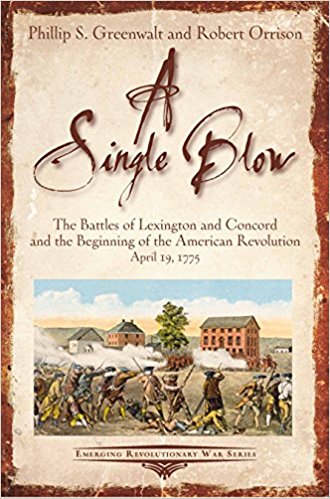
With the recent publication, the co-author, Robert Orrison and myself bounced various potential titles off each other. Then we had a list of our favorites included in the initial information sheet sent to Ted Savas, of Savas Beatie, LLC, the publisher. Yet, one continued to stand out, as it was written in a diary by a British junior officer slightly more than a month before the Battles of Lexington and Concord.
The entire inscription is below:
“It is certain both sides were ripe for it, and a single blow would have occasioned the commencement of hostilities.” —Lieutenant Frederick Mackenzie, Royal Welch Fusiliers, March 6, 1775.
Mackenzie’s uncanny foresight predicted the exact outcome of the fighting that erupted on April 19, 1775. With casualties suffered by both sides, the war of words and near-misses became a war of shot and shell.
Hostilities had commenced and we had a title. A Single Blow: The Battles of Lexington and Concord and the The Beginning of the American Revolution.
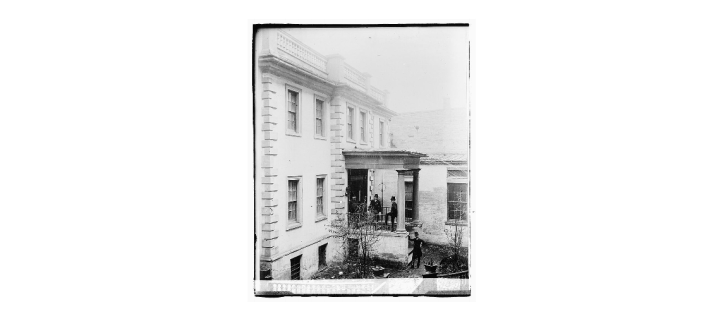
The campaigns of 1755 began when Britain’s ranking military leaders in North America met in Alexandria, Virginia with the colonial royal governors of Maryland, Massachusetts, New York, Pennsylvania, and Virginia, at the home of prominent Ohio Company member, John Carlyle. On April 14-15, 1755, in what became known as the “Carlyle House Congress,” the newly minted commander in chief of His Majesty’s Forces in North America, Major General Edward Braddock, presented London’s military objectives for that coming spring and summer. The Crown’s strategy, on paper, was simple: capture and hold key French fortifications within the boundaries of New York, Nova Scotia, and Pennsylvania before the enemy could concentrate his strength. This plan was intended to oust the French from His Majesty’s colonial possessions on the continent before a large-scale conflict could commence.
The John Carlyle House, c. 1918-1920, Library of Congress.
The task of subduing the French, Canadians, and their Native American auxiliaries in these regions fell upon a mixed contingent of British Regular soldiers, colonial provincial troops, and British-allied Native American warriors. How each group would be utilized depended upon how the respective expeditionary field commander chose to execute his orders by moving, supplying, and fighting his men. Continue reading “The Carlyle House Congress and Britain’s Military Objectives for 1755”→
Love brought Dr. Samuel Prescott, a practicing physician, to the town of Lexington on the night of April 18, 1775. The young doctor was courting Ms. Lydia Mulliken, when the alarm of the British soldiers marching from Boston went out to the local militia. Lydia’s brother was one of those called to gather.
Love. That emotion also drew Dr. Prescott back toward his hometown of Concord—this time to alert friends, neighbors, and family members of the urgent news of the evening. En route, Dr. Prescott along with Paul Revere and William Dawes, alerted the countryside of the moving British troops. After being vetted and vouchsafed as a true friend of liberty, Dr. Prescott rode posthaste to his hometown, where his word carried greater weight.
A artist’s interpretation of Paul Revere’s (or maybe William Dawes or Dr. Samuel Prescott)’s ride to warn the Massachusetts countryside. (courtesy of VFW)
As British General Thomas Gage and his American Whig (or Patriot) antagonists squared off in Boston and the surrounding towns, information gathering became the key to success. Both sides had created networks of spies, but the advantage was clearly in favor of the Whigs. During the winter 1774-1775, groups such as the Sons of Liberty had established a complex spy network within Boston comprised of a system of riders that spread information and “alarms’ quickly. The Committee of Safety and the Massachusetts Provincial Congress relied on this network to stay informed of what was going on in Boston and the British intentions. Continue reading “Two Riders….Gage Gathers Information”→






 Emerging Revolutionary War sent an email inquiry to our friends at American Battlefield Trust to elaborate a little further on what this name change means and the impact to their current and future preservation efforts.


 Emerging Revolutionary War Era