This week we interview our Symposium co-host, Liz Williams! Like all of our speakers, we asked Liz to answer a few questions about her passion for history. We appreciate Liz partnering with us for the third year to put on a great program. Liz is the Director of Gadsby’s Tavern Museum in Alexandria, VA and has been with the Office of Historic Alexandria, part of the City of Alexandria, since 2004. She has a passion for history and having fun at work (as shown by her photo!).
Liz is a graduate of Mary Washington College in Fredericksburg, Virginia, where she earned her B.A. in Historic Preservation. She went on to receive her graduate degree at The George Washington University in Washington, D.C., where she earned an M.T.A. in Tourism Administration, concentrating on heritage tourism.
She is a Superfan of the musical “1776” and educates everyone she knows about the famous ride of Caesar Rodney, one of her home state’s epic Rev-War stories.
What first attracted you to the study of early American history? What keeps you involved in the study of this history? Do you find these things are the same or different?
It is all my Dad’s fault. Summer family vacations to historic sites embedded history deep into my soul at an early age. I think what attracted me then still attracts me now, just refined by time. I always connected with the people of the past and how they got from Point A to Point B. However, in my older age, I understand those decisions were not so cut and dry like I once thought they were.
Why do you think it is important for us to study the Revolutionary Era?
So many of our traditions, things we celebrate as “America,” stem from this era. It helps us all understand how we got to 2022.
What do you think was the most significant foreign impact on the American Revolution?
Other nations using our revolution as a model and inspiration for their own. Imitation is the highest form of flattery, right? Perhaps…
What are some of the important lessons of the American Revolution do you think are still relevant today?
Envision Barbra Streisand singing “People…” People are complex. How the revolution began, ended, and everything in between is rooted in humanity—choices made for a variety of reasons. Recognizing this human dimension is essential to understanding both the past and the present.
What was it about the American Revolution that elicited such global interest?
We defeated the big bad British (with the help of France, but I digress). It was David vs. Goliath. Of course people across the globe wanted to stay up-to-date on all the ins and outs of this action packed tale – from start to finish to the next chapter. We tell that next chapter story at Gadsby’s. We won the Revolution – Yippie! What do we do now? Those across the globe watched as we made choices to build and create what we now know as the United States of America.
Join us for our Third annual Emerging Revolutionary War Symposium on September 24, 2022. Emerging Revolutionary War is excited to continue our partnership with Gadsby’s Tavern Museum and The Lyceum of Alexandria, VA to bring to you a day-long Symposium focusing on the American Revolution.
Registration fee is now only $60 per person and $50 for OHA members and students. If you feel more comfortable attending virtually, the fee is $30 to register visit: https://shop.alexandriava.gov/EventPurchase.aspx
We are happy to welcome Norman Desmarais to our Third Annual Symposium on the American Revolution, co-hosted with Gadsby’s Tavern Museum, The Lyceum and Emerging Revolutionary War. This year’s theme is “The World Turned Upside: The American Revolution’s Impact on a Global Scale. We asked Norm to answer a few questions about their talk and their passion for history.
Mr. Desmarais is the author of The Guide to the American Revolutionary War series (six volumes about the war on land and seven volumes about the war at sea and overseas), as well as America’s First Ally: France in the American Revolutionary War and Washington’s Engineer: Louis Duportail and the Creation of an Army Corps. He is the former editor-in-chief of The Brigade Dispatch, the Journal of the Brigade of the American Revolution.
Norm translated the Gazette Françoise, the French newspaper published in Newport, Rhode Island by the French fleet that brought the Comte de Rochambeau and 5,800 French troops to America in July 1780. He also translated and annotated Louis-François-Bertrand du Pont d’Aubevoye, comte de Lauberdière’s journal, published as The Road to Yorktown: The French Campaigns in the American Revolution, 1780-1783 (Savas Beatie 2021). He has also completed the translation and annotation of Journal of a French Quartermaster on the March to Yorktown June 16—October 6, 1781 which hopefully will find a publisher before the conference.
Norm was inducted into the American French Genealogical Society French-Canadian Hall of Fame in 2015 and received the Albert Nelson Marquis Lifetime Achievement Award in 2019 and 2020.
What first attracted you to the study of early American history?
Watching the Walt Disney television miniseries The Swamp Fox and Davy Crockett with Fess Parker and Buddy Ebsen as a youngster captured my interest. Later, during the nation’s bicentennial, I attended some reenactments and my interest blossomed in a different direction.
When I was going through a period of writer’s block and looking for a project for my first sabbatical, I was speaking with one of my friends who suggested I consider following one of my interests and that brought me into the Revolutionary Era.
What keeps you involved in the study of this history?
Continually learning about our nation’s history. The best way to learn is by doing, so I’m involved with reenacting which feeds my research and gives me opportunities to share my knowledge with the public and other historians. It’s an educational experience like no other.
Do you find these things are the same or different?
I think they’re different, but they are related. They use the same sources in different ways for different objectives—sort of a repurposing of information.
Why do you think it is important for us to study the Revolutionary Era?
People today go to great effort to do their family genealogy to discover their roots. Going back to the Revolutionary Era is sort of like doing our national genealogy and going back to our national roots. If we don’t know where we come from, we can’t understand where we’re going as family members or as a nation.
What do you think was the most significant foreign impact on the American Revolution?
The entry of France in the war. France began providing covert aid to support the war effort right from the beginning. However, once she officially entered the war, she could provide military assistance along with a lot of materiel the Continental Army needed so badly. French artillery helped win the battle of Saratoga which was key to France joining the war. Without French involvement, we could not have won at Yorktown. Three quarters of the allied force at Yorktown was French (army and navy).
What are some of the important lessons of the American Revolution do you think are still relevant today?
Logistics: Supplying and maintaining an army across an ocean is extremely difficult. Consider our experience in Vietnam, Syria and Afghanistan among others.
Morale: An army that has a will to fight for its independence, homeland or whatever can sometimes defeat a better supplied and trained army that has a lesser will to fight.
National support: Think of this as morale on the home front. If the populace of a nation doesn’t support the war effort, it’s going to be very difficult to win. Consider our experience in Vietnam and what Russia is experiencing in the Ukraine.
What was it about the American Revolution that elicited such global interest?
First of all, it was inspired by the ideological principles of the Enlightenment which introduced some novel ideas and ways of thinking that inspired Europeans.
Second, there was great resentment about the increasing expansion of the British empire and its dominance in world politics and economy.
Third, Britain pretty much controlled the trade routes between Europe and the West and East Indies, in other words, the lucrative sugar trade and the tea and spice trade. The rest of Europe wanted to minimize Britain’s power and to obtain a share of that trade. Then there were the lucrative fishing rights off the coast of North America.
Fourth, People began to realize that the power of the monarchy resided in the willingness of the people to be governed by the monarchy. As they realized this and acted upon it, there arose a series of revolutions for independence and changes of government.
Join us for our Third annual Emerging Revolutionary War Symposium on September 24, 2022. Emerging Revolutionary War is excited to continue our partnership with Gadsby’s Tavern Museum and The Lyceum of Alexandria, VA to bring to you a day-long Symposium focusing on the American Revolution.
Registration fee is now only $60 per person and $50 for OHA members and students. If you feel more comfortable attending virtually, the fee is $30. To register visit: https://shop.alexandriava.gov/EventPurchase.aspx

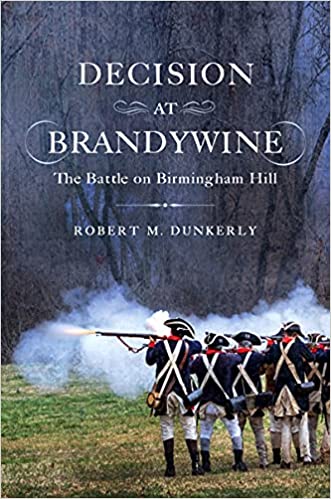
This Sunday on the Emerging Revolutionary War’s Facebook page, Robert Dunkerly will join the “Rev War Revelry” to discuss his newest publication, Decision at Brandywine: The Battle of Birmingham Hill.
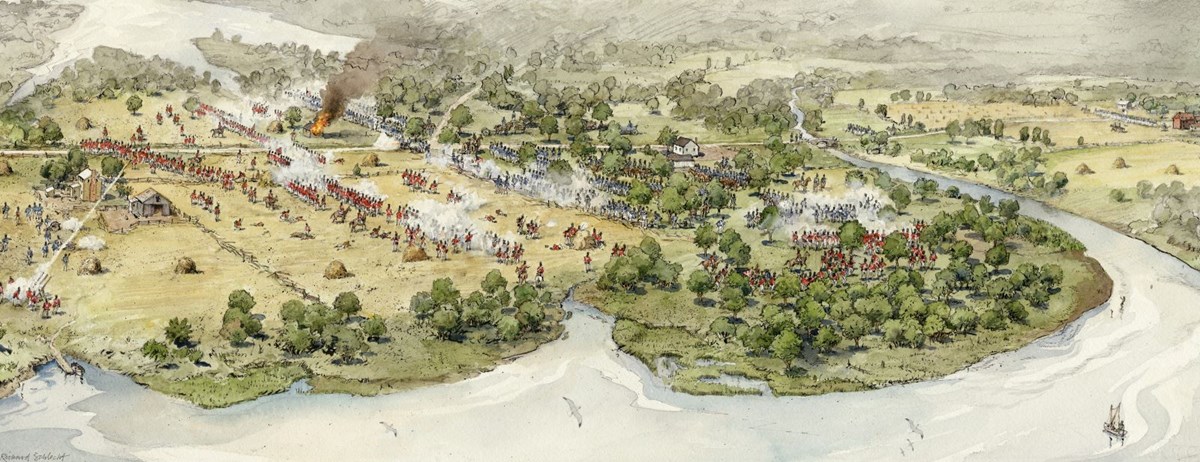
The Battle of Brandywine, fought on September 11, 1777, saw the defeat of the American forces in southeastern Pennsylvania. The victory by the British opened the road to Philadelphia, which fell to Sir William Howe’s forces on September 26, fifteen days after the battle.
Dunkerly, a park ranger with Richmond National Battlefield Park and a contributing historian for Emerging Revolutionary War will discuss the pivotal action that happened around Birmingham Hill on that Thursday in 1777. The engagement at Brandywine was the largest and longest battle in the entire American Revolution and the third bloodiest. This new publication examines the action near Birmingham Hill and Meeting House where the action that day turned against George Washington’s forces.
Thus, this Sunday, at 7 p.m. EDT, tune into ERW’s Facebook page for the next historian happy hour as the popular “Rev War Revelry” series continues with this author spotlight.
On the edge of the historic town of Litiz, Pennsylvania in Lancaster County stands an impressive, unique, and solemn, historic site. Two stone monuments and a plaque comprise the complex, marking the final burial of Continental soldiers from the hospital that stood nearby.
The historic marker says that wounded from the battles of Brandywine (September 11, 1777) and Germantown (October 4, 1777) were received here. Yet that does not match what I uncovered in researching this. The dates of the Lititz hospital seem to coincide more with the Valley Forge (winter 1777-78) timeframe.
In late summer, 1777, British General William Howe and his army left New Jersey and invaded Pennsylvania with the object of capturing Philadelphia. General George Washington’s army tried to stop the British at Brandywine but met defeat. The British occupied Philadelphia, and Washington struck back at Germantown, but again came up short. There were many smaller battles across southeastern Pennsylvania like Paoli, Fort Mifflin, and Whitemarsh.
On the afternoon of June 4, 1782 in the grasslands of western Ohio, a Pennsylvania volunteer named Francis Dunlavy spent a portion of his time trying to shoot a Native American he later called “Big Captain Johnny.” For his part, the Indian attempted with equal passion to kill Dunlavy. At some point, they worked themselves into a position on opposite sides of a recently fallen tree at the edge of a wood that adorned a modest, but noticeable rise that could pass for a hill in the surrounding plain. Even dropped on its side, the tree still held a full canopy of leaves, and the two combatants stalked each other around it. Eventually, “Big Captain Johnny” saw his opening. He was close enough to rise and hurl tomahawks at Dunlavy. Fortunately, he missed and Dunlavy survived to relate the tale to his friends and family. In 1872, more than 30 years after Dunlavy passed, his family related the tale to C.W. Butterfield, who wrote the first history of the Crawford Campaign. Before telling the story again, I wanted to confirm it. That meant searching for Francis Dunlavy and Captain Johnny anywhere, and everywhere, they might have left footprints in history.
Emerging Revolutionary War welcomes back guest historian Karl G. Elsea
It is common for artists to use “artistic license” when painting historic events including American Revolutionary War art. The problem is this practice also
aids inaccuracies persisting. Here is one case study of one picture involving an historic event that is presented by the National Park Service (NPS) at Yorktown. Please note the staff is helpful and the grounds are beautiful. As for the severity of the problem, the reader can decide after reading the information.
The following picture is from the field at Yorktown where the French Artillery Park was located. The picture illustrates the idea of what an artillery park was.
The problem is this picture contains a number of images that are wrong. For example, the carriages, wagons, carts, and limbers should be painted light blue. The French Army artillery had been painted light blue prior to 1750. There is a lot of confusion to this day concerning gun and limber carriage colors. This confusion may have been generated by a current belief there was one French artillery color. The French used the color of the items to assist which department owned the material. The French Navy department [Ministry of Marine] was responsible for the colonies, including North America, and their cannon were on red carriages with, in all most all cases, iron barrels. The French Quartermaster’s department had their wagons were painted a brighter red. The French Army artillery was painted light blue with bronze barrels. Thus, the French Army barrels shown should appear to be “brass.”
In June 1778, the Continental army marched out of their winter encampment in Valley Forge, Pennsylvania and headed toward New Jersey in pursuit of the retreating British army. The past six months, from December 1777 to June 1778, ushered in a period of suffering, renewal, and change.
Valley Forge is imprinted into the psyche of Americans as the the toughest winter of the entire American Revolution. In fairness, it was one of many tough winters that the Continental army survived. However, the reasons why this winter stands out will be part of the discussion of this Sunday evening’s “Rev War Revelry” which can be found on Emerging Revolutionary War’s Facebook page at 7 pm. EDT.
This week’s historian happy hour includes a discussion with Philip S. Greenwalt author of the recently released Emerging Revolutionary War Series title, The Winter that Won the War. This is the fourth volume in the series, with previous ones covering Lexington and Concord, Trenton and Princeton, and Monmouth.
Greenwalt will discuss how the Valley Forge winter was the intersection of various issues and how the decisions made and the determination of survival by the army made this the winter that won the war.
Tune in as well to hear how you can purchase a copy of this book to take with you as you plan that summer trip to Valley Forge and the Philadelphia area!
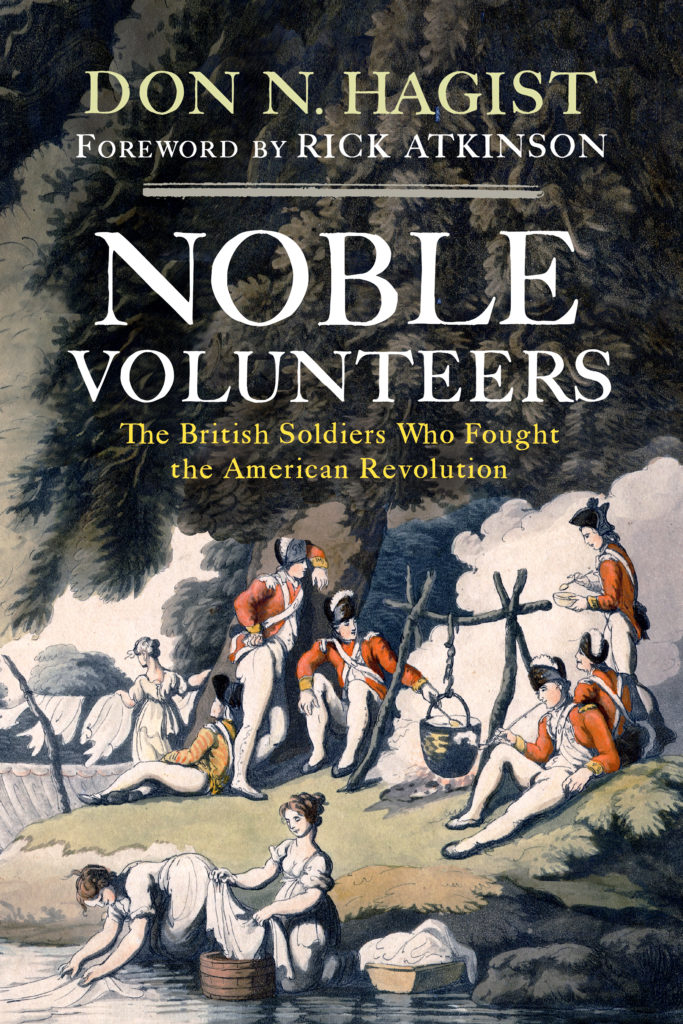
Don Hagist is one of our foremost American authorities on the common British soldier during the American Revolution. His latest book, Noble Volunteers: The British Soldiers Who Fought the American Revolution, is an institutional portrait of the British army that fought the American Revolution. Hagist has walked this ground before, most notably in British Soldiers, American War, which dedicated a chapter to a specific individual as a way of illustrating the experience of the common soldier. Noble Volunteers extrapolates on that, using soldier accounts, regimental paybooks, muster rolls, pension applications, and any other available material to give us an integrated picture of the entire army and how it functioned. It’s an extraordinarily valuable book.
Emerging Revolutionary War welcomes guest historian Sean Chick
On October 7, 1780, Britain’s attempt to regain at least part of the rebellious North American colonies was dealt a major blow at King’s Mountain. The rebels rejoiced, since it was their first major victory since 1777 and it came after the twin disasters at Charleston and Camden. Thomas Jefferson, then governor of Virginia, considered it the decisive battle of the war. Years later, Theodore Roosevelt echoed that sentiment. In 1930, when the site was set to become a national park, Herbert Hoover gave a speech. For the embattled president, it was an attempt to shore up his falling support and vindicate his strategy to peel southern states away from the Democratic Party. Hoover said “This is a place of inspiring memories. Here less than a thousand men, inspired by the urge of freedom, defeated a superior force entrenched in this strategic position. This small band of Patriots turned back a dangerous invasion well designed to separate and dismember the united Colonies.”
Hoover, understandably, never mentioned the atrocities committed. Many were executed after the battle. Nor did he mention that King’s Mountain was not a contest between redcoats and rebels, but brother against brother. The only British man present was Major Patrick Ferguson. His command was made up entirely of Loyalists. His second in command, Captain Abraham de Peyster, was from New York City.
Joseph Galloway (courtesy of NYPL)
Few groups in American history are as forgotten as the Loyalists and few were as complex. They were a varied lot, often making up the highest in colonial society, including wealthy merchants and colonial officials. They often included the very lowest in the society, such as recent immigrants, slaves, indigenous, and subsistence farmers. Their ideology was in many ways not radically different from those who rebelled. They were generally not in favor of absolute monarchy or the supremacy of Parliament but simply favored union with Britain and slow reform. A few, such as Joseph Galloway, were part of early protests against British colonial policy, but were unwilling to jump into the chasm of revolution. Some, such as South Carolina merchant David Fanning, were merely aggrieved and sought to settle scores. Others were on the margins of society and saw the colonists, or at least the revolutionary colonial elite, as their real oppressors.
The Loyalists were at first spurned by the British high command. Major General William had over 30,000 men under his command in 1776 and Loyalists would have added to the logistical strain. He also thought a soft war policy that he hoped would induce the colonies to return, and therefore it was reasonable to avoid civil war. Yet, by 1777 the British were using some Loyalist regiments. They would fight in John Burgoyne’s ill-fated drive on Albany and served as rangers at Brandywine.
Emerging Revolutionary War welcomes back guest historians Karl G. Elsea and William W. Welsch for thefinal installment of their three part series
1770 drawing of Hessian three-pounder gun and limber (courtesy of Kriegskarten from Hessisches Staatsarchiv Marburg, Germany at http://www.digam.net/?str=177)
The v. Lossberg Artillery detachment:
Bombardier Conrad Volprecht was about 44 years old with over 27 years of service. He led the v. Lossberg artillery detachment consisting of another bombardier, 13 gunners and 3 matrosses, with two three-pounder guns and associated horses, harness, and limber.[i]
Over two years after the battle and being a prisoner Bombardier Volprecht gave testimony that indicated the sequence of battle for his detachment was roughly as follows: First went to field, second fired north, third ordered south, and fourth got stuck in the mud till the end of the battle. There is a problem though, the sequence that better fits the data from the battle was as follows: first went to field, second ordered south, third fired west, and fourth got stuck in the mud.
John Adams wrote “Facts are stubborn things. They cannot be altered by our wishes, our inclinations, or the dictates of our passions.” In studying firsthand accounts of the battles in the Revolutionary War they are sometimes not correct or even true. For example, there is an enjoyable firsthand account (written many years later) by a patriot Sergeant White (The Good Soldier White) that is often quoted in accounts of the battle. Parts of his story are no doubt true. The problem is that when Sgt. White states he was with “Lieut. Munroe, our late President of the U. States” and “I was the first that reach them [cannons],” and “They had all left it, except one man tending vent,” those specific parts of the story cannot be true. Hessian Lt. Englehardt would not have time to do all that he did and then cross the Assunpink bridge before the Jagers if artillery men from Sullivan’s column were that far up King Street. Facts from the battle mean that part of that story does not work.
The most important place in all the 13 states fighting for independence on December 26, 1776 from 8:00 am to 9:00 am was the long, narrow bridge over the Assunpink creek. It was held by Hessian Sergeant Muller and 18 men. Sgt. Muller was about 50 years old with about 32 years of service. The importance of this place was not fully realized by the Hessians, but the Patriots knew it had to be closed, and General Washington had two full brigades, Sargent’s and Glover’s, tasked with taking, as quickly as possible, and then holding the bridge.
At about 8:03 am Patriot General Sullivan was about one mile from Trenton center along the River road when he attacked the outlying Jager pickets. General Sullivan had the artillery fire several canister shots at the Jagers. This firing also served as a signal to General Washington so he would know his other wing was attacking. It was to be recalled that General Washington started his attack about 8:00 am on the Pennington road and he also was about a mile from Trenton center. This cannon firing was also a signal to General Ewing so he knew when to start his distraction. General Ewing heard the three cannon shots and he quickly followed with his guns and howitzers firing ten shots from across the Delaware River. General Ewing kept up his firing until he could make out that Patriots were approaching. The v. Knyphausen regiment was forming on Second Street and was the logical unit to resist any attack coming from the River Road.
Volprecht’s detachment with its two guns followed Lt. Fischer’s detachment east on Fourth Street from the Methodist church into the field north and east of the Quaker lane. Lt. Fischer’s detachment was falling back from its earlier engagement and picked up the v. Lossberg detachment as it passed by. It took longer for the v. Lossberg artillery detachment to prepare for the battle because the horses had to be collected, harnessed, hitched, and the guns limbered. Fischer testified that the “cannon were unhorsed, and the horses unharnessed and brought back again into the stable” from the cancelled early morning patrol.[ii] For the morning patrol the horses had been hitched and guns limbered at 4:00 am but the patrol was cancelled so the men/horses/limber/guns were brought back to the Methodist church and waited for sunrise to unhorse.
The infantry of the v. Lossberg and Rall regiments followed Volprecht’s detachment into the field. It was in this field that these two regiments would form a line for battle. While waiting for the v. Lossberg regiment to form Volprecht was ordered by Lt. Weiderhold, “Artillery men, come here with the cannon” meaning they were to join the v. Knyphausen regiment.[iii] The v. Knyphausen regiment was on Second Street heading to the open field just east of Trenton and away from the Assunpink bridge. Volprecht and his v. Lossberg artillery detachment moved south on Quaker lane, linked up with the v. Knyphausen regiment, and set up his gun position facing threats coming from Trenton. The following map presents Trenton as it was in 1776.[iv]
While this was happening on the Hessian side, the right wing of the Patriot forces was moving east on River Road. General Sullivan rushed two of his brigades toward the Assunpink bridge. Neil’s battery with Sargent’s brigade and Sargent’s battery with Glover’s brigade made it to the bridge and across. Glover’s brigade with Sargent’s battery continued along the Assunpink creek to cut off possible exits for the v. Knyphausen regiment. St Clair’s brigade was moving east on Second Street with Moulder’s (three four-pounders) and Hugg’s artillery (two three-pounders).
Hessian Bombardier Volprecht testified that he fired his gun five times and the other gun fired one time.[v] One of those six shots hit the fore horse of one of Hugg’s three-pounder guns as they advanced in support of Patriot St. Clair‘s brigade. John Greenwood, a fifer in the 15th Continental, recorded that one of Hugg’s guns had the fore horse shot by a Hessian three-pounder gun, ”the ball from which struck the fore horse that was dragging our only piece of artillery, a 3-pounder. The animal, which was near me … was struck in its belly and knocked over on its back. While it lay there kicking the cannon was stopped.”[vi] That was the only hit scored by the Hessian artillery that day. St. Clair’s brigade with Col. Stark’s infantry in the lead applied great pressure causing the v. Knyphausen regiment to pull back farther east. Volprecht’s artillery detachment pulled back with the regiment.
As the Hessian artillery detachment pulled back east disaster struck both guns. Volprecht had been ordered into a valley without the ground being checked. Both guns got stuck in the mud. The rest of the battle the men of the artillery, with some aid from nearby infantry, was spent trying to extract the guns from the mud. One gun was extracted just before the surrender, the other gun was extracted after the battle was over.
Mud ended the third artillery engagement. The battle at Trenton was over. The Patriots had a great victory. What is shocking was the limited number of shots from the Hessian artillery. The Rall artillery detachment fired twelve solid shot and one grape, the v. Knyphausen artillery detachment fired “seven or eight shots,” and the v. Lossberg artillery detachment fired six shots.[vii] These few shots lend support for how quickly the Patriots won the Battle of Trenton.
Sources:
[i] William S. Stryker, The Battles of Trenton and Princeton (The Riverside Press, Cambridge, 1898), 388
[ii]Hessian Documents of the American Revolution, Morristown National Historical Park, ML, The Affair at Trenton Dec. 26, 1776, English Translation, ML 337
[iii] Hessian Documents of the American Revolution, Morristown National Historical Park, ML, The Affair at Trenton Dec. 26, 1776, English Translation, ML 277
[v] Hessian Documents of the American Revolution, Morristown National Historical Park, ML, The Affair at Trenton Dec. 26, 1776, English Translation, ML 277
[vi] John Greenwood, Revolutionary Services of John Greenwood of Boston and New York, 1775-1783, 40-41. “the first intimation I received of our going to fight was the firing of a 6- pound cannon at us, the ball from which struck the fore horse that was dragging our only piece of artillery a 3-pounder.” Retrieved from https://archive.org/details/revolutionaryser00gree/page/38/mode/2u
[vii] Hessian Documents of the American Revolution, Morristown National Historical Park, ML, The Affair at Trenton Dec. 26, 1776, English Translation, ML 341