While driving near York, Pennsylvania, I decided to stop by Prospect Hill Cemetery to visit the grave of Union General William Franklin. The cemetery was massive, and after locating Franklin’s grave and snapping a few photographs, I continued up the hill where I saw a plot devoted to dead Union soldiers who died while being treated at the army hospital located in York during the war. They were men from all throughout the North. Many of them simply having volunteered to fight, marched away from home, got sick, and died.
An older grave caught my eye just a stone’s throw away from the Civil War graves – a notable one that I did not know was in the cemetery. It was the grave of another non-Pennsylvanian. In fact, he was a New Yorker, and died in York in June of 1778, while a sitting member of the Continental Congress. It was the final resting place of a signer of the Declaration of Independence – Philip Livingston.
Philip Livingston certainly is not one of the Founding Fathers we remember. In fact, we probably remember his brother, William, who served as New Jersey’s Governor during the war, more. But Philip had a very impressive resume and played a part in nearly every major political conference in the colonies held in the years leading up to and during the early days of the American Revolution.
Born in 1716, Livingston graduated from Yale and pursued a career in the import business. Quickly, he built on his status and influence after relocating to Manhattan. He attended the Albany Congress in 1754, and was a member of the Stamp Act Congress, New York’s Committee of Safety, and president of the New York Provincial Congress in 1775. The prior year, Livingston was appointed to the First Continental Congress and was forced to flee his Manhattan home with his family when the British occupied the city in 1776. While he participated in the Second Continental Congress, he also served in the New York Senate.
Unfortunately, Livingston would never get to see his dream of an independent American nation become a reality. Following the British capture of Philadelphia in 1777, the Continental Congress relocated to York, Pennsylvania. Livingston had been suffering from dropsy, and his health was quickly deteriorating. He died suddenly in York while Congress was in session on June 12, 1778, and was laid to rest on Prospect Hill.
Grave of Philip Livingston, Prospect Hill Cemetery, York, Pennsylvania
If you ever find yourself near York, take the time to visit the grave of a Founding Father who, far from home, died before the cause in which he pledged his life and sacred honor for could be won.
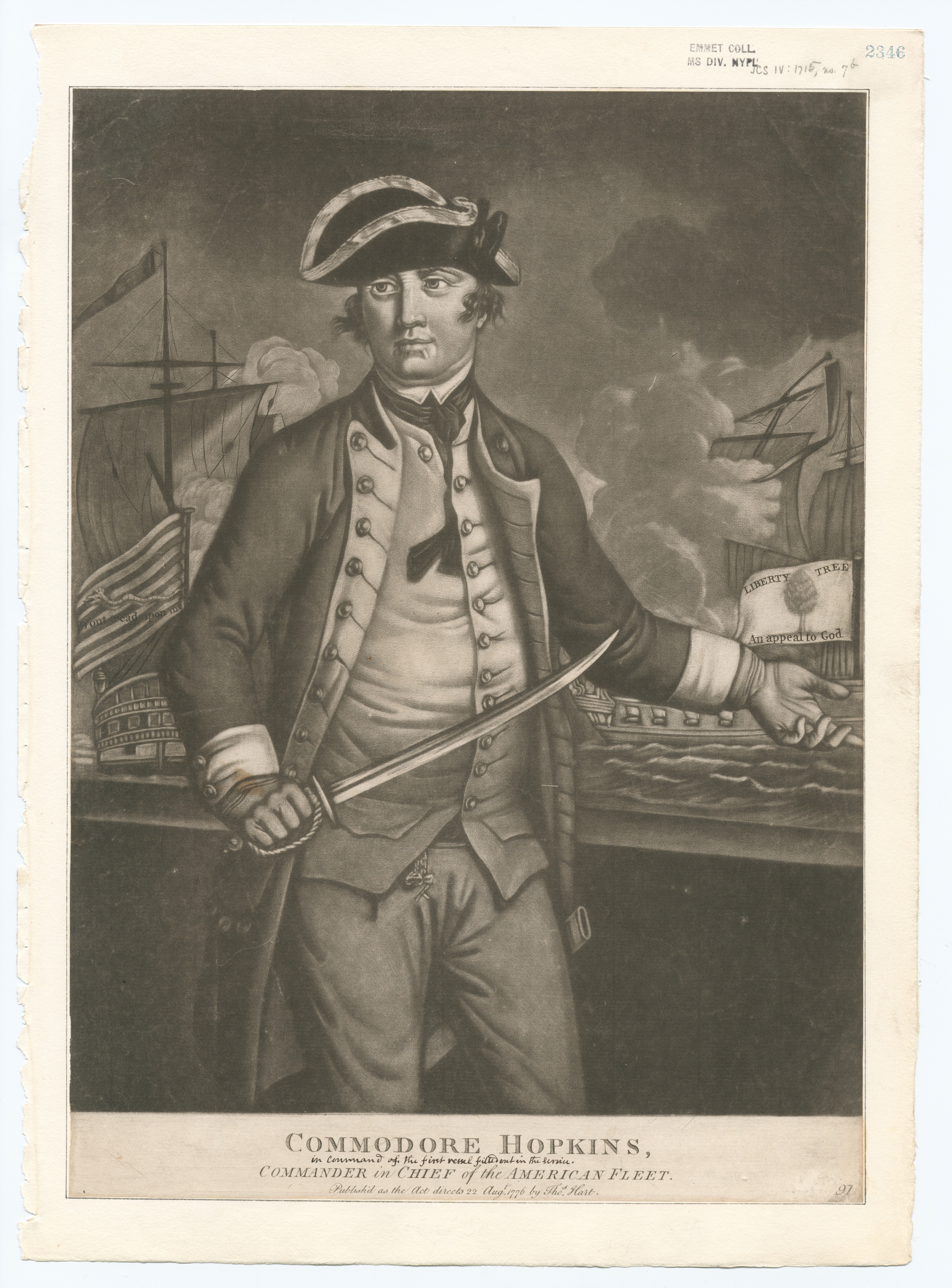
In March, 1776 Commodore Esek Hopkins led the bulk of the Continental Navy on a raid to the Bahamas, where it occupied the town of New Providence on Nassau Island for two weeks. Hopkins and his captains were drawn by a report of gunpowder stored in the town, which the patriot cause desperately needed.[1] Unfortunately for Hopkins, the colony’s governor had spirited away some 150 barrels the night before the American flotilla’s arrival. Not all was lost as the Marines quickly demanded and received the surrender of two small forts defending the town and its harbor. With those in hand, Hopkins and his men quickly got to work removing artillery, military stores, and other useful supplies.
While the American Marines and sailors managed to recover just 24 casks of powder, their haul in sizeable artillery pieces and mortars was impressive: 88 cannon ranging from 9- to 36-pounders; 15 mortars from 4-11 inches; 5,458 shells; 11,071 roundshot; 165 chain & double shot, plus fuses, rams, sponges, carriage trucks, mortar beds, copper hoops, and various stores not required for artillery.[2] It was a boon to be sure. The curious part of Hopkins’ inventory of captured war material, however, is that he sent it to Connecticut Governor Jonathan Trumbull, not a representative of the Naval Committee that had issued his orders. To John Hancock, president of the Continental Congress, he sent a report of his mission, but only mentioned “I have taken all the Stores onboard the fleet.”[3] Indeed, his report of the armaments aboard the British schooner Hawke, which the fleet captured on its return to American waters, was more complete. It took another day, until April 9, for Hopkins to forward the inventory of seized cannon. Congress merely resolved that an extract of his letter should be published for delegates to peruse.[4] Perhaps inadvertently, Hopkins exacerbated regional political conflicts and undermined his own command.
Join us this Sunday night at 7pm as we welcome Glenn F. Williams, PhD to our popular Sunday night Rev War Revelry! Glenn will examine the political and economic causes of the American Revolution beginning at the end of the Seven Years War / French and Indian War through the resistance movements. He will dispel or clarify some of the popular beliefs about the grievances that eventually led the thirteen colonies to break with the Mother Country. This will be a timely discussion as we approach the 250th anniversary of the Boston Tea Party. Glenn Williams is a retired U.S. Army officer that until recently also enjoyed a “second career” as a military historian. He retired as a senior Historian after 18 years at the U.S. Army Center of Military History and 3 1/2 years as the historian of the American Battlefield Protection Program of the U.S. National Park Service.
Grab your favorite drink and tune in, we will be live so feel free to drop your questions in the live chat. If you are not able to tune in on Sunday, the video will be placed on our You Tube and podcast channels.
We are happy to welcome Eric Sterner to our Third Annual Symposium on the American Revolution, co-hosted with Gadsby’s Tavern Museum, The Lyceum and Emerging Revolutionary War. This year’s theme is “The World Turned Upside: The American Revolution’s Impact on a Global Scale. We asked Eric to answer a few questions about their talk and their passion for history.
Eric Sterner is a writer focusing on American history, particularly the Revolutionary War and Civil War. He writes frequently for the Journal of the American Revolution (http://allthingsliberty.com) and blogs regularly at the Emerging Revolutionary War Era (http://emergingrevolutionarywar.org) in addition to contributing to other publications over the years. Westholme Publishing released his book: Anatomy of a Massacre: The Destruction of Gnadenhutten, 1782 in 2020. He is currently working on a micro history of the Crawford Campaign (1782) and a survey of George Rogers Clark’s Illinois Campaign (1778-1779).
In his prior life, Eric worked in the fields of national security and aerospace, holding senior staff positions for two different Congressional committees and serving at the Department of Defense and NASA. In the private sector, he worked in the fields of national security policy analysis and telecommunications and then held fellowships at the George C. Marshall Institute and the American Foreign Policy Council. At both places, his work focused on national security, cyber-power, and space policy and appeared in the academic, trade, and popular media. He also taught graduate courses in cyber power at Missouri State University, Georgetown, and George Washington University. He holds a Bachelor’s Degree in Soviet and International Studies and
What first attracted you to the study of early American history? What keeps you involved in the study of this history? Do you find these things are the same or different?
I was born in the Land of Lincoln, but as a kid, we often visited our grandparents outside Philadelphia, touring the local sites. My great-grandfather sometimes took us on walks through Valley Forge and the memories stuck. History became a hobby after that, but stories about real people and events always held more fascination than fiction. So, when the opportunity came later in life to pursue that interest with intensity, it was only natural to take it.
Why do you think it is important for us to study the Revolutionary Era?
We still wrestle with many of the same questions as the founding generation: what conditions warrant rebellion, how to prevent the abuse of power, how to secure individual liberty, how to determine and enact the majority’s will, etc. Despite their limitations, that generation’s answers to those questions are still relevant and illuminating.
What do you think was the most significant foreign impact on the American Revolution?
France’s declaration of war and alliance with the United States, followed by Spain’s declaration of War on Great Britain, transformed the Revolution into a global struggle. The stakes grew exponentially from an imperial and philosophical perspective and Britain immediately had to change its strategy.
What are some of the important lessons of the American Revolution do you think are still relevant today?
Warfare always exacerbates a tendency towards extremism, dehumanization, and excess, often reducing people to the most base instincts. Somehow, the Revolutionary War generation managed to overcome—in the main—the disastrous effects of these tendencies. While they failed to adhere to their ideals in many ways, principally by in leaving the institution of slavery in tact, the the fact that they managed to bridge differences, compromise, and create a republic in the aftermath of a war with so many facets is remarkable. Understanding how they did that and what it might require of us would serve the United States well 250 years later.
What was it about the American Revolution that elicited such global interest?
It is easy to focus on the effects of a colonial rebellion on European states with colonies all over the world. Clearly, a successful rebellion had implications for those colonies. But, Enlightenment ideas also popular in Europe ranged from the rationalization and efficiency of government institutions to more well-known and celebrated concepts of human individuality and the sources of sovereign authority. In many ways, the American Revolutionary Era was the first real-world test of those ideas. Thus, whether one opposed the Revolution for imperial reasons or supported it for philosophical ones, it could not help but fascinate the world.
Join us for our Third annual Emerging Revolutionary War Symposium on September 24, 2022. Emerging Revolutionary War is excited to continue our partnership with Gadsby’s Tavern Museum and The Lyceum of Alexandria, VA to bring to you a day-long Symposium focusing on the American Revolution.
Registration fee is now only $60 per person and $50 for OHA members and students. If you feel more comfortable attending virtually, the fee is $30. To register visit: https://shop.alexandriava.gov/EventPurchase.aspx
In the throes of the winter of 1778, spent at Valley Forge, General George Washington and his staff formulated a mountain of paperwork to multiple recipients of the American cause. On February 16, 1778, Alexander Hamilton composed a letter for the commander-in-chief of the Continental army to a gentleman who had moved from the military to the political ranks; George Clinton of New York.
George Clinton
He had seen service in the Hudson Highlands and had been commissioned a brigadier general in the Continental army on March 25, 1777. Later that same year both governor and lieutenant governor of New York, formally resigning the latter and accepting the former on July 30, 1777. In that capacity, he received the letter, excerpts below, from Valley Forge.
“It is with great reluctance, I trouble you on a subject, which does not properly fall within your province; but it is a subject that occasions me more distress, than I have felt, since the commencement of the war; and which loudly demands the most zealous exertions of every person of weight and authority, who is interested in the success of our affairs.”I mean the present dreadful situation of the army for want of provisions and the miserable prospects before us, with respect to futurity. It is more alarming, than you will probably conceive, for to form a just idea, it were necessary to be on the spot.2 For some days past, there has been little less, than a famine in camp. A part of the army has been a week, without any kind of flesh & the rest three or four days.3 Naked and starving as they are, we cannot eno⟨ugh⟩ admire the incomparable patience and fidelity of the soldiery, that they have not been, ere this, excited by their sufferings, to a general mutiny and dispersion. Strong symptoms however of discontent have appeared in particular instances; and nothing but the most active effort⟨s⟩ every where, can long avert so shocking a catastrophe.
Washington then asks for any help or supplies that Clinton can send his way, even though the army is outside the state lines of New York. Washington’s mindset is that the cause of the army in Pennsylvania is the cause of American independence and that Clinton, who had served would recognize that and do his utmost to provide what he can.
“I am calling upon all those, whose stations and influence enable them to contribute their aid upon so important an occasion, and from your well known zeal, I expect every thing within the compass of your power, and that the abilities and resources of the state over which you preside, will admit. I am sensible of the disadvantages it labours under, from having been so long the scene of war, and that it must be exceedingly drained by the great demands to which it has been subject, But though you may not be able to contribute materially to our relief, you can perhaps do something towards it; and any assistance, however trifling in itself, will be of great moment, at so critical a juncture, and will conduce to keeping the army together, ’till the Commissary’s department can be put upon a better footing, and effectual measures concerted to secure a permanent and competent supply. What methods you can take, you will be the best judge of; but if you can devise any means to procure a quantity of cattle or other kind of flesh, for the use of this army, to be at camp in the course of a month, you will render a most essential service to the common cause.“
Not only did Clinton receive this missive from Washington, dated February 16, but the following day Gouverneur Morris from a camp committee established by the Continental Congress also sent the New York governor a letter asking for any assistance he could provide for the army at Valley Forge.
These letters underscore the seriousness of the plight of the army encamped at Valley Forge as the winter slowly turned to spring. The action at Washington’s headquarters and from the camp committee helped create a path forward through that pivotal winter. To learn more about what transpired during those six months from December 1777 to June 1778, follow the link above to the “2022 Bus Tour” and join Emerging Revolutionary War on our second annual bus tour November 11-13, 2022.
The entire letter from Washington (Hamilton) to George Clinton can be found here.
In June 1778, the Continental army marched out of their winter encampment in Valley Forge, Pennsylvania and headed toward New Jersey in pursuit of the retreating British army. The past six months, from December 1777 to June 1778, ushered in a period of suffering, renewal, and change.
Valley Forge is imprinted into the psyche of Americans as the the toughest winter of the entire American Revolution. In fairness, it was one of many tough winters that the Continental army survived. However, the reasons why this winter stands out will be part of the discussion of this Sunday evening’s “Rev War Revelry” which can be found on Emerging Revolutionary War’s Facebook page at 7 pm. EDT.
This week’s historian happy hour includes a discussion with Philip S. Greenwalt author of the recently released Emerging Revolutionary War Series title, The Winter that Won the War. This is the fourth volume in the series, with previous ones covering Lexington and Concord, Trenton and Princeton, and Monmouth.
Greenwalt will discuss how the Valley Forge winter was the intersection of various issues and how the decisions made and the determination of survival by the army made this the winter that won the war.
Tune in as well to hear how you can purchase a copy of this book to take with you as you plan that summer trip to Valley Forge and the Philadelphia area!
As this posting goes live today, July 2, there is a link to the American Revolutionary War era. This was the day that John Adams, future president of the United States, believed would be the date Americans would celebrate as their independence day.
Yet, the day reserved for that celebration would fall two days later, on July 4, the date that John Hancock affixed his signature as president of the Continental Congress.
However, join Emerging Revolutionary War historians and three guest historians this Sunday, July 5, at 7 pm EST, on our Facebook page, as another date to talk “All Things Independence Day” including John Adams and Independence Hall.
Joining ERW to discuss John Adams and Thomas Jefferson, which will be the volume in the Emerging Revolutionary War Series, is Emerging Civil War co-founder and Stevenson Ridge historian-in-residence, Dr. Chris Mackowski.
Savannah Rose, a National Park Service ranger at Independence National Historical Park and the new layout coordinator for the Emerging Revolutionary War Series. You can see her work with the upcoming A Handsome Flogging, on the engagement at Monmouth Course House, which just shipped from the printer this week.
Rounding out the triumvirate of guest historians will be Dan Welch, who you may remember from his dramatic reading of “A Midnight Ride” the poem about Paul Revere’s Ride. Dan is also a seasonal historian with the National Park Service at Gettysburg National Military Park.
As you round out your holiday weekend, we hope that you include “Rev War Revelry” as one of the events you attend to commemorate Independence Day weekend. We look forward to toasting you as we enjoy our favorite brews and discuss “All Things Independence.”
Emerging Revolutionary War welcomes back guest historian Blake McGready for part two of the series. To read part one, click here.
While her poetry avoided wartime
setbacks and conjured stories of revolutionary unity, Stockton’s poems did
confront the violent realities of what she called “a most cruel and
eventful war”. Her choice
allusions demonstrate how, in her mind, wartime violence bound the
revolutionaries together. Following the death of General Joseph Warren
at the battle of Bunker Hill she lamented, “That heart, which, studious of his
countries good / Held up her rights and seal’d them with his blood!” In 1776 Stockton
wrote of revolutionary soldiers who “fought and bled to save their native land
/ From bowing to a tyrant’s stern command,” and honored great men dying on
battlefields “Made fertile by the blood of heroes slain.” Whereas historians
have noted how the war’s violence was often deliberately excluded from the
popular imagination, by contrast, Stockton’s war and violence were inseparable.[i]
Setting aside one day to give national thanks to God for the blessings of the prior year and beseech him for future blessings had been frequently practiced in England, but it merged with several Puritan traditions in New England during the 17th century. By the time of the American Revolution, Thanksgiving was a well-established custom. The Second Continental Congress turned a regional tradition into a national one when offered its first Thanksgiving Proclamation on November 1, 1777, recommending that the individual states of the new United States set apart December 18th as a day of Thanksgiving and praise. During the Revolution, Congress continued the practice, issuing its last proclamation in 1784.
A few random musings on the importance of this date in American Revolutionary history…
President’s chair, Independence Hall, Independence National Historical Park (author collection)
This day was the date that the assembled Second Continental Congress voted on the draft of a document that was Richard Henry Lee, a delegate from Virginia had put forth in a measure, in June, to be voted on declaring;
“That these United Colonies are, and of right out to be, free and independent States, that they are absolved from all allegiance to the British Crown, and that all political connection between them and the State of Great Britain is, and ought to be, totally dissolved.”
Thomas McKean by Charles Wilson Peale
On July 4, two days after this resolution passed, the final and formal version was approved by Congress. John Hancock, president of the Continental Congress affixed his signature boldly and largely at the bottom of the document. Eventually 55 other men would place their signature on the Declaration of Independence, with Thomas McKean, generally accepted, as the last to sign the document, possibly as late as January 1777.
Copies were made and four days later, on July 8, the first public reading occurred in Philadelphia. George Washington had the document read to the Continental Army in New York on the following day, July 9.
John Adams by Gilbert Stuart
For John Adams, future second president of the United States, the second day of July would and should be the day to remember American Independence, as he wrote;
“The most memorable Epocha, in the History of America. I am apt to believe that it will be celebrated, by succeeding Generations, as the great anniversary Festival…It ought to be solemnized with Pomp and Parade with shews, Games, Sports, Guns, Bells, Bonfires, and Illuminations from one End of this continent to the other from this Time forward forever more.”
And that is how many Americans choose to celebrate the anniversary of the Declaration of Independence, however, usually two days later on July 4th. Yet, it took another war; World War II, for July 4th to become a national paid holiday for workers of the Federal government when Congress approved it in 1941.
So, happy Independence Day!
*Feel free to add any interesting historical tidbits about the Second Continental Congress, the signers, or 1776 below!*






 Emerging Revolutionary War Era