A New Look for <i>A Dear-Bought Victory</i>

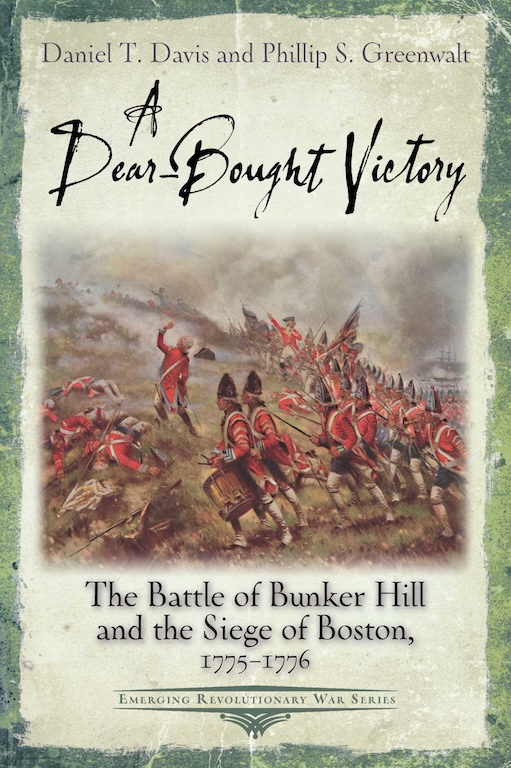
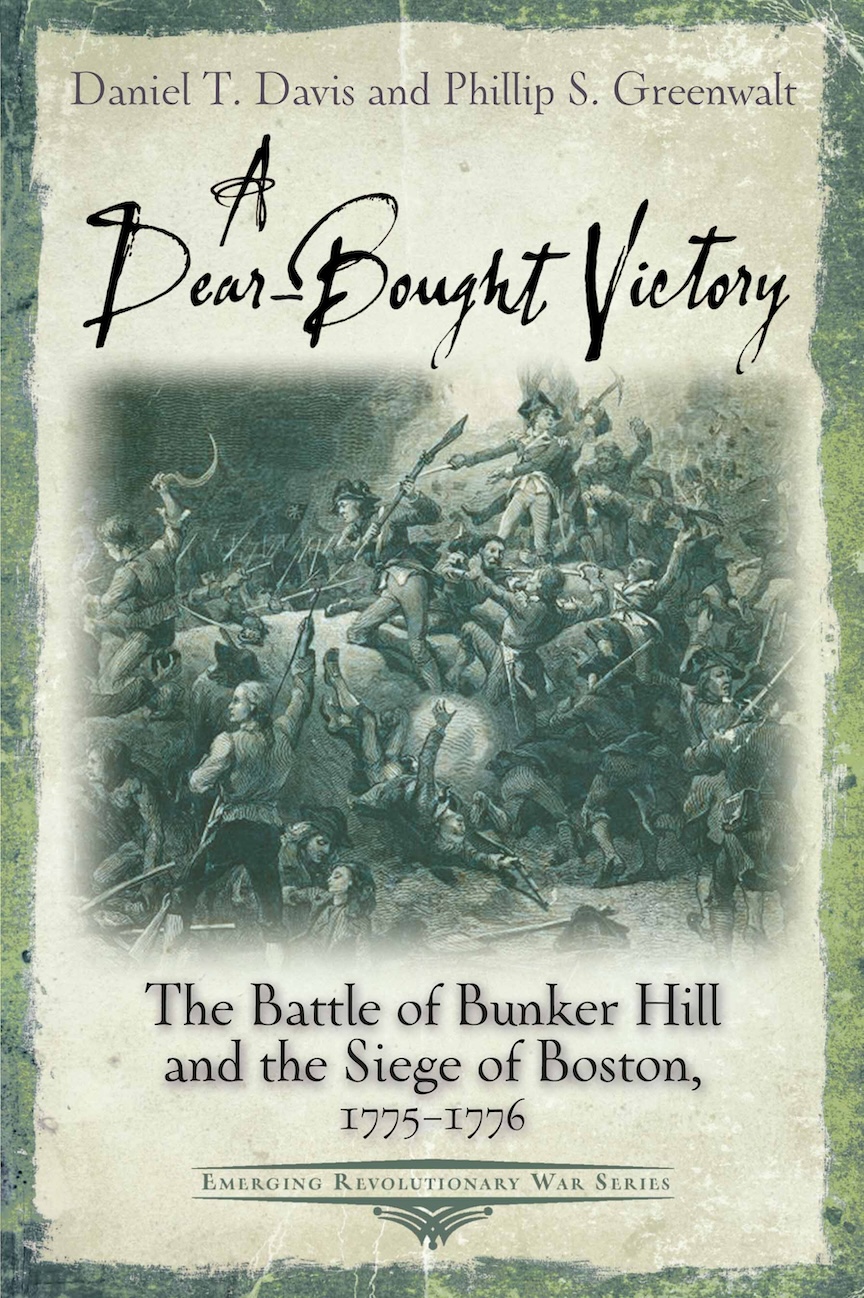
We’ve made an update to the cover of our upcoming book on the battle of Bunker Hill by Dan Davis and Phill Greenwalt. We thought you’d like a peek:

The previous cover design featured a woodcut that was obviously in the public domain–yet we couldn’t quite put our finger on it. That made us nervous enough to swap out the image!

The replacement image, which comes courtesy of the Library of Congress, was painted by E. Percy Moran around 1909. It shows the advance of British troops up the slope of Breed’s Hill, where they paid a heavy toll—indeed, a dear-bought victory.

We love the contrast between the red coats and the green design, which is much more eye-catching than the original cover. We hope you agree: this really pops!

Look for A Dear-Bought Victory: The Battle of Bunker Hill and the Siege of Boston by Daniel T. Davis and Phill Greenwalt coming in June 2026.

Coming Soon: A Dear-Bought Victory: The Battle of Bunker Hill and the Siege of Boston 1775-1776

We’re excited to share one of the 2026 new releases in the Emerging Revolutionary War Series. Published by Savas Beatie, a sneak peek, including the cover, is below.

About the Book:

“I wish we could sell them another hill at the same price we did Bunkers Hill,” Nathanael Greene wrote to the governor of Rhode Island after the battle of June 17, 1775.

Actually fought on Breed’s Hill outside Boston, Massachusetts, the battle of Bunker Hill proved a pyrrhic victory for British forces. Confident in their ability to overwhelm the New England militia that opposed them, long lines of neatly uniformed British infantry and marines swept uphill toward a quickly built earthen redoubt defended by a motely collection of farmers, shopkeepers, and tradesmen.

“Don’t fire until you see the whites of their eyes!” the colonials urged each other—or did they?

By the end of the fight, the British gained the summit and Colonial forces scattered. One of the patriot leaders, Dr. Joseph Warren, lay dead—one of the first martyrs of the American Revolution. But for the British, the scene was far, far worse: it would be the greatest number of casualties they would ever suffer in any battle of the American Revolution. As British General Henry Clinton commented afterward, “A few more such victories would have surely put an end to British dominion in America.”

The siege of Boston would continue, but the sobering lesson of Bunker Hill changed British strategy—as did the arrival soon thereafter of a new commander-in-chief of Continental forces: General George Washington.

In A Dear-Bought Victory, historians Daniel T. Davis and Phillip S. Greenwalt separate the facts from the myths as they take readers to the slopes of Breed’s Hill and along the Boston siege lines as they explore a battle that continues to hold a place in popular memory unlike few others.

About the Authors:

Daniel T. Davis is the Senior Education Manager at the American Battlefield Trust. He is a graduate of Longwood University with a bachelor’s degree in public history. Dan has worked as a Ranger/Historian at Appomattox Court House National Historical Park and Fredericksburg and Spotsylvania National Military Park. He is the author or co-author of numerous books on the American Civil War. This is his first co-authored book in the Emerging Revolutionary War Series. Dan is a native of Fredericksburg, Virginia.

Phillip S. Greenwalt is the co-founder of Emerging Revolutionary War and a full-time contributor to Emerging Civil War. He is a graduate of Wheeling Jesuit University with a bachelor’s degree in history along with graduate degrees in American History and International Studies and Leadership from George Mason University and Arizona State University, respectively. He is the author of co-author of seven books on the American Revolutionary and Civil Wars. Phill has worked for the National Park Service for the last 17 years at numerous natural and cultural sites. He is a native of Baltimore, Maryland.

August 15, 1780 – Horatio Gates, Thomas Sumter and the road to Camden

Major General Horatio Gates, “Hero of Saratoga” was tasked with saving the American effort in the south. Credit NPS

On August 15, Maj. Gen. Horatio Gates began to finalize his plans to move against Camden, SC. Gates, appointed as the new commander of the Southern Department the previous month, believed the British garrison in Camden was weak. Gates was receiving intelligence gathered by partisan commander Thomas Sumter who was acting in and around Camden. He informed Gates that the American army outnumbered the British post and that a large portion of the men at Camden were taken ill and not fit for duty (on this account, Sumter was correct). Sumter did not provide the intelligence that Lord Cornwallis was now in Camden with reinforcements and was taking personal command of the British force in Camden.

Modern day image of the area at Rugeley’s Mills, with modern day Flat Rock Road following the historic trace of the Great Wagon Road. Credit Rob Orrison

With this information, Gates felt confident in his ability to take on the British in Camden. He developed a plan that involved a three-part movement. He would leave his force south to Saunder’s Creek (about six miles north of Camden) and establish a strong defensive position. He also ordered Francis Marion and his men to the southeast. Gates wanted Marion to take command of the Williamsburg militia, watch the British movements, and destroy boats in the Santee River that a defeated Cornwallis might need to retreat from Camden to Charleston. The third prong he ordered a few days earlier on August 13. Gates, under the encouragement of Thomas Sumter, decided to send 100 Maryland Continentals and 300 Carolina militiamen (as well as two brass three pounders) to join Sumter and move down the western side of the Wateree. From this location Sumter could attack supplies and reinforcements going into Camden from Ninety Six to the west. Gates’s confidence was evident.

South Carolina militia Brig. Gen Thomas Sumter. Credit New York Public Library

As Gates made his final disposition to move south, Sumter’s militia along with his Continental detachment met some success west of Camden. The Wateree River flowed south just one mile west of Camden. Near the important Wateree Ferry that served the major route west from Camden, Loyalist Lt. Col. James Cary built a small fort on his farm near the ferry. Sumter was aware of the fort and decided to see if he could capture it. When Col. Thomas Taylor of Sumter’s command launched the attack, most of the defenders inside were asleep, and the others were deceived by Patriot militia dressed just like those occupying the fort. The Loyalists immediately surrendered. Sumter reported that his men killed 7 and captured 30 prisoners, including Cary. Also included in the loot were 38 wagons of supplies and nearly 300 head of cattle. After capturing Cary’s Fort, Sumter was also able to attack and capture a relief column from Ninety Six to Camden. Sumter’s spoils from this attack numbered nearly 70 prisoners and numerous wagons. Sumter also reaffirmed his earlier intelligence to Gates by writing that the British in Camden “do not exceed two thousand, and not as many as one thousand of the militia, who aregenerally sickly, and much dispirited.” Sumter’s intelligence, though not accurate, gave Gates encouragement on the upcoming movement toward Camden. At 10pm on August 15, Gates had his army on the road south towards Camden.

Gates was flush with optimism, at that same time Cornwallis had his army on the road north. Though the British forces were about half the size of Gates, they were more than Gates expected and consisted of some of the best men in the British army led by one of their most accomplished generals. Soon, due to a twist of fate, these two armies collided along the Great Wagon Road in the long life pine forest of South Carolina. The result was one of the worst days in the history of the United States Army.

Authors Rob Orrison and Mark Wilcox’s new book “All That Can Be Expected: The Battle of Camden and the British High Tide in the South, August 16, 1780” is due out August, 2023 and available at: https://www.savasbeatie.com/

Sir Henry Clinton’s Close Encounter

Emerging Revolutionary War welcomes the contribution of Eric Olsen, Park Ranger/Historian at Morristown National Historical Park

Military history tends to be a lot of “so and so’s” brigade advanced on the left wing, while “what’s his face’s” division withdrew.” Lots of movements of large faceless masses of soldiers. Personally, I prefer the little personal stories of individuals in the face of battle. Here is one such story from the battle of Monmouth in June 1778. 

Sir Henry Clinton

I recently ran across this little tidbit in a July 7, 1778, letter written by the Adjutant General of the Hessian forces in America, Major Carl Leopold Baumeister. He described an incident during the battle of Monmouth involving the British commander in chief, Sir Henry Clinton. “General Clinton in the thickest fire, was saved by one of his adjutants, Captain Sutherland, when a rebel colonel aimed at him, but missed. Captain Sutherland’s horse was wounded. Another adjutant, Lloyd, stabbed the colonel.”

The story sounded vaguely familiar. Then I recalled something I’d read written by a British officer named Thomas Anbury. He was a prisoner of war, part of Burgoyne’s captured “Convention Army.” Anbury and the other prisoners were being held near Charlottesville, Virginia. At a place called Jones’s Plantation, Anbury related the following story on May 12, 1779,

“A very singular circumstance took place in that battle [Monmouth], which fully marks the coolness and deliberation, though in the heat of action, of Sir Henry Clinton: As he was reconnoitering, with two of his Aide de Camps, at the short turning of two roads, they met with an American officer, exceedingly well mounted upon a black horse, who, upon discerning them, made a stop, and looked as if he wished to advance to speak to them, when one of Sir Henry Clinton’s Aid de Camps fired a pistol at him, and he instantly rode off. Sir Henry was much displeased at his Aide de Camp, and censured him for being so hasty, adding, he was confident that the man wished to speak to him, and perhaps, might have given intelligence that would have been very essential, remarking, that when he was in Germany last war, and reconnoitering with Prince Ferdinand, a man rode up in a familiar manner, and gave such intelligence as decided the fate of the day.”

To read more about the Battle of Monmouth, check out “A Handsome Flogging, the Battle of Monmouth, June 28, 1778 by William Griffith, part of the Emerging Revolutionary War Series.

Rev War Revelry Discusses NEW Emerging Rev War Book!

Charleston, South Carolina is one of the most beautiful and historic cities in the United States. Numerous sites, battlefields, and buildings from the period of the Revolution still exist.

Join us this Sunday at 7pm as we discuss ERW’s newest release “To The Last Extremity: The Battles for Charleston” by Mark Maloy. In To the Last Extremity: The Battles for Charleston, historian Mark Maloy not only recounts the Revolutionary War history of Charleston, he takes you to the places where the history actually happened. He shows you where the outnumbered patriots beat back the most powerful navy in the world, where soldiers bravely defended the city in 1779 and 1780, and where thousands suffered under occupation. Through it all, brave patriots were willing to defend the city and their liberty “to the last extremity.”

We will talk to Mark about his research, his favorite and most compelling stories and why this book is a “must have” for any history buff. Join us this Sunday, April 16 at 7pm on our Facebook page to join in on the conversation. As always, if you can not join us live you can catch the talk at any time on our You Tube or podcast channel.

The March in…on this date in 1777

Beginning on December 8, 1777, General George Washington and his Continental army left the environs of White Marsh to begin the movement toward their winter encampment. The rank-and-file crossed over the Schuylkill River and headed westward. Within three days the soldiers had trudged into an area called the Gulph on a December Thursday morning.

During this sojourn Washington wrote a a flurry of orders and letters, finally selecting Valley Forge. His reasoning was explained in the general orders for that day while also observing another delay in order to honor a day of fasting and thanksgiving decreed by the Continental Congress. Washington began that general order on December 17, 1777 by acknowledging the thousands of men that were braving the weather, lack of sustenance, and the rigors of the 1777 campaigning season.

“The Commander-in-Chief with the highest satisfaction expresses his thanks to the officers and soldiers for the fortitude and patience with which they have sustained the fatigues of the Campaign. Altho’ in some instances we unfortunately failed, yet upon the whole Heaven hath smiled on our Arms and crowned them with signal success; and we may upon the best grounds conclude, that by a spirited continuance of the measures necessary for our defence we shall finally obtain the end of our Warfare, Independence, Liberty and Peace.

The march resumed around 10 a.m. on December 19, a Friday, as the Continental army trudged out of the Gulph Mills area and on to their final destination for 1777; Valley Forge. The army would soon spread out to occupy over 7,800 acres of Pennsylvania countryside and spend the next six months resting, recuperating, surviving, and training.

To read more about the end of the 1777 campaign and the winter spent at Valley Forge, check out the book, by yours truly, Winter that Won the War, part of the Emerging Revolutionary War Series, published by Savas Beatie, LLC.

An Advantageous Situation

Not long after the American surrender of Charleston, SC in May 1780, British infantry and cavalry detachments began moving inland, deploying across South Carolina. Hoping to create a defensive perimeter, they occupied various towns such as Camden and Ninety-Six. After Charleston fell, Patriot hopes in South Carolina rested almost solely on a few partisan fighters.

Prior to the surrender, however, General George Washington yet had hopes of lifting the British siege and raising the spirits of the southern people. From his post in the North, he dispatched a force of Maryland and Delaware Continental brigades to South Carolina. Under the overall command of Major General Johann von Robais, Baron de Kalb, the regiments making up these brigades contained some of the toughest combat troops to ever see action in the Continental Army. And their commander, the German-born, 59-year-old de Kalb, was himself a seasoned veteran of many European battlefields.

By mid-July, and after a difficult march through Virginia, de Kalb’s regulars reached Buffalo Ford in North Carolina where they halted to await orders and much needed supplies. Joining them in camp a few days later was the newly appointed commander of the Southern American Army, Major General Horatio Gates. Sent by Congress, the “Hero of Saratoga” brought news that a large force of Virginia militia was on its way to join them.

Major General Horatio Gates

At Buffalo Ford, Gates took stock of what he would term his “Grand Army”. The 1st Maryland Brigade was commanded by General William Smallwood. The 2nd Maryland, which included Colonel David Vaughn’s venerable Delaware Regiment, was under the command of General Mordecai Gist. There were three companies of Continental Artillery, with Lieutenant Colonel Charles Armand Tuffin, Marquis de la Rouerie’s Legion of approximately 120 infantry and cavalry troops on its way. Expecting militia troops from Virginia and North Carolina, Gates made the decision to focus his energies on Camden. To the dismay of his officers, he ordered his tired and hungry troops to prepare to march.

On August 13, 1780, by what some officers considered to have been an unnecessarily circuitous route, the Patriot army, which now included around 100 Virginia State troops under Lieutenant Colonel Charles Porterfield and the North Carolina militia commanded by General Richard Caswell, straggled into Rugeley’s Mills. Located around thirteen miles from Camden, the site was owned by loyalist, Colonel Henry Rugeley, and consisted of his home, barn, and mills. The next day, August 14, saw the arrival of the long-awaited Virginia militia, 700 strong, under General Edward Stevens.

At about this time, Horatio Gates made the dubious decision to detach around 300 regulars from the 5th Maryland Regiment, along with two field pieces, to join the partisan forces of General Thomas Sumter. Known as the Gamecock, Sumter was operating on the west side of the Wateree River and hoped to capture a British supply train heading to Camden from the post at Ninety-Six.

Almost immediately upon his arrival, General Gates made the determination that Rugeley’s Mills was not a secure and defensible position and sought information regarding sites closer to the British garrison which was now consolidated within the defenses at Camden. On August 15, he sent his capable engineering officer, the European Colonel John Christian Senf, along with Lieutenant Colonel Charles Porterfield, south along the Great Wagon Road towards Camden to reconnoiter. Returning from the scout, Senf recommended a defensible spot about halfway between Rugeley’s Mills and the town. In his later report to Congress regarding the affair, Gates indicated that, upon receiving the engineer’s report, he resolved to “…take post in an Advantageous Situation, with a deep creek in front, about seven miles from Camden.” 

It was believed by some at the time that Gates’ intention, in moving the army closer to the British, was to use what he believed to be his numerical superiority to attack and overwhelm a smaller enemy force. In a communication to his acting deputy adjutant general, the Marylander, Colonel Otho Holland Williams, General Gates relayed to him “a rough estimate of the forces under his command, making them upwards of 7,000.”  British strength was, at the time, estimated to be around 2,500, with several hundred ill and unfit for duty. Based on these troop figures, or what he believed them to be, an argument could reasonably be made that, at least initially, Gates was indeed contemplating a surprise attack on the British on the night of August 15, 1780. According to his Aide-de-Camp, Major Thomas Pinckney of South Carolina, a staunch supporter of the General, it was actually not Gates’ desire with this move to attack the enemy, however, “but for the purpose of occupying a strong position so near him as to confine his operations, to cut off his supplies of provisions, and to harass him.”  Such a move, therefore, to confine and harass the British is more logical, as it would be reminiscent of the strategy that had worked so well for Gates against British General John Burgoyne, at Bemis Heights, during the fighting at Saratoga in 1777.

On the afternoon of the 15th, Gates called “all the general officers in the army, to a council, to be held in Rugeley’s Barn.” Gates presented his plan to march south, with no objections voiced by the officers in attendance. According to the engineer, Colonel. Senf, “It was unanimously agreed upon to march that night the army to that creek, by which means they could get a more secure encampment, come nearer Genl Sumter, occupy the road on the east side of Wateree River, and would be able to get nearer intelligence of the enemy.” Otho Holland Williams would later write that, while there were no dissenting votes by the officers present, there were a few who harbored misgivings on the possible success of an American army comprised of so many green, untested militiamen. Still, the orders were issued; the army would “march at 10 PM at Night.” 

Upon learning of General Gates’ questionable estimate of his army’s troop strength, Colonel Williams had gone about the business of ascertaining a more reliable return from the field officers. In a lengthy description by Williams, he “busied himself in collecting these returns and forming an abstract for the general’s better information. This abstract was presented to the general just as the council broke up…He (Gates) cast his eyes upon the numbers of rank and file present fit for duty, which was exactly three thousand and fifty-two.” When learning that he commanded an army, not of 7,000 troops but, rather, an army of just over 3,000, placing them more on even terms with the British, the General seemed not to be deterred. He stated to Williams that “these are enough for our purposes.” But what exactly were those “purposes”?

Setting up a defensive position on the opposite bank above “a deep creek” made good sense. Based on Senf’s recommendation then, it was Gates’ apparent intension to march his army south along the Great Wagon Road to the ford at Sanders Creek where he would prepare a defensive line in hopes of luring the British into an attack. The location was well chosen as it was the only fordable spot along the creek for several miles.

The American Army began to prepare for the night’s march. According to General Gates, he ordered all heavy and excess baggage north, along with all remaining camp followers, to the safety of the Waxhaws. Ammunition wagons and other necessary baggage would make the march to Camden. The army, tired, hungry, and constantly without adequate supplies, needed to be fed. Before the march, Gates made another dubious decision: he would feed his hungry and depleted troops a full meal out of the hospital stores. This would include a gill (4 ounces) of molasses in place of rum, of which the Army had none. Otho Holland Williams would write: “As there were no spirits yet arrived in camp; and as, until lately, it was unusual for troops to make a forced march, or prepare to meet an enemy without some extraordinary allowance, it was unluckily conceived that molasses, would, for once, be an acceptable substitute.”  The effect on the men’s digestive systems was almost immediate. According to Williams: “The troops of General Gates’ army, had frequently felt the bad consequences of eating bad provisions; but, at this time, a hasty meal of quick baked bread and fresh beef, with a desert of molasses, mixed with mush, or dumplings, operated so cathartically, as to disorder very many of the men, who were breaking the ranks all night, and were certainly much debilitated before the action commenced in the morning.” Sergeant William Seymour of the Delaware Regiment would likewise write: “You must observe that instead of rum we had a gill of molasses per man served out to us, which instead of enlivening our spirits, served to purge us as well as if we had taken jallap.”

Thus, Horatio Gates, after a series of questionable decisions, put his weak, exhausted, and ill army on the road to Camden around 10 PM on August 15, 1780. The stage, as it would turn out, was set for disaster; 242 years ago today.

Mark Wilcox is the co-author (along with Rob Orrison) of a forthcoming book on the Battle of Camden titled “All That Can Be Expected” The Battle of Camden, August 16, 1780; published by Savas Beatie Publishing. The book is due out summer 2023.

“Rev War Revelry” The Winter that Won the War, Valley Forge

In June 1778, the Continental army marched out of their winter encampment in Valley Forge, Pennsylvania and headed toward New Jersey in pursuit of the retreating British army. The past six months, from December 1777 to June 1778, ushered in a period of suffering, renewal, and change.

Valley Forge is imprinted into the psyche of Americans as the the toughest winter of the entire American Revolution. In fairness, it was one of many tough winters that the Continental army survived. However, the reasons why this winter stands out will be part of the discussion of this Sunday evening’s “Rev War Revelry” which can be found on Emerging Revolutionary War’s Facebook page at 7 pm. EDT.

This week’s historian happy hour includes a discussion with Philip S. Greenwalt author of the recently released Emerging Revolutionary War Series title, The Winter that Won the War. This is the fourth volume in the series, with previous ones covering Lexington and Concord, Trenton and Princeton, and Monmouth.

Greenwalt will discuss how the Valley Forge winter was the intersection of various issues and how the decisions made and the determination of survival by the army made this the winter that won the war.

Tune in as well to hear how you can purchase a copy of this book to take with you as you plan that summer trip to Valley Forge and the Philadelphia area!

ERW Annual Fall Trip Takes on Yorktown, Great Bridge and Williamsburg

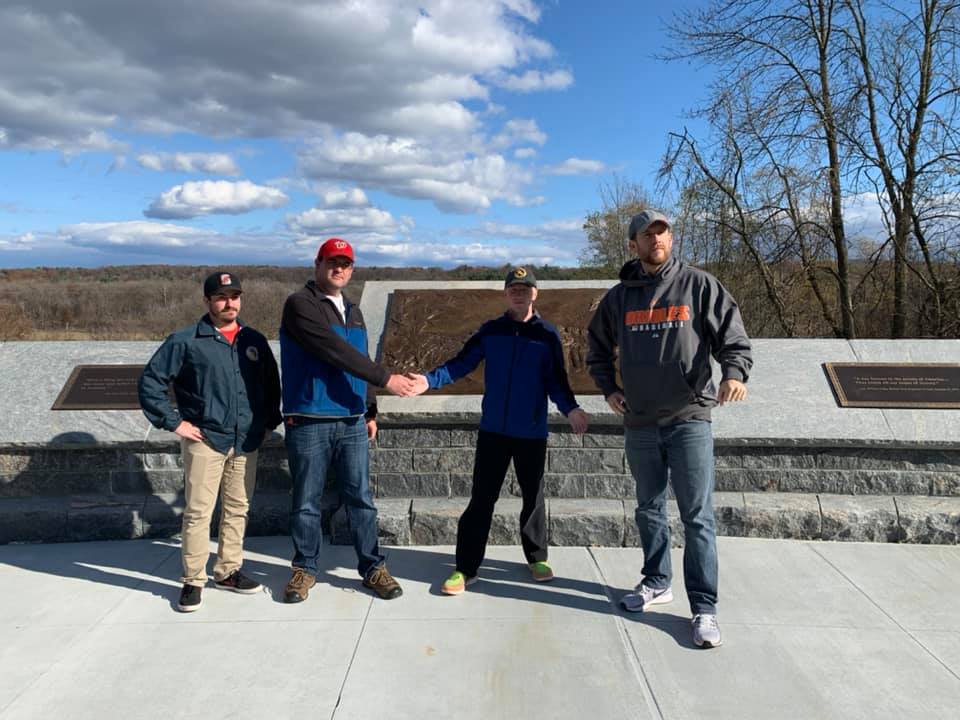
Every year the historians of Emerging Revolutionary War take a fall trip to research, visit Revolutionary War sites/battlefields and to promote our museum partners and preservation. The trip usually is a follow up to our Annual Symposium, but with the COVID-19 pandemic, that has been moved to May 22nd (you can get more information on speakers, topics and registration on our Symposium link from our main page).

The ERW Crew recreates the surrender scene at Saratoga last fall.

After much discussion, we have decided to keep our annual fall trip tradition, but a more scaled back version. Don’t worry there will still be revelry and Facebook lives! Our original plan was to head to North and South Carolina, as a follow up to our visit there in 2018. In lieu of COVID-19, we have decided to keep it more “local” by focusing on sites in and around Yorktown, VA (many of our contributors are based in Virginia and Maryland). We will visit sites such as Gloucester, Yorktown, Spencer’s Ordinary, Green Spring, Great Bridge and Williamsburg.

Memorial at Green Spring Battlefield

We will be posting FB Live videos the entire trip, bringing you some behind the scenes opportunities with our museum partners, some exclusive talks with historians and we will wrap up the trip with a special Sunday Night Rev War Revelry. Stay tuned to our blog and social media pages starting on November 6th and continuing on to our Sunday Night Rev War Revelry on November 8th.

Our goal is not just to share with you great information and encourage support for historic sites/museums but also to share with you the fun and passion we have for interpreting the events around the American Revolution. As a public history focused effort, we feel making history fun and accessible leads to a great appreciation for our shared history. We hope you join us virtually on our trip this November.

“Rev War Roundtable with ERW” Author Interview: William “Billy” Griffith

This Sunday, at 7 p.m. join Emerging Revolutionary War on our Facebook page as we interview William “Billy” Griffith, author of the latest volume in the Emerging Revolutionary War Series.

His book, A Handsome Flogging, The Battle of Monmouth, June 28, 1778 was just released by Savas Beatie, LLC this month. The book is so new that Amazon still has it listed for pre-sale, but don’t worry, you can purchase the book directly from Savas Beatie by clicking here.

Billy Griffith is a full-time contributor to ERW and is also the author of The Battle of Lake George: England’s First Triumph in the French and Indian War, which was released in 2016 by HistoryPress. A native of Branchburg, New Jersey, he has a family connection to the the Monmouth area; he graduated with a degree in history from Shepherd University and holds a graduate degree in military history from Norwich University. He currently works as a full-time Gettysburg Licensed Battlefield Guide. We would be remiss if we did not include his other passion, besides American military history, the New York Yankees. Feel free to join the Facebook Live to disparage his love of the Evil Empire!

ERW looks forward to seeing you, hearing your questions, comments, and what personalized message you want inscribed on your copy of Billy’s latest publication. Although this happy hour historian discussion centers on an author interview, it is still a “happy hour” so bring your favorite brew; we can guarantee the two historians on the program will be imbibing theirs!