

Join us this Sunday, January 11th at 7pm as we welcome back historian Patrick Hannum as we discuss the events in Virginia after the Battle of Great Bridge. The results of the British loss at Great Bridge had profound impacts on Dunmore’s plans in Virginia which led to the destruction of Virginia’s largest city. Was Norfolk burned by Dunmore as has been popularly understood or is the story more complicated? What became of the former slaves that joined Dunmore’s army? Tune in and learn about the events in Virginia in the winter 1775 – spring 1776. This Revelry is pre-recorded and will be posted to our Facebook page on Jan. 11 at 7pm and also to our You Tube and Spotify channels.
Category: Militia (Loyalist) Leadership
Rev War Revelry: The Battle of Great Bridge with Patrick Hannum
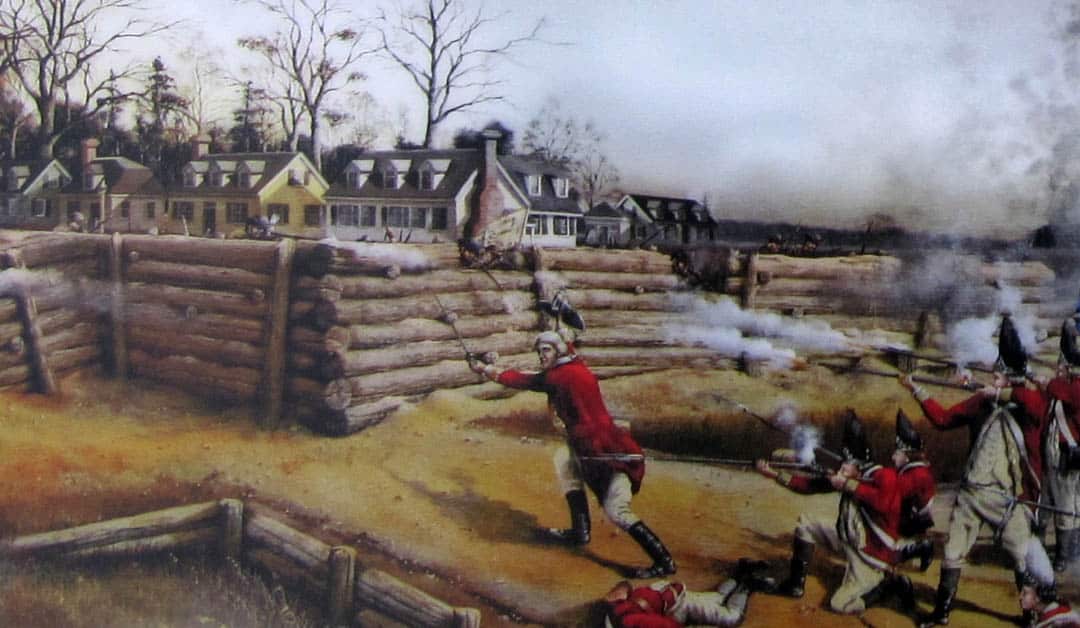
Join us this Sunday as we welcome historian Patrick H. Hannum, as we discuss the events leading up to and including the Battle of Great Bridge, fought on December 9, 1775. Patrick will also share his research of the men who were there at the battle and the long lasting impacts his small battle had on Virginia in the American Revolution. With the 250th anniversary of the Battle of Great Bridge upon us, this is a great time to catch up on the events in Virginia during the fall of 1775.
Patrick H. (Pat) Hannum served for 45 years the Department of Defense, 29 years as a U.S. Marine (Assault Amphibious Vehicle Officer), including battalion command, and 16 years as a civilian professor at the Joint Forces Staff College, National Defense University, where he specialized in operational-level warfare and Phase II Joint Professional Military Education. He continues to study and promote the history and relevance of the American Revolution through membership in the Norfolk Chapter of the Sons of the American Revolution and the Great Bridge Battlefield & Waterways History Foundation, including staff rides, battlefield tours and other educational venues.
This Rev War Revelry will be recorded and placed on our Facebook page this Sunday at 7pm and subsequently on our You Tube and Spotify Channels. So after you fill up on turkey and football, tune in to catch a little history!
“the Americans have hoisted their standard of liberty at Salem.” The Salem Alarm, February 26, 1775 – In Their Own Words
Next week on February 26, 2025, Salem, MA will mark the 250th anniversary of the Salem Alarm, or more commonly known today as “Leslie’s Retreat.” As British Gen. Gage received word from his spies that the local towns around Boston were securing various cannon for a possible war, he sent out Col. Leslie from Boston with several hundred British Regulars to Salem. Here Gage believed several of these cannon were we being refit and stored. Gage believed these cannon were to be used against him in a possible rebellion and were above and beyond a militia’s regular armament. After a tense stand off at the draw bridge across North River Bridge, Leslie returned to Boston without finding any cannon (which were removed during the stand off). This event was a critical step towards the open revolution that would take place on April 19 in Lexington. Though violence was avoided, the situation intensified the apprehension between Gage and the colonial leaders and militia of the towns around Boston. Below are two newspaper accounts of the events on February 26, 1775. One from Essex, Massachusetts and the other from London.
Essex Gazette, Feb. 28, 1775; an 1856 history of Leslie’s Retreat by Charles Endicott references the account was written by Col. Timothy Pickering.
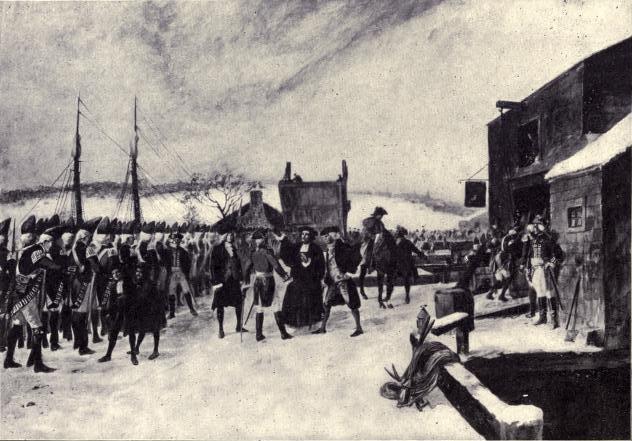
” Last Sabbath the peace of the town was disturbed by the coming of a regiment of the King’s troops, the particulars relative to which are as follows. A transport arrived at Marblehead apparently manned as usual. Eetween 2 and o o’clock (as soon as the people had gone to meeting) the decks -were covered with soldiers, who having loaded and fixed their bayonets, landed with great dispatch, and instantly marched off. Some of the inhabitants suspecting they were bound to Salem to seize some materials there preparing for an artillery, dispatched several messengers to inform us of it. These materials were at the north side of the North River, and to come at them it was necessary to cross a bridge, one part of which was made to draw up for the convenience of letting vessels pass through. The inhabitants kept a look out for the appearance of the troops. The van-guard arrived, and took their route down in town as far as the Long-wharf; perhaps to decoy the inhabitants thither, away from the place to which the main body were destined. The main body arrived soon after and halted a few minutes by the Town-House. It is said inquiry was immediately made by some of the officers for a half brother of Col. Brown- the mandamus counsellor. Be this as it may, he was very soon whispering in the Colonel’s ear, in the front of the regiment and when he parted from the Colonel, the regiment marched off with a quick pace, in a direct course for the North Bridge ; just before their entrance upon which the draw-bridge was pulled up. The regiment however rushed forward till they came to the draw-bridge, not observing (as it seemed) that it was drawn up. The Colonel who led them expressed some surprise : and then turning about, ordered an officer to face his company to a body of men standing on a wharf on the other side the draw-bridge, and lire. One of our townsmen! (who had kept along side the Colonel from the time he marched from the Town House) instantly told him he had better not fire, that he had no right to fire without further orders, ” and if you do fire (said he) you will be all dead men.” The company neither faced nor fired.
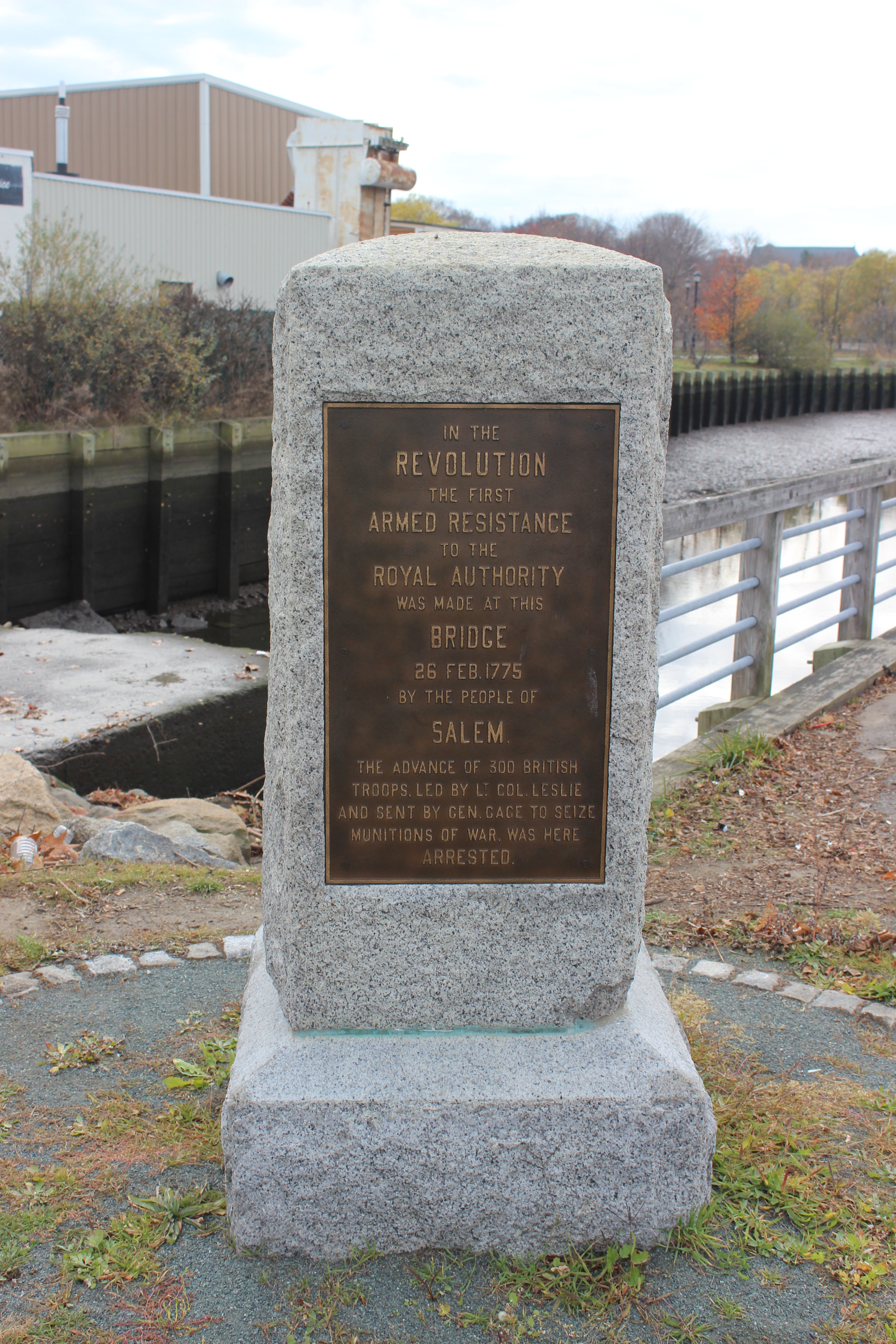
The Colonel then retired to the centre of his regiment, assembled his officers, and held a consultation ; At which being ended the Colonel advanced a little, and declared he would maintain his ground, and go over the bridge before he returned, if it were a month first. The same townsman replied, he might stay there as long as he pleased, no body cared for that. The half brother before mentioned (it is said) made towards the bridge, but seeing the draw-bridge up, says ” it is all over with us.” He has since disappeared. Meanwhile two large gondolas that lay aground (for it was low water were scuttled, lest they should cross the channel in them. But whilst one gentleman with his assistants was scuttling his own gondola, a party of about twenty soldiers jumped into it, and with their bayonets charged against our unarmed townsmen (some of whom they pricked) compelled them to quit it ; but before this a sufficient hole had been made in the bottom. This attack of the soldiers, and some other occurrences, occasioned a little bickering, but by the interposition of some of the inhabitants the disputes subsided.
At length some gentlemen asked the Colonel what was his design in making this movement and why he would cross the bridge? He said he had orders to cross it, and he would cross it if he lost his life, with the lives of all his men. And now (or before) asked why the King’s highway was obstructed? He was told it was not the King’s road, but the property of the inhabitants, who had a right to do what they pleased with it. Finally the Colonel said he must go over; and if the drawbridge were let down so that he might pass, he pledged his honor he would march not above thirty rods beyond it, and then immediately return. The regiment had now; been on the bridge about an hour and an half ; and every thing being secured, the inhabitants directed the drawbridge to be let down. The regiment immediately passed over, marched a few rods, returned, and with great expedition went back again to Marblehead, where they embarked on board the transport without delay. The regiment brought with them, lanthorns, hatchets, pickaxes, spades, hand-spikes, and several coils of rope.
When all the circumstances are considered, there can remain no doubt that the sole purpose of the menoeuvre was to steal away the artillery materials before mentioned. In the first place the regiment was taken from the Castle, so that the inhabitants of Boston might be prevented giving us any intelligence: The transport arrived at Marblehead a considerable time before the regiment was landed, but the men were kept snug under hatches: As soon as the inhabitants of Marblehead had got to meeting, the troops landed, and pushed on their march to Salem, and proceeded to the very spot where the materials for the artillery were lodged. But meeting with this sad rebuff and finding their plot was discovered, they then made a retreat. ‘Tis regretted that an officer of Colonel Leslie’s acknowledged worth, should be obliged, in obedience to orders to come upon so pitiful an errand.
Various reports were spread abroad respecting the troops —the country was alarmed ; and one company arrived in arms from Danvers just as the troops left the town. We immediately dispatched messengers to the neighboring towns to save them the trouble of coming in; but the alarm flew like lightning (and fame doubtless magnified the first simple reports) so that great numbers were in arms, and soon on the march before our messengers arrived.”
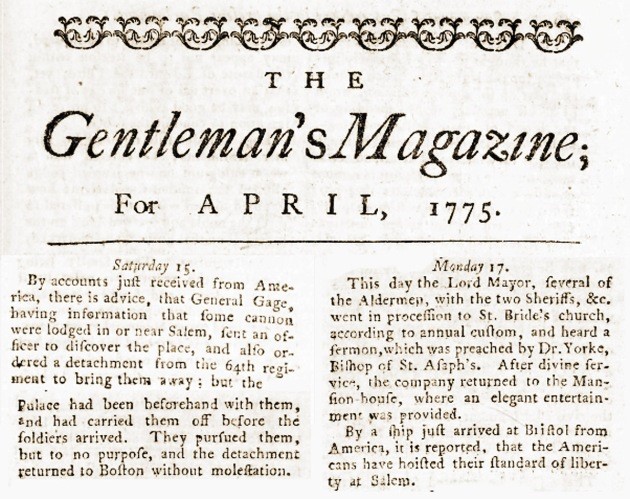
The news of the events at Salem were published in the Gentleman’s Magazine of London on April 17th. “By a ship just arrived at Bristol from America, it is reported that the Americans have hoisted their standard of liberty at Salem.
Little could the residents of London know that two days after the news of Salem was received in London, their American colonies would be in open rebellion.
“If you Fire, You’ll all be dead men” The Salem Alarm
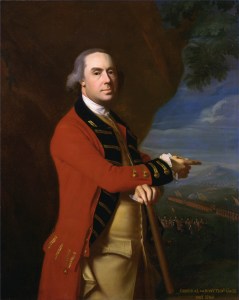
We reshare a post from 2018 about the Salem Alarm also known as “Leslie’s Retreat.” As we approach the 250th anniversary of this important event (February 26, 1775), we will share primary source accounts of the event. This event set the kindling for the spark that lit a war in Lexington a month later.
As events quickly spiraled out of control in the winter and spring of 1774-1775 around Massachusetts, several armed confrontations between local “Patriots” and the British army heightened tensions. On many occasions, both sides adverted open confrontation and were able to diffuse the situation. Understanding these events and how they made an impression on both sides helps explain what happened on the Lexington Common on April 19, 1775.
As soon as British General Thomas Gage arrived in Boston in the spring of 1774, he set about enforcing the newly passed “Coercive Acts.” In response to these new laws that restricted many of the rights the people of Massachusetts had grown accustomed too, local groups began to arm themselves in opposition to British authority. Even though Gage was once popular in the colonies, he soon became an enemy to those around Boston who believed the Coercive Acts were an overstep of British authority. Continue reading ““If you Fire, You’ll all be dead men” The Salem Alarm”
Rev War Revelry: Fort William and Mary, December 1774
Many have heard of Paul Revere’s ride to Lexington and the shot heard round the world at Concord (and Lexington) but few know about the December 1774 raid and skirmish at Fort William and Mary in New Castle, New Hampshire. Here, inspired by news from Paul Revere, local militia attacked and captured a small British garrison at Fort William and Mary. Join us as we welcome Dr.
Dr. Cynthia Hatch to discuss this much over looked action leading up the American Revolution.
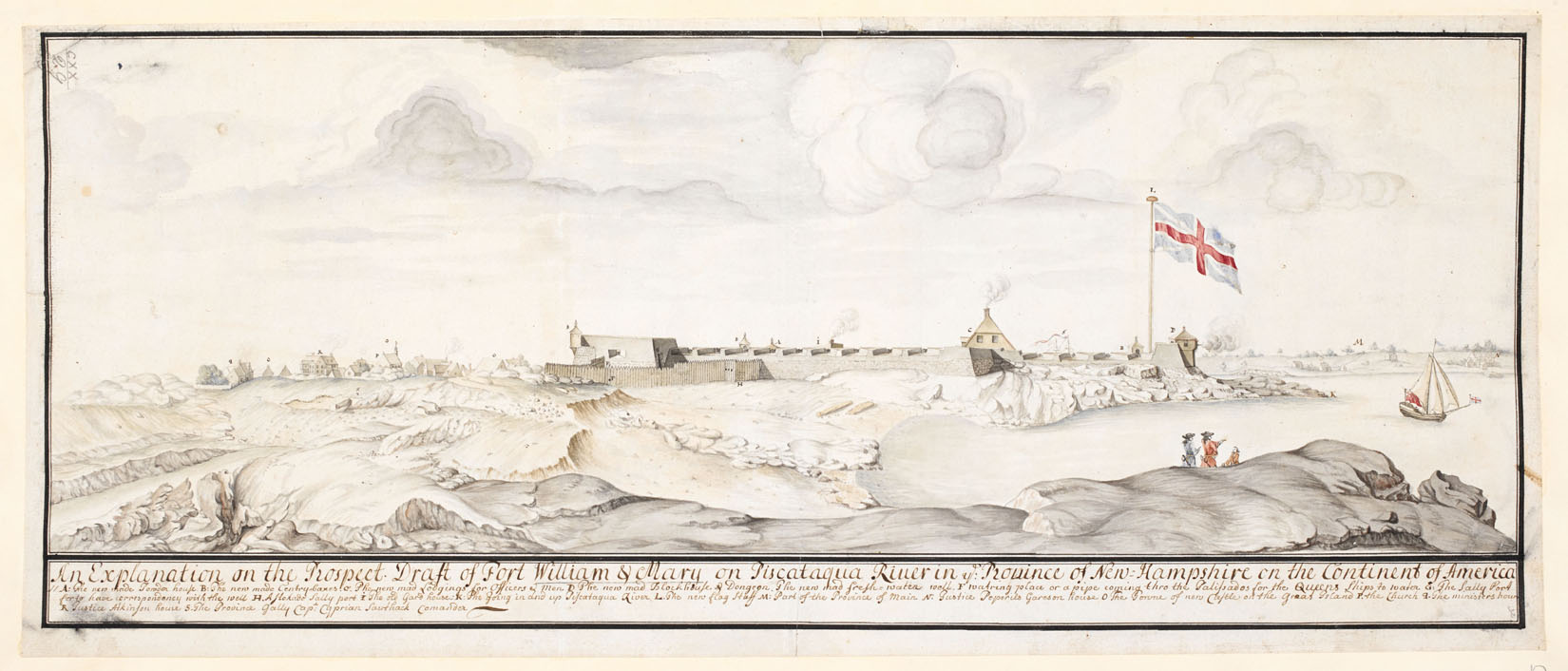
Dr. Hatch is an Oklahoma State University Institute of Technology instructor specializing in Revolutionary War history. With a PhD in History, she explores the intricate political, social, and cultural dynamics of the 18th century, with a particular focus on the colonial legal system and the pivotal role of local narratives in shaping historical interpretations during the Revolutionary Era.
Join us as we discuss the events leading up and during the raid of Fort William and Mary and learn, were these the FIRST shots of the American Revolution? This Rev War Revelry will be pre-recorded and posted to our Facebook page at 7pm on Sunday, December 8th.
“Rev War Revelry” Author Matthew E. Reardon, “A Traitor’s Homecoming…”
Although 1781 is most known for the pivotal and successful victory at Yorktown, action in the American Revolution unfolded throughout the eastern seaboard. In early September 1781, Benedict Arnold returned to the land of his birth to lead a raid on New London and the port that harbored preying privateers.
During this raid, the American militia under Lieutenant Colonel William Ledyard especially, stoutly defended Fort Griswold until overcome by superior numbers. The town of New London was also torched and saw a rarity like the battle of Trenton, in that combatants fought through the very streets of the town.
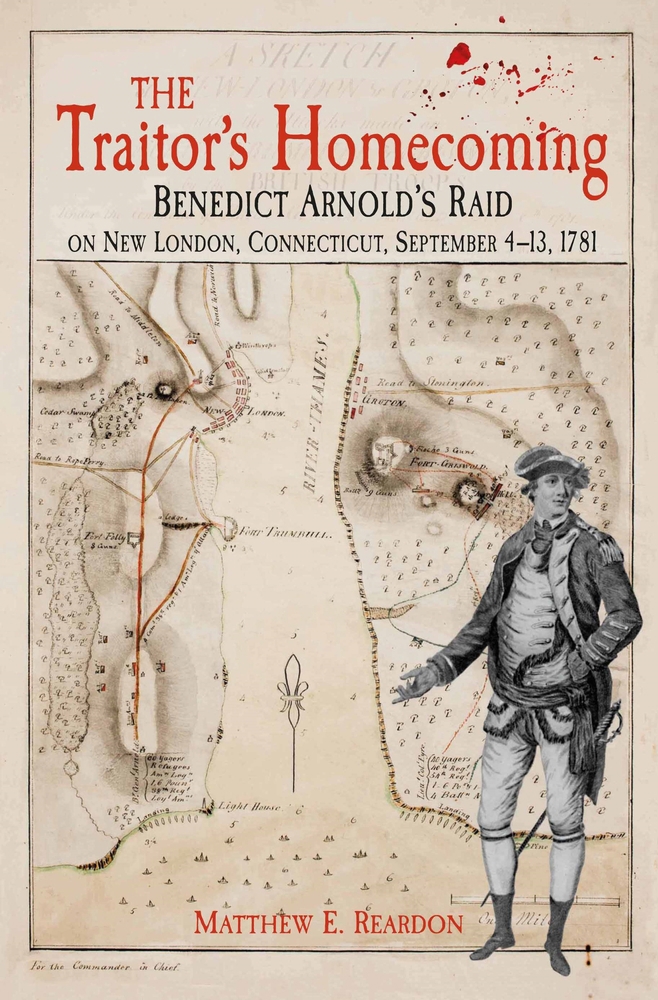
Capturing all this and uncovering new primary sources, Matthew Reardon weaves a narrative that balances military history, from the fighting to the strategies, with the impact on New London and Connecticut. His book, “The Traitor’s Homecoming, Benedict Arnold’s Raid on New London, Connecticut, September 4 – 13, 1781” was recently published by Savas Beatie, LLC. Matthew is a native of northeastern Connecticut and is a public educator along with being a command historian for the Connecticut Military Department. He can be reached for inquiries on speaking engagements or how to purchase the book here.
The book will be the focus of this week’s “Rev War Revelry.” We hope you can join us on our Facebook page on Sunday, 7 p.m. EDT.
*Note*
This “Rev War Revelry” will be recorded in advance as the Emerging Revolutionary War crew will be in Lexington and Concord, Massachusetts for the 4th Annual Emerging Revolutionary War bus tour.
Rev War Revelry: The Battles of Fort Watson and Fort Motte with Dr. Steven Smith
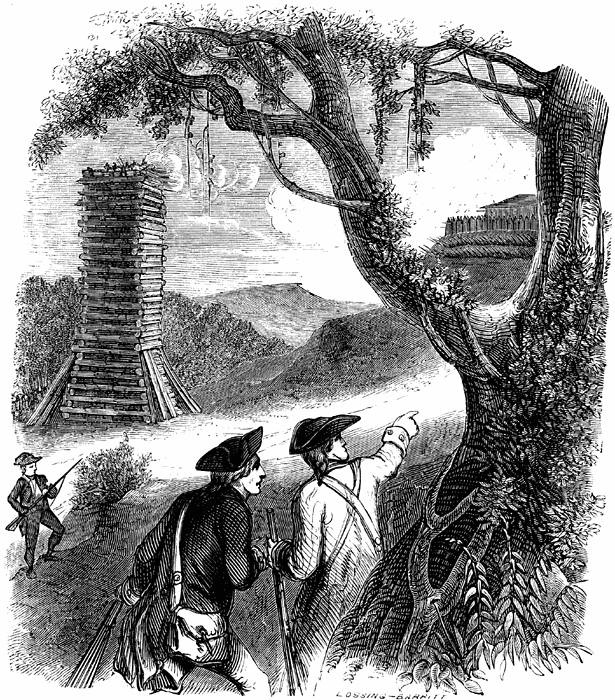
Join us as we welcome back Dr. Steven Smith as he discusses his new book “The Battles of Fort Watson and Fort Motte, 1781.”
Dr. Smith will discuss the history of four critical weeks from April 12 until May 12, 1781, in which the tide of the Southern Campaign of the Revolutionary War turned in favor of the Americans. Focusing on General Francis Marion’s and Colonel Henry Lee’s capture of two key British forts, Fort Watson and Fort Motte, coordinating with Nathanael Greene in retaking the South Carolina backcountry. These posts defended the supply line between Charleston and the British-occupied villages of Camden and Ninety Six. Although there would be much more fighting to do, once the two forts were lost, the British had to abandon the backcountry or starve. The British would never again be on the strategic offensive and were confined to the Charleston environs until they abandoned the city in December 1782.
Smith will also discuss how archaeological investigations have helped change the interpretation and mythology of both battles. Join us for a livestream on our You Tube channel in what will be a great discussion. The video will be posted to our Facebook page at its conclusion
Rev War Revelry: King George and Broadswords, The Battle of Moores Creek Bridge with Bert Dunkerly
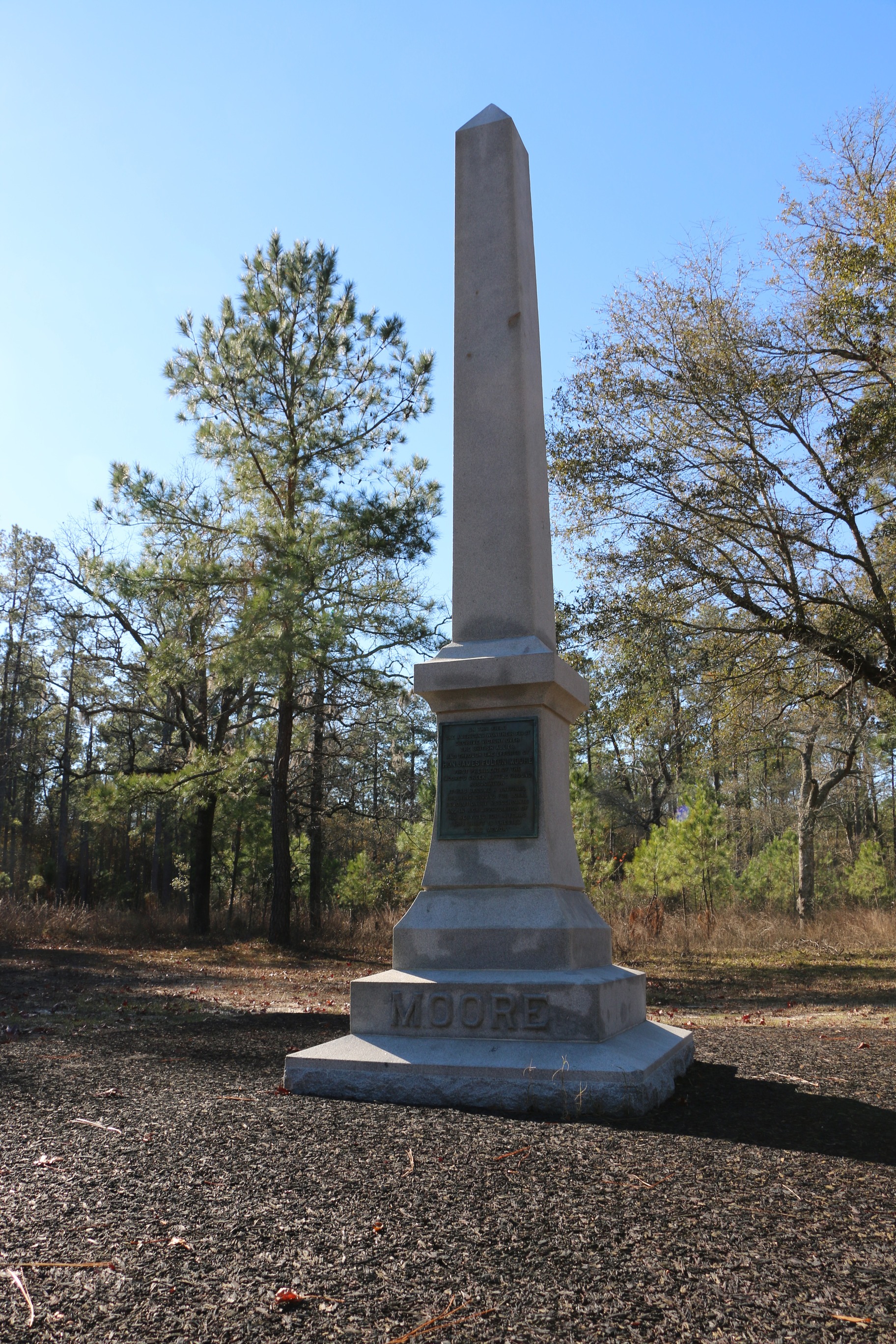
On February 27, 1776 Patriot and Loyalist forces faced off at Moores Creek Bridge in southeastern North Carolina. Loyalist forces anticipated support from a British army arriving along the North Carolina coast and planned to use this combination force to return British authority in North Carolina. Though, when help did not arrive, a mixed bag of North Carolina Patriots turned back an attack at Moores Creek Bridge. Their victory, combined with the Patriot victory at Great Bridge, VA in December 1775, solidified their control of North Carolina. Additionally, the Loyalist defeat served as a major deterrent for Loyalist support until the opening of the Southern Campaign four years later. This small action had long lasting impact on the entire war in the south.
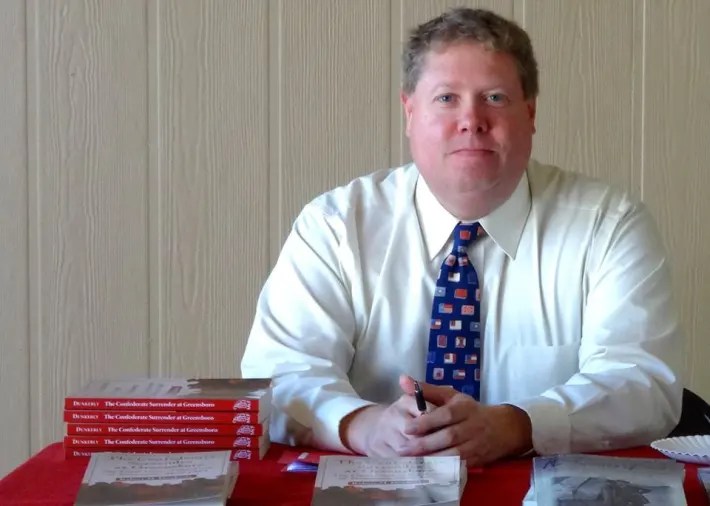
Join us this Sunday night at 7pm on our You Tube Channel ( https://www.youtube.com/@emergingrevolutionarywar8217 ) as we welcome back our own ERW historian Bert Dunkerly. Bert has extensive knowledge on the history of this battle and experience working at the battlefield itself. We will discuss the complex situation leading up to the battle and how this small battle changed the war strategy in the south. Grab a drink and join in on the discussion!
Black Loyalists
Emerging Revolutionary War welcomes guest author Michael Aubrecht
At the time of the Revolutionary War it is estimated that there were over a half million African-Americans living in the thirteen colonies. As the rebellion’s patriotic call to fight for liberty grew, the British government sought to undermine the expanding Continental Army by soliciting slaves who ran away from their masters. By promising to grant them their freedom and security, the Redcoat ranks were able to boost their manpower on the battlefield instead of constantly relying on the importation of additional troops who took months to travel to the Americas from England. Some of these all-black units even flourished as in the example of the Royal Ethiopian Regiment and later, the Black Pioneers.
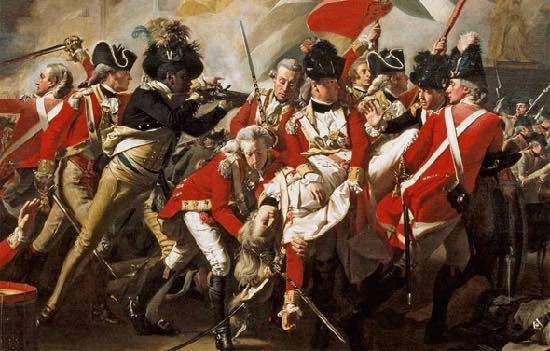
According to the Atlantic Canada Virtual Archives Website Black Loyalists in New Brunswick: “In November 1775, Virginia Governor Lord Dunmore, hoping to bolster the British war effort, encouraged slaves and indentured servants of the Patriots to join His Majesty’s army. Many did so. When the British evacuated their army from Boston to Halifax in 1776, a “Company of Negroes” was part of the entourage. British Commander-in-Chief Sir Henry Clinton extended the policy of appealing to African Americans in his Phillipsburg Proclamation of 1779 in which he offered security behind British lines to ‘every negro who shall desert the Rebel Standard.'”
Following the British Army’s surrender, it is estimated that nearly 35,000 loyalists fled the United States to settle north in the provinces of Canada including the maritime regions of New Brunswick and Nova Scotia. Nearly 3,500 free black loyalists were among them including many who had fought alongside the Redcoats on behalf of the English crown. New Brunswick saw thousands of African-Americans settle in as new citizens and many went on to fight again for Britain in the War of 1812. Despite their service to the king, many black loyalists and their families still faced racial discrimination, although it paled in comparison to the institution of slavery that continued to thrive in the southern United States.
Michael Aubrecht is the author of Thomas Jefferson and the Virginia Statute for Religious Freedom: Faith & Liberty in Fredericksburg.
Galloway’s Foreshadowing
Joseph Galloway is best known as one of the preeminent and prominent Loyalists who remained in the American colonies through the majority of the American Revolution. Prior to the colonies declaring independence, especially during the First Continental Congress, Galloway was active in the debates that decided the path forward. Besides attending and being active in the discussions in Philadelphia he penned a pamphlet entitled A Candid Examination of the Mutual Claims of Great Britain and the Colonies.
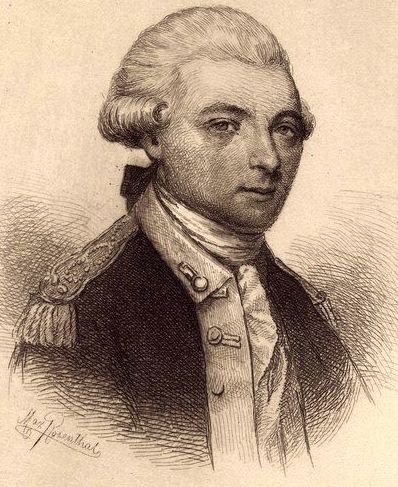
Within the pages, he called African American slavery “the dangerous enemy within” and the “natural weakness” of the soon-to-be Southern states. If a division ensued, Galloway predicted that,
“If the colonies happen to vie and try their reciprocal strength with each other, the political force of the Northern Colonies will soon destroy the opulent force of the Southern.”
Furthermore, Galloway pointed to the colonies/states of Georgia, Maryland, North and South Carolina, and Virginia as vulnerable because of the institution of slavery. In a conflict without the overarching guidance by Great Britain, the division between Northern and Southern colonies/states would lead to a domestic civil war and the possibility that African American slaves would join the Northern effort in vanquishing their former owners.
Although Galloway was writing to prop support for remaining loyal to the British crown he foreshadowed accurately the rift that plagued the independent United States. In laying out his views, Galloway quite succinctly predicted what would happen in 78 years after independence was won by the United States.
Galloway left Philadelphia when the British evacuated the city in 1778 and left for England where he would position himself in a leading role for loyalists in exiles. He never returned to the United States. His succinct prediction of the future though proved eerily accurate.
Sources:
Disunion Among Ourselves, The Perilous Politics of the American Revolution by Eli Merritt
University of Michigan, Evans Early American Imprint Collection, click here for the link.
 Emerging Revolutionary War Era