On October 7, 1780, patriot militia, some coming from over the Appalachian Mountains descended on a Loyalist militia force in northwest South Carolina. This pro-British force, commanded by the only British regular on the field that day, Major Patrick Ferguson retreated onto Kings Mountain.
American fought American.
On that hilltop one of the pivotal battles of the American Revolutionary War unfolded. The ramifications reverberated through the southern theater of operations, played a part on the psyche of civilians and militia, and added luster to the burgeoning backwoods, frontier American persona.
Emerging Revolutionary War focuses in on the Battle of Kings Mountain this Sunday, on the next “Rev War Revelry.” Join us on our Facebook page at 7 p.m. EST for a historian happy hour, as we discuss, dissect, imbibe, and provide commentary on this strategic battle, the national park there, and the campaigns that decided this theater of operation.
This Sunday, May 10th, at 7 p.m. EST, Emerging Revolutionary War returns with the “Rev War Roundtable with ERW” for another installment of “Rev War Revelry.”
This week ERW welcomes guest historian Gabe Neville, historian and founder of the blog, 8th Virginia Regiment, and ERW historians Mark Maloy, Mark Wilcox, Billy Griffith, and Travis Shaw for a chat about militia (both Patriot and Loyalist) and Continental units. Click here to see Gabe’s blog.
Join the panel of historians as they debate, discuss, and share their favorite units, the differences between militia and Continental units, regiments or companies that deserve more recognition, or all of the above. Questions and comments are welcomed and encouraged.
Just head on over to Emerging Revolutionary War’s Facebook page Sunday evening, for our weekly happy hour historical discussion. We’ll be there sharing our insight, but not our favorite brews! See you Sunday!
Join Emerging Revolutionary War this Sunday, at 7p.m. EST on our Facebook page as we head, virtually, down to South Carolina to discuss the importance of that colony/state in the American Revolution.
Most are familiar with the larger engagements, such as Cowpens and Kings Mountain or maybe the massacre at the Waxhaws. How about the Siege of Charleston, or the battles of Ninety-Six, or the countless other engagements that made the Palmetto State (which got its nickname from this era) one of the most hotly contested areas of the entire conflict.
Joining the “Rev War Revelry” will be ERW historians Vanessa Smiley, former Chief of Interpretation and Education at the Southern Campaign of the American Revolution National Park Group, which includes Cowpens, Kings Mountain, and Ninety-Six and Bert Dunkerly, former park ranger at Kings Mountain and author of a few histories on South Carolina in the Revolutionary War topics.
We look forward to seeing you for our sojourn into the Southern Theater this Sunday. Oh, and remember to grab your favorite brew for the trip!
Mark your calendars for September 28, 2019! Emerging Revolutionary War is excited to announce that we are partnering with Gadsby’s Tavern Museum and The Lyceum of Alexandria, VA to bring to you a day long Symposium focusing on the American Revolution.
Gadsby’s Tavern Museum
Alexandria is George Washington’s hometown and we feel is a great place for us to start this new endeavor. Historic “Old Town” Alexandria is home to dozens of museums and historic sites as well as great pubs, restaurants and shops. Gadsby’s Tavern Museum is the premier 18th century tavern museum in the country and is host to the famous annual George Washington Birthnight Ball. The Lyceum: Alexandria’s History Museum will be our host location. Today The Lyceum serves as the City’s history museum and is a center of learning through lectures, demonstrations and exhibits.
This year’s theme is “Before They Were Americans” and will highlight several topics
The Lyceum
about the years leading up to the American Revolution. Our speakers include: Phillip Greenwalt, Katherine Gruber, William Griffith, Stephanie Seal Walters and Dr. Peter Henriques as the keynote. Registration will open on July 1, 2019 through AlexandriaVA.gov/Shop or by calling 703-746-4242. Stay tuned as we highlight each of our speakers and their topics.
The British and loyalists would not have to wait long. Word of the landing reached the Massachusetts government within a matter of days, and preparations for a counterattack began almost immediately. There was such a hurry to respond that the General Assembly voted to carry out the operation with state forces rather than wait for Continental assistance.[1] Despite the initial rush it still took a month to assemble a force of over 1,000 militiamen, as well as the food, arms, and other supplies to sustain them. All of these troops and their supplies would be transported by a fleet of 21 transports, accompanied by nearly twenty state and Continental navy vessels and privateers. Among the warships the largest was the Frigate Warren of 32 guns which served as the flagship of Commodore Dudley Saltonstall. The Connecticut born officer was given overall command of the naval forces – no small task given the lack of experience with large scale fleet actions among his subordinates. Command of the land forces was given to Massachusetts Brigadier Solomon Lovell. Lovell has seen experience early in the war outside of Boston, but was also relatively untested in battle. The inexperience and poor communication between Saltonstall and Lovell was to have a decisive impact on the coming expedition. Notable among the other officers in the expedition was Paul Revere, who commanded the Massachusetts artillery. The expedition was also joined by a band of the local Penobscot Indians allied to the Continental Congress.
The New England fleet entered the Penobscot Bay on July 25th and immediately attempted a landing. Clearly outnumbered and with their works incomplete, General McLean and his men were determined to resist the Americans, but expected the worst. Saltonstall’s fleet sailed in close to the shore and exchanged cannon fire with both the British defences and the three remaining Royal warships, now under the command of Captain Henry Mowatt. In the confusion and smoke the Americans lowered seven launches full of marines and militiamen, but as they neared the shore they were met by a hail of musket fire[2]. At least one of the attackers – a Native American – was killed and the boats returned to the safety of the fleet. It was an inauspicious start to the battle for the New Englanders and already the relationship between the two commanding officers was becoming strained. General Lovell knew little about sailing or naval operations. He questioned the Commodore as to why he couldn’t just sail his fleet into the harbor and blast the British to pieces while his troops landed under their covering fire. The Connecticut seaman replied curtly, exclaiming “You seem to be damn knowing about the whole matter! I am not going to risk my shipping in that damned hole!”[3]
On the 26th a second militia landing on the peninsula was repulsed after the lead boat carrying militia Major Daniel Littlefield was swamped by British chain shot, drowning the Major and two privates.That same day, however, the Americans scored a small victory when a force of 200 Continental marines and artillerymen landed on Nautilus Island and captured the small British battery there[4]. More artillerymen were landed and soon the Americans had a battery from which they could harass the British shipping. With the Americans making some headway Captain Mowatt withdrew the remaining British ships deeper into the harbor, creating a defensive line across the Bagaduce River.
Castine Harbor, looking out roughly where Captain Mowatt anchored the British transports and warships (Author’s photo)
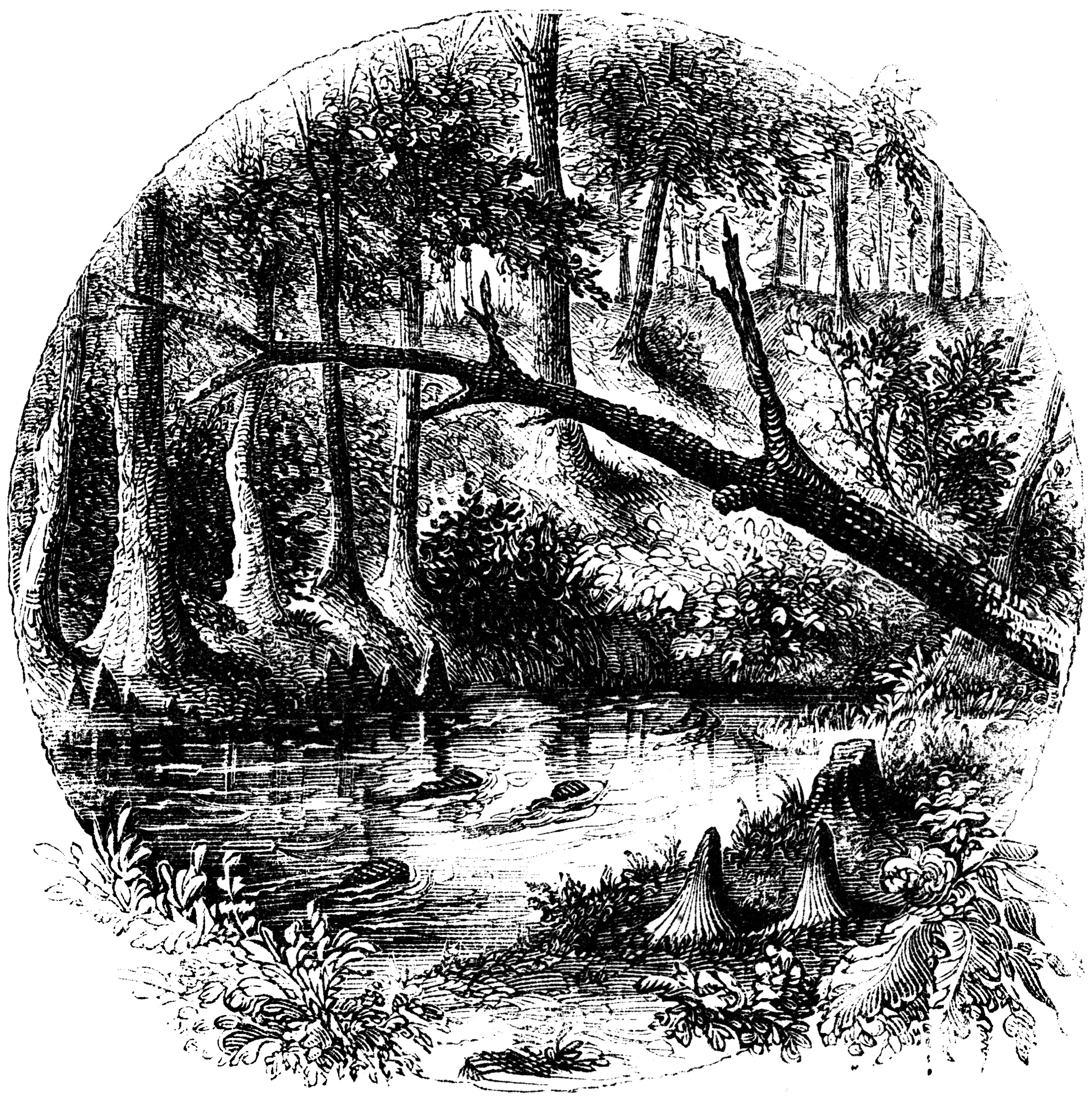
Sketch of the Wabash River Made During Hamilton’s 1778 Campaign (Wikimedia Commons)
In the summer of 1778, Lieutenant Colonel George Rogers Clark of the Virginia militia launched one of the most daring American military operations of the Revolutionary War when he invaded the “Illinois country” and captured Cahokia and Kaskaskia in modern-day Illinois and Vincennes in southern Indiana, effectively neutralizing British power on the Illinois, Wabash, and Mississippi Rivers. Henry Hamilton, Lieutenant Governor of Quebec and Britain’s Superintendent for Indian Affairs in Detroit, could not allow such audacity to succeed, lest Britain’s influence with the western Indian nations wane. Learning of Fort Sackville’s fall at Vincennes on the Wabash River, he set out to recapture it.
Emerging Revolutionary War is pleased to welcome back historian Bert Dunkerly, who is the co-author (with Irene B. Boland) of the upcoming book; “Eutaw Springs; The Final Battle of the American Revolution’s Southern Campaign” slated to be released this month.
Part One
The weather was warm and the men had been marching for days, but their morale was high. They had been through a lot recently: caught off guard and defeated at Hobkirk’s Hill, a month of grueling siege work – and for naught, at Ninety Six. Not to mention the engagements that many of them had fought in previously: Kings Mountain, Cowpens, Guilford Courthouse, and dozens of smaller battles.
Yet the army that General Nathanael Greene led forward on the morning of September 8, 1781, was confident and ready to come to grips with its adversary. Everyone from the private in the ranks on up to the commanding general knew that ahead lay an opportunity.
Battles in the Revolution were, in fact, rare opportunities for commanders. Engagements were the short, pulse-pounding events that broke up the monotony of marching and maneuvering. An army spent most of its time in garrison, in camp, or on the road. In battle the infrequent opportunity came to crush an opponent and influence the outcome of a campaign, or the war. These chances were few and far between.
“Eutaw Springs” by Benson Lossing
Both commanders at Eutaw Springs appreciated this fact. General Nathanael Greene’s forces had experienced a series of close calls at Guilford Courthouse, Ninety Six, and Hobkirk’s Hill. The American army fought well in all of these engagements, save Hobkirk’s Hill, yet they met defeat in every one. Greene hoped Eutaw Springs would put the finishing touches on his South Carolina campaign, and end it with a clear cut victory.[i]
Eutaw Springs was a rare chance for Greene to pick the time and place of engagement, array his forces to his choosing, and initiate the battle, and control its \tempo. It was the only set engagement of the campaign, other than Guilford Courthouse, in which Greene chose the ground and initiated the battle. Commanders do not often have this luxury, and Greene earnestly hoped to make the most of it. Continue reading “Eutaw Springs”→
On October 7, 1780, one of the most pivotal battles of the American Revolution fought in the South occurred on a hillside in northwest South Carolina.The engagement brought militia from both sides; those loyal to the British and those adhering to the independence movement against each other. In fact, only one regular British soldier was present on that autumn day; the British commander Major Patrick Ferguson.
How did Ferguson and his militia end up on King’s Mountain? This was due to the campaign being waged by British General Lord Cornwallis in the Southern colonies.
Ferguson’s role was to protect the flank of Cornwallis’ force as it turned north from South Carolina. After issuing a call of bravado, where Ferguson gave Patriot militia an ultimatum; lay down your weapons or suffer the consequences, the British officer began to move through the South Carolina countryside. This decree emboldened the Patriot militia, some of which would come from across the Appalachian Mountains–or “Overmountain”–to join in the fight against Ferguson. This combined force would gather around Sycamore Shoals in present day Tennessee.
Word quickly reached Ferguson near Gilbert Town, North Carolina by way of deserters that a large force of Virginia, Carolinas, and militia from the area of Tennessee had arrived and were planning to march toward his encampment.
Still showing a high degree of disdain for the Patriot militia, Ferguson did not act immediately on the intelligence. Three days later, the Loyalist militia and the British officer started their retrograde movement toward Charlotte and Lord Cornwallis’s main army.
By October 4, 1780 now joined by a sprinkling of Georgia militia, the Patriots had reached Ferguson’s old encampment site. Two days later the militia forced marched through the Cowpens of South Carolina, which had not witnessed the hard hand of battle yet. Just a day’s march ahead was Ferguson’s forces.
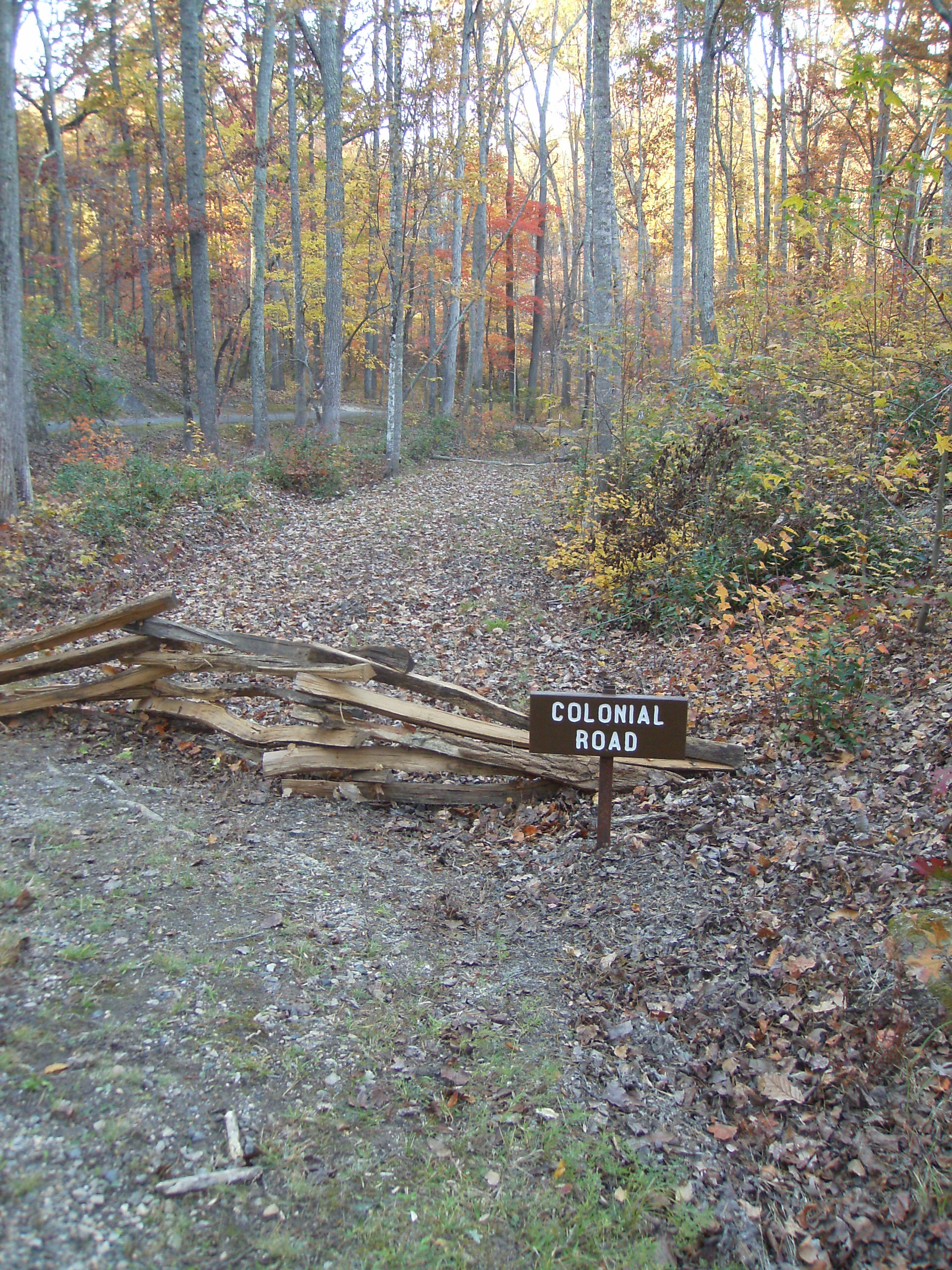
Colonial Road trace near Kings Mountain (author collection)
At this juncture, Ferguson made a fateful decision. Instead of continuing his retreat and he was less than a full-days march away from the main British army, the British officer held up his forces on a forested hill just inside South Carolina and laid out his camp on the highest point; Kings Pinnacle.
Realizing that time was of the essence, the Patriot force, now numbering 900 men, found plentiful horseflesh to mount up and close the gap between the two sides. Riding through the rain and darkness of the night of October 6, the fifteen-mile gap between forces was erased and by late morning the Patriot militia was reining up within striking distance of Kings Mountain.
By mid-afternoon, at approximately 3:00 p.m. the fighting erupted. The Patriot militia broke into smaller commands, numbering between 100-200 men and started to ascend the slopes. Luckily for the Patriots, Ferguson had not detected just how close the enemy was and had also neglected to fortify his encampment. His force though, outnumbered the Patriots by approximately 200 men.
Some of the Loyalist militia did not realize that the enemy had arrived until the Patriot militia came hollering and yelling up the slope of the hillside. With the conglomerate of various militia, there was no unified command of the Patriot forces and the fight quickly boiled down to independent maneuvering and fighting. Using the terrain, the Patriot militia fired from behind trees and boulders. Answering this tactic, Ferguson ordered a bayonet charge down the hill. This caused the Patriot force to retreat to the base of the hill as most of the men were carrying rifles which did not accommodate the bayonet.
Virginia militia Colonel William Campbell and North Carolinian militia Colonel John Sevier helped rally the militia that had broken and sent the force back up the hillside. This back and forth would happen a few more times; Ferguson’s force charging down hill with bayonets, the militia backtracking, than reforming, and charging back up after the Loyalist momentum had waned.
Finally, after an hour of combat the Patriot militia forced their way to the crown of the hill and was able to flank the Loyalist force and attack in rear of their position. This maneuver forced the Loyalists back into their encampment where numbers of them began to surrender.
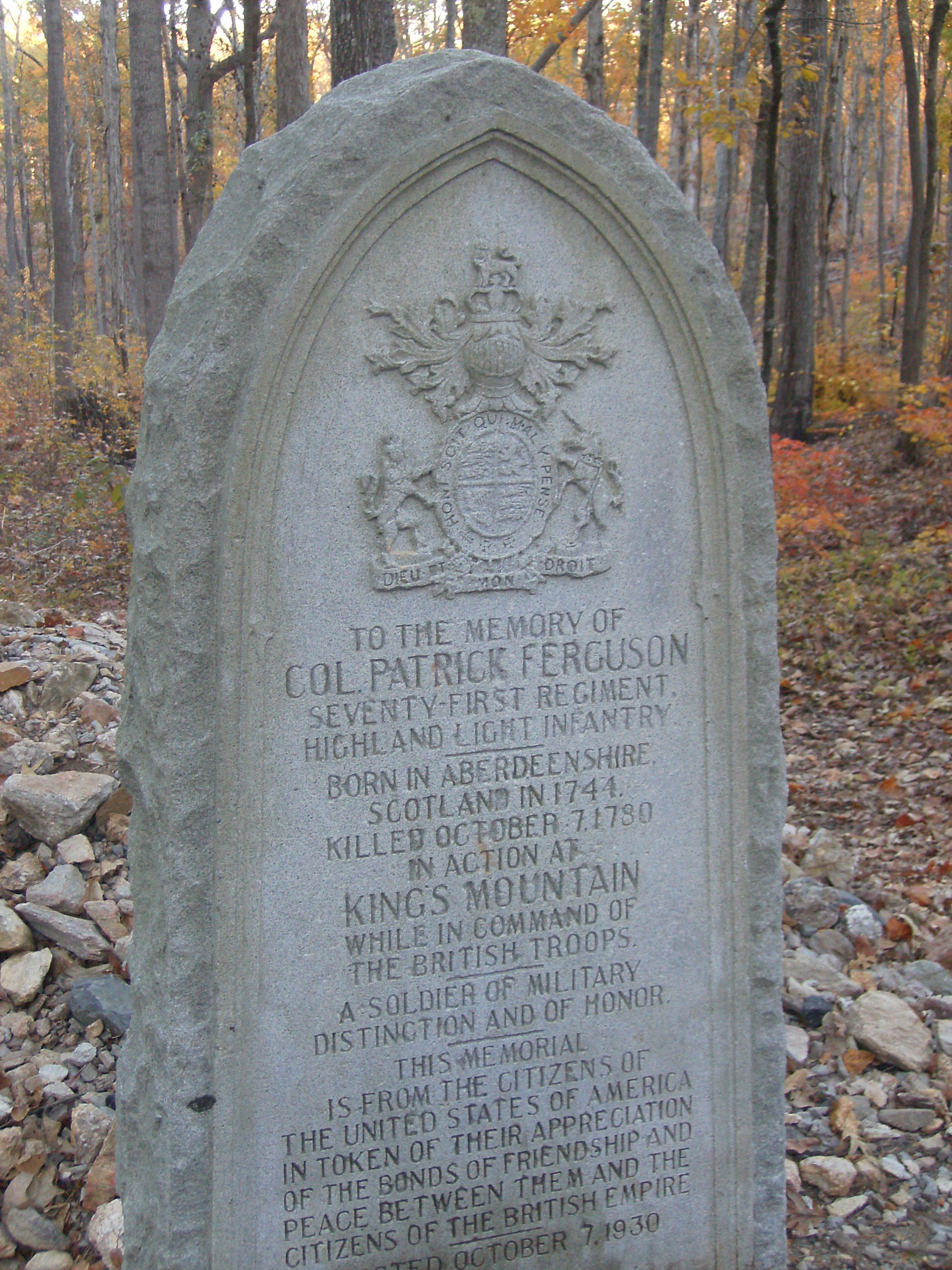
Marker to the memory of Major Patrick Ferguson (author collection)
Ferguson sensing the tide turning against the Loyalists, tried to rally his troops, supposedly yelling, “Hurrah,brave boys, the day is ours!” Gathering a few stalwarts, Ferguson made a desperate move to fight his way out of the encircling Patriot militia. A volley from Colonel Sevier’s militia force unhorsed Ferguson who fell entangled in his stirrups. Unfortunately, the horse, spooked with the musketry and smell of gunpowder dragged Ferguson through the Patriot line. After getting untangled from the straps on the horse, Ferguson lay prone on the ground, where a Patriot officer demanded his surrender. Still with some fight in him, Ferguson shot and killed the man. Other Patriot militia responding to the scene fired a collective volley at the downed British officer, killing Ferguson.
Some of the Patriot militia were opposed to accepting the Loyalist surrender, as they remembered the massacres and atrocities committed to their brethren in arms by the infamous Banastre Tarleton. Cooler heads prevailed and the firing died down.
By the time the second white flag was sent out by Captain Abraham DePeyster, Patriot militia officers were finally able to reign in their commands and over 600 Loyalist soldiers surrendered.
Within the one-hour and five minute engagement, Ferguson’s force ceased to exist. Total casualties for the Loyalist force was 290 killed, 163 wounded, and 668 captured. The Patriots suffered a total of 87 casualties; 29 killed and 58 wounded.
The Patriots, with the close proximity of Cornwallis’s forces, who the day after the battle would finally get the request for reinforcements from his slain subordinate, quickly retreated back into the safety of the South Carolina countryside.
However, the Battle of Kings Mountain would become a critical turning point, not only in the Southern Campaign of the American Revolution, but in the entire war itself. The victory, which demolished the Loyalist militia force covering his flank, forced Cornwallis to altere his strategy for the campaign. He would be forced to return to South Carolina, giving up advancing further than Charlotte into North Carolina in order to re-solidify control of territory in his rear. When Cornwallis finally returned to the Tar Heel State the following year, he would suffer eventually suffer a Pyrrhic victory at Guilford Court House in March 1781.
All that was in the future and so is your visit to this battlefield of the American Revolution.
Kings Mountain Battle Monument commemorating the Patriot victory (author collection)
On March 3, 1931, Kings Mountain National Military Park was formed by an act of Congress and placed under the control of the United States War Department. Two years later, in March 1933, the property was transferred to the National Park Service by an executive order. At this juncture, the entire land mass of the park was comprised of 40 acres that had been originally donated by the Kings Mountain Battlefield Association. The park has grown since that time and now preserves slightly under 4,000 acres.
For further details on how to visit the battlefield, which includes trails, a visitor center, exhibits, and a bookstore, click here. The park is open daily 9:00 a.m. to 5:00 p.m. with extended hours on the weekend between Memorial and Labor Days. Even better there is no fee to access this national military park!
*All the photos taken for this post was done by the author during a visit to the battlefield in autumn.*
Emerging Revolutionary War welcomes back historian Bert Dunkerly. The accounts below come from Mr. Dunkerly’s book on the battle.
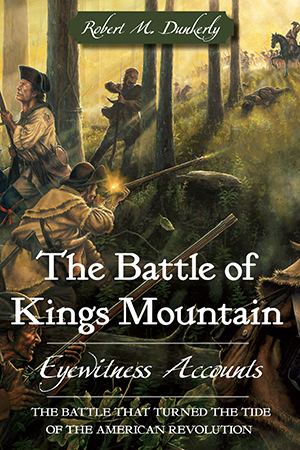
“The Battle of Kings Mountain, Eyewitness Accounts” by Bert Dunkerly (Acadia Publishing)
The battle of Kings Mountain was an intense, one-hour battle fought just below the North Carolina-South Carolina border. The October 1780 engagement pitted about 900 American militia from five states (Virginia, the two Carolinas, Georgia, and modern-day Tennessee) against 1,100 Loyalists under Maj. Patrick Ferguson. With Ferguson’s wounding late in the action, command fell to his subordinate, Captain Abraham DePeyster. As the Americans closed in, the Loyalists surrendered.
Eyewitness accounts provide details of the battle, especially its lesser known aspects like the conclusion of the battle and subsequent Loyalist surrender. Here are a few detailed accounts, presented with original spelling and grammar.
Virginia militiaman Leonard Hice had quite an experience in the battle, being wounded four times. He would spend two years recovering:
“I was commanded by Captain James Dysart where I was dreadfully wounded, I received two bullets in my left arm and it was broken. We were fighting in the woods and with the assistance of my commander who would push my bullets down, I shot 3 rounds before I was shot down. I then received a bullet through my left leg. The fourth bullet I received in my right knee which shattered the bone by my right thigh and brought me to the ground. When on the ground I received a bullet in my breast and was bourne off the ground to a doctor.”
Andrew Cresswell was a militiaman from Virginia who found himself too far in front during the final phase of the battle. He also was fortunate to witness the surrender and provided one of the only accounts of Captain Abraham DePeyster surrendering to Colonel William Campbell. His account also speaks to the brutal nature of the fighting between Loyalist and Whig.
“I saw the smoke of their guns and as I saw but one man further round than myself I spoke to him and told him we had better take care least we might make a mistake. I retreated about ten paces where I discharged my gun. About that moment they began to run. I waited for nobody. I ran without a halt till I came to the center of their encampment at which moment the flag was raised for quarters. I saw Capt. DePeyster start from amongst his dirty crew on my right seeing him coming a direct course towards me. I looked round to my left I saw Col. Campbell of Virginia on my left DePeyster came forward with his swoard hilt foremost. Campbell accosted him in these words “I am happy to see you Sir. DePeyster, in answer swore by his maker he was not happy to see him under the present circumstances at the same time delivered up his sword – Campbell received the sword, turned it round in his hand and handed it back telling him to return to his post which he received. Rejoining these words, God eternally damn the Tories to Hell’s Flames and so the scene ended as to the surrender.”
Lt Anthony Alliare was a New York Loyalist in Ferguson’s command. He recounts the experience of the New York detachment, which launched a series of unsuccessful bayonet charges early in the battle. His reference to the “North Carolina regiment” refers to local Loyalist troops fighting alongside his men.
“The action continued an hour and five minutes, but their numbers enabled them to surround us. The North Carolina regiment seeing this, and numbers being out of ammunition, gave way, which naturally threw the rest of the militia into confusion. Our poor little detachment, which consisted of only seventy men when we marched to the field of action, were all killed and wounded by twenty, and those brave fellows were soon crowded as close as possible by the militia.’
Ensign Robert Campbell of Virginia also witnessed the close of the battle, and recounts a white flag being raised.
“It was about this time that Colonel Campbell advanced in front of his men, and climbed over a steep rock close by the enemy’s lines to get a view of their situation and saw they were retreating from behind the rocks that were near to him. As soon as Captain Dupoister observed that Colonel Ferguson was killed, he raised flag and called for quarters. It was soon taken out of his hand by one of the officers on horseback, and raised so high that it could be seen by our line, and the firing immediately ceased. The Loyalists, at the time of their surrender, were driven into a crowd, and being closely surrounded, they could not have made any further resistance.”
Isaac Shelby, from the Carolina frontier (modern Tennessee) was a militia commander in the battle. He also provides insights in the battle’s final moments.
“They were ordered to throw down their arms; which they did, and surrendered themselves prisoners at discretion. It was some time before a complete cessation of the firing, on our part, could be effected. Our men, who had been scattered in the battle, were continually coming up, and continued to fire, without comprehending in the heat of the moment, what had happened; and some, who had heard that at Buford’s defeat the British had refused quarters to many who asked it, were willing to follow that bad example. Owing to these causes, the ignorance of some, and the disposition of other to retaliate, it required some time, and some exertion on the art of the offices, to put an entire stop to the firing. After the surrender of the enemy, our men gave spontaneously three loud and long shouts.”
In one hour, the entire Loyalist force of 1,100 was killed, wounded, or captured. October 7 marks the anniversary of this battle which, in the words of Thomas Jefferson, was the “turn of the tide of success.”
Plaque at Kings Mountain National Military Park
Robert M. Dunkerly (Bert) is a historian, award-winning author, and speaker who is actively involved in historic preservation and research. He holds a degree in History from St. Vincent College and a Masters in Historic Preservation from Middle Tennessee State University. He has worked at nine historic sites, written eleven books and over twenty articles. His research includes archaeology, colonial life, military history, and historic commemoration. Dunkerly is currently a Park Ranger at Richmond National Battlefield Park. He has visited over 400 battlefields and over 700 historic sites worldwide. When not reading or writing, he enjoys hiking, camping, and photography.
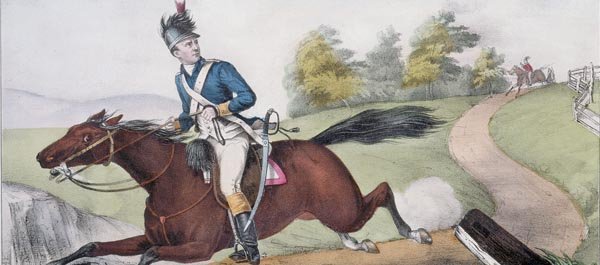
The past few months of John Champe’s life were probably the most memorable. In the fall he was asked to go on a mission to capture the recent traitor Benedict Arnold. The mission was ordered by George Washington himself and only known to Washington and “Lighthorse” Harry Lee. Champe, a trusted member of Lee’s Legion, was promised a promotion for undertaking the daring mission. He successfully fled from the American camp, gained the trust of British General Sir Henry Clinton and Arnold and was given a commission in Arnold’s Loyalist regiment. He worked with patriots in New York and recruited others to help him in his plan to kidnap Arnold. Now it was December and the next day was the day to kidnap Arnold and return him to Washington.
Then the day before the kidnapping was planned, Clinton set into motion a plan to finally use Arnold militarily. Arnold would take his Loyalist troops and some British regulars and invade the Virginia Capes. Virginia had largely dodged the hardships of war and Clinton believed this would be a great opportunity for Arnold to prove himself. With only Virginia militia located in the colony, Arnold should have no problem wreaking havoc on the Commonwealth.
These new developments ruined Champe and Lee’s plans. When Arnold got orders from Clinton, he moved his headquarters – one day before Champe was to carry out his plan. Furthermore, Champe was also moved to another part of New York and was not able to get word to Lee that the plan was off. Lee and his dragoons waited and waited at Hoboken with no sight of Champe. Soon Lee returned to camp without any word on what happened to Champe. Lee and Washington worried that the worst had happened and Champe was “discovered.”[i]
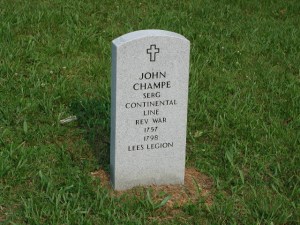
Grave at John Champe, Prickett Cemetery, Fairmont, WV
Champe soon found himself on a transport in New York harbor with Arnold’s “American Legion.” The destination was unknown to most of the men. Soon though Champe learned that he was to be part of an invasion force against his native state! The thoughts that must have gone through his mind; he had risked everything to capture Arnold – labeled a deserter and now he would have to go into battle against his fellow Virginians. The two week trip to the Virginia Capes must have afforded Champe plenty of time to ponder how close he was coming to succeeding and now what he was called upon to do.
Champe was involved in most of Arnold’s campaign against Virginia. He was part of the force that captured Richmond and found himself in several battles and skirmishes against his fellow Virginians. Arnold was replaced by Gen. William Philips and soon Cornwallis’s army joined Philips in Virginia in May 1781. Sometime after this, Champe was able to “escape” the British army and headed west to the Blue Ridge Mountains. Champe then worked his way south and finally by July he was back with Lee who was then with Nathaniel Greene’s army in the Carolinas. Lee was delighted to see his devoted cavalryman. Surely Champe and Lee had a lot to discuss.
Though Champe was promised a promotion, it was believed by Lee and Washington that it would be too dangerous for Champe to take the field again. If he was captured, the British would surely execute him as a spy. Champe was offered an unknown sum for a reward and headed back home to Loudoun County. His legendary adventure was over.
Sergeant Major John Champe Memorial, Aldie, VA
After the war, Champe did not seek fortune or fame from his exploits. He led a simple life and was a middle class farmer. He struggled to support his family and continuously looked for cheaper and more fertile land to the west. It was due to his desire for new land that he was on a trip looking at land near Morgan Town (modern day Morgantown, WV) in 1798 where he became ill and died. Washington did not forget Champe. In 1798 Washington was appointed by President John Adams commander of the American army in preparation for war with France. Washington called on Champe to be an officer in his army, only finding out that he had recently died.[ii]
Though Champe disappeared mostly from the history books in 1781, his family fought for nearly 100 years to gain the compensation that was due to Champe. Champe was never paid a pension nor given bounty lands that were owed to him for his service. Plus, his promised promotion was never given and they argued that the owed pension should be based off of the rank that was promised him personally by Washington. Unfortunately, the mission was so secret, that very few could confirm it. In petitions filed with Congress in 1818 and 1839, Champe’s widow was finally given a life time pension, though in an amount not reflecting his rank. Finally in 1847, a Congressional act provided for compensation in the amount of $1,200 to the heirs of John Champe and granted him the promotion that was promised to him by Washington. [iii]
Champe has remained a local hero in Loudoun County. In 1861, a local Confederate unit went off to war as the “Champe Rifles” (8th VA Infantry). In the early 20th century, the location of his home was marked with a small obelisk (reportedly made by stone from the foundation of the home). Today the monument sits on the south side of Route 50 a few miles west of Aldie.
In 2001, his grave was finally properly marked with a head stone and a full ceremony. Most recently Champe has been bestowed the highest honor a local hero can be given, a high school in his honor. John Champe High School was opened in Aldie in 2012 and one hopes that his name and legacy will be no longer be forgotten.
Lyrics from Sergeant Champe, ca. 1781
Come sheathe your swords! My gallant boys, And listen to the story, How Sergeant Champe, one gloomy night, Set off to catch the tory
[i]The Revolutionary War Memoirs of General Henry Lee; DeCapo Press, 1998, 409.




 announce that we are partnering with Gadsby’s Tavern Museum and The Lyceum of Alexandria, VA to bring to you a day long Symposium focusing on the American Revolution.




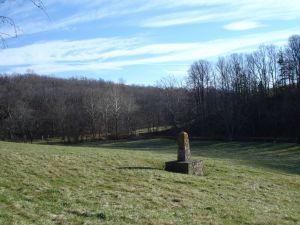
 went off to war as the “Champe Rifles” (8th VA Infantry). In the early 20th century, the location of his home was marked with a small obelisk (reportedly made by stone from the foundation of the home). Today the monument sits on the south side of Route 50 a few miles west of Aldie.
 Emerging Revolutionary War Era