George Rogers Clark Recaptures Fort Sackville, Part II

Vincenes (Army Center of Military History)
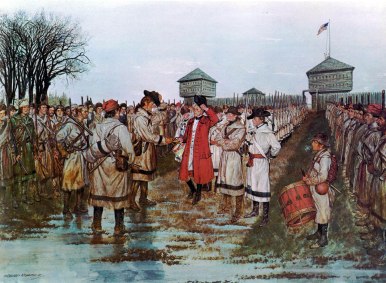
Hamilton Surrenders Fort Sackville (U.S. Army Center for Military History)

By February 23, 1779–two hundred and forty years ago—Virginia Lieutenant Colonel George Rogers Clark had marched his little army from the Mississippi across the flooded plains of what would become southern Illinois to the French town of Vincennes on the Wabash River, in modern Indiana.  His men were tired, hungry, and waterlogged, but they had made it safely across the Wabash and delivered themselves to the same shore as the town and Fort Sackville, then defended by the much-hated British Lieutenant Governor Henry Hamilton.  His river scouts had managed to find a small, dry hillock covered by a grove of trees and within sight of the town and Clark’s force, about 170 strong, lay in the grove drying their clothes by the sun, occasionally taking a wandering citizen from the town prisoner.   Clark later reported:

Continue reading “George Rogers Clark Recaptures Fort Sackville, Part II”

Alexander Hamilton’s “First” Duel

glc07167engweb_
Lt. Col. Alexander Hamilton at Yorktown, VA by Alonzo Chapel

Alexander Hamilton has reappeared as a modern pop star with the wide success of the Broadway musical “Hamilton.” Due to this success, most people today know that Alexander Hamilton met his end in a duel with Aaron Burr on the banks of the Hudson River. But this was not Hamilton’s first involvement in a duel, nearly 26 years earlier Hamilton found himself embroiled in a feud with one of highest ranking Continental officers, Maj. Gen. Charles Lee.

It all started on June 28, 1778 at the Battle of Monmouth. The beginning of the battle had gone against the Americans and Lee, who was in command of the vanguard was ordering a retreat in front of the British. Washington, seeing the retreat rode ahead and encountered Lee. What was said between the men has been debated since that day, but what is not indisputable is that Lee took offense. Continue reading “Alexander Hamilton’s “First” Duel”

Phillis Wheatley: American Poet

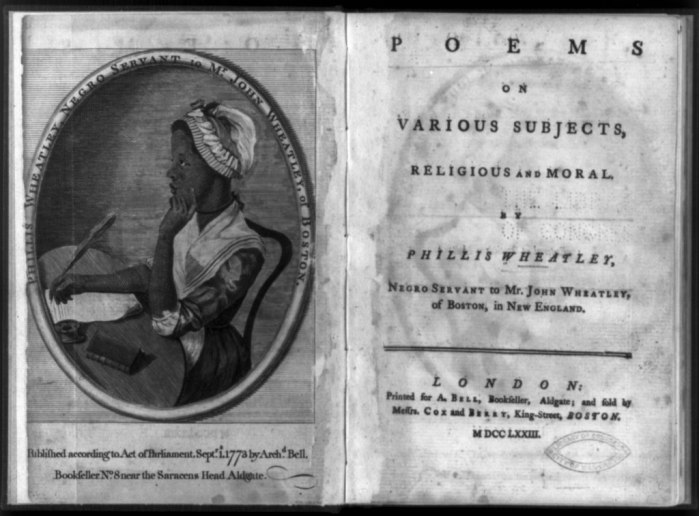
Phyllis Wheatley Book Frontspiece
Title Page from Phillis Wheatley’s Book of Poetry

The American Revolution was loaded with contradictions, perhaps none more glaring than the notion of fighting for individual liberty while slavery was so deeply embedded in the rebelling colonies.  To truly understand the American Revolution, it’s necessary to wrestle with that reality.  The stories of some individuals help shed light on the experience of enslaved Americans during the war.

Phillis Wheatley was born in West Africa, likely in 1753, and then imported into the British colonies in 1761.  John Wheatley of Boston purchased her to assist his wife Susanna and daughter Mary as a house servant.  Like many slaves, she was given the last name of her owners; her first may have come from the name of the ship that brought her across the Atlantic.  Susanna and Mary noticed something in young Phillis and taught her to read and write, introducing her to the Bible and religion.  She published her first poem in 1767 and the 1770 poem “An Elegiac Poem, on the Death of the Celebrated Divine George Whitefield,” gave her some degree of fame.

Continue reading “Phillis Wheatley: American Poet”

Book Review: Young Washington by Peter Stark

erw-book-reviews-11Peter Stark, Young Washington: How Wilderness and War Forged America’s Founding Father, Kindle ed., (New York: HarperCollins, 2018).

While traveling in southwestern Pennsylvania, outdoor writer Peter Stark discovered the region’s deep history and the central role it played in transforming George Washington from a callow young man on the make to the kind of leader who could forge a nation. Stark was not accustomed to thinking about Washington on those terms.  He decided to study the younger man in greater detail, retracing Washington’s steps as a surveyor and explorer, messenger for Virginia’s colonial governor, defeated commander at Fort Necessity, aide to General Braddock, commander in the Virginia militia, honorary brigadier during the Forbes Campaign, frustrated suitor of his neighbor and best friend’s wife, and prickly colonial frustrated with ill treatment at the hands of the British empire.  While Stark includes chapters that cover Washington’s early life and the circumstances that brought him to the frontier, Young Washington revolves around the period of Washington’s service just before and during the French and Indian War. Continue reading “Book Review: Young Washington by Peter Stark”

The Battle of the Kegs (January 5th, 1778)

Francis Hopkinson
Francis Hopkinson, Signer of the Declaration and Satirical Lyricist

The Philadelphia Campaign did not end well for the Continental Army after three separate defeats at Brandywine, Paoli, and Germantown followed by the British occupation of the new nation’s capital.   Among other things, however, it would produce an amusing little ditty commemorating an attack on the British on January 5, 1778 for American audiences eager to poke fun at the British.

When informed that the British had occupied his adopted hometown, Benjamin Franklin reportedly waved off his concern and replied, “No, Philadelphia has captured Howe.”[i]  Franklin was more militarily astute than many politicians observing the war.  When his army captured Continue reading “The Battle of the Kegs (January 5th, 1778)”

Hamilton Recaptures Fort Sackville: Norman MacLeod’s Campaign Journal, December 17, 1778

(An occasional series highlighting British Lieutenant Governor Henry Hamilton’s march south from Detroit to recapture Vincennes (Indiana) on its 240th anniversary through the entries in Captain Norman MacLeod’s diary.)

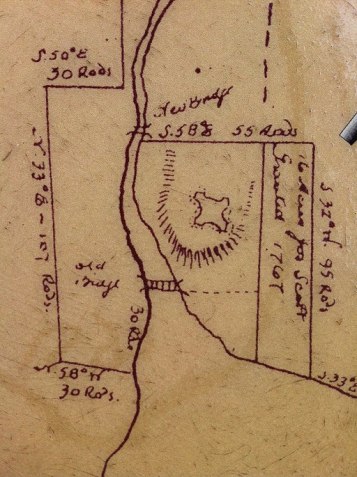
Fort Sackville Map Inset, (Nova Scotia Archives and Record Management, Wikimedia Commons)
Fort Sackville Map Inset, Nova Scotia Archives and Records, (Wikimedia Commons)

As Lieutenant Governor Henry Hamilton’s army arrived on the lower Wabash, the river widened and deepened, enabling his much-fatigued army to spread out and make better progress to Vincennes and Fort Sackville.  All along the way, the governor’s efforts to grow his army through the addition of Indian allies had largely succeeded, not only increasing his numbers but improving his intelligence about the American forces awaiting him.  Those were paltry, indeed.

Continue reading “Hamilton Recaptures Fort Sackville: Norman MacLeod’s Campaign Journal, December 17, 1778”

Norman MacLeod’s Campaign Journal, November 27, 1778

(An occasional series highlighting British Lieutenant Governor Henry Hamilton’s march south from Detroit to recapture Vincennes (Indiana) on its 240th anniversary.)

As fall progressed, cold set in and the weather began to catch up with Hamilton’s advancing army.  By November, it regularly dealt with freezing rain, snow, mud, and ice on the river and nearby trails.  MacLeod’s November 27th entry alludes to a few of those logistical challenges and the rather low opinion that the captain had of American soldiers, which began to place higher in MacLeod’s thinking as the army neared the territory so recently conquered by George Rogers Clark.

“Embarked at eight as usual, met with Great fields of ice this day But pretty good water.  So that we made us of our Oars only in two Rapids where most of the men was obliged to drag especially those in Boats because they draw more water than the Perogues, besides this the channels in the River are as if cut Purposely for no other Craft than Perogues.  We arrived at K [one or two words illegible] at 4 oClock called [sic; camped?] 10 miles from Weatono.  Us as our tents were Pitched five Savages from that Plase Arrived in camp, who acquainted us that there was no less than 200 of their nation ready to Join us the moment we arrived at the above Place.  They further told us that the Rebels had abandoned Au Post.  How true this is alittle more time we discover.  But it agrees with my own opinion for I never once thorough they would make a Stand either there or at the Illinois with So numbers especially on hearing that the Lieut. Govr. was coming who they know had all the Indians read at [hi]s call.”

William A. Evans and Elizabeth S. Sklar, eds., Detroit to Fort Sackville, 1778-1779: The Journal of Norman MacLeod, (Detroit: Friends of the Detroit Public Library/Wayne State University Press, 1978), 87.  The spelling and grammar errors are all from the original as transcribed by Evans and Sklar.  Evans and Sklar suspect “Weatono” is MacLeod’s reference to “Ouiatenon.”

George Washington Passed By Here

One of my favorite places to visit are the Laurel Highlands of southwestern Pennsylvania. The area abounds in history, and its scenery is, in my view, unparalleled. Rugged mountains overlook beautiful valleys of hardwoods, streams and waterfalls. Rocky outcroppings emerge from the forest. Powerful rivers wind through the region

It is a center of industrial history: railroading and mining, transportation like canals, the National Road, and other scenic highways. There is even a bit of Civil War history in the region. But my favorite topic to explore is its French and Indian War history. Which brings me to the person who started it all, George Washington.

Continue reading “George Washington Passed By Here”

George Washington’s Greatest Speech?

On the morning of March 15, 1783, George Washington strode into the “New Building” or “Temple” as the structure was referred as, to address the assembled officers of the Continental Army. He asked General Horatio Gates if he could have the floor to say a few words and when he unfolded his pieces of paper on the podium, the words lost their importance.

Why? Continue reading “George Washington’s Greatest Speech?”

Norman MacLeod’s Campaign Journal, October 13, 1778

Sketch of Wabash River, 1778
Sketch of the Wabash River Made During Hamilton’s 1778 Campaign (Wikimedia Commons)

In the summer of 1778, Lieutenant Colonel George Rogers Clark of the Virginia militia launched one of the most daring American military operations of the Revolutionary War when he invaded the “Illinois country” and captured Cahokia and Kaskaskia in modern-day Illinois and Vincennes in southern Indiana, effectively neutralizing British power on the Illinois, Wabash, and Mississippi Rivers.  Henry Hamilton, Lieutenant Governor of Quebec and Britain’s Superintendent for Indian Affairs in Detroit, could not allow such audacity to succeed, lest Britain’s influence with the western Indian nations wane.  Learning of Fort Sackville’s fall at Vincennes on the Wabash River, he set out to recapture it.

Continue reading “Norman MacLeod’s Campaign Journal, October 13, 1778”