

 Most people with an interest in the American Revolutionary War have heard of the Boston Massacre, in which Captain Thomas Preston of the 29th Regiment of Foot, commanding a contingent of British soldiers, fired into a crowd, or a mob depending on one’s point of view, harassing/threatening a guard outside the Customs House. Both sides in the growing dispute between Britain and its colonies rapidly turned the event, which occurred 250 years ago, to their political ends. Several books have been written about the massacre and tried to sort fact from propaganda, at least in the context of revolutionary Boston. In their latest book, John Adams Under Fire: The Founding Father’s Fight for Justice in the Boston Massacre Murder Trial, Dan Abrams and David Fisher tackle the trials of Captain Preston and his soldiers that followed. Continue reading “Review: John Adams Under Fire: The Founding Father’s Fight for Justice in the Boston Massacre Murder Trial by Dan Abrams and David Fisher”
Category: Personalities
“The Sword is Now Drawn…” The Powder Incident, Lexington and Concord moves Virginia to Revolution

One of the most amazing parts of the events on April 19, 1775 is just how sophisticated the colonial information network was. As soon as Lt. Col. Francis Smith’s British Regulars began to move across the Charles River, riders fanned out from Boston and to neighboring towns. Each town then had more riders that spread out and soon dozens of men were riding through the New England countryside warning of the fighting that took place. Soon information spread to the mid-Atlantic colonies and Philadelphia on April 24th. In the age of no electricity, the complexities and speed that news traveled from Boston to the other colonies was pretty amazing. Stories grew from person to person and it would take months and even years to decipher truth from exaggeration. It was imperative for both the “Patriots” and General Thomas Gage to get their version of the events of April 19th out as fast as possible. Facts or not, the importance of the public relations was of utmost importance to both sides to win the hearts and minds of the other colonies.
As the news reached Virginia, the colony was already at a crossroads with their

Governor. The last House of Burgesses that met in Williamsburg was dissolved in August 1774 over their vocal support of the people of Massachusetts after the Boston Port Act. The once popular Governor, John Murray, 4th Earl of Dunmore (Governor Dunmore), was angered over their overt support and ordered them dissolved and returned home. The legislature defied his orders and met soon after at the nearby Raleigh Tavern, thus constituting the “First Virginia Convention.” With questionable legal authority, the Convention called for solidarity and non-importation of British goods. They also agreed to meet again in the future. The “Second Virginia Convention” met in March of 1775 in Richmond, a safe distance from the Governor’s influence in Williamsburg. It was at this Convention that Patrick Henry made his famous “Give me Liberty or Give me Death” speech on March 23. Though considered radical at the time, the speech energized the Convention and set the tone. When the Governor learned of the Convention and especially Henry’s speech, he made a fateful decision to remove the gunpowder stored in the magazine in Williamsburg. Continue reading ““The Sword is Now Drawn…” The Powder Incident, Lexington and Concord moves Virginia to Revolution”
Lafayette at Brandywine
Marquis de Lafayette was a French aristocrat serving in the French army, and recently married, when the Revolution broke out in America. He followed events with interst, and was motivated to come and fight with the Americans.
He arrived in March, 1777, nineteen years old and eager. He immediately formed a friendship with Washington, and was an aide on his staff. In the meantime British forces had invaded Pennsylvania, intent on capturing Philadelphia. Washington’s army took a position behind Brandywine Creek, and the British attacked on September 11, 1777. British troops had flanked the Americans, and reinforcements were rushed to the threatened sector, making a stand on Birmingham Hill.
Eager to get to the fighting, Lafayette and a group of French officers rode to the unfolding battle at Birmingham Hill, arriving as the action was at its hottest. Approaching from the south, they rode up the Birmingham Road, and turned to the left, coming in behind the brown-coated troops of General Thomas Conway’s Pennsylvania brigade.
Continue reading “Lafayette at Brandywine”The Journal of Nicholas Cresswell, Part 6

Skirmish in New Jersey
Cresswell found cheap lodging in New York and reunited with Joseph Brewer, who had fled Philadelphia himself, leaving his wife behind. “The persecution against the friends of Gorvernment was too violent for a man of his warm temper to stay any longer amongst them with safety either of person or property.”[1] While in New York, he watched the buildup of forces that Howe would later take on the Philadelphia campaign, but his focus remained on securing passage home. It would take months, but Cresswell found ways to kill time, including watching a skirmish with the Americans he had so frequently cursed.
Continue reading “The Journal of Nicholas Cresswell, Part 6”
The Journal of Nicholas Cresswell, Part 5
Escape from America
Finally, in the spring of 1777, Cresswell again decided to try returning to England. Thomson Mason, who had already intervened with two Committees of Safety to protect the Englishman, offered to help with Virginia authorities once more, provided that Cresswell swear not to join the British Army. Cresswell did. The best plan was to leave Leesburg, travel overland to Alexandria, then take a schooner down the Potomac and Chesapeake for Williamsburg and Hampton, where it might be possible go aboard a ship bound for British-occupied New York. As he made his preparations, the local Committee of Safety arrived on April 16 to search his possessions for treasonable items. They seized a shot pouch, powder horn, and bearskin he acquired from the Delaware Indians. Cresswell decided not to contest the seizure lest it complicate his departure.
Continue reading “The Journal of Nicholas Cresswell, Part 5”
Gaming Away Social Distancing. Deal or Duel: An Alexander Hamilton Card Game

Among his many aphorisms, Ben Franklin reportedly said “games lubricate the body and the mind.” Given the large number of quotes attributed to the sage, it is suspect. But, his generation certainly understood games, both as a way of sharpening the mind and passing time in amicable company. Franklin was fond of chess, but not above games of chance and gambling. George and Martha Washington often played different card games with their guests. George, of course, also made an occasional wager, particularly when traveling on business. Even today, many parlors in restored colonial homes will contain a gaming table. Continue reading “Gaming Away Social Distancing. Deal or Duel: An Alexander Hamilton Card Game”
Beer Drinking in the 18th Century
Emerging Revolutionary War welcomes back guest historian Vanessa Smiley
“Beer is living proof that God loves us and wants us to be happy.” – Benjamin Franklin, Poor Richard’s Almanack
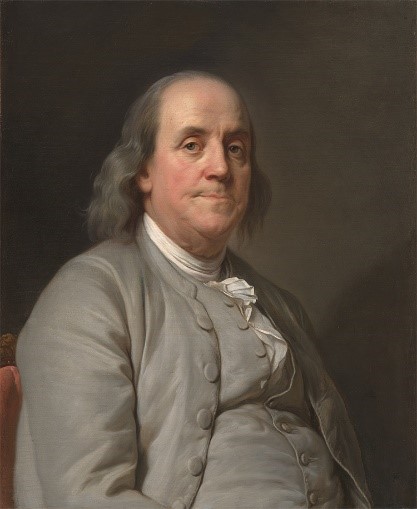
(Benjamin Franklin by Joseph Siffred Duplessis, c. 1785)
During the 18th century, Colonial society held three common beliefs about beer drinking:
- Drinking beer was healthier than drinking water
- Beer and its ingredients were a healthy supplement to the entire family’s diet
- It was an accepted way to promote social discourse
A little different from today’s society, except for beer connoisseurs (such as the Emerging Revolutionary War folks), these beliefs were formed from the circumstances of the time.
Though a generation away from understanding the connection between boiling water and sanitation, most folks understood that water could make you deathly ill. And yet, ale and beer drinkers did not seem to have that same risk. They did not know it at the time, but the boiling process to make these alternative drinking options neutralized much of any tainted water’s ill effects. Therefore, many substituted beer, ale, and other alternatives such as hard cider over water, making these a major dietary staple in the colonies.
Continue reading “Beer Drinking in the 18th Century”The Journal of Nicholas Cresswell, Part 4
A Loyalist under House Arrest
Having failed to reach the British Army in New York, Cresswell spent a miserable autumn and winter of 1776/1777 in northern Virginia, often arguing with his host, James Kirk, a Patriot and the only man who had ensured the Englishman could keep clothes on his back and a roof over his head. Cresswell’s loyalist proclivities and extensive travels were widely known and on November 28, three men of the Committee of Safety in Alexandria “waited on me and informed me that the committee did not think it prudent to let me go out of the Country at this time and hoped that I would give my word of honour not to depart this Colony for three months. Otherwise they would confine me. I was obliged to do the first as the lesser evil of the two. They were polite enough not to search my chest.”[i] Depressed as ever and suspecting Kirk of arranging the entire affair in order to keep him in Virginia, Cresswell did what he usually did when he was unhappy. He got drunk.
Continue reading “The Journal of Nicholas Cresswell, Part 4”
The Journal of Nicholas Cresswell, Part 3
A Loyal Englishman in a Hostile Country
Part 2 click here.
When he arrived in Alexandria, Virginia in October 1775, Nicholas Cresswell, an Englishman visiting the colonies in search opportunity, found himself in dire straits. The war had cut off his father’s money, while his loyalist principles strained his acquaintances and put him in an awkward position. He summed it up: “if I enter into any sort of business I must be obliged to enter into the service of these rascals and fight against my Friends and Country if called upon. On the other hand, I am not permitted to depart the Continent and have nothing if I am fortunate enough to escape the jail. I will live as cheap as I can and hope for better times.”[i]
Continue reading “The Journal of Nicholas Cresswell, Part 3”
The 245th Anniversary of "Give Me Liberty or Give Me Death"
On this date, in 1775, Virginian Patrick Henry, a delegate to the Second Virginia Convention from Hanover County, Virginia sat in on the ongoing debate at St. John’s Episcopal Church in Richmond, Virginia.

The 28-year old then stood to give his defense of his proposed amendments to the petition then being debated. Below is the last few lines of his now famous statement, with the last sentence being the one most remembered;
“If we were base enough to desire it, it is now too late to retire from the contest. There is no retreat but in submission and slavery! Our chains are forged! Their clanking may be heard on the plains of Boston! The war is inevitable and let it come! I repeat it, sir, let it come.
Continue reading “The 245th Anniversary of "Give Me Liberty or Give Me Death"” Emerging Revolutionary War Era