They waded ashore during the morning of July 6, 1758. Full of confidence, the vanguard of Major General James Abercromby’s massive army of over 16,000 men had completed its nearly thirty-mile trek northward across the waters of Lake George. They began pushing inland – men from Thomas Gage’s 80th Regiment of Light-Armed Foot, Phineas Lyman’s 1st Connecticut Regiment, and of Robert Rogers’ famed rangers – scattering small pockets of French resistance. By early afternoon the entire army had debarked at the designated landing site and formed into four columns to begin its advance towards the primary objective: Fort Carillon. Moving forward into the thick wilderness with the rightmost column of mixed regular and provincial units was Abercromby’s second-in-command, Brigadier General George Howe. [1]
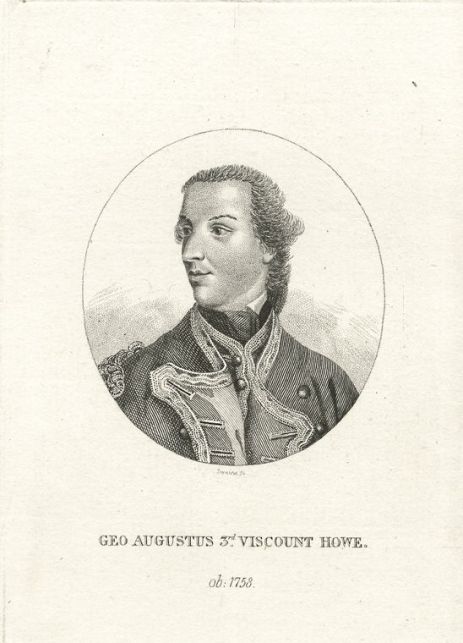
George Augustus, Third Viscount Howe. New York Public Library
George Augustus, Third Viscount Howe, was born in Ireland in 1725. Like his younger brothers, Richard and William, George was destined for a career in His Majesty’s Forces and to serve in North America. His father, Emanuel Scrope, Second Viscount Howe, was a prominent member of parliament and served several years as the Royal Governor of Barbados before dying there of disease in 1735. Upon his father’s death, George assumed the title of Third Viscount and in 1745, at age twenty, was made an ensign in the 1st Foot Guards. Subsequently serving as an aide-de-camp to William Augustus, Duke of Cumberland, Howe fervently studied the strategies and tactics employed by his own commanding officers and the enemy, and witnessed firsthand the carnage of the War of Austrian Succession. Just ten years later, when the world was set ablaze by war yet again, George was ordered to Halifax, Nova Scotia with a commission as colonel of the 60th Regiment of Foot (Royal Americans) that was set to take part in a failed operation to capture Fortress Louisbourg in 1757. He was later made colonel of the 55th Regiment of Foot, and in December, appointed Brigadier General by William Pitt. The following summer, he accompanied the largest field army ever assembled in North America up to that time as its second-in-command. Continue reading ““The soul of General Abercromby’s army seemed to expire”: The Death of George Howe, July 6, 1758”→
When the musical 1776 debuted on Broadway, it came at what seemed like an unconventional time. The Vietnam War was underway, and American patriotism was being taxed as it had never been taxed before during wartime. Nonetheless, the production was a commercial and critical success, earning three Tony Awards, including Best Musical.
The show made the jump to film—I know a number of people who watch it every year on the Fourth of July—and it enjoyed revivals in 1997 and 2016. But the show never enjoyed the sort of enduring life off Broadway that classics like Hello, Dolly or Oklahoma! or Mame have enjoyed. (I could rattle off a dozen such names, and most readers would go, “Ohhhh, that’s a good one.” South Pacific? Meet Me in St. Louis? The Wizard of Oz? On and on….) As written, 1776 requires a cast of twenty-four men and only two women. That makes it exceptionally difficult to cast on the community theater level, where a majority of auditioners are typically female.
So perhaps the new national touring production of 1776, based on a 2022 Broadway revival, might offer a new way to look at the show. The new production, which I saw last week at the Kennedy Center in Washington, D.C., consists of “a company of artists who reflect multiple representations of race, ethnicity, and gender, and who identify as female, trans, nonbinary, and gender nonconforming.” That’s a mouthful, but the bottom line is that these are not your typical Founding Fathers because they aren’t “fathers” at all.
The production owns its new lens from the opening lines. To a backdrop of John Trumbull’s famous painting The Declaration of Independence, John Adams (as played by Gisela Adisa) begins the show: “In my many years, I have come to a conclusion that one useless man is a shame, two is a law firm, and three or more is a congress.” Adisa, a black woman, looks pointedly at the painting. “By God, I have had this Congress,” she says.
Her meaning is unmistakable: these dead white men are tired and old. Time for something new.
The cast comes onstage and literally steps into the buckle-topped leather shoes of the Founders. They hoist the bottom cuffs of their pantlegs up, transforming them into knickerbockers. And away they go! Soon enough, the whole cast is shout-singing at Adams to “Sit down, John!”
The production conceit obviously owes a lot to the Tony Award-winning Hamilton, which opened in 2015 with a multicultural cast. Writer Lin-Manuel Miranda reportedly read Ron Chernow’s biography of Alexander Hamilton and saw a lot of himself in the Founder: an Everyman from humble beginnings who transformed himself into a self-made man. If Miranda could see himself in this old “dead white male,” couldn’t others, as well?
Casting the Revolutionary generation outside of its historical color, race, and gender boundaries proved revolutionary in and of itself, but it proved remarkably successful. Hamilton’s story—and the larger story of America—became newly accessible to huge new audiences. Ditching fifes and drums for a hip-hop and soul soundtrack also reframed the story and increased history’s modern appeal.
Ironically, one of Miranda’s inspirations for Hamilton was the much more traditional 1776. “1776 certainly paved the way for Hamilton,” Miranda said in feature in Playbill, “not just in that it’s about our founders, but also in that it engages fully with their humanity. I think it makes them accessible to us in a very real way.” That Playbill piece, funny enough, consisted of a conversation between Miranda and William Daniels, who played John Adams in the original 1776 production and in the film. (It’s a neat interview. You can read it here.)
As I prepared to watch 1776 at the Kennedy Center, I pondered whether the same conceit would work for this show the way it had for Hamilton. I understand the “Everyman” idea, but on the other hand, the members of the Second Continental Congress were hardly “Everymen.” They were, quite literally, the political elites of their respective colonies. But there’s room, too, to get into the weeds on that. Benjamin Franklin and John Adams both came from humble origins even if Edward Rutledge or Richard Henry Lee did not. And that’s the point of good history: get into the weeds. Look at the shades of gray. Find new lenses to see the familiar in new ways so you can better understand what you’re looking at.
It would be a mistake to brush aside this production of 1776 as woke-ism or political correctness or any of that. “I’m not interested in talking about American history because I want to punish America,” said Bryan Stevenson, creator of the National Memorial for Peace and Justice in Montgomery, Alabama, quoted by the show’s directors in the program. “I want to liberate America.”
1776 proved liberating. While the production conceit didn’t work 100% of the time, it mostly did, and at those times it worked best, it added powerful, powerful resonance. When the delegates sang of the slave trade in “Molasses to Rum,” for instance, and some of those performers were Black women, the sinister nature of the dark bargain at the heart of the Founding reverberated with a tragic sense of the now. And when echoes of Adams’s plaintive “Is Anybody Out There,” sung by a black woman, wove through, it was chilling and urgent. History spoke from the stage to us in the present.
Newly sanctioned additions to the production gave us Abigail Adams’s “remember the ladies”—magnified in its power among a non-male cast. It also adds Robert Hemings, Thomas Jefferson’s enslaved servant, as a silent figure on stage, voiceless as Jefferson pens the enduring words “All men are created equal.” These were delightful, thought-provoking moments that confronted American history without being confrontational.
1776 is, to be sure, a delightful show, but it’s less jingoistic than one might expect for a story about America’s birthday. It asks us to consider the costs of that founding, not so we can feel bad about America but so can be reminded of the ongoing work to live up to our own ideals. It asks us not to think of a founding moment but, instead, the beginning of founding process that we are all invited to be part of because the work belongs to us all.
Happy Carolina Day! This June 28 marks the 247th anniversary of the Battle of Sullivan’s Island. In the battle, an outgunned and outnumbered group of Patriots defending an unfinished palmetto fort repulsed one of the most powerful navies in the world. The battle marked the first major battle of the Revolutionary War around Charleston and the battle’s anniversary (often referred to as Carolina Day or Palmetto Day) has been celebrated by Charlestonians and South Carolinians since 1777. But this was only the first of many actions that occurred in and around Charleston during the Revolutionary War.
Author Mark Maloy holding the newest Emerging Revolutionary War Series book: “To the Last Extremity: The Battles for Charleston, 1776-1782”
Just in time for the anniversary of this battle, Emerging Revolutionary War is proud to announce the sixth installment of the Emerging Revolutionary War Book Series: “To the Last Extremity: The Battles for Charleston, 1776-1782” by Mark Maloy. In our first book that explores the southern campaign of the Revolutionary War, “To the Last Extremity” gives and overview of what happened in Charleston, South Carolina during the war, including the Battle of Sullivan’s Island, Prevost’s 1779 invasion, the 1780 Siege of Charleston, and the occupation and liberation of the city. Additionally, the book includes three tours in and around the city that shows where the major actions occurred and what you can see there today.
Celebrate Carolina Day this year by picking up a copy of “To the Last Extremity” at Savas Beatie or wherever books are sold! If you are lucky enough to be in Charleston, this year’s annual celebration will take place in White Point Garden in Charleston, South Carolina with an address by Dr. David Preston who joined Emerging Revolutionary War a few months ago for one of our Rev War Revelries.
On December 16, 1773, a protest orchestrated by the Sons of Liberty in Boston, Massachusetts turned words into action. Upset over recently passed legislation and the belief that “no taxation without representation” 116 people dumped 342 chests of tea owned by the British East India Company into Boston Harbor. The event was one of the milestones on the way to the American Revolution and American independence. As the Boston Tea Party, as it is known to history, closes in on its 250th anniversary, Emerging Revolutionary War will invite Evan O’Brien, the creative director for the Boston Tea Party Ships and Museum this Sunday, June 25, evening for the next “Rev War Revelry.”
We hope you can join us at 7 p.m. EDT on Emerging Revolutionary War’s Facebook page for a discussion of the history behind and on December 16, 1773 and the efforts to commemorate and interpret that time frame. If you are contemplating venturing up to Boston in December to be in the city for the 250th anniversary of this event, you will not want to miss this discussion, as Evan will share some of what the museum has been planning to commemorate when Boston Harbor became a “tea-pot.”
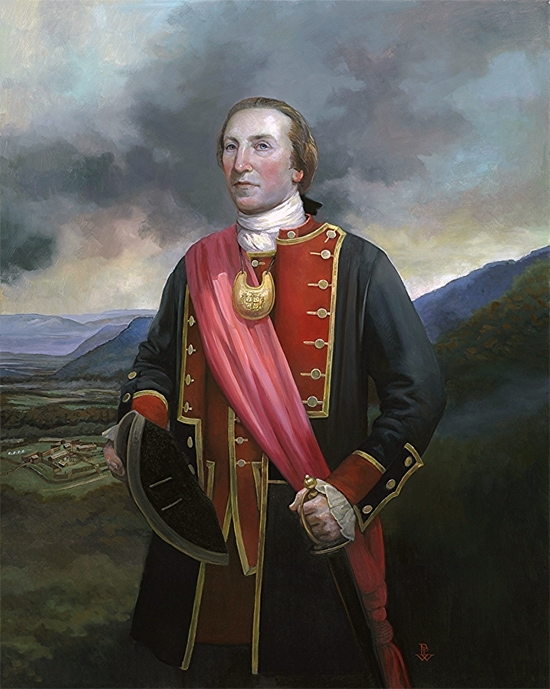
Young George Washington’s performance in the French and Indian War is largely viewed as one of failure and recklessness. His actions in the Ohio River Valley ignited a conflict in North America that in turn lit the world ablaze. He could boast of no great military laurels, other than that he had emerged unscathed from the bloody battle of the Monongahela, and that he had commanded colonial provincials in Gen. John Forbes’ successful campaign against Fort Duquesne. He left military service following the latter event, with his hopes of receiving a commission in His Majesty’s Army worthy of his merit dashed years before.
“Young George Washington” by Pamela Patrick White, White Historic Art (whitehistoricart.com)
However, one aspect of Washington’s service in the French and Indian War has been widely neglected. The commander of the Virginia Regiment was tasked with defending the western frontier from enemy raiding parties. It was an unenviable position that he tackled with limited resources. It was during this period that Washington began to develop the leadership qualities that would inspire others to follow him into the depths of Hell some twenty years later. On the last day of 1758, as Washington prepared to pursue a life outside of military greatness, the officers of the Virginia Regiment drew-up a heartfelt petition to urge the now 26 year-old colonel they had grown to admire to rescind his resignation. Below is that document:
“To George Washington Esqr. Collo. of the Virginia Regiment & Commander of all the Virginia Forces The humble Address of the Officers of the Virginia Regiment
Fort Loudoun, Dec. 31st 1758
Sir,
We your most obedient and affectionate Officers, beg Leave to express our great Concern, at the disagreeable News we h⟨ave received⟩ of your Determination to resign the Command of that Corps, in which we have under you long ⟨served⟩.
The ⟨happine⟩ss we have enjoy’d and the Honor we have acquir’d, together with the m⟨utua⟩l Regard that has always subsisted between you and your Off⟨icers,⟩ have implanted so sensible an Affection in the Minds of us all, that we cannot be silent at this critical Occasion.
In our earliest Infancy you took us under your Tuition, train’d us up in the Practice of that Discipline which alone can constitute good Troops, from ⟨the⟩ punctual Observance of which you never suffer’d the least Deviation.
Your steady adherance to impartial Justice, your quick Discernment and invarable Regard to Merit, wisely intended to inculcate those genuine Sentiments, of true Honor and Passion for Glory, from which the great military Atcheivements have been deriv’d, first heighten’d our natural Emulation, and our Desire to excel. How much we improv’d by those Regulations, and your own Example, with what Alacrity we have hitherto discharg’d our Duty, with what Chearfulness we have encounter’d the severest Toils, especially while under your particular Directions, we submit to yourself, and flatter ourselves, that we have in a great Measure answer’d your Expectations.
Judge then, how sensibly we must be Affected with the loss of such an excellent Commander, such a sincere Friend, and so affable a Companion. How rare is it to find those amiable Qualifications blended together in one Man? How great the Loss of such a Man? Adieu to that Superiority, which the Enemy have granted us over other Troops, and which even the Regulars and Provincials have done us the Honor publicly to acknowledge! Adieu to that strict Discipline and order, which you have always maintain’d! Adieu to that happy Union and Harmony, which has been our principal Cement!
It gives us an additional Sorrow, when we reflect, to find, our unhappy Country will receive a loss, no less irreparable, than ourselves. Where will it meet a Man so experienc’d in military Affairs? One so renown’d for Patriotism, Courage and Conduct? Who has so great knowledge of the Enemy we have to deal with? Who so well acquainted with their Situation & Strength? Who so much respected by the Soldiery? Who in short so able to support the military Character of Virginia?
Your approv’d Love to your King and Country, and your uncommon Perseverance in promoting the Honor and true Interest of the Service, convince us, that the most cogent Reasons only could induce you to quit it. Yet we with the greatest Deference, presume to entreat you to suspend those Thoughts for another Year, and to lead us on to assist in compleating the Glorious Work of extirpating our Enemies, towards which so considerable Advances have been already made. In you we place the most implicit Confidence. Your Presence only will cause a steady Firmness and Vigor to actuate in every Breast, despising the greatest Dangers, and thinking light of Toils and Hardships, while lead on by the Man we know and Love.
But if we must be so unhappy as to part, if the Exigencies of your Affairs force you to abandon Us, we beg it as our last Request that you will recommend some Person most capable to command, whose Military Knowledge, whose Honor, whose Conduct, and whose disinterested Principles we may depend upon.
Frankness, Sincerity, and a certain Openness of Soul, are the true Characteristics of an Officer, and we flatter ourselves that you do not think us capable of saying anything, contrary to the purest Dictates of our Minds. Fully persuaded of this, we beg Leave to assure you, that as you have hitherto been the actuating Soul of the whole Corps, we shall at all times pay the most invariable regard to your Will and Pleasure, and will always be happy to demonstrate by our Actions, with how much Respect and Esteem we are, Sir, Your most affectionate & most obedt humble Servants.”[i]
[i] “Address from the Officers of the Virginia Regiment, 31 December 1758,” Founders Online, National Archives, https://founders.archives.gov/documents/Washington/02-06-02-0147. [Original source: The Papers of George Washington, Colonial Series, vol. 6, 4 September 1758 – 26 December 1760, ed. W. W. Abbot. Charlottesville: University Press of Virginia, 1988, pp. 178–181.]
On September 14, 1814, United States forces defending Fort McHenry in Baltimore repelled the British attempt to capture the city. Flying defiantly over the brick parapets was a 30 x 42 -foot the following day, clearly seen by the British and one captive American, Francis Scott Key. Over 100 years later the poem Key began writing on September 15 became the national anthem of the United States of America. But, what about the flag that the military commander of Fort McHenry, Major George Armistead had made? Well, this iconic flag became a part of the Armistead family for almost the next century as well.
Now, historian Tom McMillan, who has written on another member of the Armistead family, returns with his latest publication, Our Flag Was Still There: The Star-Spangled Banner that Survived the British and 200 Years–and the Armistead Family Who Saved It. This fascinating read, tracing the flag and its intertwined connection with the Armistead family, will be the subject of this week’s “Rev War Revelry.” McMillan gave a bit of a teaser to entice you to listen in on Emerging Revolutionary War’s Facebook page Sunday at 7 p.m. EDT.
“OUR FLAG WAS STILL THERE details the improbable two-hundred-year journey of the original Star-Spangled Banner — from Fort McHenry in 1814, when Francis Scott Key saw it, to the Smithsonian in the 21st century – thanks to three generations of an enduring military family, the Armistead’s, who defended, kept, hid, and ultimately donated the most famous flag in American history.”
We hope you grab your favorite beverage and tune in. The book is now available for purchase and Tom will have details on how to attain a copy!
We interact with history at a personal level in many ways. We enjoy careers in the field, read, tour locations, work as living historians (or interact with them), dig through archives, trace our roots, visit museums, or simply stumble across some connection in the course of living our daily lives. But, a fortuitous bit of family history struck on a recent weekend, just shy of the 241st anniversary of a battle.
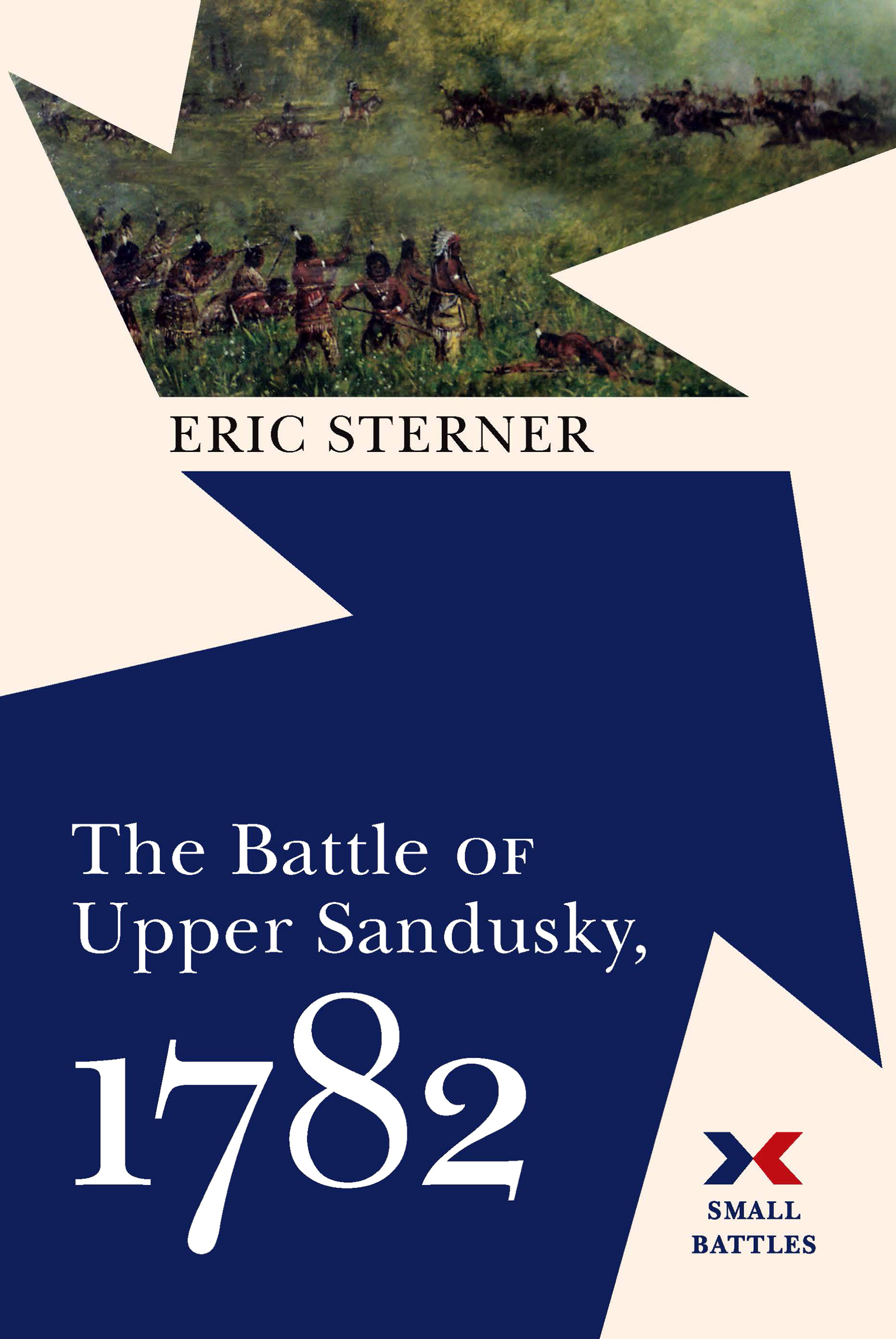
My wife and oldest daughter spent a Sunday morning with my in-laws to visit and record some family stories and memories. They came back with a box of material. The first document they perused was a 19thcentury application for membership in the Daughters of the American Revolution. I was in a different room and suddenly heard yelling as my wife came to find me. I assumed a snake had gotten into the house or we’d won the lottery without playing. It turned out that the DAR applicant, a direct forebear of both my wife and daughter, was descended from Nicholas Dawson, who had fought in the Crawford Campaign, which happened to be the subject of my second book, The Battle of Upper Sandusky, 1782. (Shameless bit of self-promotion: it just went on sale). Talk about coincidence.
Many volunteer actions on the frontier during the American Revolution lacked troop rosters. But, to stimulate volunteering for the Crawford campaign the county lieutenants for Pennsylvania’s Washington and Westmoreland counties offered to count the time on campaign against a volunteer’s legal militia obligations. So, they created rosters, some of which partially survived. The Pennsylvania Archives published that material. Sure enough, Nicholas Dawson shows up as a miscellaneous volunteer, meaning only that the roster didn’t include his company assignment. The ever-helpful Fold3 database also holds pension debt certificates issued to Dawson on January 18and 20, 1785.
Lieutenant General Henry Clinton, New York Public Library
With the Charleston in British hands, Clinton believed that all he had to do was establish outposts in South Carolina stationed with British regulars. This be believed would put down what was left of the rebellion in the state. These posts assisted the recruitment and training of the thousands of Loyalist troops he believed would now rally around the King’s Colors. To take the best advantage of his Regular troops, Clinton determined to establish three major outposts in the South Carolina backcountry. Clinton established these posts at Augusta (Georgia), Ninety-Six, and Camden. While these posts were to be centers for the British army, the local Loyalist militias were to serve as the pacification forces in South Carolina while the main British force was freed up for larger strategic goals.
To recruit, enlist, and train the large, expected influx of Loyalist militia, Clinton named Maj. Patrick Ferguson as Inspector of Militia. Ferguson was ordered to enlist younger men, preferably unmarried, into companies that would form battalions. He was instructed to recruit from Georgia to North Carolina and offer short enlistments if necessary. Clinton believed that having the colonists maintain their own law and order (via Great Britain’s authority) would cause less apprehension with those that were mostly undecided about to whom they should throw their support, the Patriots or the British.
By mid-May, the British army set out for their destinations in the back country. Clinton’s second in command, Lieut. Gen. Charles Lord Cornwallis, marched to Camden while Ferguson moved to Ninety-Six. Without much resistance, Clinton’s plan to conquer South Carolina was working perfectly. Patriot leaders scrambled to find ways to organize their resistance. The only organized Continental force remaining in South Carolina was a small force of Virginians under Col. Abraham Buford that was on its way to Charleston when the city surrendered. Ordered by Brig. Gen Isaac Huger to reverse course and make his way north toward Hillsborough, North Carolina. There along with the North Carolina militia, he could be the core of American defense in North Carolina.
On May 27, Cornwallis ordered Lieut. Col. Banastre Tarleton with 300 of his dragoons and mounted infantry in pursuit of Buford. Tarleton’s British Legion was mostly composed of Loyalist recruits, so many in his force were from America. Tarleton pushed him men and horses hard, many horses falling out along the way. Buford was aware of a possible British pursuit but underestimated the speed in which Tarleton closed the gap. On May 29, Tarleton caught up with Buford in a region near the South and North Carolina border called the “Waxhaws.”
Lieutenant Colonel Banastre Tarleton, New York Public Library
The events that took place next are still debated today. Tarleton under a flag of truce tried to get Buford to surrender. Writing to Buford, Tarleton wrote “Resistance being vain, to prevent the effusion of human blood, I make offers which can never be repeated.” Tarleton was already creating an image of himself as an aggressive and brutal fighter. Buford, however, refused, replying, “I reject your proposals, and shall defend myself to the last extremity.” With that, Buford continued his march north towards North Carolina as did Tarleton’s pursuit. Around 3:00 p.m. the lead elements of Tarleton’s force wiped out Buford’s small rearguard, forcing Buford to stop and deal with Tarleton.
Buford decided to create a single battle line east of the Rocky River Road. Tarleton, ever the aggressive commander, ordered his horsemen to charge the Virginians. Here, Buford made what would be a devastating blunder. He ordered his men to not fire until the British cavalry was within ten yards of the American line. This would not allow the Americans a chance to fire another volley before the British charge was upon them. The Virginians fired, taking out some of the British dragoons and horses (Tarleton himself became briefly trapped under his horse), but most charged through Buford’s line, wielding their sabers and cutting down the Virginians. Total chaos ensued, and many of Buford’s men attempted to flee. Some tried to surrender by throwing their arms to the ground, but American accounts state that the British were offering “no quarter” and killing everyone that tried to surrender. Other accounts report that Buford sent a white flag to Tarleton, but probably because he was injured, it was never received, and the fighting continued. Accounts differ widely between the Americans and British on the fighting, but the fact cannot be argued that Buford’s command was destroyed.
Waxhaws Grave and Monument, photo and flags courtesy of the author
American casualties were estimated at 350, 113 men killed, 147 wounded, 50 captured, and 2 six-pound artillery pieces and 26 wagons captured. Buford himself was able to escape the field. Tarleton only suffered 5 killed and 12 wounded, a complete victory. What has become known as “Buford’s Massacre” was not referred to as a massacre at all in many period accounts. Tarleton himself blamed the “slaughter” on the fact that his men thought he was killed in the battle and sought revenge. The disparity in numbers and the reports of indiscriminate British slaughter of Americans led to the creation of “Tarleton’s Quarter.” Patriot leaders quickly pounced on this and began to spread stories about Tarleton’s brutal tactics. This proved to be a public relations coup for the Patriot cause, as it energized their side and led to a more robust recruitment of militia and partisan forces to take on the British who now faced no organized opposition in South Carolina or Georgia.
Stay Tuned for the Emerging Revolutionary War Series newest book releases “To the Last Extremity: The Battles for Charleston, 1776-1782” by Mark Maloy and “All That Can Be Expected: The Battle of Camden and the British High Tide in the South, August 16, 1780” by Rob Orrison and Mark Wilcox to learn more abou the 1780 Southern Campaign. Both releases are published by Savas Beatie Publshing: https://www.savasbeatie.com/american-revolution/
Thomas Paine wrote the line used as the title for this post in his pamphlet titled “American Crisis” in 1776. Most people recognize the opening lines that Paine penned in that same essay.
“These are the times that try men’s souls: The summer soldier and the sunshine patriot will, in this crisis, shrink from the service of their country; but he that stands it now, deserves the love and thanks of man and woman.”
However, on this Memorial Day, while reading through his essay, I was struck by the line I used for the title. Furthermore, by the far too numerous men who served in the militia and Continental service that lay in unknown or unmarked graves throughout the eastern United States. To them that gave the ultimate sacrifice in pursuit of the principles they held most dear, we remember on this day. To them and the thousands that came after and paid with their lives so others can have “life, liberty, and the pursuit of happiness” we also remember today on this Memorial Day.
One of the main objectives of Emerging Revolutionary War is to visit the sites attributed to the American Revolutionary War era and to provoke interest and expand learning on the people, places, and history. That includes remembering those that lay in these unmarked graves “known only to God.”
The Battle of Waxhaws, fought on May 29, 1780, was a lopsided British victory by Lieutenant Colonel Banastre Tarleton’s British cavalry over American Colonel Abraham Buford’s Continental forces in Waxhaws South Carolina. Buford lost 316 of 350 men with the British losing less than 20. Known popularly as “Buford’s Massacre,” Continental leaders used the battle as a propaganda tool against the Crown forces in the south. But, was it really a massacre?
Join us as we welcome historian and author Dr. Jim Piecuch as we discuss his research and theory about the Battle of Waxhaws and its aftermath. Dr. Piecuch has written several books on the Southern Campaign of the American Revolution including his book “Blood Be Upon Your Head: Tarleton and the Myth of Buford’s Massacre.” This Rev War Revelry will be pre-recorded and posted on May 28th at 7pm. Grab a drink and a good seat and enjoy this great presentation on one of the most controversial battles of the American Revolution.







 Emerging Revolutionary War Era