Yes, this may be the first college student protest recorded in what became the United States of America.
No, this was not just about butter or butter substitutes.
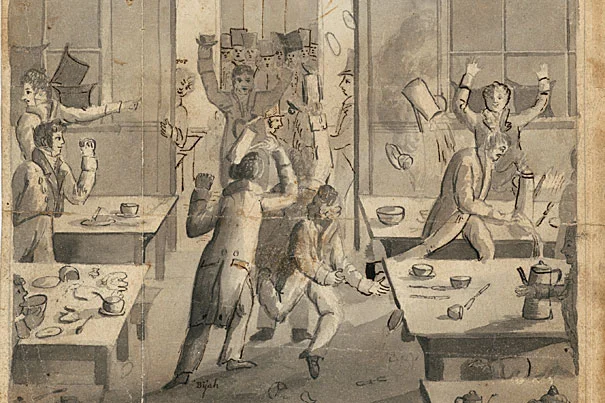
At Harvard College, in 1766, three students, all seniors at the institution, Asa Dunbar, Daniel Johnson, and Thomas Hodgson had had enough of the lack of fresh food being served to the student body. Dunbar, who may be best known as the grandfather of Henry David Thoreau, led the protest, stating that the butter served by the college was “stinketh” and he incited the student body to reject this rancid fare by jumping onto his chair and yelling
“Behold our butter stinketh! Give us therefore butter that stinketh not!”
Dunbar faced disciplinary action, being punished for insubordination and instigating a potential riot. After he received his punishment, the student body enacted another protest, by walking out of the hall, cheering loudly in Harvard Yard, and continuing into Cambridge to dine instead. To give some credit to the college, the adminstration acknowledged the butter ws rancid. With restrictions due to economic difficulties the availability of fresh food was limited however.
As Massachusetts moved closer to open rebellion in their remonstrances against British Parliament and the British crown their example was mirrored by the student body of Harvard. After a month of impassed including “insulting proceedings” the royal governor of Massachusetts, Sir Francis Bernard personally addressed the student body in the chapel on campus and the protests and insubordination of the student body concluded.
A depiction of a student protest courtesy of The Harvard Gazette
Concluding, with a Butter Rebellion, a Tea Party, what food or drink would the colonists focus on next? For me, I think I will sip my Samuel Adams brew. Leave the butter and tea to the Massachusettans.
(Yes, I know that Samuel Adams beer was not around at the time of the American Revolution but I thought it was fitting. And beer and history go together anyways right?)
As the word of the “Intolerable Acts” spread throughout the colonies in response to the Boston Tea Party, colonial governments began to show support for Boston. Then in May 1774, the Virginia House of Burgesses voted for a day of “prayer” on June 1, 1774 in support of Boston and Massachusetts. In response to this, Virginia Governor Lord Dunmore dissolved the assembly. Soon after, the men of the Burgesses met at the Raleigh Tavern in Williamsburg to set up the “First Virginia Convention.” This extra legal body set the path towards revolution.
Join us this Sunday, May 12th at 7pm for this will be a pre-recorded discussion with historians J. Michael Moore and Maureen Wiese to commemorate the 250th anniversary of the First Virginia Convention. We will cover this early movement by an American colony to revolution and how it impacted other movements across the colonies.
Amid the hot weather of June 28, 1778, the British army under General Henry Clinton battled General George Washington’s Continental Army in the fields outside Freehold, New Jersey. The Battle of Monmouth Courthouse ranks as the eleventh deadliest battle of the Revolutionary War, claiming at least 700 casualties between the two armies. While the armies moved on after the sharp fight, the citizens of Freehold were left to deal with the battle’s aftermath.
Below are excerpts from two letters written by citizens of Freehold in the immediate aftermath of the battle that describes the toll the armies and battle took on their homes.
An unidentified “young gentleman, an inhabitant of Freehold,” penned the first letter on June 29, 1778. This citizen marched during the battle with Nathanael Greene’s troops, who only arrived on the battlefield proper near the end of the fight. Thus, he could “form an idea of the particular movements of the…engagement only from the dead…” There was abundant evidence provided by the corpses on the battlefield as the British “left very many dead upon the field of action…” Beyond the furrowed ground sliced by artillery shots and musket balls, the British columns left a path of destruction in their wake. “The destruction the enemy have made is dreadful. A great number of houses, barns and out-houses, on and near the public roads, are entirely reduced to ashes. They have been all round us, and yet we have escaped.”
A lady of Freehold wrote her letter two days after the battle. She equally said the horrid aftermath of an 18th-century conflict. “The enemy declared, at Robert McKnight’s, they intended to pay us a visit the next day, as they went down to the Court-house, and said their orders were to burn all the houses in this neighborhood. Doctor Henderson is burnt out, as also Peter Foreman, David Foreman, Benjamin Covenoven, George Walker, Mr. Solomon, David Covenoven, Garret Vanderveer, David Clayton, and a number of others. Most of the people on the public road have lost every thing the enemy could carry off or destroy.”
This anonymous woman was pleased that the British army had passed on, though they left their dead behind “as thick as bees round Mr. Sutfin’s.”
The occupation of the area by the warring armies “I fear…will make a famine among us,” she sadly concluded.
The Battle of Monmouth Courthouse was only one of a long stretch of days for central New Jersey’s civilians between 1775 and 1783.
This sketch of British troops burning homes around Lexington, Massachusetts, is a view similar to the one had by Freehold’s citizens as the British army passed through their homes.
Kentuckians knew 1777 as the “Bloody Sevens” due to the severity and frequency of Native American attacks. Those raids were difficult in the spring, but only intensified after June, when Henry Hamilton, a Detroit-based lieutenant governor of Quebec, executed his orders to actively promote and support Native American offensives across the Ohio River. In particular, war parties from the Ohio and Great Lakes Indian nations allied with Britain crossed the Ohio and struck the region’s three largest towns: Harrodsburg, Boonesborough, and St. Asaph’s/Logan’s Fort. Of the three, the last was the smallest by far, and yet it was the scene of some of the year’s most dramatic moments.
In the spring of 1775, Benjamin Logan led a surveying party into Kentucky and established a “town” of sorts—mostly surveyor’s huts—that they dubbed St. Asaph’s. For his part, Logan built a log cabin and planted a corn crop that later established his land claim. Logan’s group did not remain long as Kentucky was already under attack, but he and several others, including his family, eventually returned in March 1776.[1] A raid on Boonesborough that summer prompted the St. Asaph’s residents to begin fortifying their town. Logan’s family left for the additional safety of Boonesborough, but he remained behind with several enslaved people to continue working on the fort.
Fortified towns were typically established by building two lines of cabins in parallel lines with their fronts face one another. Windows were limited to the front and perhaps the sides, but the rear wall was solid with narrow firing slits. Gaps in between cabins were then closed by digging a trench and standing cut posts in them upright, then filling in the trench and creating a wall. It was a fast means of quickly building a fort. More robust defenses would include blockhouses at the corners with overhanging rooms on a second story enabling defenders to fire down and along walls. There would be a substantial gate on one side and then perhaps a sally port or two along the walls or in a corner blockhouse. The common area between the rows of cabins would often have common buildings and facilities, such as a smithy, herb gardens, a powder magazine, etc. Several buildings, ranging from cabins to storehouses and horse stalls, might remain outside the walls. Residents of the community would then retreat into town when concerned about attack. Logan moved his family back to the fortifying town in February.[2] Logan took the additional step of digging a trench to a nearby spring to create a secure water supply. He then covered it and it was sometimes referred to as a tunnel, even though it was not completely underground.[3] The fort at St. Asaph’s, now more widely known as Logan’s Fort, was completed just in time.
Join us this Sunday at 7 pm as we welcome Saratoga historian Lauren Roberts. Lauren will discuss with us the upcoming as we discuss their upcoming Women in War Symposium and Bus Tour hosted by the Saratoga County 250th Commission. The third Annual Women in War Symposium will be held on May 4, from 8:15 a.m. to 3:30 p.m. at the Old Saratoga American Legion Post, located at 6 Clancy St. As an enhancement to the Symposium, a bus tour of historic sites will be offered on May 5.
Lauren will also discuss some of the topics being covered at the Symposium and some of the diverse history in Saratoga that relates to the American Revolution. We all know about the Battle of Freeman’s Farm and Bemis Heights, but how many know about the “witch of Saratoga”? Grab a drink and join us this Sunday night at 7pm on our Facebook page for a fun and insightful discussion into the great work that Saratoga County is doing to commemorate “America’s Turning Point.”
On this date in 1754, a young George Washington penned the letter below to Thomas Cresap explaining the difficulties of procuring supplies for the Virginian’s expedition to the Ohio River Valley. His main objective was to fortify the land at the confluence of the Allegheny, Monongahela, and Ohio Rivers – the “Forks of the Ohio.” The several hundred mile expedition would have to be made over treacherous terrain and through vast wildernesses, which meant a road needed to be cleared that could carry men, animals, and wagons. Years before, Cresap, while serving as an agent for the Ohio Company, had widened an old Indian trail leading to the west. Washington planned to utilize and improve this same route. That same day, he and 159 men under his command departed Winchester, Virginia, and began their march. Over a month later, they would fire the first shots of the French and Indian War at Jumonville Glen.
“Sir
The difficulty of getting Waggons has almost been insurmountable, we have found so much inconvenience attending it here in these roads that I am determined to carry all our provisions &c. out on horse back and should be glad if Capt. Trent with your Assistance would procure as many horses as possible against we arrive at Wills Creek that as little stoppage as possible may be made there. I have sent Wm Jenkins with 60 Yrds of Oznabrigs [Osnaburg] for Bags and hope you will be as expeditious as you can in getting them made and fill’d.
Majr Carlyle acquainted ⟨me⟩ that ⟨a number of kettles, tomhawks, best gun flints, and axes might be had⟩ from the Companys Store which we are much in ⟨want and s⟩hould be glad to have laid by ⟨for us, Hoes we sh⟩all also want, and several pair of Hand cuffs.
I hope all the Flower [flour] you have or can get you will save for this purpose and other provisions and necessary’s which you think will be of use (that may not occur to my memory at present) will be laid by till our Arrival which I expect will be at Job Pearsalls [20 miles from Wills Creek] abt Saturday night or Sunday next, at present I have nothing more to add than that I am Yr most Hble Servt
[i] “From George Washington to Thomas Cresap, 18 April 1754,” Founders Online, National Archives, https://founders.archives.gov/documents/Washington/02-01-02-0042. [Original source: The Papers of George Washington, Colonial Series, vol. 1, 7 July 1748 – 14 August 1755, ed. W. W. Abbot. Charlottesville: University Press of Virginia, 1983, pp. 82–83.]
On September 20, 1777 an American force under General Anthony “Mad Anthony” Wayne was surprised and routed by British forces under General Charles Grey. Wayne’s entire division was put to flight losing nearly 300 men (with the British losing just a dozen). Called by many the “Massacre at Paoli”, the fight was one of many that was part of the 1777 Philadelphia Campaign.
Join ERW on Sunday, April 14th at 7pm on our Facebook page as we welcome back historian and author Michael C. Harris, expert on the Philadelphia Campaign, we will discuss the battle, its role in the campaign, the personalities and the myths around Paoli. Harris is now working on his third volume in his much acclaimed Philadelphia Campaign trilogy, that will include the Battle of Paoli. If you can not make the livestream, the Revelry will be posted to our You Tube and Spotify channels.
Reverend John Gano served as a pastor of a Baptist Church in New York City before the Revolution. When the British occupied the city, his congregation split and dispersed. Although he resisted attempts to recruit him as a chaplain, the minister accepted an invitation to preach to a Continental regiment on Sundays until the Royal Navy cut him off from Manhattan. Recalled Gano, “I was obliged therefore, to retire, precipitately, to our camp.”[1] The preacher would become a chaplain after all. Gano joined Colonel Charles Webb’s Connecticut Regiment and followed it.
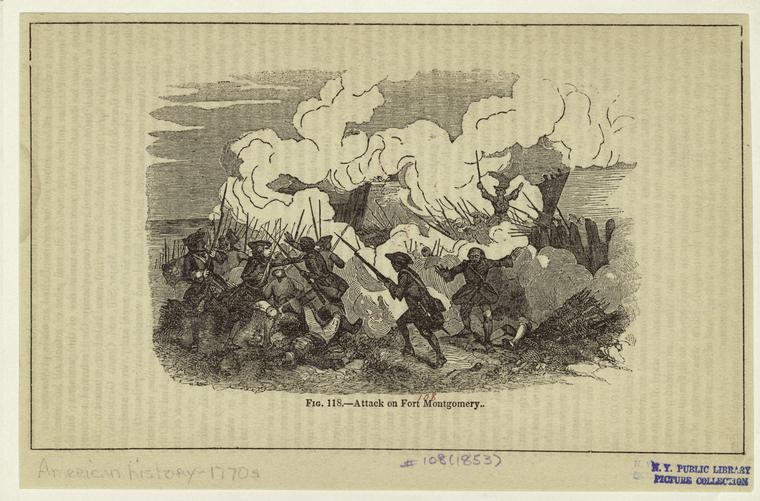
Gano stayed with the army, was there during the battles in New York and mistakenly found himself in front of his regiment at White Plains. He remained with the unit until enlistments expired at the beginning of 1777. The minister pledged to rejoin if Webb and his officers raised a new regiment, but instead found himself at Fort Montgomery on the Hudson, eventually succumbing to arguments from General James Clinton and Colonel “Dubosque” to join the men stationed there as a chaplain. (This was probably Colonel Lewis Dubois of the 5th New York.) He remained there until Sir Henry Clinton launched his autumn attack into the Hudson Highlands to support General Burgoyne’s campaign to Albany. Allowing for the uncertainties and errors of first-hand experiences and perspectives, the happenstance-chaplain provided an excellent first-hand account of the battles for Fort Montgomery and Fort Clinton on October 6, 1777.
“We had, both in Fort Montgomery, and Fort Clinton, but about seven hundred men. We had been taught to believe, that we should be reinforced, in time of danger, from the neighbouring militia; but they were, at this time, very inactive. We head of the approach of the enemy, and that they were about a mile and a half from Fort Clinton. That fort sent out a small detachment, which was immediately driven back. The British army surrounded both our forts, and commenced universal firing. I was walking on the breastwork, viewing their approach, but was obliged to quit this station, as the musquet balls frequently passed me. I observed the enemy, marching up a little hollow, that the might be secured from our firing, till they came within eighty yards of us. Our breast-work, immediately before them, was not more than waist-band high, and we had but a few men. The enemy, kept up a heavy firing, till our men gave them a well directed fire, which affected them very sensibly. Just at this time, we had a reinforcement from a redoubt, next to us, which obliged the enemy to withdraw. I walked to an eminence, where I had a good prospect, and saw the enemy advancing toward our gate. This gate, faced Fort Clinton, and Captain Moody, who commanded a piece of artillery at that fort, seeing our desperate situation, gave the enemy a charge of grape-shot, which threw them into great confusion. Moody repeated his charge, which entirely dispersed them for that time.
About sun-set, the enemy sent a couple of flags, into each of our forts, demanding an immediate surrender, or we should all be put to the sword. General George Clinton, who commanded Fort Montgomery, returned for answer, that the latter was preferable to the former, and that he should not surrender the fort. General Hames Clinton, who commanded in Fort Clinton, answered the demand in the same manner. A few minutes after the flags had returned, the enemy commenced a very heavy firing, which was answered by our army. The dusk of the evening, together with the smoke, and the rushing in of the enemy, made it impossible for us to distinguish friend, from foe. This confusion, have us an opportunity of escaping, through the enemy, over the breastwork. Many escaped to the water’s side and got on board a scow, and pushed off.”[2]
In his recent history of the Saratoga Campaign, Kevin Weddle cites General Clinton’s estimate of 350 American casualties: 70 killed, 40 wounded, and 240 captured, roughly half of the combined garrison of both forts. (Weddle estimates the American garrison at 700, not the 800 Gano believed). British losses amounted to forty killed and 150 wounded out of 2,150 in the assaulting forces.[3]
Gano spent the remainder of his service in the northeast, accompanying the men during General Sullivan’s campaign against the Iroquois, but otherwise spending the time in encampents. He finally returned to New York and reoccupied his house after war: “My house needed some repairs, and wanted some new furniture; for the enemy plundered a great many articles.”[4] After the war, the minister rebuilt his congregation in New York before relocating to Kentucky, where he died in 1804.
[1]Biographical Memoirs of the Late Rev. John Gano (New York: Printed by Southwick and Hardcastle for John Tiebout, 1806), 93.
Many of our readers love seeing the rifle and cannon demonstrations held in National Parks. Have you ever wondered about how park rangers manage this program? Recently I attended Historic Weapons Certification, an intense, two-week training held every few years for Park Rangers.
The program began in the 1970s with the coming of the nation’s Bicentennial, and has evolved over the years. Held at a National Guard base in Anniston, Alabama, the course teaches participants how to load and fire historic weapons, care and maintenance of equipment, historic manuals for loading and drill, storage and handling of black powder (a Class A Explosive), and Park Service policies for historic weapons programs. There are only about 152 certified Historic Weapons Supervisors in the entire National Park Service.
The following is from David Reuwer, who was a good friend of Charles Baxley and worked with Charles to help preserve and interpret the story of Camden, Hobkirk’s Hill and South Carolina in the American Revolution. Both men shared an unmatched level of passion and enthusiasm for history.
“I never heard that,” was a common cadence with which this practical lawyer and self-taught historian responded to new information about the American Revolution in South Carolina. He both challenged the statement maker to support it and welcomed the newbie into the fellowship of the Southern Campaigns. This is how Charles B. Baxley operated with both hands – one gladly shaking an entry to join our exploits and the other cautioning you to rise to ever higher and increasing standards. He would push, exacerbate, pull, and uplift you. The Southern Campaigns of the American Revolution was created in 2004 by Charles Baxley and David Reuwer when they delineated the tripod elements of scholarship, fellowship and fun. Charles defined scholarship as building blocks of historic research, inquisition and field evidence; fellowship as to include anyone who would cite source material gone before us while presently lifting others up around us; and fun as joyfully sharing one another’s knowledgeable victories as we pursued historic adventures.
The substantive virtue Charles practiced daily was broad inclusion – come and join us! There was always another chair at the table and more room for additional players according to him. However, you had to participate somehow, to care about the commonweal, and to help others with their project needs and requests. You had to give as well as take.
Charles suffered from PAD – project aggrandizement disorder – in that he cajoled and made each of us go deeper when all the rest of us thought it had been done. He could come up with endless lists of questions when everyone else considered the subject utterly exhausted. History was neither boring, stale nor irrelevant the way Charles viewed and worked it. History is an experience, as much about the present as it was about the past. We must place our “boots on the ground” – the actual locatable sites – in order to fulfill our duties of scholarship and fellowship. Only when a little more (or a lot) is known and understood, that we can pass on, have we accomplished the tasks before us responsibly to the future generations. Charles achieved much of this by writing, sending and responding to multiplicative emails and countless phone calls while sitting in his “war room” den at home late into the night and wee morning hours.
Charles was inherently an encourager of others making us to think hard about their historic project, to question everything, to counsel with others, to be in mentorship, and to ./explore new thinking about what one is doing. His queries to you could sometimes be unnerving but if you really worked for the answers, the growth toward historic truth was rewarding. No wonder he was awarded the Order of the Palmetto by Governor Mark Sanford in 2006; no surprise in 2022 that Governor Henry McMaster appointed him the Chairman of the South Carolina American Revolution Sestercentennial Commission (SC250). He was one of the key people who took on the gigantuan task of restoring South Carolina’s Revolutionary battlefield stories into their proper place in American history since 1856 when Senator Andrew Butler vociferously debated Charles Sumner of Massachusetts on the floor of the U.S. Senate.
It is true that he liked chairing the Round Tables with intervening commentary and being the centrifugal point-man in most other Revolutionary War conversations. His verbal editorials were always engaging and usually enlightening.
He liked playing “director” and was sincerely effectual at connecting people with other people and endeavors with other projects. His brain was way ahead of most other thinking minds, historically, and he courteously provoked when he did. Perhaps no other single person currently had as much comprehensive breadth-and-depth knowledge about the Revolution in SC as Charles. “Learning is not virtue but the means to bring us an acquaintance with it. Integrity without knowledge is weak and useless, and knowledge without integrity is dangerous and dreadful. Let these be your motives to action through life, the relief of the distressed, the detection of frauds, the defeat of oppression, and diffusion of happiness,” professed 38-year-old General Nathanael Greene, final military commander of the Southern Department during the Revolution. Charles embodied this learning for 70 plus years and shared this way to live with all the rest of us. If you were not about doing a task, he would assign you one. Charles often related that we were only as good as our current task, project or mission and persuasively demanded that we focus on it for the purpose of sharing it with others.
Our State has lost one most caring advocate of the Revolutionary founding 1770-1783 era – a hero of history. For him, it was about accurately working the historic puzzle and conclusively moving the story forward in truth. Most substantively, many of us State residents, numerous thousands of 250th out-of-state tourists, and untold future generations of all Americans will HEAR and HAVE HEARD of South Carolina’s significant persons, places, battles, and events of the Southern Campaigns because of Charles B. Baxley. Mirroring Christopher Gadsden, he lived for “What I can do for my country, I will do.”





 Emerging Revolutionary War Era