Our monthly recap of what our good friend and fellow historian Tom Hand has written on his blog, AmericanaCorner.
The Midnight Ride of Paul Revere October 26th
The story of Paul Revere and his Midnight Ride is one of the many fascinating subjects of the grand American past. Taking place in conjunction with the Battles of Lexington and Concord, on April 19, 1775, the tale has passed down from generation to generation. Read more here.
Forefathers Gather at Historic First Continental Congress October 19th
The First Continental Congress was a key link in the chain of events that led to our nation’s gaining its independence from England. The brief convention brought together most of the influential leaders from colonial America to determine an answer to Parliament’s recently enacted Coercive Acts. Read more here.
The Boston Tea Party Takes Colonists Past the Point of No Return October 12th
The Boston Tea Party is one of the most iconic moments in American history. In some ways, it sealed our fate to separate from England and become our own nation. The road that led to this watershed event began several years earlier with the Townshend Acts. Read more here.
Aftermath of the Boston Massacre October 5th
The violence on the evening of March 5, 1770, in Boston is known to us today as the Boston Massacre. It was an unfortunate incident that left five people dead and growing anger between American colonists and leaders in England. Read more here.
After you give out the last piece of candy or consume the last piece of candy or just need a break from the doorbell ringing and handing out candy, join Emerging Revolutionary War for our latest “Rev War Revelry” this Sunday, at 7 p.m. EDT, on our Facebook page. This next installment of the historian happy hour will discuss Headless Hessians and other German tales from the American Revolution.
Joining Emerging Revolutionary War historians Kevin Pawlak and Mark Wilcox will be guest historian Ross Schwalm who specializes in the history of Hessians and their role in the American Revolutionary era. Besides diving into this tale on Halloween night, the history behind Washington Irving’s fictional tale will also be discussed.
Questions such as; Was the Headless Horsemen really a Headless Hessian? What is fact and what is fiction? The answers to these questions and more (and we encourage questions from the viewers) will be answered this Sunday. Grab your favorite pumpkin beverage and/or Halloween treat and tune in to this exciting “Rev War Revelry.”
The air was stifling on the morning of August 16, 1780. It was made worse by the acrid smoke from the musket and artillery fire that hung low under the canopy of tall, Long Leaf pines that grew on either side of the Great Wagon Road leading to the small town of Camden, South Carolina. The battle fought on that morning between the forces of American Major General Horatio Gates and British Lieutenant General Charles, Earl Cornwallis was short; less than an hour.
Most of the militia troops on the American left flank fled from the field shortly after the first shots were fired but the hard-bitten Continentals on the right, men from Maryland and Delaware, stood fast and paid a severe price, holding against the British regular and loyalist infantry until cavalry forces under the dreaded Lieutenant Colonel Banastre Tarleton swept in on their rear. Then, for the American regulars, it became a game of escape and survival.
For the American commander, Horatio Gates, the loss at Camden would be a nightmare. Having been swept from the field early in the battle with the retreating militia, he would ultimately leave his Continental troops to fend for themselves as he made his escape. Thus, the reputation of the former “Hero of Saratoga” would be marred forever. One officer who would not make his escape from this field, however, was the commander of the American right wing, Major General Baron Johann de Kalb.
Baron de Kalb
He was a seasoned veteran of many European battlefields. Commanding the Maryland and Delaware Continental troops at Camden, the German-born 59 year-old de Kalb would continue leading his troops, fighting valiantly throughout the battle until wounds brought him down, forcing him out of action. He would be later found on the battlefield by the British, having suffered 11 wounds in the engagement. According to his Aide-De-Camp, le Chevalier de Buysson, the Baron “having had his horse killed under him, fell into the hands of the enemy, pierced with eight wounds of bayonets and three musket balls.” The two officers were taken to Camden where de Kalb was treated by Lord Cornwallis’ own surgeon; he died on August 19. Of their captivity, de Buysson would write: “Lord Cornwallis and Rawdon treated us with the greatest civility. The baron, dying of his wounds two days after the action, was buried with all the honors of war, and his funeral attended by all the officers of the British army.”
Reportedly buried alongside British officers likewise killed in the battle, Baron de Kalb’s original grave site was located in a field near Meeting Street, between Broad and Church Streets “in the southwestern part of the town.” On his tour of the southern states in 1791, President George Washington visited the grave of the gallant Baron de Kalb. Over time though, the exact location of this site was forgotten. In the early 1820’s, an extensive search was begun to locate the grave. Leading the way in the search were the Masons of South Carolina who were intent upon finding the original resting place of this brother in freemasonry.
Baron de Kalb had come to America from France in 1777 to help in the fight for independence. Having fought with the French Army in the War of Austrian Succession and the Seven Years War, he’d had a distinguished military career in Europe. He traveled to America with the wealthy young French aristocrat, the 20-year-old Marie-Joseph Paul Yves Roch Gilbert du Motier, Marquis de Lafayette. These two men couldn’t have come from more different backgrounds. Lafayette was genteel and extremely well educated, having been born into a family known for their vast wealth. Johann de Kalb was a farmer’s son. But, along with his military accomplishments, he’d married well and amassed a fortune of his own. By all accounts, these two very different men had a mutual respect for one another and at least one thing in common; they were both Freemasons.
With the rediscovery of Baron de Kalb’s grave site in the early 1820’s, it was decided that his remains would be carefully removed to the yard of Bethesda Presbyterian Church in the center of Camden where a proper monument would be erected. The people of South Carolina contributed handsomely to the design of the monument and the accompanying dedication ceremony. The monument was designed by artist Robert Mills, who had likewise designed the church where it would be erected along with the United States Treasury Building and the Washington Monument in Washington City. The ceremony was planned and the cornerstone for the new monument to Baron de Kalb would be laid in March 1825. Laying the cornerstone would be none other than his brother Freemason, the Marquis de Lafayette.
Now in his late 60’s, the aged hero had made a triumphant return to the United States in August 1824 and begun a grand tour of the country. As part of his tour, the Marquis and his party arrived in Camden on March 8, 1825. On behalf of the Baron de Kalb Monument Committee, General Lafayette was invited to lay the cornerstone of the new monument to which he readily agreed. He was escorted into Camden with military honors; banquets and speeches would follow. On March 9, a procession bearing the remains of Baron de Kalb formed and marched to the monument site, in the yard of Bethesda Presbyterian Church. After an invocation, the remains were laid to rest in a vault. With members of the Kershaw Lodge offering appropriate Masonic honors, the Marquis de Lafayette laid the cornerstone. The final work on the marble monument that would be erected over the vault was completed in 1827. Inscribed on the monument are these words: “Here lie the remains of Baron De Kalb, German by birth, but in principle, citizen of the world”.
Grave of Baron de Kalb
After laying the cornerstone, nearly 50 years after the two men had first arrived together in America, Lafayette offered a few noble remarks about his friend. “His able conduct, undaunted valor, and glorious fall in the first battle of Camden, form one of the remarkable traits of our struggle for independence and freedom. He was cordially devoted to our American cause, and while his public and private qualities have endeared him to his contemporaries, here I remain to pay to his merits on this tomb, the tribute of an admiring witness, of an intimate companion, of a mourning friend.” It was certainly a fitting tribute.
In modern times, Baron de Kalb’s legacy continues. After nearly 200 years, a new statue bearing his likeness was unveiled in October 2021. Created by sculptor Maria J. Kirby-Smith, the new statue stands on the grounds of the Revolutionary War Visitor Center in Camden, SC. This will be one of the many stops along The Liberty Trail, a “unified path of preservation and interpretation across South Carolina” that will tell the story of the Revolutionary War in the South. The Liberty Trail is currently under development through a partnership between the American Battlefield Trust and the South Carolina Battleground Preservation Trust.
When one thinks of December 1776 in American Revolutionary War history, one’s mind immediately goes to Washington crossing the Delaware River and the Battle of Trenton, fought on December 26th. Historians refer to that engagement as the beginning of the “Ten Crucial Days” that culminated with the American victory at the Battle of Princeton on January 3, 1777.
However, days prior, American militia under Colonel Samuel Griffin fought an engagement with Hessian troops under the command of Colonel Carl von Donop. The actions occurred on December 22 and 23, 1776. Although the American forces were pushed out of their positions, the end result was the occupation of Bordentown by Donop and his troops, approximately 10 miles from their fellow Hessian comrades at Trenton.
To discuss these engagements, collectively known as the Battle of Iron Works Hill, Emerging Revolutionary War welcomes historian Adam Zelinski to “Rev War Revelry.” Zelinski is a writer and published historian and has worked on various projects with the American Battlefield Trust and the American Revolution Museum in Philadelphia. He will also speak on some exciting news coming out of the Iron Works battlefield too.
Emerging Revolutionary War looks forward to you tuning in, this Sunday, at 7 p.m. EST on our Facebook page as we discuss another component of the 1776 campaign season as we prepare for our inaugural bus tour of the Trenton and Princeton battlefields next month (only 4 tickets left!). If you can’t make it on Sunday night, you will be able to find it later (along with all our videos) on our YouTube page.
On the afternoon of June 4, 1782 in the grasslands of western Ohio, a Pennsylvania volunteer named Francis Dunlavy spent a portion of his time trying to shoot a Native American he later called “Big Captain Johnny.” For his part, the Indian attempted with equal passion to kill Dunlavy. At some point, they worked themselves into a position on opposite sides of a recently fallen tree at the edge of a wood that adorned a modest, but noticeable rise that could pass for a hill in the surrounding plain. Even dropped on its side, the tree still held a full canopy of leaves, and the two combatants stalked each other around it. Eventually, “Big Captain Johnny” saw his opening. He was close enough to rise and hurl tomahawks at Dunlavy. Fortunately, he missed and Dunlavy survived to relate the tale to his friends and family. In 1872, more than 30 years after Dunlavy passed, his family related the tale to C.W. Butterfield, who wrote the first history of the Crawford Campaign. Before telling the story again, I wanted to confirm it. That meant searching for Francis Dunlavy and Captain Johnny anywhere, and everywhere, they might have left footprints in history.
Emerging Revolutionary War welcomes back guest historian Karl G. Elsea
It is common for artists to use “artistic license” when painting historic events including American Revolutionary War art. The problem is this practice also
aids inaccuracies persisting. Here is one case study of one picture involving an historic event that is presented by the National Park Service (NPS) at Yorktown. Please note the staff is helpful and the grounds are beautiful. As for the severity of the problem, the reader can decide after reading the information.
The following picture is from the field at Yorktown where the French Artillery Park was located. The picture illustrates the idea of what an artillery park was.
The problem is this picture contains a number of images that are wrong. For example, the carriages, wagons, carts, and limbers should be painted light blue. The French Army artillery had been painted light blue prior to 1750. There is a lot of confusion to this day concerning gun and limber carriage colors. This confusion may have been generated by a current belief there was one French artillery color. The French used the color of the items to assist which department owned the material. The French Navy department [Ministry of Marine] was responsible for the colonies, including North America, and their cannon were on red carriages with, in all most all cases, iron barrels. The French Quartermaster’s department had their wagons were painted a brighter red. The French Army artillery was painted light blue with bronze barrels. Thus, the French Army barrels shown should appear to be “brass.”
On January 3, 1777, George Washington’s forces struck the British outside the town of Princeton, New Jersey. The battle culminated a ten-day period that would be crucial to the survival and eventual victory of American independence.
As Emerging Revolutionary War builds up to the first annual bus tour of the Trenton and Princeton in November, this “Rev War Revelry” will provide some of the background of this engagement. Joining Emerging Revolutionary War on this installment of the “Revelry” will be historian and Princeton Battlefield History Educator Will Krakower.
Join us, this Sunday, at 7pm EST on our Facebook page for this great discussion on the Battle of Princeton and the history around it.
Our monthly recap of what our good friend and fellow historian Tom Hand has written on his blog, AmericanaCorner. Also, check out Emerging Revolutionary War’s YouTube page for a “Rev War Revelry” with Tom Hand done earlier this month.
September 21st: Americans with a Shared Future Meet at the Stamp Act Congress
The Stamp Act Congress was held in New York in 1765 in response to the Stamp Act, a piece of legislation passed by Parliament. The Act itself and the events that transpired because of it would prove to be hugely impactful on the destiny of America. Read it here.
September 14th: Fort Ticonderoga: A Key Component in America’s Quest for Independence
Fort Ticonderoga in upstate New York is arguably the best-preserved fort from the 1700s in North America. It was the site of several engagements in both the French and Indian War and the American Revolution. Its military significance is matched only by the natural beauty that surrounds the site. Read it here.
September 7th: British Colonies Work Together During the Albany Congress of 1754
The Albany Congress was held in the summer of 1754 and represents the first time the British colonies in North America ever attempted joint action. Unlike the conventions held in later decades, which focused on pushing back against England, the goal of this conference was to help the British in their fight against the French and their Indian allies. Read it here.
In another installment of #TrentonTuesday we look at Washington’s plan of attack. George Washington, who had been mulling the prospect of an attack for weeks, saw an opportunity in the Hessian outpost at Trenton. Much of his information was coming from his spies and he also realized that the British employed numerous spies in his own camp, so he would need to conceal his plans. Secrecy and stealth would be the most important aspects if he wished to keep the element of surprise on his side. Washington though needed to act. His aide, Colonel Joseph Reed wrote to Washington that “Our affairs are now hasting fast to ruin if we do not retrieve them by some happy event. Delay is now equal to total defeat.”
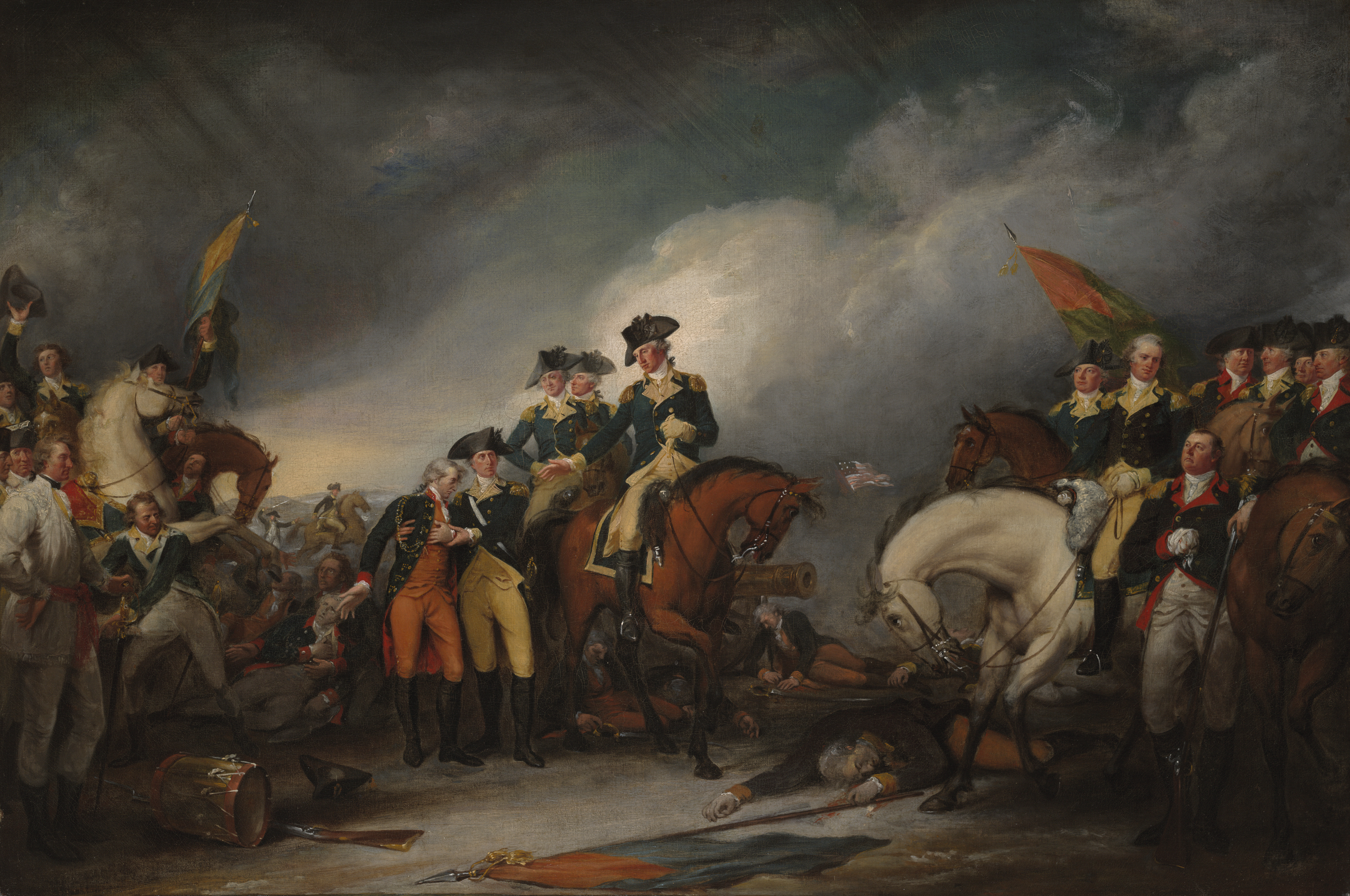
John Trumbull’s painting of the surrender of the Hessians at Trenton depicts a wounded James Monroe lying behind the dying Colonel Rall.
Join ERW historians Mark Maloy and Rob Orrison as we welcome Scott Harris, Executive Director of the James Monroe Museum, to discuss James Monroe’s service in the American Revolution. Monroe had a well-known and distinguished political career, but it all started as a solider in George Washington’s army. Leaving his studies at the College of William & Mary in 1776 he would distinguish himself on numerous battlefields during the war. We will highlight Monroe’s role in the Battle of Trenton as we gear up for our November bus tour! At the Battle of Trenton, Monroe was nearly killed in some of the fiercest fighting in that pivotal engagement. Tune in on Sunday to learn more and join us in November to see where it actually happened!
To watch it live, visit our Facebook page at 7p.m. EST on Sunday, September 19. If you can’t make it on Sunday, you can watch it and dozens of other programs on our YouTube page.




 Emerging Revolutionary War Era